Grace Cathedral: Nob Hill's Gothic Landmark Worth More Than a Quick Look
Perched at the summit of Nob Hill, Grace Cathedral is the cathedral church of the Episcopal Diocese of California and one of the most architecturally significant religious buildings on the West Coast. Its French Gothic facade, gilded bronze doors, and twin labyrinths draw visitors well beyond the usual tourist circuit.
Quick Facts
- Location
- 1100 California St, Nob Hill, San Francisco, CA 94108
- Getting There
- California Street cable car (stops in front of the cathedral); Muni 1 bus to California St & Taylor
- Time Needed
- 45 minutes to 1.5 hours
- Cost
- Sightseeing admission typically Adults $14 / Seniors (65+) $12 / Youth & young adults (12–22) $10 / Under 12 free (confirm at gracecathedral.org); free for prayer/meditation during visitor hours
- Best for
- Architecture lovers, quiet reflection, photography, first-time visitors to San Francisco
- Official website
- gracecathedral.org
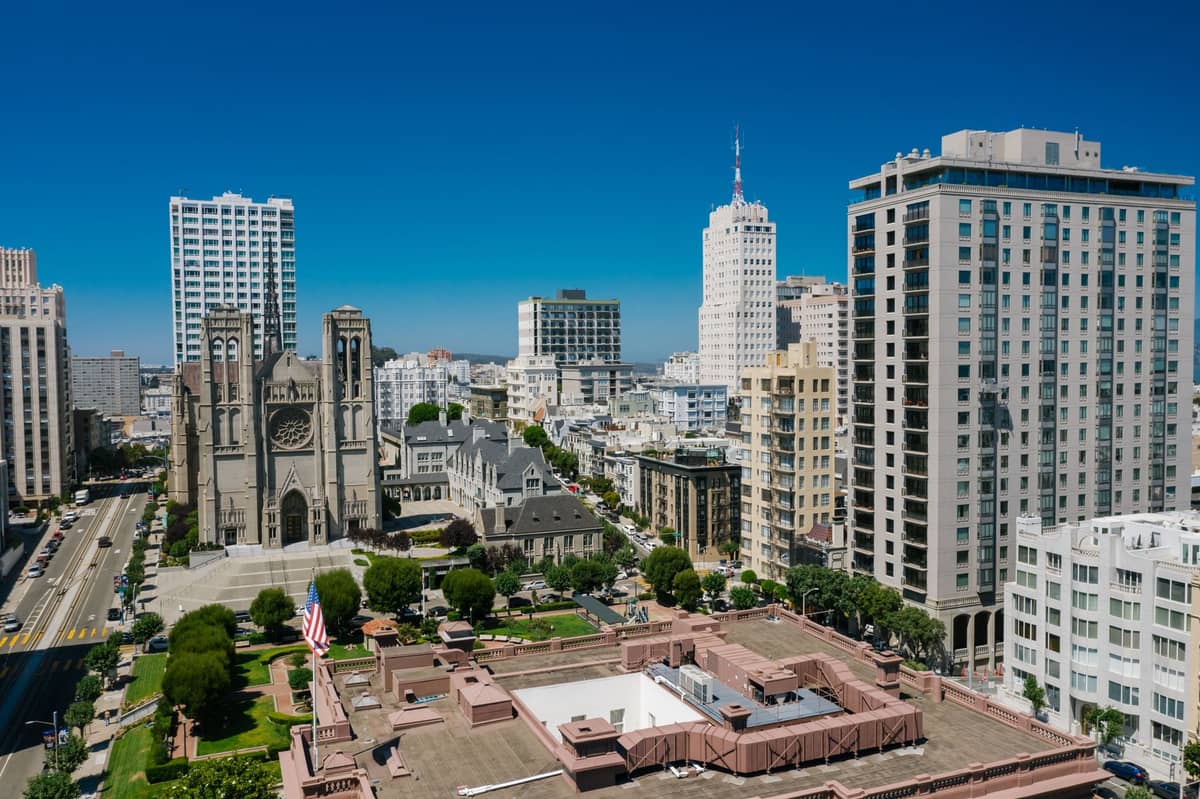
What Grace Cathedral Actually Is
Grace Cathedral is the seat of the Episcopal Diocese of California, which makes it a functioning bishop's cathedral rather than a decorative landmark. The cornerstone for the current building was laid in 1910, and major construction then began in the late 1920s and continued in stages through 1964, meaning the cathedral you visit today is a product of more than three decades of building work. That long timeline is part of what makes the building so coherent: each phase followed a consistent French Gothic vocabulary rather than switching styles mid-project.
The address is 1100 California Street, at the corner of California and Taylor, but the entrance most visitors approach is the great west portal steps on Taylor Street. The hill itself is part of the experience. You climb through one of San Francisco's most polished residential and hotel districts to reach a broad terrace where the cathedral sits in surprising calm above the city grid below.
ℹ️ Good to know
Sightseeing hours are typically Monday–Saturday 10:00 a.m. to 5:00 p.m. and Sunday 1:00 p.m. to 5:00 p.m., with closures around services and special events. General sightseeing uses timed admission (adults typically around $14; discounted rates for seniors, youth, and young adults — confirm current prices at gracecathedral.org). Visitors seeking a private place for prayer or meditation are welcomed without the sightseeing fee during open hours. Verify hours and any special closures before your visit.
Getting There: The Cable Car Is Not Just Scenic
The California Street cable car line is genuinely the most practical way to reach Grace Cathedral. It stops at California & Taylor directly in front of the cathedral and drops you within a very short, steep walk of the front steps. The Muni 1 bus also serves California Street at Taylor nearby if you prefer a flat-fare option over the cable car fare.
Parking near the cathedral is limited. A paid garage is available in the area, but given Nob Hill's one-way streets and tight blocks, driving is rarely the easiest choice. For a broader look at getting around the city, the San Francisco transit guide covers cable car routes and Muni options in detail.
The cathedral states it is accessible for visitors with disabilities. If you need step-free access, contact the cathedral directly, as the main Taylor Street entrance involves a staircase approach and alternate entry points may be more suitable.
Tickets & tours
Hand-picked options from our booking partner. Prices are indicative; availability and final rates are confirmed when you complete your booking.
Sonoma and Napa Valley wine tour from San Francisco
From 127 €Instant confirmationFree cancellationGo City | San Francisco Explorer Pass
From 76 €Instant confirmationFree cancellationMuir Woods and Sausalito guided tour with transportation
From 82 €Instant confirmationFree cancellationSan Francisco CityPASS
From 77 €Instant confirmationFree cancellation
The Architecture: What to Look For Before You Step Inside
Before entering, stop on the terrace and spend a few minutes with the Ghiberti Doors, formally called the Doors of Paradise. These are full-scale bronze casts of Lorenzo Ghiberti's original 15th-century doors from the Baptistery of Florence. The panels depict Old Testament scenes in low relief, and in morning light the gilded surfaces catch a warm glow that photographs dramatically. Most visitors walk straight past them into the interior without pausing, which is a genuine missed detail.
The facade follows a French Gothic model, with twin towers, pointed arches, and a large rose window above the entrance. Unlike many Gothic revival buildings that use soft limestone, Grace Cathedral is built in reinforced concrete, a structural decision shaped by the 1906 earthquake and fire, which destroyed the Crocker family mansions that previously occupied this Nob Hill block. The concrete is clad in stone veneer, giving the exterior its textured, historically appropriate appearance while making the building seismically resilient.
💡 Local tip
Photography tip: The best exterior light on the west facade is in the afternoon, when the low San Francisco sun catches the relief detail on the bronze doors. Morning light is better for interior shots through the stained glass, particularly the rose window.
Inside: Stained Glass, Scale, and the Labyrinths
The interior is larger than it appears from the street. The nave runs roughly 200 feet and the ceiling height creates an acoustic environment that catches footsteps and whispered voices in equal measure. On weekday mornings, the cathedral holds a small number of visitors in near-silence, and the filtered light through the stained glass windows shifts noticeably every fifteen minutes as cloud cover changes. On weekend afternoons, visitor numbers increase, and the ambient noise level rises accordingly.
The stained glass program includes 23 windows, among them a series of human endeavor windows designed in the mid-20th century that depict figures from science, labor, and social justice alongside traditional religious iconography. One of the most discussed panels features Albert Einstein. It is an unusual choice for a cathedral window and speaks to the building's tradition of combining Episcopal liturgy with engagement in broader civic and intellectual life.
Two labyrinths are available for walking. The outdoor terrazzo labyrinth on the north terrace is based on the 13th-century pavement labyrinth at Chartres Cathedral and is open at all hours. The indoor labyrinth, a tapestry version also modeled on Chartres, is inside the cathedral and available during visitor hours. Walking a labyrinth is not a maze; there are no dead ends, and the path always leads to the center. Many visitors who arrive curious but skeptical find the 15 to 20 minutes spent walking the indoor version unexpectedly calming.
💡 Local tip
The outdoor labyrinth on the north terrace is accessible even when the cathedral is closed to sightseers. If you arrive outside visitor hours and just want a few quiet minutes on Nob Hill, this is a legitimate option.
How the Experience Changes by Time of Day
Early weekday mornings, before the 10:00 a.m. opening, the cathedral grounds are used by neighborhood residents and hotel guests from the adjacent Mark Hopkins and Fairmont hotels taking quiet walks. The surrounding streets carry almost none of the pedestrian density you find further downhill near Union Square.
Once the doors open, the first hour tends to be the quietest sightseeing window. By midday on weekends, tour groups and families arrive in larger numbers, and the nave can become considerably noisier. If contemplative atmosphere matters to you, a weekday visit between 10:00 a.m. and noon is consistently the most peaceful. Sunday afternoons, when visitor hours begin at 1:00 p.m., can be busy because morning services have just concluded and some attendees remain on the grounds.
On overcast days, which are common in San Francisco through much of June and July due to the marine layer, the light inside the cathedral becomes softer and more diffuse. The dramatic color contrasts of the stained glass are actually more vivid on partly cloudy days than in flat gray light or direct sun. Winter months, when the sun angle is lower, produce some of the most striking interior light conditions.
Nob Hill's climate follows San Francisco's overall pattern: mild temperatures year-round, with the warmest and clearest conditions typically in September and October. If you're planning your overall trip, the best time to visit San Francisco guide breaks down the seasonal differences in detail.
Nob Hill Context: What Surrounds the Cathedral
Grace Cathedral sits on the former site of the Crocker family mansion, one of several Gilded Age estates that occupied Nob Hill before the 1906 earthquake destroyed most of them. The neighborhood still carries that late-19th-century character in its grand hotels and residential buildings. The Nob Hill neighborhood is walkable and compact, with the cable cars providing a direct link downhill toward the Financial District and Chinatown.
A short walk downhill brings you to the edge of Chinatown, one of the most densely populated neighborhoods in North America, where the transition from Nob Hill's hotel-district quiet to the commercial energy of Grant Avenue happens within about three blocks. Many visitors combine both in a half-day itinerary without needing to use transit between them.
For first-time visitors trying to structure a full day, the first-time visitor guide to San Francisco includes Nob Hill and Grace Cathedral within a broader itinerary that also covers the waterfront and Golden Gate Park.
Who This Is For, and Who Should Skip It
Grace Cathedral rewards visitors who approach it with some patience. If you walk in, take a few photos, and leave within ten minutes, you will have seen the building but not experienced it. The stained glass, the labyrinth, the acoustic quality of the space, and the details of the Ghiberti Doors each take time to absorb. Budget at least 45 minutes, and ideally an hour.
If your primary interest in San Francisco is outdoor recreation, the waterfront, or food culture, Grace Cathedral sits lower on the priority list. It does not compete with the Golden Gate Bridge or Alcatraz for spectacle, and it should not try to. What it offers is a different register entirely: architectural seriousness, historical depth, and a genuinely quiet interior within a city that offers few of those.
Travelers who find religious buildings uncomfortable or unstimulating are not the target audience, regardless of denomination. The cathedral is Episcopal, holds regular services, and functions first as a place of worship. Sightseeing visitors pay timed admission (with optional guided tours at a higher fee), and the staff and docents on most days are knowledgeable about the history and art inside.
Insider Tips
- The outdoor terrazzo labyrinth on the north terrace is open 24 hours and free, even when the cathedral is closed. It is worth knowing this if you are in the neighborhood outside visitor hours.
- The Forum, Grace Cathedral's event program, regularly hosts concerts, lectures, and interfaith services. Check the official calendar at gracecathedral.org before your visit; a choral evensong or organ concert in that acoustic space is a significantly different experience from a daytime visit.
- The Ghiberti Doors on the west portal are cast copies of the original Florence Baptistery doors. Most visitors walk past them without stopping. Spend five minutes here before entering and you will understand the architectural program of the building much better.
- Weekday mornings between 10:00 a.m. and noon offer the smallest crowds and the best light for interior photography. Bring a steady hand or a small tripod, as flash photography does not do justice to the stained glass.
- The California Street cable car is one of the three operating lines in San Francisco and the only one that primarily runs east–west across downtown. Riding it to Nob Hill is practical transport, not just a tourist experience, and it connects directly to the Financial District and Chinatown.
Who Is Grace Cathedral For?
- Architecture and design travelers with an interest in Gothic revival construction and ecclesiastical art
- Visitors seeking quiet and reflection in a city with very few genuinely calm indoor spaces
- Photographers who want dramatic stained glass interiors and gilded bronze door details
- First-time visitors to San Francisco combining Nob Hill with a walk down to Chinatown
- Travelers interested in California history, particularly the 1906 earthquake and the Gilded Age estates that preceded the cathedral
Nearby Attractions
Other things to see while in Nob Hill:
- Cable Car Museum
The San Francisco Cable Car Museum sits inside the actual working powerhouse that drives the city's cable car network. Admission is free, the machinery is loud and hypnotic, and the collection spans back to the 1870s. It is one of the most substantive free attractions in the city.
- San Francisco Cable Cars
The San Francisco cable car system is the world's last manually operated circulating cable car network, running since 1873 across three lines that climb through Nob Hill and down to Fisherman's Wharf. Part living transit, part rolling landmark, it rewards visitors who understand how to use it.