San Francisco Cable Cars: The Complete Visitor Guide to an Iconic Ride
The San Francisco cable car system is the world's last manually operated circulating cable car network, running since 1873 across three lines that climb through Nob Hill and down to Fisherman's Wharf. Part living transit, part rolling landmark, it rewards visitors who understand how to use it.
Quick Facts
- Location
- Three lines: Powell & Market St (downtown) for the Powell-Hyde and Powell-Mason lines, and California & Market St for the California Street line (running west to Van Ness)
- Getting There
- Powell Street BART/Muni Metro station for the Powell lines; Embarcadero BART for the California Street line eastern terminus
- Time Needed
- A single ride takes roughly 20–25 minutes end to end; allow 30–60 min including wait time at peak hours
- Cost
- Around US$9 per ride (cash or accepted payment, ages 5+); seniors may receive a reduced fare at certain times. Muni Visitor Passes cover cable cars — verify current fares with SFMTA before travel
- Best for
- First-time visitors, history enthusiasts, families, and anyone who wants to get up Nob Hill without the climb
- Official website
- www.sfmta.com/getting-around/muni/cable-cars
What the San Francisco Cable Car System Actually Is
The San Francisco cable car system is not a theme park ride dressed up as transit. It is genuine public transportation that has been running since 1873, making it one of the oldest mechanical transit systems in the United States still in regular operation. When you ride it, you are using the same basic technology that has hauled San Franciscans up steep grades for over 150 years: a continuously moving underground cable, gripped and released by a grip operator on board, with no engine on the car itself.
The system currently runs three lines. The Powell-Hyde line is the most scenic, cresting over Russian Hill before descending sharply to the turnaround at Hyde and Beach Streets near Ghirardelli Square. The Powell-Mason line shares the Powell Street corridor downtown before splitting off toward Fisherman's Wharf. The California Street line runs east-west from the foot of Market Street at the Embarcadero, through the heart of Nob Hill, and out to Van Ness Avenue. Each line offers a different cross-section of the city.
San Francisco's cable cars are recognized as a National Historic Landmark, and their continued operation at a minimum service level is protected in the city charter. The system is operated by the San Francisco Municipal Transportation Agency (SFMTA) as part of the broader Muni network. If you want deeper historical context on how the cable cars fit into the city's transport story, the San Francisco cable car guide covers the full picture.
ℹ️ Good to know
The cable car system operates daily from 7:00 a.m. to 11:00 p.m. Hours and service may be adjusted for maintenance or special events. Check SFMTA for current schedule updates before you go.
The Ride Itself: What to Expect Moment by Moment
Standing at the Powell and Market turnaround, you hear the cable car before you see it fully assembled: a low mechanical rumbling rises from the slot in the pavement, steady as a heartbeat. That is the cable itself, moving at a constant speed of around 9 1/2 miles per hour beneath the street. The grip operator, who stands at the front of the car, works a pair of large levers to clamp onto or release this moving cable. It requires real physical effort and trained judgment — nothing about it is automated.
Once moving, the open-air benches on the sides of the car give you a completely unobstructed view. On the Powell-Hyde line, the ascent up Powell Street starts gradually, then the car tilts backward as it crests the grade near California Street and continues over Russian Hill. On a clear morning, the descent toward Hyde Street opens up a direct sightline to the bay, Alcatraz, and the Marin headlands beyond. The cold air off the Pacific hits your face, and if you are holding one of the exterior poles, the car sways slightly on the downgrade.
The California Street line is a quieter, less touristy experience. Fewer visitors use it, partly because it lacks the turnaround spectacle downtown and partly because it connects neighborhoods rather than landmarks. It runs through Nob Hill's church-and-hotel corridor, giving you views down the steep cross streets to the bay on one side and the downtown skyline on the other. If you want to ride without a 45-minute wait, this line is worth prioritizing.
Tickets & tours
Hand-picked options from our booking partner. Prices are indicative; availability and final rates are confirmed when you complete your booking.
Sonoma and Napa Valley wine tour from San Francisco
From 127 €Instant confirmationFree cancellationGo City | San Francisco Explorer Pass
From 76 €Instant confirmationFree cancellationMuir Woods and Sausalito guided tour with transportation
From 82 €Instant confirmationFree cancellationSan Francisco CityPASS
From 77 €Instant confirmationFree cancellation
How the Experience Changes by Time of Day
Early mornings, roughly 7:00 to 9:00 a.m., are the most practical time to ride. The queue at Powell and Market is measured in minutes rather than in city blocks. The light at that hour is also better for photography: the sun hits the buildings on Powell Street at a low angle, and the bay is often clear before the afternoon fog layer rebuilds itself. The cars themselves are quieter, carrying a mix of commuters and early-rising visitors.
By late morning, especially on weekends between May and September, the Powell Street queue can stretch well past a full city block. Waiting times of 45 minutes to over an hour are common at peak periods. This is not exaggeration designed to scare you off; it is a predictable result of a fixed number of cars serving an enormous number of tourists on a short route. If you arrive at 10:30 a.m. on a Saturday in July without a plan, you will wait.
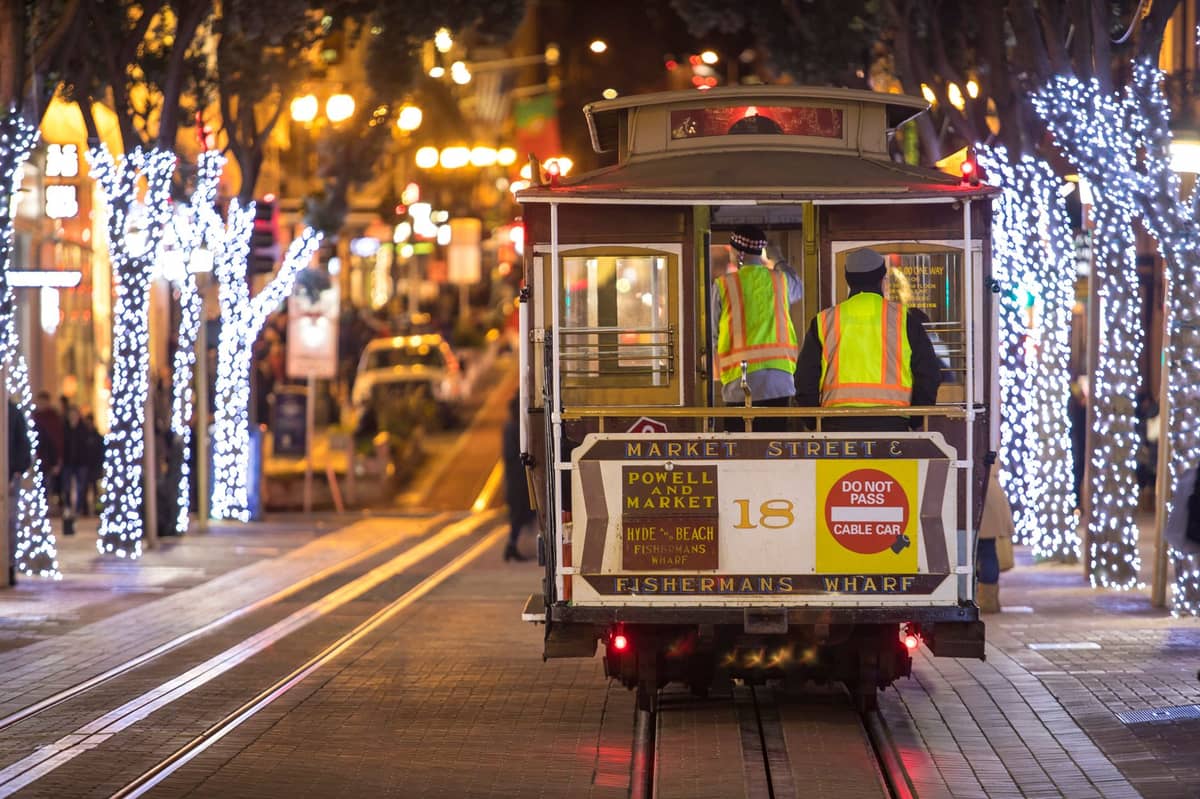
Evenings are underused by visitors and often genuinely pleasant. After 9:00 p.m. the fare drops, the queues disappear, and the city takes on a different quality. The California Street line at night, passing the illuminated facade of Grace Cathedral and the grand hotels of Nob Hill, is a different experience from the daytime tourist rush entirely.
💡 Local tip
Skip the Powell and Market turnaround queue by boarding mid-route. Walk a few blocks up Powell Street to catch the car after it has turned. You may need to stand, but you will bypass the main queue entirely. The California Street line rarely has waits at any boarding point.
Historical and Cultural Context
The system opened in 1873, conceived by engineer Andrew Hallidie as a solution to a specific problem: San Francisco's hills are steep enough that horses regularly lost footing and fell on the grades. The original clay street surfaces made descents dangerous after rain. The cable grip system, running below street level, was a mechanical answer to a physical geography that no other city has in quite the same configuration.
At its peak in the late 19th century, the city operated over 20 cable car lines covering most of the major hill corridors. The 1906 earthquake and fire destroyed much of the network, and subsequent decades saw further line closures as buses and motor vehicles replaced the slower, more expensive cable operation. By the 1940s and 1950s, city administrators proposed eliminating the remaining lines entirely. A citizen campaign led largely by Friedel Klussmann in the early 1950s succeeded in preserving the system and eventually led to its landmark protection. The three lines that exist today are the surviving remnant of what was once a much larger network.
The Cable Car Museum on Mason Street, located in the actual working powerhouse that drives the cables, is one of San Francisco's more genuinely interesting free attractions. You can watch the massive sheave wheels turning and pulling the cables in real time, which makes the mechanics of the street-level ride suddenly comprehensible. It is worth pairing with a Powell-Mason line ride. The Cable Car Museum is free to enter and open most days of the year.
Practical Walkthrough: Riding Each Line
Powell-Hyde Line (Most Scenic)
Boarding at Powell and Market Streets (the main downtown turnaround), this line travels north on Powell, crosses California Street at the peak of Nob Hill, continues over the top of Russian Hill, and descends steeply down Hyde Street to the turnaround at Hyde and Beach. The turnaround at the northern end is walking distance from Ghirardelli Square, the Aquatic Park, and the San Francisco Maritime National Historical Park. The full run is roughly 2.1 miles.
The stretch of Hyde Street between the crest of Russian Hill and the waterfront includes what many visitors consider the best views on any cable car route: the bay opens up in front of you as the car descends, framing Alcatraz Island directly ahead on clear days. Sit or stand on the right side of the car when descending for the best angle.
Powell-Mason Line
Sharing the Powell Street corridor from the downtown turnaround, this line splits off at Jackson Street and heads toward Bay and Taylor Streets near Fisherman's Wharf. It is slightly less scenic than Powell-Hyde but more direct to Pier 39 and the northern waterfront. The turnaround at Taylor and Bay is a short walk from the main Fisherman's Wharf area.
California Street Line (Quieter, More Local)
Running east-west rather than north-south, this line does not share the Powell Street turnaround and is entirely separate from the other two lines. It starts near the Embarcadero at Market Street, climbs through the Financial District, passes through Nob Hill's dense corridor of churches and hotels, and continues to Van Ness Avenue. If you want to actually get somewhere useful (Nob Hill, Grace Cathedral, the neighborhood around the Fairmont Hotel) without the downtown crowd, this is the line to use. Boarding is typically immediate at any stop along the route.
Getting There, Fares, and Accessibility
The Powell and Market turnaround sits directly above the Powell Street BART and Muni Metro station, making it the most accessible boarding point in the system. The eastern end of the California Street line at California and Market is a short walk from the Embarcadero BART station. Taxis and rideshare services commonly drop at both the Powell and Market area and at Fisherman's Wharf.
The standard daytime cash fare is around US$9 per ride for passengers aged 5 and up, with reduced fares available for eligible seniors at certain times of day. Muni Visitor Passes, which cover unlimited rides on cable cars and other Muni services, are available for purchase and can represent better value if you plan to use the system multiple times. Verify current fares directly with SFMTA before your visit, as fares are subject to change. For context on how cable cars fit into broader San Francisco transit planning, the getting around San Francisco guide covers all options.
A significant practical limitation: the cable cars are generally not wheelchair accessible. Boarding requires stepping up onto the car and finding space on narrow bench seats or standing areas. Riders with mobility limitations should contact SFMTA's customer service (311 within the city) for guidance on alternative accessible routes. This is a genuine constraint of the Victorian-era hardware, not an oversight.
⚠️ What to skip
San Francisco's summer (June through August) is the peak tourist season and also the city's foggiest period. Expect cold temperatures on open cable car sections even in July, especially on the Hyde Street descent toward the water. A wind-resistant layer is worth carrying year-round.
Photography Tips and What to Actually Photograph
The most photographed shot, a cable car cresting a steep grade with the bay in the background, is achievable from the sidewalk on Hyde Street near Lombard. Stand on the uphill side of the street and wait for a car to appear over the grade. Morning light works better here than afternoon, when the sun moves behind the hills. You do not need to ride the car to get this image.
From inside the car, the best shots are taken from the exterior running boards or the end platforms, looking back down the grade you just climbed. The cable slot in the center of the road, the overhead wires where present, and the operator's grip levers all make compositionally interesting foreground elements. Wide-angle lenses suit the cramped conditions; telephoto lenses are difficult to use safely while the car moves.
For the broader question of where to find San Francisco's best elevated views beyond the cable car routes, the best views in San Francisco guide covers the full range of hilltop and waterfront vantage points.
Insider Tips
- Board the California Street line at any mid-route stop for a typically immediate or short-queue boarding experience, even on peak weekend afternoons. It serves Nob Hill directly and is genuinely useful transit, not just a tourist loop.
- The Powell Street turnaround is worth watching even if you do not plan to ride: the grip operators and brakemen manually rotate the car on a wooden turntable by pushing it by hand, which takes about 90 seconds and draws a crowd. The mechanics are visible and worth understanding before you board.
- After 9:00 p.m. the reduced fare applies and queues disappear. A night ride on Powell-Hyde, with the illuminated city below and fewer people on the car, is a meaningfully different experience from the daytime tourist rush.
- The Cable Car Museum on Mason Street is the actual working powerhouse that pulls all three lines. Watching the cables from the viewing platform while the sheave wheels turn overhead makes the physics of the street-level ride suddenly clear. It is free and typically uncrowded.
- If you are combining the cable car with a walk, ride Powell-Hyde to the northern terminus and explore the waterfront on foot before returning by bus or on foot along a different route. The F-Market historic streetcar line runs along the Embarcadero and connects back downtown, offering a second historic transit experience on the same day.
Who Is San Francisco Cable Cars For?
- First-time San Francisco visitors wanting to experience a working piece of the city's civic identity
- Families with children old enough to grip the exterior poles safely (the open-air ride is more engaging for older children than small toddlers)
- Architecture and history enthusiasts interested in Victorian-era mechanical engineering still in daily use
- Anyone needing to travel between downtown and Nob Hill who would prefer not to climb a 17-plus-percent grade on foot
- Photographers looking for San Francisco street scenes with genuine period character
Nearby Attractions
Other things to see while in Nob Hill:
- Cable Car Museum
The San Francisco Cable Car Museum sits inside the actual working powerhouse that drives the city's cable car network. Admission is free, the machinery is loud and hypnotic, and the collection spans back to the 1870s. It is one of the most substantive free attractions in the city.
- Grace Cathedral
Perched at the summit of Nob Hill, Grace Cathedral is the cathedral church of the Episcopal Diocese of California and one of the most architecturally significant religious buildings on the West Coast. Its French Gothic facade, gilded bronze doors, and twin labyrinths draw visitors well beyond the usual tourist circuit.