San Anton Gardens: Malta's Grandest Free Green Space
Planted in the early 17th century for a Knights of Malta Grand Master, San Anton Gardens in Attard offer 40,000 square metres of formal pathways, ancient trees, lily ponds, and roaming peacocks. Entry is free, the shade is deep, and the atmosphere is a world away from Malta's coastal crowds.
Quick Facts
- Location
- St Anthony St, Attard, Malta (central island, between Mdina and Valletta)
- Getting There
- Public buses from Valletta or Mdina stop nearby; free street parking available
- Time Needed
- 45 minutes to 1.5 hours
- Cost
- Free entry
- Best for
- Garden lovers, families, photography, quiet walks, and anyone needing a break from sightseeing
- Official website
- www.visitmalta.com/en/attraction/san-anton-gardens-malta
What San Anton Gardens Actually Is
San Anton Gardens is the largest and most historically significant public garden in Malta. Located in the village of Attard in the central part of the island, it wraps around San Anton Palace, the official residence of Malta's President. The palace itself is closed to the public, but the gardens are open every day and free to enter.
The grounds cover roughly 40,000 square metres and feel genuinely vast by Maltese standards. Formal limestone pathways cut through dense tree canopy, past sculpted hedges, ornamental ponds, fountains from the 1620s, and a small aviary. Peacocks walk the paths without any particular urgency, and if you arrive on a quiet weekday morning, you may have whole sections of the garden almost to yourself.
💡 Local tip
Opening hours shift seasonally. Summer closing is approximately 19:00; winter closing is around 17:00. The garden opens at 09:00. Confirm current hours with Visit Malta before planning an early or late visit.
A 400-Year History in One Garden
The garden was first planted in the early 17th century, when Grand Master Antoine de Paule developed his private villa here. The estate was significantly expanded between 1623 and 1636, and the gardens were shaped in the formal style of the era: ordered, symmetrical, with water features and shaded walks designed for both leisure and display.
The garden was opened to the public in 1882. Some of the trees you walk past today are over 300 years old, including Norfolk Island pines that rise well above the perimeter walls and rosewood specimens that create a dense, almost tropical canopy in the central sections. This age is unusual in Malta, where most green spaces are modest. Here, the scale and the history are genuinely different.
The connection to the Knights of Malta runs through everything here. For more on that history and how it shaped the island's landscape and architecture, the Knights of Malta history guide provides the fuller context.
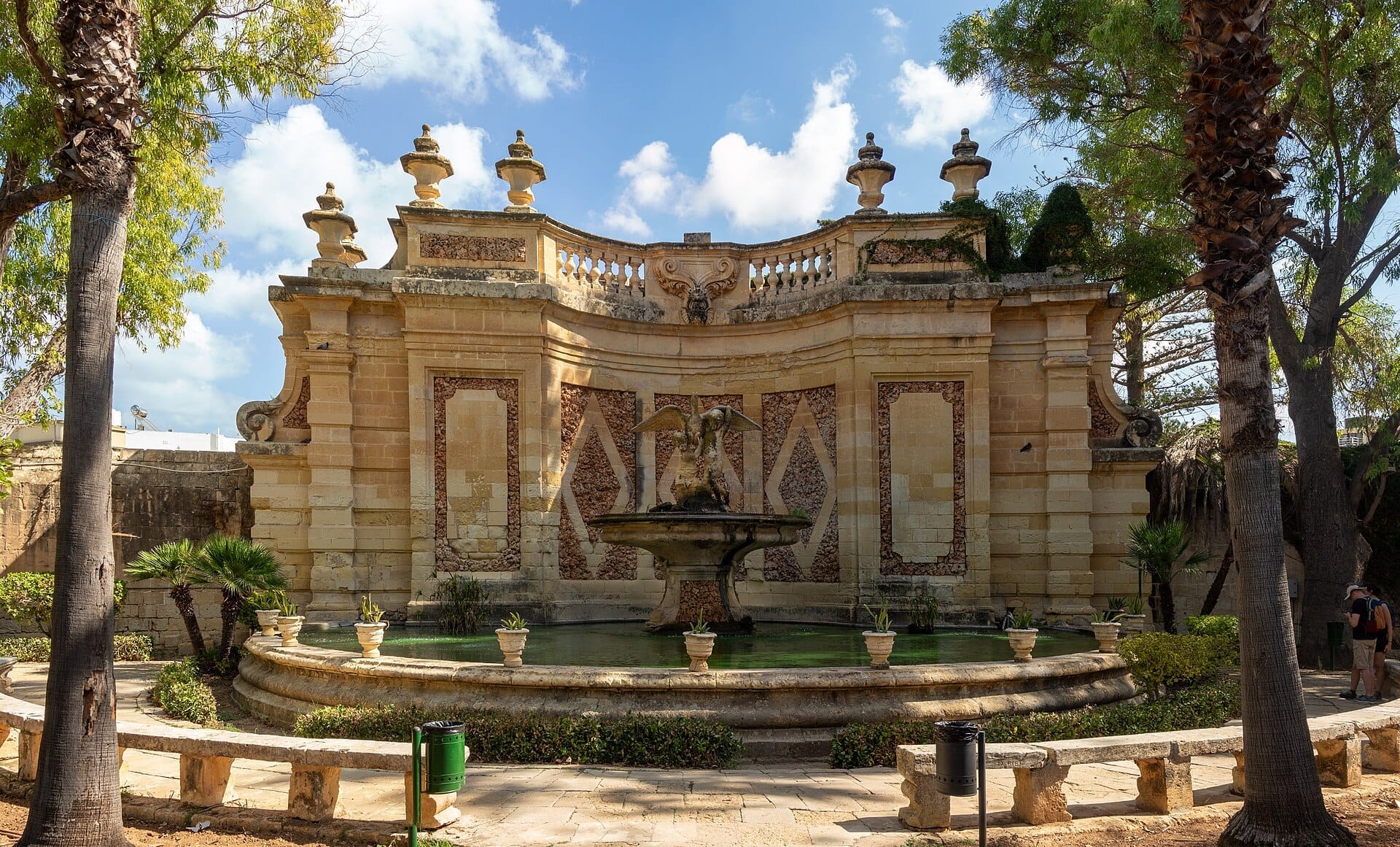
The Eagle Fountain, dating to the 1620s, sits as one of the oldest surviving ornamental features on the grounds. It's easy to walk past it without realising what you're looking at. The stone is worn smooth, the detail has softened over four centuries, but it is still functioning and structurally intact.
Tickets & tours
Hand-picked options from our booking partner. Prices are indicative; availability and final rates are confirmed when you complete your booking.
City Sightseeing hop-on hop-off bus tour of Gozo
From 20 €Instant confirmationFree cancellationThe Malta Experience Audio-Visual Show and La Sacra Infermeria Tour
From 20 €Instant confirmationFree cancellationLuggage Storage in Malta
From 6 €Instant confirmationFree cancellation6-day heritage and attractions pass in Malta
From 80 €Instant confirmationFree cancellation
What You'll See Walking Through
The garden has multiple distinct zones. The formal areas near the main entrance are the most structured: clipped hedges, symmetrical flowerbeds, seasonal planting that changes throughout the year. In spring, the colour is dense. In summer, the palette becomes drier but the shade deepens.
Moving further in, the planting becomes wilder and more tropical. Palm trees, succulents, and flowering climbers fill the mid-sections. The lily ponds attract swans and ducks, and the reflections in still morning light are genuinely photogenic. The small aviary houses various birds and is a draw for younger visitors.
Peacocks roam freely throughout the garden. They tend to be most active in the morning and will sometimes spread their tails without much prompting, particularly during spring. The behaviour is unpredictable enough that it still registers as a small event when it happens.
ℹ️ Good to know
The garden hosts an annual Horticultural Show, typically in spring, and occasionally hosts outdoor performances in summer. Check the Visit Malta events calendar closer to your travel dates for specific programming.
How the Garden Changes Through the Day
Early morning, before 09:00, is when the garden is at its quietest. Light filters through the pine canopy in long, low beams. The air smells of wet limestone and cut grass, especially after overnight moisture. Local residents use the paths for morning walks, and the pace is gentle. This is the best time for photography, with soft directional light and no crowds blocking compositions.
By mid-morning, especially in summer, families with children start arriving. The garden becomes social without becoming loud. Benches fill up around the central fountain. The sound of water from the ornamental features becomes the dominant backdrop.
Midday in July and August is the one time worth reconsidering. The shade is good, but the heat radiates from the limestone paths and the humidity between the tree rows can feel oppressive. Visiting before 10:00 or after 17:00 in high summer is a practical improvement, not just a preference.
Late afternoon in spring or autumn is arguably the best overall slot. The light turns golden, the peacocks are active, and the garden has a calm that few other attractions in Malta can match at any price point.
Getting There and Getting Around
Attard sits roughly equidistant between Mdina and Valletta in the central part of Malta. Public buses from both destinations connect to stops near the garden. Free parking is available along the nearby streets, making it straightforward by rental car. The main entrance is on St Anthony Street.
San Anton Gardens works naturally as a midpoint stop on a central Malta day that includes Mdina's walled city and the Rotunda of Mosta, both within a short drive. It also fits cleanly into a half-day loop from Valletta without backtracking.
The internal paths are paved limestone, generally flat in the main areas. Some secondary paths are slightly uneven, and the surface can be slippery after rain. Prams and pushchairs can navigate the main routes without much difficulty. There are shaded benches throughout, which matters considerably in warm months. Facilities including toilets are available on site.
⚠️ What to skip
The San Anton Palace building itself is the official residence of Malta's President and is not open to general visitors. Do not attempt to access the palace directly. The gardens are entirely separate and fully accessible.
Photography, Families, and Honest Assessment
For photography, the combination of ancient trees, reflective ponds, ornate fountains, and freely roaming peacocks gives a lot to work with. The light before 09:30 and after 17:00 is optimal. The main fountain area and the lily ponds are the two most reliably photogenic locations. In spring, when seasonal flowers are in full colour, the formal entrance beds add a strong foreground element.
Families will find the garden one of the better free options on the island. Children respond well to the peacocks, the ducks on the ponds, and the open space to move around. For a broader family itinerary with more active options, the Malta with kids guide covers the island's full range.
Who might not find this worthwhile: travellers with very limited time who are prioritising Malta's historical monuments, divers, beach-focused visitors, or anyone who finds formal European garden layouts uninteresting. The garden is genuinely lovely, but it is a garden. It rewards a slow walk and some patience. If you are ticking off major attractions at pace, it may not compete with the island's more dramatic sites.
If the green space of San Anton appeals, it pairs well with a visit to the Upper Barrakka Gardens in Valletta for a different kind of formal garden experience, one with panoramic harbour views rather than historical seclusion.
Insider Tips
- Visit on a weekday morning in April or May when the Horticultural Show preparations begin and the spring planting is at peak colour. The garden is used by local school groups on weekday mornings, but they typically clear by mid-morning.
- The Eagle Fountain near the palace walls is one of the oldest surviving ornamental water features in Malta, dating to the 1620s. Most visitors walk past it without pausing. Take a moment to look at the stonework closely.
- Peacocks are more likely to display in spring and more active in morning hours. If seeing a full tail spread matters to you, aim for a late March or April visit before 10:00.
- The garden continues to undergo phased renovation, meaning some sections may occasionally be fenced off while benches, walls, or plantings are restored. The overall experience remains intact, but do not plan your visit around a specific minor feature.
- There is no café inside the garden. Bring water, particularly in summer. The nearest cafés are in central Attard, a short walk from the main entrance.
Who Is San Anton Gardens For?
- Garden enthusiasts and horticulture lovers looking for a genuinely historic site
- Families with young children wanting free, open space with wildlife interest
- Photographers seeking soft morning light, reflective water, and unpredictable peacocks
- Travellers combining a central Malta loop with Mdina and Mosta
- Anyone needing a quiet, shaded break from Malta's sun and pace
Nearby Attractions
Combine your visit with:
- Blue Grotto
The Blue Grotto is a cluster of sea caves cut into Malta's southern limestone cliffs, accessible only by small traditional boats. The vivid phosphorescent blues inside are striking in morning light, but the experience depends heavily on sea conditions and timing.
- Dingli Cliffs
Standing at 253 metres above the Mediterranean, Dingli Cliffs form the most dramatic natural viewpoint in Malta. The clifftop road offers sweeping open-sea panoramas, a centuries-old limestone chapel at the edge, and a sunset that turns the rock face deep amber. No admission, no crowds (if you time it right), and no guide required.
- Għajn Tuffieħa Bay
Għajn Tuffieħa Bay sits on Malta's northwest coast, separated from the road by more than 200 steep steps — a deliberate filter that keeps it quieter than most Maltese beaches. The reward is a wedge of reddish-orange sand framed by green clay cliffs, a 17th-century watchtower on the headland, and water that shifts from pale aquamarine to deep cobalt by midday.
- Għar Dalam
Għar Dalam is a 144-metre cave in Birżebbuġa that preserves the bones of dwarf elephants, hippos, and bears from Malta's prehistoric past. The attached museum adds scientific depth to the raw geology of the cave itself. It is a serious natural history site, not a polished tourist spectacle.