Rotunda of Mosta: The Dome That Survived a Wartime Miracle
The Rotunda of Mosta is a neoclassical basilica in central Malta with one of the largest unsupported domes in the world. Its wartime story, architectural scale, and accessible interior make it one of the most compelling church visits on the island.
Quick Facts
- Location
- Rotunda Square, Mosta, Malta
- Getting There
- Malta Public Transport buses serve Mosta from Valletta and Sliema. Check routes via Malta Public Transport.
- Time Needed
- 1 to 1.5 hours (add time for the WWII shelter and dome balcony)
- Cost
- Admission fee (if applicable) covers basilica access; check official website for current pricing, inclusions, and any fees for balcony or shelter
- Best for
- History enthusiasts, architecture lovers, and anyone curious about WWII Malta
- Official website
- mostachurch.com/?lang=en
What Is the Rotunda of Mosta?
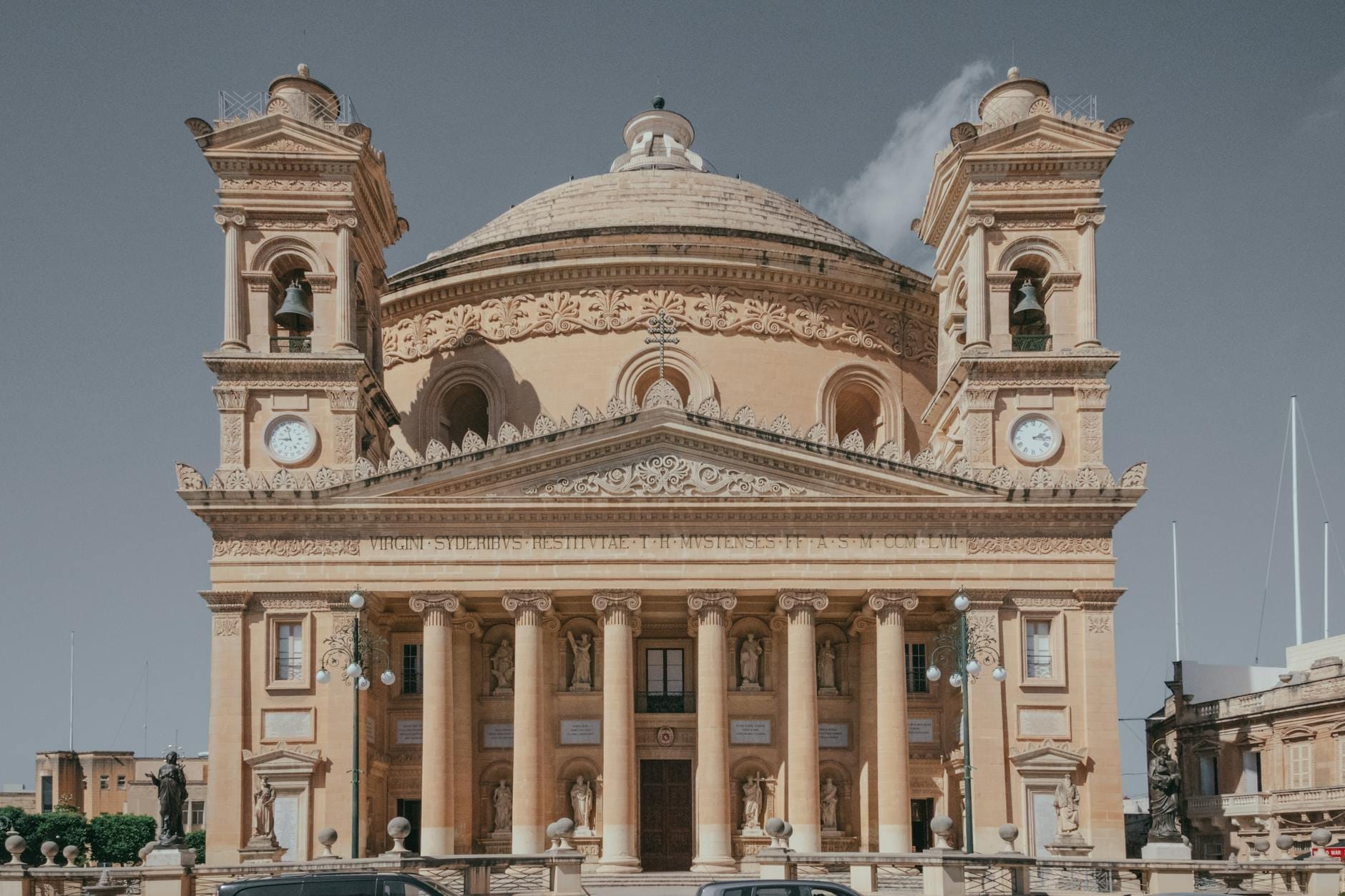
The Sanctuary Basilica of the Assumption of Our Lady, universally known as the Rotunda of Mosta or simply the Mosta Dome, rises above the rooftops of central Malta with a presence that stops you mid-step. Its neoclassical drum and dome are visible from several kilometers away, disproportionately large against the surrounding two-story townhouses of Mosta. Standing in the square in front of it, the scale takes a moment to register: the outside diameter is 56.2 metres, the interior diameter 39.6 metres, and the internal height reaches 54.7 metres. According to the basilica's own records, it holds the distinction of being the third-largest unsupported dome in the world.
The church was designed by Giorgio Grognet de Vassé, a self-taught Maltese architect who modeled it explicitly on the Pantheon in Rome. Construction began in 1833 and stretched through the 1860s, with the basilica officially dedicated on October 15, 1871. What makes this more remarkable is that the entire project was financed and built by the local community of Mosta, largely without external funding.
ℹ️ Good to know
Opening hours vary and should be checked on the official website, as the basilica is an active place of worship with Mass times affecting access. The basilica is an active place of worship, so visiting during scheduled Mass times will restrict access to the interior.
The WWII Miracle That Defined This Place
No account of the Rotunda of Mosta is complete without the event of April 9, 1942. During the height of the Siege of Malta, a German aerial bomb pierced the dome during an afternoon Mass attended by several hundred worshippers. The bomb skidded across the floor of the nave without detonating. No one was killed. Whether one attributes this to fortune, engineering, or something else entirely, the story became woven into Maltese national identity almost immediately.
The bomb casing is now displayed in the sacristy, a plain, cylindrical object that looks almost mundane given its history. Seeing it in person adds something that photographs cannot convey: the size of the casing relative to the room, the proximity to the altar, the simple absence of a detonator that changed an entire congregation's fate. Replicas of the bomb are sold throughout Malta as souvenirs, which tells you how deeply this story has embedded itself into local culture.
Malta was one of the most heavily bombed places in the Second World War, a fact that shapes the context of every historical site on the island. For broader context, the Knights of Malta history guide covers the military and religious threads that run through Maltese heritage, from medieval sieges to the WWII period.
Tickets & tours
Hand-picked options from our booking partner. Prices are indicative; availability and final rates are confirmed when you complete your booking.
City Sightseeing hop-on hop-off bus tour of Gozo
From 20 €Instant confirmationFree cancellationThe Malta Experience Audio-Visual Show and La Sacra Infermeria Tour
From 20 €Instant confirmationFree cancellationLuggage Storage in Malta
From 6 €Instant confirmationFree cancellation6-day heritage and attractions pass in Malta
From 80 €Instant confirmationFree cancellation
Inside the Dome: What to Expect
Entering through the main doors, the first impression is one of cool, compressed air and the smell of old stone and candle wax. The nave is circular rather than longitudinal, which means the eye has nowhere obvious to settle. Instead it moves upward, drawn to the coffered ceiling and then to the interior of the dome itself. The blue and gold decorative scheme gives the interior a gravity it might not otherwise have.
The €5 admission fee covers access to the inner dome balcony via a staircase, which offers a perspective of the church's interior from height, as well as views across the surrounding town. The balcony is narrow and involves a climb, so it is worth factoring in if you have mobility limitations. The WWII air raid shelter beneath the church is also included in the ticket, and it is genuinely worth the detour: a low-ceilinged network of tunnels that gives a concrete sense of what civilian life looked like during the siege.
The mobile audio guide app, included with admission, is functional and informative without being excessive. It works well for visitors who want to move at their own pace.
💡 Local tip
Dress modestly to enter the basilica. Shoulders and knees should be covered. Scarves or wraps are not provided at the door, so bring your own if you are visiting in summer.
Visiting at Different Times of Day
Morning visits on weekdays are the quietest. By 9:30 AM when the doors open, the square outside is calm and the low sun angles across the facade, which makes for clean, unobstructed photographs. The interior light before midday is soft and even, coming in through the upper drum windows without the harsh contrast you get later in the afternoon.
By midday, particularly in summer, tour groups from cruise ships and day trips arrive in waves. The square fills quickly and the interior can become crowded near the sacristy where the bomb casing is displayed. If you are visiting between June and September, arriving at opening time or late afternoon is noticeably better.
Late afternoon light, roughly from 4:00 PM onward on weekdays, creates a warmer tone inside the church and the square outside is less congested. Sunday visits are complicated by the restricted opening hours: the church does not open until noon and the later start compresses visitor flow into a shorter window.
Architecture in Context: Why This Dome Matters
The Rotunda of Mosta was built when Malta was under British colonial rule, yet Grognet de Vassé deliberately looked to classical Rome rather than British neoclassicism for his model. The decision to replicate the Pantheon's proportions and structural approach on a Mediterranean island, using local limestone quarried from the area, says something specific about Maltese ambition and identity in the 19th century.
The dome is constructed from Maltese globigerina limestone, a warm, golden-toned stone that weathers over time into deeper ochre shades. Up close, you can see the texture of the stone and the precision of the coursing, which is impressive given that the project was largely community-funded and community-built over several decades.
Malta's churches are central to its urban identity in ways that go beyond the religious. The St. John's Co-Cathedral in Valletta offers the other major ecclesiastical experience on the island, quite different in feel and period, but equally significant for understanding how church architecture functions in Maltese life.
Getting to Mosta and Getting Around
Mosta is a large town in the central part of Malta, roughly equidistant between Valletta and the northern resort areas of Mellieha and Sliema. Malta Public Transport buses connect Mosta to most parts of the island, and the bus stop near Rotunda Square is a short walk from the church entrance. Check current routes and schedules on the Malta Public Transport website, as routes are adjusted periodically.
Driving to Mosta is straightforward, but parking near the rotunda requires some patience during peak hours. The streets around the square are narrow and parking is limited. If you are combining the visit with other stops in central Malta, taxis or ride-hailing apps such as Bolt and Uber are practical options for door-to-door access.
Mosta sits close to several other points of interest worth combining into a half-day itinerary. The nearby town of Mdina, Malta's ancient walled city, is roughly 10 minutes by car. The Mdina Old City and the Domus Romana in adjacent Rabat make a natural pairing with a Mosta visit. For a structured approach to planning, the things to do in Malta guide includes multi-stop itinerary ideas for central Malta.
Honest Assessment: Is It Worth Your Time?
For most visitors, yes. The combination of architectural scale, the WWII narrative, and the inclusion of the shelter and balcony in a single €5 ticket makes this one of the better-value heritage experiences on the island. The visit takes between one and one and a half hours if you use the audio guide and explore everything included in the ticket.
That said, visitors who have already seen the Pantheon in Rome may find the exterior somewhat derivative, and the interior decoration, while impressive in scale, does not match the artistic density of St. John's Co-Cathedral in Valletta. If your time in Malta is limited and you are choosing between the two, the Co-Cathedral is the stronger single experience for art and history. The Rotunda earns its place primarily through the WWII story and the sheer physical presence of the dome.
Visitors with significant mobility limitations should be aware that the inner dome balcony involves a narrow staircase. The main church floor and the sacristy are accessible without the climb, and the bomb casing itself is viewable at ground level. The WWII shelter involves low ceilings and uneven surfaces, so check with staff before entering if this is a concern.
Insider Tips
- Arrive at 9:30 AM on a weekday to have the interior largely to yourself. The first hour after opening is consistently quieter than midday, especially in summer months when cruise passengers arrive in organized groups.
- The exterior photograph most people take is from directly in front of the main facade. Walk around the side streets to find narrower alleys where the dome rises dramatically above the low rooftops, giving a much better sense of its proportional dominance over the town.
- The mobile audio guide app is genuinely useful but requires a data connection or prior download. Connect to WiFi before your visit to ensure it works without issues once you are inside.
- The WWII shelter tour is often overlooked by visitors who rush through the sacristy. Budget an extra 20 minutes specifically for it. The shelter predates the 1942 bombing and was used by civilians throughout the siege period.
- If you are visiting in summer, the interior of the dome is significantly cooler than outside. The stone walls and the height of the space maintain a lower temperature, which makes a midday visit more comfortable than you might expect.
Who Is Rotunda of Mosta For?
- History travelers with a specific interest in WWII Malta and the Siege of Malta
- Architecture enthusiasts interested in neoclassical design and large-scale dome construction
- Families with older children who can engage with the WWII shelter and the story of the unexploded bomb
- Visitors combining a day trip through central Malta with stops in Mdina and Rabat
- Photographers looking for a monumental subject that rewards early-morning light
Nearby Attractions
Other things to see while in Mosta:
- Palazzo Parisio
Palazzo Parisio in Naxxar is Malta's most ornate private palace, modified between 1900 and 1907 in a blend of Art Nouveau and Sicilian Baroque styles. Its gilded ballroom, frescoed ceilings, and manicured Italian gardens make it one of the most architecturally distinctive historic houses on the island.