Marché aux Puces de Saint-Ouen: Paris's Grand Flea Market Explained
Spread across seven hectares just north of the 18th arrondissement, the Marché aux Puces de Saint-Ouen is the world's largest antiques market, drawing five million visitors a year. Eleven covered markets and five open shopping streets hold over 2,000 dealers selling everything from 18th-century furniture to vintage Levis. Entry is free, the atmosphere is unlike anything else in Paris, and knowing how to navigate it makes all the difference.
Quick Facts
- Location
- Porte de Clignancourt, Saint-Ouen (just north of Paris's 18th arrondissement)
- Getting There
- Métro Line 4 – Porte de Clignancourt; Métro Line 13 – Garibaldi; or Métro Line 14 – Mairie de Saint-Ouen (approach from the north)
- Time Needed
- 2–4 hours for a focused visit; a full day if you browse seriously
- Cost
- Free entry; individual dealer prices vary widely
- Best for
- Antique hunters, vintage fashion lovers, design professionals, curious browsers
- Official website
- www.pucesdeparissaintouen.com/en/les-puces
What the Marché aux Puces Actually Is
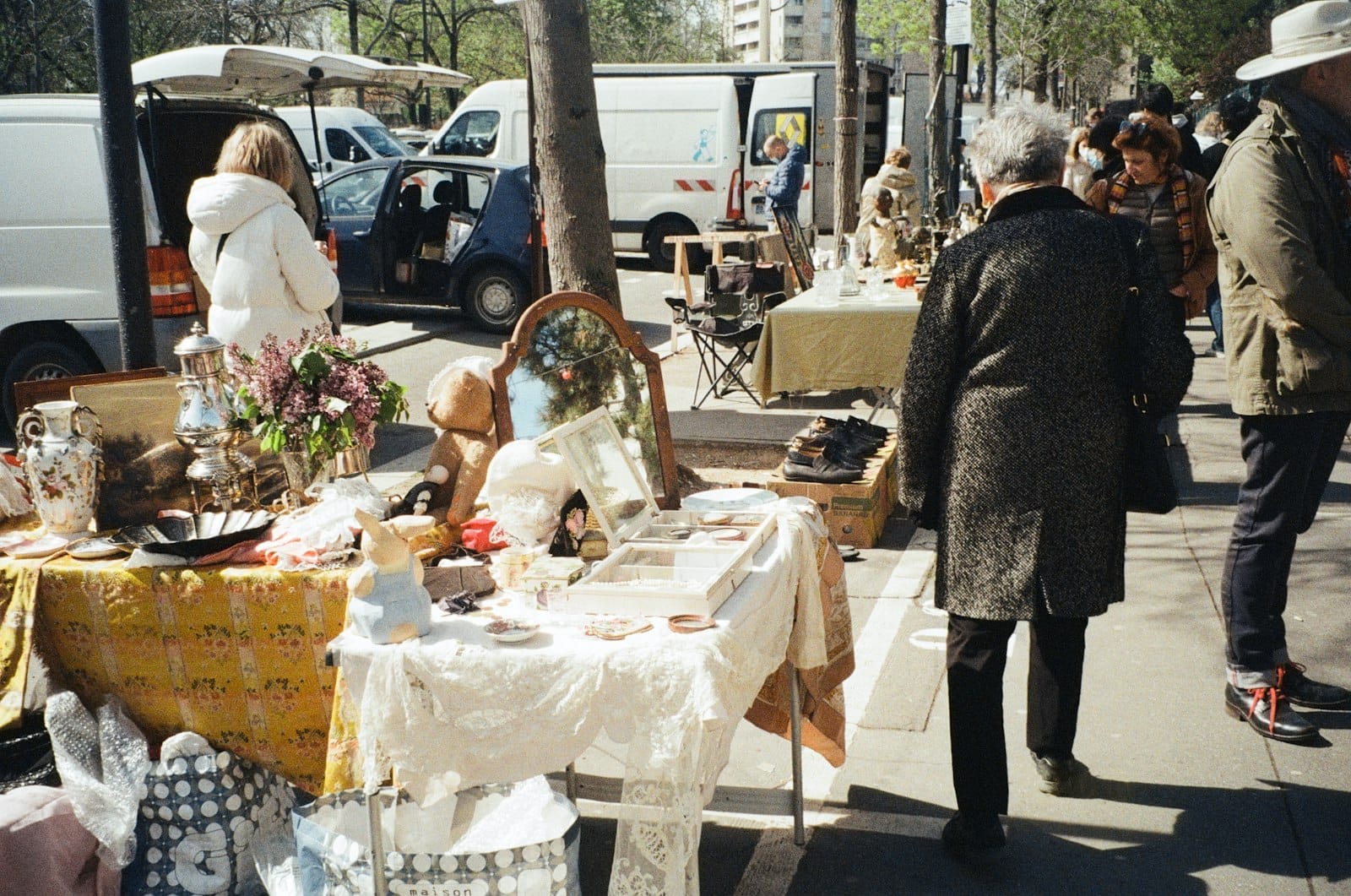
The Marché aux Puces de Paris Saint-Ouen is not a single market. It is a small city of trade, spread across seven hectares of streets, covered pavilions, and open-air passages at the northern edge of Paris. Eleven distinct covered markets operate under individual names, each with its own character and speciality, alongside five open shopping streets known as Pucières. The whole complex holds more than 2,000 registered dealers and attracts around five million visitors a year, making it the world's largest antiques market and, by some counts, the fifth most visited tourist site in France.
That statistic deserves some unpacking. The markets range from formal, gallery-style spaces where 18th-century armoires and Art Deco lamps are displayed with museum-grade care, to ramshackle outdoor stalls heaped with secondhand records, mismatched cutlery, and vintage workwear. The gap between those two extremes is part of what makes a visit interesting. You can spend 200 euros on a signed lithograph in the Marché Serpette and then find a pair of 1970s Levi's for fifteen euros three streets away.
💡 Local tip
The covered markets cluster around Rue des Rosiers, the main spine of the Puces. Arrive by 10am on Saturday to get first look at freshly set stalls before crowds thicken. The outdoor sidewalk stalls along Avenue Michelet are set up by dealers who often don't have permanent pitch agreements, so stock rotates completely each weekend.
A Brief History: From Waste Pickers to Heritage Zone
The flea market's origins trace to the 1870s, when ragpickers expelled from central Paris by Haussmann's renovations gathered on the wasteland north of the city limits to sort and sell their finds. The name 'puces' (fleas) reflects what the earliest sellers were accused of carrying in their salvaged clothing and rags. By 1885, the municipality of Saint-Ouen had paved streets and designated formal market zones, transforming an informal encampment into a commercial district with addresses.
Over the following decades, the Puces evolved in social status. What began as a market for the destitute became a hunting ground for artists, then interior decorators, then international collectors. Coco Chanel reportedly shopped here for inspiration. By the mid-20th century, antique dealers and brocanteurs had established permanent covered pavilions with lockable display cases and consistent weekly hours. In 2001, the site received ZPPAUP classification, a French heritage protection status that limits demolition and regulates new construction throughout the market district.
Tickets & tours
Hand-picked options from our booking partner. Prices are indicative; availability and final rates are confirmed when you complete your booking.
Full-day trip to Giverny and Rouen from Paris
From 245 €Instant confirmationFree cancellationParis Essential dinner cruise at 6.15pm
From 99 €Instant confirmationFree cancellationEiffel Tower reserved elevator entrance to 2nd floor with walking tour and Seine cruise
From 94 €Instant confirmationFree cancellationBest of Paris city tour with Eiffel Tower lunch and Seine cruise
From 144 €Instant confirmationFree cancellation
The Eleven Markets: What Each One Offers
Knowing which market to head to first saves time. The eleven covered markets each developed distinct identities, and serious buyers tend to treat them as separate destinations rather than one continuous browsing loop.
- Marché Vernaison: The oldest and largest, most labyrinthine. Narrow passageways lead past 200-plus stalls selling toys, glassware, scientific instruments, and vintage textiles. Budget at least an hour just for this one.
- Marché Paul Bert and Serpette: The prestige address for serious collectors. Furniture, fine art, mirrors, and decorative objects displayed in gallery-style booths. Prices are high, but so is the quality.
- Marché Biron: Grand furniture, particularly French provincial and Baroque pieces. The ceiling heights accommodate wardrobes and four-poster beds that wouldn't fit anywhere else in Paris.
- Marché Dauphine: Two floors of books, vintage fashion, vinyl records, posters, and smaller collectibles. Strong on mid-century design and 20th-century popular culture.
- Marché Malassis: Concentrates on jewelry, watches, silver, and small decorative objects. Good for affordable estate jewelry if you know how to spot quality.
- Marché Jules-Vallès: Eclectic mix of vintage objects, industrial pieces, and curiosities. Less curated than Paul Bert, more interesting than a generic brocante.
- Marché Cambo, l'Entrepôt, le Passage, l'Usine: Smaller or more specialist spaces, covering everything from garden furniture to African art to architectural salvage.
The five Pucières streets (Rue Jules Vallès, Rue Lecuyer, Rue Paul Bert, Rue des Rosiers, and l'Impasse Simon) add a more informal layer between the covered pavilions. These are where dealers without permanent stalls set up folding tables, and where pricing tends to be more flexible.
How the Experience Changes by Time of Day
Friday morning is the Puces at its most professional. The official Friday hours run from 8am to noon, and the crowd at that hour is almost entirely trade: interior decorators with measuring tapes, antique shop owners restocking, and export dealers sourcing pieces for clients abroad. Prices are rarely negotiated downward at this hour because dealers know their buyers. For a civilian visitor, Friday is atmospheric but not particularly buyer-friendly.
Saturday before noon is the sweet spot for serious shoppers. The markets open at 10am, and the first two hours bring professional buyers alongside early-arriving tourists. Stock is at its freshest, dealers are alert, and the atmosphere has the focused energy of a market that means business. By early afternoon on Saturdays, the food stalls along Rue des Rosiers fill with visitors taking a break over moules-frites or a glass of Beaujolais, and the crowds in the narrower covered passages become genuinely difficult to navigate.
Sunday afternoons feel looser and more social. The serious collectors have been and gone; what remains is a more relaxed browsing crowd mixed with Paris locals on a weekend outing. Some dealers begin quietly reducing prices in the final hour before closing at 6pm, particularly on bulkier items they don't want to pack away again. Monday hours (10am to 6pm, though some stalls close at 5pm) see the lowest footfall of the weekend, which suits slow, unhurried browsing but means a smaller proportion of dealers are open.
⚠️ What to skip
The stretch of stalls along Avenue de la Porte de Clignancourt immediately outside the Métro exit sells cheap tourist goods, counterfeit goods, and knock-off sunglasses. This area is not part of the regulated Marché aux Puces and has nothing to do with antiques. Walk through it quickly and continue north to reach the actual market district.
Getting There and Getting Around
The most direct route is Métro Line 4 to Porte de Clignancourt. From the exit, walk north along Avenue de la Porte de Clignancourt for around five minutes until you pass under the périphérique (the ring road) and the covered market entrances appear on your left and right. A less-used but genuinely useful alternative is Métro Line 13 to Garibaldi, which deposits you at the northern end of the market district, near the Marché Biron and Paul Bert. This approach avoids the tourist gauntlet entirely and drops you straight into the antiques quarter. For broader context on navigating Paris by public transport, the getting around Paris guide covers the Métro, RER, and bus network in full detail.
The seven-hectare site is almost entirely flat and walkable, though the covered passages have uneven flooring in places and stalls are tightly packed. Serious buyers visiting multiple markets in a single day often bring a rolling trolley or a large tote bag: carrying a 1930s lamp through crowds for two hours is exactly as awkward as it sounds. Comfortable, flat shoes are non-negotiable. The outdoor streets are cobbled in sections.
ℹ️ Good to know
Cash is accepted everywhere and is often preferred by smaller dealers for negotiation. Card machines are standard in the larger covered markets like Paul Bert and Serpette, but don't count on them at outdoor stalls. ATMs are available near the Porte de Clignancourt Métro exit.
The Art of Negotiating (and When Not To)
Bargaining is expected at the outdoor stalls and on the open streets. The usual approach is to express genuine interest, ask the price, and then offer 70–80 percent of the asking price calmly and without theatrics. Dealers who deal in volume will meet you somewhere in the middle; dealers who specialize in a single category and know their stock's value will not. Asking 'C'est votre meilleur prix?' (Is that your best price?) is the neutral, polite way to open a negotiation without causing offence.
In the upscale covered markets, particularly Paul Bert and Serpette, prices reflect genuine research and often documented provenance. Aggressive bargaining here reads as amateur and may simply end the conversation. A more productive approach is to ask questions about the piece, demonstrate that you understand what you're looking at, and allow the dealer to offer a modest reduction on their own terms. For high-value purchases, dealers can typically arrange shipping and export documentation for international buyers.
Photography, Food, and Practical Details
Photography inside the covered markets is a nuanced question. The outdoor stalls and open streets are freely photographable. Inside the upscale covered pavilions, many dealers prefer you ask before pointing a camera at their inventory, particularly for displayed pieces. A simple 'Je peux prendre une photo?' almost always gets a yes. The visual material available here is extraordinary: stacked gilt frames, rows of porcelain, walls of vintage advertising posters, and industrial hardware that photographers treat as a free studio.
Rue des Rosiers, the main pedestrian artery through the market, has several sit-down restaurants that are worth noting for a mid-visit break. The food is unpretentious: mussels, grilled meats, French fries, wine by the carafe. The restaurants fill quickly on Saturday afternoons, so arrive before 12:30pm or after 2:30pm if you want a table without a wait. If you're planning a full Paris market day, the nearby Marché d'Aligre in the 12th arrondissement operates on a completely different schedule (mornings only, Tuesday through Sunday) and makes an interesting contrast in terms of scale and atmosphere.
For visitors building a broader Paris itinerary around markets, shopping, and street-level discovery, the Paris on a budget guide covers free and low-cost experiences across the city. Since the Puces charges no entry, a full day here costs only what you choose to spend.
Who Will Love It, and Who Should Think Twice
The Puces rewards curiosity and patience. Visitors who arrive with a specific object in mind (a particular style of chair, a set of vintage cookware, a certain era of fashion) tend to leave satisfied because the scale of the market makes finding almost anything plausible. Visitors who arrive expecting a photogenic, curated, Instagram-friendly experience may feel overwhelmed: this is a working commercial market, not an edited lifestyle destination. For something more polished and contained, the covered passages of Paris offer antique bookshops and vintage print dealers in a more intimate 19th-century arcade setting.
Visitors with mobility difficulties should know that while the site is flat, the outdoor areas include cobblestones and uneven surfaces, and the covered passages vary widely in width. Busy Saturday afternoons in markets like Vernaison, where passageways narrow to two people abreast, can be genuinely difficult to navigate with a wheelchair or a stroller. A weekday Friday morning visit offers more space but fewer open stalls.
Travelers who prefer a compact, single-afternoon cultural stop may find the scale here more exhausting than rewarding. The Puces is not a place to rush. If your Paris schedule is tight and focused on major monuments, it may be more sensible to hold this for a return trip. For a manageable introduction to antique Paris on a shorter timeline, the Palais Royal arcades house a handful of specialist antique and curiosity dealers in a far smaller footprint.
Insider Tips
- The Garibaldi Métro exit (Line 13) deposits you at the quieter, northern end of the market near the upscale dealers. Using this entry point avoids the tourist stall corridor at Porte de Clignancourt and saves ten minutes of walking past things you didn't come to see.
- Dealers in the outdoor Pucières streets are more willing to negotiate in the final 90 minutes before closing on Sunday, particularly on large or awkward items. If you spotted something earlier in the day, return toward 5pm and ask again.
- Many dealers in the Paul Bert and Serpette markets close for lunch between 1pm and 2:30pm even on busy Saturdays. If you arrive during this window, you may find padlocked booths and no one to talk to. Plan accordingly.
- Ask dealers about provenance and documentation before buying anything priced above a few hundred euros. Legitimate dealers in the regulated markets can typically provide a receipt with their dealer registration number, which matters for customs declaration if you're traveling internationally.
- The Marché Dauphine's upper floor, reached by a narrow internal staircase, is where the vinyl record dealers, vintage fashion boutiques, and vintage poster sellers concentrate. Most first-time visitors miss it entirely by staying on the ground floor.
Who Is Paris Flea Markets For?
- Antique and vintage collectors looking for specific categories with dealer expertise
- Design professionals and interior decorators sourcing one-of-a-kind pieces
- Fashion lovers hunting for deadstock and vintage clothing from the 20th century
- Curious travelers who want a slice of Paris commercial life far from the tourist centre
- Photographers seeking textured, layered visual material in a non-staged environment
Nearby Attractions
Combine your visit with:
- Bois de Vincennes
Covering nearly 1,000 hectares on the eastern edge of Paris, the Bois de Vincennes is the city's largest green space, combining ancient woodland, three lakes, a botanical garden, a world-class zoo, and a medieval royal castle. It rewards both casual afternoon strollers and full-day explorers.
- Château de Fontainebleau
Older than Versailles and used by more French monarchs, the Château de Fontainebleau is a UNESCO World Heritage palace 55 km southeast of Paris. With over 1,900 rooms, free formal gardens, and a manageable crowd count compared to other royal sites, it rewards visitors who make the 40-minute train trip from Paris.
- Château de Vaux-le-Vicomte
Built between 1656 and 1661 for finance minister Nicolas Fouquet, Château de Vaux-le-Vicomte is the largest privately owned château in France. Its formal gardens, gilded state rooms, and extraordinary backstory make it one of the most rewarding half-day trips from Paris.
- Château de Vincennes
Rising at the eastern edge of Paris, Château de Vincennes is one of the most complete medieval royal fortresses in Europe. Home to France's tallest medieval keep and a stunning Gothic chapel, it rewards visitors who venture beyond the tourist centre with centuries of largely undisturbed royal history.