Rudolfinum: Prague's Grand Concert Hall on the Vltava
Standing on Jan Palach Square since 1885, the Rudolfinum houses the Czech Philharmonic in one of Central Europe's most architecturally impressive concert halls. Whether you're attending a performance in Dvořák Hall or visiting the Galerie Rudolfinum, this is where serious music and serious architecture meet.
Quick Facts
- Location
- Alšovo nábřeží 79/12, 110 00 Praha 1
- Getting There
- Staroměstská (Metro Line A, trams)
- Time Needed
- 2–3 hours for a concert; 45–90 minutes for a gallery visit
- Cost
- Concert tickets vary by programme and seat category; gallery admission varies per exhibition (some free). Check rudolfinum.cz for current prices.
- Best for
- Classical music lovers, architecture enthusiasts, art gallery visitors
- Official website
- www.rudolfinum.cz
What the Rudolfinum Actually Is
The Rudolfinum is a neo-Renaissance cultural complex on the right bank of the Vltava River, at the edge of Prague's Old Town. The Rudolfinum is a neo-Renaissance cultural complex on the right bank of the Vltava River, at the edge of Prague's Old Town. It serves three distinct functions under one roof: as the permanent home of the Czech Philharmonic, the Czech Chamber Music Society, and as the venue for Galerie Rudolfinum, one of the country's most respected contemporary art exhibition spaces. These are separate operations with separate ticketing, but they share the same landmark building and the same address on Jan Palach Square. These are separate operations with separate ticketing, but they share the same landmark building and the same address on Jan Palach Square.
Visitors sometimes arrive expecting an open-access museum or a general tourist attraction. It is neither. The building is a working concert hall and gallery. Access to the interiors depends entirely on whether you have a ticket to a performance or an active gallery exhibition. The exterior and the square in front, however, are freely accessible at any hour.
ℹ️ Good to know
The Rudolfinum has two distinct visitor experiences: concerts in Dvořák Hall (Czech Philharmonic) and contemporary art exhibitions in Galerie Rudolfinum. Each has separate tickets and separate hours. Confirm which you want before you go.
The Architecture: What You'll See from the Outside
Designed by Josef Zítek and Josef Schulz, the same architectural partnership behind the National Theatre, the Rudolfinum was Designed by Josef Zítek and Josef Schulz, the same architectural partnership behind the National Theatre, the Rudolfinum was built between 1876 and 1884. The style is neo-Renaissance, built from sandstone, and the facade facing the Vltava is one of the most composed 19th-century frontages in Prague. The building is long and horizontal, anchored by a projecting central entrance loggia with columns, flanked by two corner pavilions. Busts and statues of composers and artists line the balustrade along the roofline. The style is neo-Renaissance, built from sandstone, and the facade facing the Vltava is one of the most composed 19th-century frontages in Prague. The building is long and horizontal, anchored by a projecting central entrance loggia with columns, flanked by two corner pavilions. Busts and statues of composers and artists line the balustrade along the roofline.
The building's position matters. It sits at the north end of Jan Palach Square, with the Faculty of Arts of Charles University on the opposite side and the Old Jewish Cemetery just a short walk to the north. The Vltava runs directly behind it. At dusk, when the stone facade catches the last low light and the river reflects the sky, the building reads as genuinely monumental without being overbearing. Morning light from the east picks out the texture of the sandstone columns cleanly. If you're interested in photographing the exterior, arrive before 9am to avoid tour groups gathering on the square.
The Rudolfinum is one of several major examples of 19th-century civic architecture concentrated in Prague's Old Town and surrounding areas. For broader context on how this style fits into the city's built history, the Prague architecture guide covers the full arc from Romanesque foundations to Communist-era construction.
Tickets & tours
Hand-picked options from our booking partner. Prices are indicative; availability and final rates are confirmed when you complete your booking.
Self guided tour with interactive city game of Prague
From 5 €Instant confirmationFree cancellationPrague by night city tour
From 27 €Instant confirmationFree cancellationPrague city tour with Vltava River cruise
From 38 €Instant confirmationFree cancellationPrague Castle online audio guide
From 5 €Instant confirmationFree cancellation
Dvořák Hall: Attending a Czech Philharmonic Concert
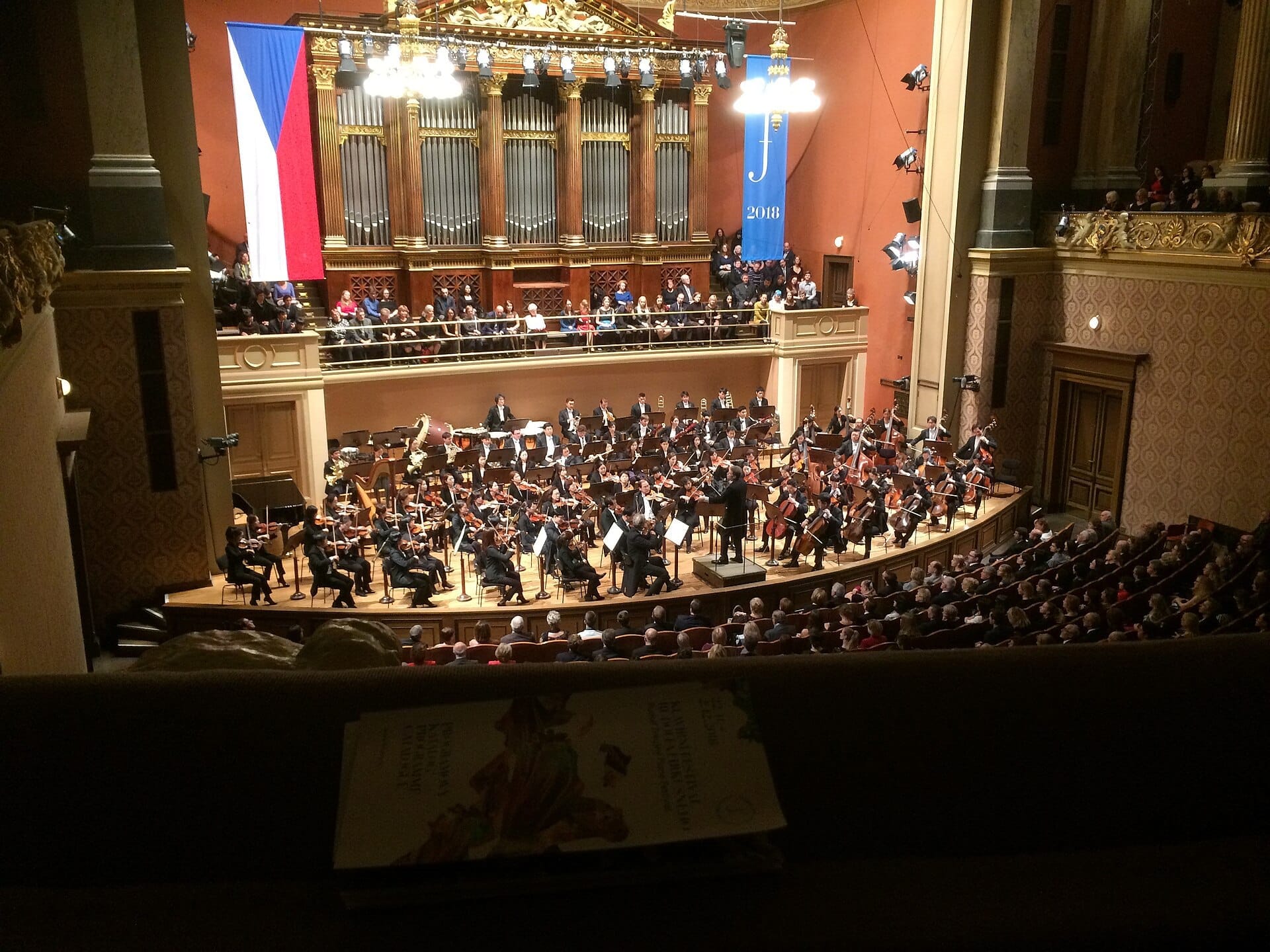
Dvořák Hall, the main concert auditorium, is where the Czech Philharmonic performs. The hall's connection to Antonín Dvořák is direct: the very first concert held there in 1896 was conducted by Dvořák himself. The interior is the kind that makes audiences quiet before the music even starts. Cream and gold plasterwork, tiered galleries, a curved ceiling, and acoustics designed for unamplified orchestral sound. The room holds several hundred seats across stalls and balcony levels. The hall's connection to Antonín Dvořák is direct: the very first concert held there in 1896 was conducted by Dvořák himself. The interior is the kind that makes audiences quiet before the music even starts. Cream and gold plasterwork, tiered galleries, a curved ceiling, and acoustics designed for unamplified orchestral sound. The room holds several hundred seats across stalls and balcony levels.
Concert programmes run from September through June, with the Czech Philharmonic's season following a subscription series structure alongside individual ticketed concerts. Ticket prices vary significantly by programme, seat location, and series type. The only reliable way to see current pricing and availability is through the Czech Philharmonic's official booking system. Seats in the upper galleries are generally the most affordable; central stalls for headline programmes sell out well in advance, especially for internationally touring conductors or soloists.
On concert evenings, the building fills in a specific rhythm. Doors typically open before the scheduled start. The foyer and staircase areas become social spaces where the Prague classical music audience mingles. The bar operates pre-concert and at interval. Latecomers are not admitted until a suitable break in the programme.
💡 Local tip
Book Czech Philharmonic tickets as early as possible for the main season. Popular programmes, especially those featuring well-known guest conductors, sell out weeks or months ahead. The official site (ceskafilharmonie.cz) lists the full season programme.
Galerie Rudolfinum: The Exhibition Spaces
Galerie Rudolfinum operates within the building's upper floor spaces and focuses on contemporary and modern art, typically through temporary exhibitions rather than a permanent collection. The programming tends toward significant solo or thematic shows, often with international artists or travelling exhibitions of genuine curatorial weight. It is not a general art museum; the gallery has a clear conceptual identity and runs a focused annual programme.
Gallery opening hours are generally Tuesday through Sunday, with Monday closures, but these are subject to change between exhibitions, and the gallery sometimes closes between shows. Admission prices are set per exhibition and may be free or ticketed depending on the show. Always check the current exhibition page on rudolfinum.cz before visiting, especially if you're making a specific trip to the gallery.
If the Galerie Rudolfinum's programme doesn't match your interests on a given visit, Prague's Old Town and surrounding areas have significant alternative gallery and museum options. The best museums in Prague covers the full range, from applied arts to fine art collections across the city.
Historical Weight: From Concert Hall to Parliament and Back
The Rudolfinum has had an unusual political history for a cultural building. Named after Crown Prince Rudolf of Austria, it opened as a multi-purpose cultural venue at a time when Czech national identity and the role of Czech-language institutions were genuinely contested within the Austro-Hungarian Empire. The building was funded by the Bohemian Savings Bank and was intended to signal civic ambition.
When Czechoslovakia was declared independent in 1918, the Rudolfinum was repurposed as the seat of the National Assembly, the new country's parliament, from 1918 to 1938. During the Nazi occupation, it was returned to cultural use. After liberation, it served as a parliament again briefly in 1945 and 1946 before being handed back to the Czech Philharmonic, which has remained its primary tenant since. This trajectory, from concert hall to seat of government and back, gives the building a layered civic significance that goes well beyond its role as a music venue.
The political and cultural history of this period in Prague is substantial. The Prague history guide provides the broader context for how the city's institutions evolved through independence, occupation, and the communist decades.
Getting There and Practical Logistics
The Rudolfinum is straightforward to reach. Staroměstská metro station (Line A, green line) is nearby. Multiple tram lines also stop at Staroměstská. From Charles Bridge, it's a short walk north along the riverbank.
The area around Jan Palach Square is flat and pedestrian-friendly. There is no dedicated parking immediately adjacent; public transport is the practical choice for most visitors. Check with the venue directly if accessibility arrangements for reduced-mobility visitors are relevant to your visit, as the building underwent major reconstruction in the 1990s but specific lift and wheelchair access details are best confirmed through the Czech Philharmonic's visitor services.
⚠️ What to skip
The Rudolfinum is not a drop-in tourist attraction. Without a concert ticket or an active gallery exhibition, you cannot access the interior. If you're visiting Prague and want to see the building inside, plan your visit around a specific event or exhibition.
Who Should Consider Skipping It
Travelers with no interest in classical music or contemporary art, and who are mainly sightseeing, will find the exterior worth a brief stop but will have no reason to linger. The interior is genuinely impressive, but it's not accessible without an event ticket. If your Prague itinerary is focused on street-level exploration, medieval history, or food and nightlife, the Rudolfinum will likely rank below other priorities.
For visitors assembling a broader Prague itinerary, the things to do in Prague overview helps rank attractions by type and interest. Those focused specifically on Old Town's walkable historic core will find the Old Town Prague neighborhood guide useful for planning what's within reach on foot.
Insider Tips
- The balustrade statues along the roofline are worth a closer look from the square. Each depicts a composer or artist, and identifying them gives you a quick read on the cultural priorities of late 19th-century Bohemian civic culture.
- For the best view of the Rudolfinum's facade, cross to the opposite side of Jan Palach Square in the morning. The Faculty of Arts building across the square provides an unobstructed sightline, and the light is at its best from the east in the first two hours after sunrise.
- If you're attending an evening concert, arrive early enough to explore the foyer and staircase areas before the performance. The interior architectural details, particularly the coffered ceilings and ironwork balustrades, repay attention when the space isn't crowded at interval.
- The Vltava riverside path directly behind the Rudolfinum is a pleasant approach to or from the building, connecting easily to both Charles Bridge to the south and Letná Park to the north.
- Galerie Rudolfinum shows sometimes include free admission periods or late-night openings during specific exhibition events. Check the gallery's programme for these, as they offer a way to see the building interior outside of concert ticketing.
Who Is Rudolfinum (Czech Philharmonic) For?
- Classical music enthusiasts wanting to hear the Czech Philharmonic in their home venue
- Architecture-focused visitors interested in high-quality 19th-century civic neo-Renaissance design
- Contemporary art visitors following Galerie Rudolfinum's exhibition programme
- Travelers seeking a refined cultural evening as part of a broader Prague visit
- Anyone walking the Vltava riverside who wants to understand the significance of the buildings along the embankment
Nearby Attractions
Other things to see while in Old Town (Staré Město):
- Church of Our Lady before Týn
The Church of Our Lady before Týn is Prague's most recognizable Gothic landmark, its twin 80-metre spires rising sharply above the rooflines of Old Town Square. Entry is free, but visiting hours are short and the interior tells a story most visitors walk past without ever stepping inside.
- Church of St. Nicholas (Old Town)
Standing in the north-west corner of Old Town Square, St. Nicholas Church is a compact Baroque masterpiece built between 1732 and 1737. Entry is free, the interior is genuinely beautiful, and most visitors walk past it without stopping. Here is why they should not.
- Clementinum
The Clementinum is one of the largest building complexes in Prague, stretching over 2 hectares in the heart of Old Town. Its guided tours take visitors into a breathtaking Baroque library hall and up a narrow tower for panoramic rooftop views over the city's spires.
- Estates Theatre (Stavovské divadlo)
The Estates Theatre in Prague's Old Town is one of the best-preserved 18th-century opera houses in Europe, and one of the surviving venues where Mozart himself conducted. Built in 1783, it staged the world premiere of Don Giovanni and remains an active performance space under the National Theatre umbrella.