The Regent's Park: London's Most Layered Royal Park
Spanning 166 hectares in north-west central London, The Regent's Park offers an extraordinary range within a single green space: formal rose gardens, an open-air theatre, London Zoo, boating lakes, and miles of walking paths. Entry is free, and the park rewards visitors at every hour of the day.
Quick Facts
- Location
- North-west central London, Westminster and Camden
- Getting There
- Regent's Park (Bakerloo line), Baker Street (Bakerloo, Circle, Jubilee, Metropolitan, Hammersmith & City lines), London Euston or Marylebone mainline stations
- Time Needed
- 2–4 hours for a relaxed visit; a full day if combining London Zoo and Primrose Hill
- Cost
- Free entry to the park. London Zoo and Open Air Theatre require separate tickets.
- Best for
- Families, joggers, picnickers, garden enthusiasts, and anyone wanting a genuine break from central London's pace
- Official website
- www.royalparks.org.uk/visit/parks/regents-park-primrose-hill
What The Regent's Park Actually Is
The Regent's Park is one of eight Royal Parks in London and covers approximately 166 hectares (487 acres), with a perimeter of around 3.3 miles, excluding the neighbouring Primrose Hill. That scale matters: this is not a pocket park you cross in ten minutes. It is a fully realised landscape that contains a working zoo, a lake with rowboats, one of London's best open-air theatres, a network of sports pitches, a formal rose garden holding over 12,000 rose plants, and long stretches of avenue that feel quiet even on weekday afternoons.
Unlike Hyde Park or St James's Park, which sit in the middle of tourist London, The Regent's Park has a slightly more residential character. Its perimeter is ringed by John Nash's elegant Regency terraces, white-stuccoed and grand, which give the park a backdrop unlike any other green space in the city. You feel, at certain points along the Outer Circle road, as though you have wandered into a planned 19th-century ideal of what a city should look like.
💡 Local tip
Pedestrian gates currently open at 5:00am and close at 9:30pm. Primrose Hill, which adjoins the park to the north, is open 24 hours. Vehicle gates open at 7:00am and close at midnight. Times can vary by season, so check the Royal Parks website before planning an early morning or evening visit.
History: From Royal Hunting Ground to Public Park
The land that became The Regent's Park was originally known as Marylebone Park, a royal hunting ground that Henry VIII appropriated during the dissolution of the monasteries in the late 1530s. It remained Crown land for centuries, leased out for farming, until the architect John Nash was commissioned in the early 19th century to create a grand development scheme for the Prince Regent, later George IV. Nash's vision was ambitious: a sweeping park enclosed by palatial terraces and dotted with villas, designed to form the southern terminus of a grand processional route from Carlton House.
The full scheme was never completed, but what was built remains striking. The terraces along the Outer Circle, including Cumberland Terrace, Chester Terrace, and Park Crescent, represent some of the finest examples of Regency architecture in Britain. The park itself opened to the public in 1835. Today it is managed by The Royal Parks charity, and admission remains free, in keeping with the public access ethos that has defined the Royal Parks for nearly two centuries.
Tickets & tours
Hand-picked options from our booking partner. Prices are indicative; availability and final rates are confirmed when you complete your booking.
Soho Instagram a self-guided walking tour to top photo spots
From 6 €Instant confirmationFree cancellationTootbus London by Night: Bus tour
From 32 €Instant confirmationFree cancellationIFS Cloud Cable Car Ride and Uber Boat Hop-on Hop-off 1 Day Ticket
From 38 €Instant confirmationFree cancellationThe Making of Harry Potter Guided Tour of London Warner Bros. Studio
From 201 €Instant confirmationFree cancellation
The Queen Mary's Gardens and Rose Garden
At the heart of the Inner Circle sits Queen Mary's Gardens, widely regarded as the finest public rose garden in London. Over 12,000 roses of approximately 85 varieties are planted here, and the garden is at its peak from late May through July, when the scent on a still morning is remarkable. The beds are formal and well-labelled, making this a practical resource for anyone curious about variety names, and the circular layout means you naturally loop back to the entrance without retracing your steps.
Outside the rose season, Queen Mary's Gardens remains worth visiting. There is a large herbaceous border, a pergola walk covered in wisteria and clematis, and a central bandstand that hosts free concerts during summer months. Even in winter, the bare structure of the garden is interesting, and the cafe nearby stays open year-round.
The Inner Circle also contains the London Zoo, which occupies the northern section of the park and requires a separate paid ticket. If you are visiting with children, combining a morning in the rose garden with an afternoon at the zoo is one of the more sensible full-day plans in this part of London.
The Boating Lake and Wider Landscape
The main lake in the western section of the park is available for rowing boats and pedalos during the warmer months, typically from spring through autumn, weather permitting. The lake also supports a significant waterfowl population: herons, grebes, cormorants, and a large resident population of ducks and geese. Early mornings in spring, before the paths fill up, the lake area is one of the quieter wildlife-watching spots in central London.
The park contains 30 hectares of sports facilities, including tennis courts, football and cricket pitches, and an athletics track. These are bookable and heavily used by local clubs. If you are visiting on a weekend afternoon, expect the pitches to be active and the paths around them to feel lively rather than serene. If quiet contemplation is the goal, the northern end of the park, near the canal and the wooded areas around the Broadwalk, is consistently less crowded.
ℹ️ Good to know
The Regent's Canal runs along the northern edge of the park, connecting it to the wider network of London waterways. A towpath walk westward from here leads toward Little Venice in approximately 30 to 40 minutes, passing through Camden Lock on the way.
The Open Air Theatre
The Open Air Theatre, located within the Inner Circle, has been staging productions in the park since 1932, making it one of London's most established outdoor performance venues. The season typically runs from May to September and regularly includes Shakespeare, musicals, and contemporary work. The setting is genuine: performances happen under the sky, and a light rain does not typically cancel a show. Audiences are encouraged to bring picnics, and the outdoor bars and food stalls open well before curtain time.
Booking well in advance is strongly advised for popular productions, particularly weekend performances in June and July. Ticket prices vary by production and seating category; check the Open Air Theatre's website directly for current season details. The experience of watching a midsummer evening performance here, with swallows crossing the stage and the trees darkening around the arc of seats, is one of those specifically London pleasures that is hard to replicate elsewhere.
Getting There and Moving Around the Park
The most direct Tube access is via Regent's Park station on the Bakerloo line, which exits onto the south side of the park. Baker Street station, served by five lines, is a slightly longer walk but gives more flexibility from other parts of the city. If you are traveling from a wider area, London Euston and Marylebone are both within walking distance. For orientation, getting around London by public transport is straightforward using Oyster or contactless payment on the Tube.
Within the park, the main paths are wide, flat, and well-surfaced, making most of the site accessible to pushchairs and wheelchairs. The Inner Circle road is open to vehicles but traffic is light, and pedestrian access around Queen Mary's Gardens is uninterrupted. The lake area and northern sports sections involve some slightly rougher grass paths in wet conditions, and proper shoes are worth considering if rain is forecast.
The park connects naturally to a broader north London walk. From the northern edge, Primrose Hill is directly accessible and adds excellent views over central London with minimal extra effort. To the northeast, the Camden area and its markets are reachable on foot in around 20 minutes, making the park a logical anchor point for a half-day itinerary in this part of the city.
When to Visit and What the Park Feels Like at Different Times
Early weekday mornings, from around 6:00am to 8:30am, the park is populated almost entirely by joggers, dog walkers, and cyclists. The light across the boating lake in early morning is particularly good for photography, and the Regency terraces catch the low sun at an angle that makes them look almost theatrical. The rose garden is essentially empty at this hour, and the scent, on a warm June morning, is stronger before the heat of the day volatilizes it.
Midday on summer weekends is the busiest period, especially around Queen Mary's Gardens and the lake. The park absorbs crowds reasonably well given its size, but the Inner Circle paths and the cafe areas can feel congested. If you arrive between 11:00am and 2:00pm on a Saturday in July, plan to be patient around the popular nodes and walk further toward the less-visited northern end if you want space.
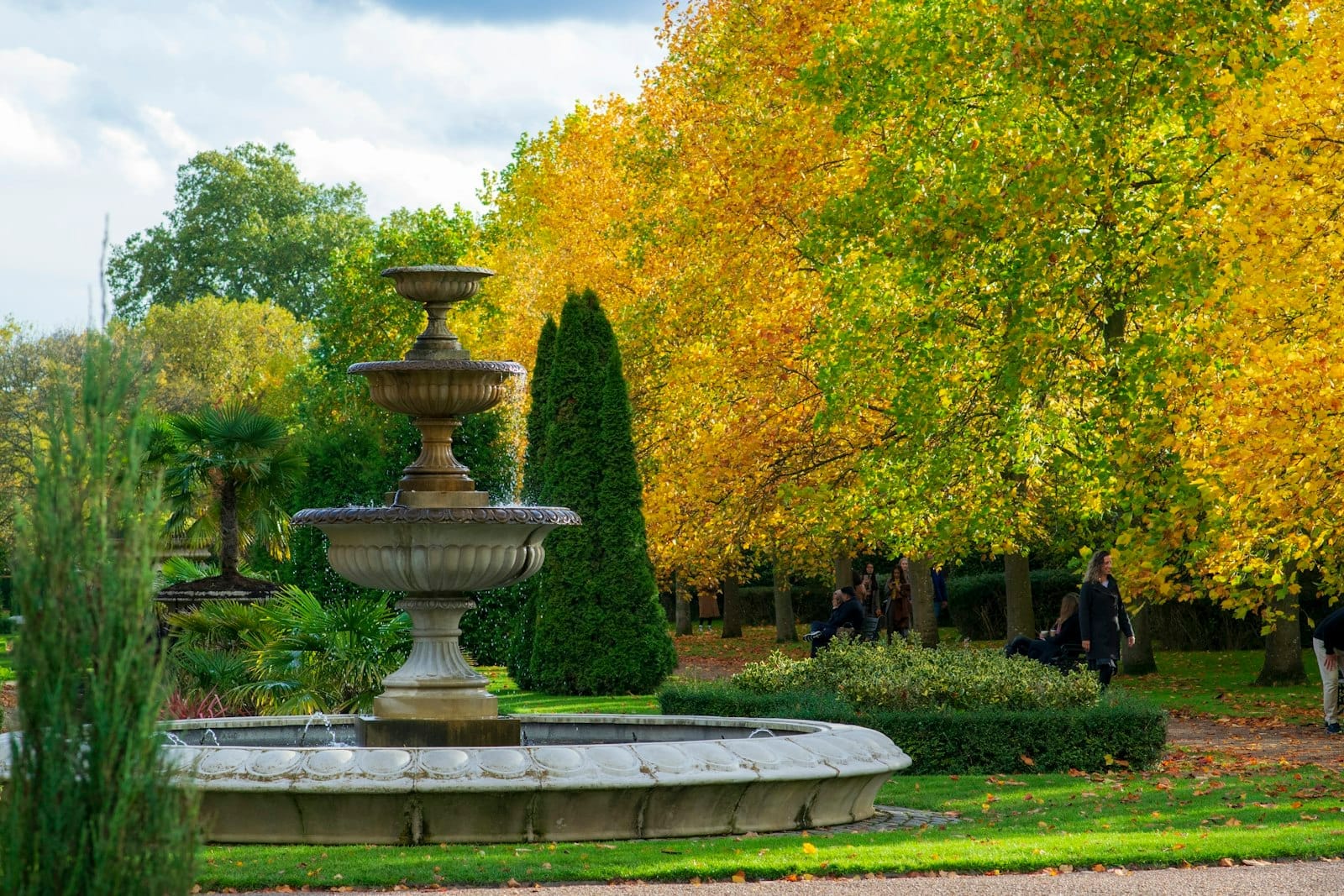
Autumn is underrated here. The plane trees along the Broad Walk turn in October, and the park is far less crowded than in summer. The rose garden has a second smaller flush of bloom in September. Winter mornings, when frost covers the grass and few people are around, give the Nash terraces an almost eerie grandeur that is impossible to appreciate in summer.
⚠️ What to skip
The park is entirely open to the weather. London's rain is rarely dramatic but it is frequent. A waterproof layer is worth carrying regardless of the forecast, particularly if you plan to spend two or more hours here. The Open Air Theatre provides ponchos for sale but not refunds for rain.
If you are planning a broader London visit and want to fit the park into a structured itinerary, the 3-day London itinerary includes practical suggestions for combining the park with nearby attractions in north and central London.
Photography and What to Expect from the Visuals
The park is frequently photographed but rarely in ways that do it full justice. The most distinctive images come from the Outer Circle road looking inward across the lake toward the Regency terraces, ideally in the golden hour before sunset. Queen Mary's Gardens in full bloom is an obvious subject, but consider shooting from low angles within the rose beds rather than from the standard standing position. For views that extend beyond the park itself, the adjoining Primrose Hill provides one of the best unobstructed panoramas of the central London skyline.
The park is included in many lists of photogenic London locations, and it earns the inclusion honestly. That said, it is not a place that photographs well in overcast flat light at midday. Time your visit for the hour after sunrise or the two hours before sunset to get images that feel proportionate to the setting.
Insider Tips
- The cafe inside Queen Mary's Gardens is less crowded than it looks from the outside, and it has outdoor seating that faces directly onto the rose beds. Arriving around 9:30am on a weekday gets you a table with minimal competition.
- The Regent's Canal towpath along the northern boundary of the park is a pleasant walking route that most first-time visitors miss entirely. Walking eastward from here toward Camden Lock takes about 15–20 minutes and gives you a completely different perspective on the park from the water level.
- Free outdoor concerts take place at the park's bandstand on selected summer weekends. The Royal Parks website publishes a schedule. These are not heavily advertised and tend to draw a local rather than tourist crowd.
- If you are visiting specifically for the rose garden, check the Royal Parks website or call ahead in late May to confirm whether the peak bloom has arrived. The timing varies by roughly two to three weeks depending on the spring temperature, and a visit at full peak versus just before or after is a meaningfully different experience.
- The park has multiple named gates, and the one you enter through significantly affects your experience. Chester Gate on the east side deposits you directly into the quieter, more formal sections. Clarence Gate from Baker Street is more central but places you immediately in heavier foot traffic. For the most atmospheric entry, the Outer Circle road near the lake is worth the slightly longer walk from the Tube.
Who Is Regent's Park For?
- Families looking for a full-day combination of green space, London Zoo, and outdoor theatre
- Joggers and cyclists who want a flat, safe route with enough distance for a real workout
- Garden enthusiasts and photographers during the rose season from late May to July
- Visitors who want to understand the Regency period of London's architectural history in a single walk around the Outer Circle
- Travellers building a north London day that combines the park with Camden Market and Primrose Hill
Nearby Attractions
Other things to see while in Camden:
- Camden Market
Camden Market is a sprawling complex of former industrial yards, canal-side warehouses and Victorian stables that has evolved into one of London's most distinctive open-air destinations. With more than 1,000 places to shop, eat and drink across several interconnected areas, it rewards slow exploration and punishes rushing. Free to enter, open every day, and unlike anywhere else in the city.
- ZSL London Zoo
Founded in 1828, ZSL London Zoo sits on the northern edge of Regent's Park and houses hundreds of animal species. As one of the world's oldest scientific zoos, it balances family entertainment with serious conservation work — making it a rewarding day out if you approach it with the right expectations.
- Primrose Hill
Perched 63 metres above sea level in north London's Camden, Primrose Hill delivers an unobstructed panorama of the city skyline. It costs nothing to visit, is open daily from 6:00 to 22:00, and rewards those who time their visit well with one of the most memorable views in the capital.