Camden Market: London's Most Anarchic Shopping Destination
Camden Market is a sprawling complex of former industrial yards, canal-side warehouses and Victorian stables that has evolved into one of London's most distinctive open-air destinations. With more than 1,000 places to shop, eat and drink across several interconnected areas, it rewards slow exploration and punishes rushing. Free to enter, open every day, and unlike anywhere else in the city.
Quick Facts
- Location
- Camden Lock Place, London NW1 8AF
- Getting There
- Camden Town (Northern line) or Chalk Farm (Northern line); buses 24, 214, 274, 393
- Time Needed
- 2–4 hours; a full half-day if eating and browsing
- Cost
- Free entry; individual traders charge their own prices
- Best for
- Street food, vintage clothing, counterculture browsing, weekend day trips
- Official website
- camdenmarket.com
What Camden Market Actually Is
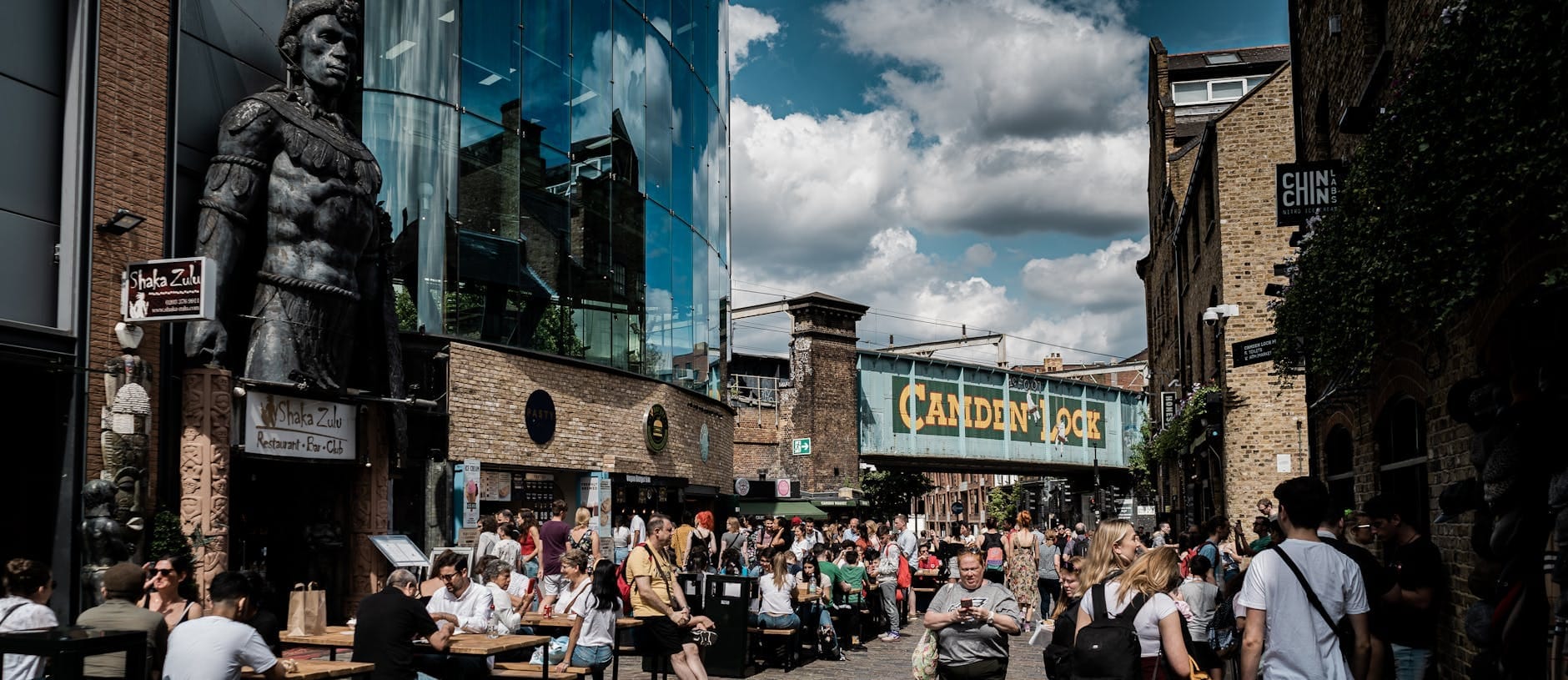
Camden Market is not a single market. It is a loose confederation of distinct areas that have grown together over five decades along the Regent's Canal and the streets north of Camden Town station. The core zones are Camden Lock, The Stables Market, and North Yard, each with its own character and crowd. Understanding this geography before you arrive makes the difference between a satisfying visit and a confused shuffle through the same alley twice.
The whole complex hosts more than 1,000 places to shop, eat and drink. That number sounds overwhelming, but in practice the areas are walkable and connect naturally if you follow the canal towpath or the main street-level drag. Chalk Farm Road runs the spine of the market from the tube station northward, and most of the action falls within a 10-minute walk of Camden Town station.
💡 Local tip
Arrive via Chalk Farm station rather than Camden Town on busy weekends. The exit is quieter, the walk down Chalk Farm Road is pleasant, and you enter the Stables Market from the top rather than fighting the crowd coming up from the station.
The History Behind the Architecture
Camden Town itself dates from 1791, when the land was developed after Charles Pratt, 1st Earl Camden, gave his name to the area. But the market's own story begins much later: Camden Lock opened in 1974 in the former T. E. Dingwall builders yard as one of London's first dedicated crafts and antiques markets. It was a scrappy, innovative idea at a time when the canal-side was derelict, and it set the template for the regeneration of disused industrial land through culture and trade.
The Stables Market occupies buildings with a different past: these were working horse stables and a horse hospital serving the canal trade. The vaulted brick tunnels, low ceilings and cobbled yard floors are not decorative choices. They are the original bones of a 19th-century working complex, and walking through them gives the area a texture that purpose-built shopping centres simply cannot manufacture.
The canal lock that gives Camden Lock its name is still functional. On quieter mornings you can watch narrowboats passing through, a small industrial theatre that plays out against the noise of several hundred food stalls. It is one of those small pleasures that rewards arriving early.
For broader context on the neighbourhood surrounding the market, the Camden area guide covers the music venues, canals and residential streets that make the whole district worth a half-day rather than a rushed hour.
Tickets & tours
Hand-picked options from our booking partner. Prices are indicative; availability and final rates are confirmed when you complete your booking.
Camden Market and Southbank Bike and Food Tour
From 82 €Instant confirmationFree cancellationSoho Instagram a self-guided walking tour to top photo spots
From 6 €Instant confirmationFree cancellationTootbus London by Night: Bus tour
From 32 €Instant confirmationFree cancellationIFS Cloud Cable Car Ride and Uber Boat Hop-on Hop-off 1 Day Ticket
From 38 €Instant confirmationFree cancellation
What You Will Find: Area by Area
Camden Lock
This is the historic core and the most immediately recognisable part of the market. The Lock area clusters around the canal basin with a mix of street food stalls, independent clothing traders and craft sellers. The architecture here includes the original lock buildings and the distinctive Stables Market entrance, with its enormous equine sculptures rising above the archway. At weekends the food court along the canal fills quickly; the smell of grilling meat, spiced noodles and frying batter drifts across the water from mid-morning onwards.
The Stables Market
North of the Lock, the Stables is the area most worth your time if you are interested in vintage clothing, furniture, art prints and unusual collectables. The vaulted brick chambers that once housed horses now contain stalls selling everything from 1970s denim jackets to handmade leather goods. Lighting is low in some corridors and the space can feel labyrinthine, which is precisely its appeal. You will stumble on things you were not looking for.
The Stables also contains several indoor food halls, including the large Kerb Camden food market which has a rotating roster of street food traders. Quality here is generally higher than the generic stalls nearer the tube, and the covered setting means it functions on rainy days without the misery factor.
North Yard
The most recently redeveloped zone sits just north of the Stables and leans toward a more polished, food-and-drink-led offer. The courtyard layout is more open than the tunnel sections, with permanent restaurant units alongside market stalls. It draws a slightly older, less tourist-heavy crowd on weekday afternoons.
How the Market Changes Through the Day
Camden Market opens at 10:00 daily, and the first hour is the best time to walk. Stalls are still setting up, the food smells are just beginning, and the lock area is almost peaceful. Traders are less pressured, which means conversations are easier and browsing feels unhurried. Photographers find this window ideal for architectural shots of the stables and canal without crowds in the frame.
By noon on a Saturday the character shifts entirely. The street-level approach from Camden Town station becomes a slow-moving press of people. The food courts reach capacity and queues form at popular stalls. This is the market at its most energetic and also its most chaotic. If you are visiting with children or have mobility considerations, the midday Saturday rush is difficult to navigate.
Weekday afternoons offer a middle ground: enough activity that the market feels alive, but space to actually look at what traders are selling. Many of the vintage clothing dealers in the Stables do their best trade mid-week when patient browsers can take their time. The canal towpath is particularly pleasant on weekday mornings in spring and early summer, when the light off the water falls into the lower sections of the Lock.
⚠️ What to skip
Sundays draw the largest crowds, particularly from early afternoon. Pickpocketing is a known issue in the densest sections near the tube station and the main food courts. Keep bags in front of you and avoid keeping phones or wallets in back pockets.
If you are planning a full day in north London, combining Camden Market with a walk along the Regent's Canal toward Regent's Park makes for a satisfying half-day route that avoids doubling back on yourself.
The Food: What Is Worth Eating
The street food offer at Camden Market is one of the most internationally varied in London, covering West African, Japanese, Ethiopian, Mexican, Korean, Peruvian and dozens of other cuisines in close proximity. The quality is uneven, and the distinction between the good and the mediocre is worth knowing before you spend money on something disappointing.
The traders in the Kerb Camden indoor hall and the North Yard courtyard tend to be more consistently high quality than the row of open-front stalls along the main tourist corridor near the lock. Those stalls are photogenic but optimised for volume, not flavour. Walk past the obvious front section and explore the covered yards before committing to a meal.
Portion sizes are typically large and prices are reasonable for London: a proper main from a good stall generally runs in the range of £8–£14. Eating at Camden is good value compared with the surrounding restaurants on Camden High Street, where similar quality costs significantly more.
For a wider survey of where London's best street food concentrates, the London markets guide covers Borough, Broadway, Maltby Street and others that make useful comparisons to Camden's offer.
Shopping: What to Buy and What to Ignore
The Stables Market contains the most interesting retail in the complex. Vintage clothing is the strongest category: there are dedicated dealers with well-curated stock, particularly for 1980s and 1990s pieces, workwear, military surplus and designer secondhand. Prices have risen considerably over the past decade as the vintage market has become mainstream, but selective buyers can still find value.
The Lock area near the main entrance skews heavily toward tourist goods: union jack merchandise, band T-shirts, novelty items, and imported costume jewellery. None of this is specific to Camden and all of it can be found cheaper elsewhere. If you came to Camden for souvenirs, you will find them, but this is not where the market's value lies.
Independent art, handmade ceramics, prints and bespoke accessories represent a better reason to browse. A number of artists and craftspeople have maintained permanent stalls for years, particularly in the deeper sections of the Stables. Prices are fixed at most stalls, though light negotiation is occasionally accepted on larger purchases.
Camden is one stop on a longer shopping and culture circuit through north and east London. The Old Spitalfields Market and Portobello Road Market draw different crowds and offer useful contrasts for travellers who want to understand London's full market landscape.
Practical Information
Camden Market is open daily from 10:00 to 18:00, including bank holidays, Some areas also operate in the evenings, particularly around the food and drink venues in North Yard and the Lock. Entry is free throughout. Individual stalls and restaurants set their own prices.
The nearest Underground stations are Camden Town and Chalk Farm, both on the Northern line. On busy weekends, Camden Town station operates a one-way exit system to manage crowd flow, which means you may need to exit at Chalk Farm and walk down if you are arriving in the afternoon. Bus routes 24, 214, 274 and 393 all serve the area, and Camden Road Overground station is approximately a six-minute walk from the market entrance.
ℹ️ Good to know
Accessibility note: the Stables Market in particular involves cobblestones, narrow passages, steps and uneven surfaces in the historic buildings. The Lock area has some step-free sections but is not uniformly accessible. Visitors with mobility requirements should check individual areas before planning a visit.
Rain makes a material difference to the experience. The Stables Market and Kerb Camden food hall are largely covered and function well in wet weather. The open-air sections of the Lock and the canal towpath become unpleasant when it rains heavily. Waterproof footwear is worth wearing between October and March regardless of the forecast.
Insider Tips
- The best vintage clothing dealers in the Stables are in the deeper, less-lit corridors away from the main through-routes. The stalls closest to the entrance tend to have higher prices and lower quality because of foot traffic alone.
- The canal towpath west of Camden Lock connects directly toward Little Venice. A morning walk along it before the market crowds arrive gives you a completely different view of the area, and the towpath itself is an attraction.
- If you want to photograph the iconic horse sculptures above the Stables entrance without people in the frame, arrive at 10:00 on a weekday. By 11:30 even on quiet days there are too many people for a clean shot.
- For food, look for stalls where the trader is also the cook. The operations run by one or two people making food to order are almost always better than the large multi-server operations that are plating identical portions at speed.
- The market is open every day except Christmas Day; during the post-Christmas period between 27 December and 1 January it maintains near-full operation and draws a local rather than tourist crowd.
Who Is Camden Market For?
- Street food explorers who want genuine international variety in one location
- Vintage and secondhand clothing buyers who are prepared to dig past the obvious tourist-facing stalls
- First-time London visitors who want to understand the city's counterculture history in a walkable, free setting
- Photographers interested in industrial architecture, canal landscapes and market portraiture
- Families with older children (12+) who can handle crowds and want an alternative to central London sightseeing
Nearby Attractions
Other things to see while in Camden:
- ZSL London Zoo
Founded in 1828, ZSL London Zoo sits on the northern edge of Regent's Park and houses hundreds of animal species. As one of the world's oldest scientific zoos, it balances family entertainment with serious conservation work — making it a rewarding day out if you approach it with the right expectations.
- Primrose Hill
Perched 63 metres above sea level in north London's Camden, Primrose Hill delivers an unobstructed panorama of the city skyline. It costs nothing to visit, is open daily from 6:00 to 22:00, and rewards those who time their visit well with one of the most memorable views in the capital.
- Regent's Park
Spanning 166 hectares in north-west central London, The Regent's Park offers an extraordinary range within a single green space: formal rose gardens, an open-air theatre, London Zoo, boating lakes, and miles of walking paths. Entry is free, and the park rewards visitors at every hour of the day.