Primrose Hill: London's Best Free Panoramic View
Perched 63 metres above sea level in north London's Camden, Primrose Hill delivers an unobstructed panorama of the city skyline. It costs nothing to visit, is open daily from 6:00 to 22:00, and rewards those who time their visit well with one of the most memorable views in the capital.
Quick Facts
- Location
- Primrose Hill Road, London NW1 4NR (Camden)
- Getting There
- Chalk Farm (Northern line), approx. 9-minute walk
- Time Needed
- 30–60 minutes for the hill; longer if exploring the neighbourhood
- Cost
- Free. Open daily 6:00–22:00.
- Best for
- Skyline photography, early-morning walks, picnics, dog owners
What Primrose Hill Actually Is
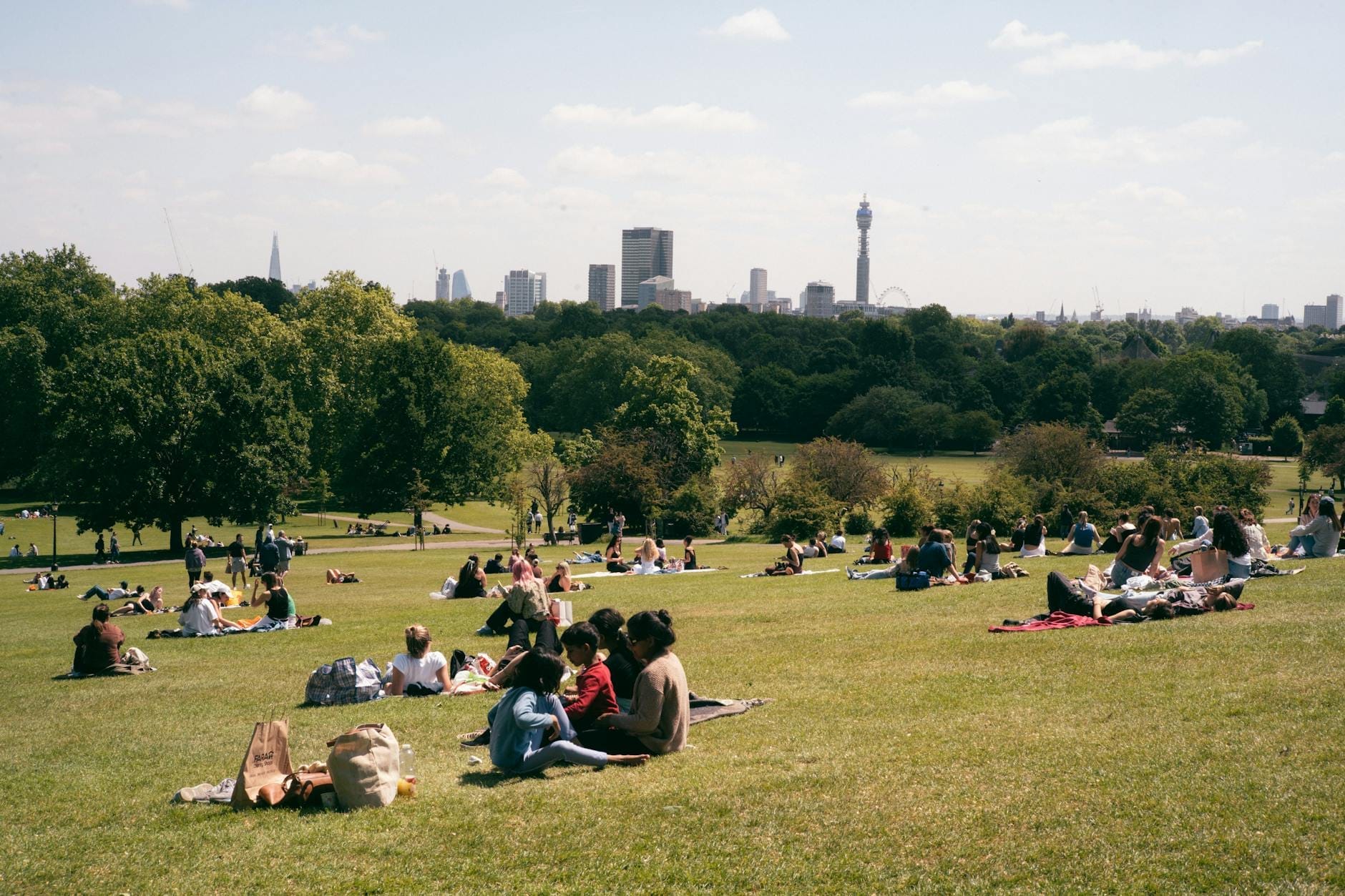
Primrose Hill is a public open space managed by The Royal Parks, sitting on the northern edge of Regent's Park in the London Borough of Camden. The summit reaches approximately 63 metres above sea level, and because trees are deliberately kept short to protect sightlines, nothing obstructs the view south across the city. On a clear day you can pick out landmarks from the Shard and St Paul's Cathedral to Canary Wharf and beyond, all spread across the skyline in a single glance.
The land was purchased from Eton College in 1841 and opened to the public in 1842, explicitly intended as green space for the working population of north London. Almost two centuries later, that democratic character survives. The park is free to enter, open daily from 6:00 until 22:00, and used daily by an extraordinarily mixed crowd: dog walkers, families with prams, office workers eating lunch on the slope, and tourists making the short climb for the view.
As one of six formally designated protected viewpoints in London, the panorama from the summit is legally safeguarded, meaning no future development can legally block it. That is a rarer guarantee than it sounds in a city that builds continuously. If the skyline view is high on your list, also consider comparing this with the free outlook from Greenwich Park or the rooftop at Sky Garden for a different perspective.
The View and What You Can See
The climb to the summit takes around five to ten minutes from the park entrance. The path is grass-covered on most of its length, with some paved sections lower down. Near the top there is a stone marker etched with a William Blake quotation: 'I have conversed with the spiritual sun. I saw him on Primrose Hill.' It makes for a good landmark and a good photograph.
From the top, the skyline sits low on the horizon to the south and southeast, and the elevated position means you see it with genuine depth rather than looking up at individual buildings. The Post Office Tower (BT Tower) is close and obvious to the south. The Shard punctuates the far left of the skyline. The dome of St Paul's is identifiable in the middle distance. On exceptionally clear days, Crystal Palace transmitter mast is visible on the far horizon, roughly 15 kilometres away.
💡 Local tip
Photography tip: The best light for shooting the skyline falls in the morning when the sun is behind you (to the east-southeast). Golden hour after sunrise produces warm-toned shots with minimal glare. In summer, this can mean arriving as early as 05:30. In winter, the sun rises late enough that you can be there comfortably by 08:00.
Weather makes a significant difference here. On overcast days, and particularly in November through February, the view can be reduced to a grey haze with landmarks barely visible. If you are making a dedicated trip for the view rather than the walk, check the forecast and pick a day with low humidity and good visibility. After a cold front passes is often the clearest condition.
Tickets & tours
Hand-picked options from our booking partner. Prices are indicative; availability and final rates are confirmed when you complete your booking.
Soho Instagram a self-guided walking tour to top photo spots
From 6 €Instant confirmationFree cancellationTootbus London by Night: Bus tour
From 32 €Instant confirmationFree cancellationIFS Cloud Cable Car Ride and Uber Boat Hop-on Hop-off 1 Day Ticket
From 38 €Instant confirmationFree cancellationThe Making of Harry Potter Guided Tour of London Warner Bros. Studio
From 201 €Instant confirmationFree cancellation
How the Hill Changes Through the Day
Early morning is the quietest and most atmospheric time. Before 08:00 on weekdays, the hill is almost entirely the domain of dog walkers. The grass is often wet with dew, the city noise has not yet built up, and the view carries a stillness that disappears once the day gets going. If you are staying in central London, the Tube starts running from around 05:30 on weekdays on most lines, which makes an early visit realistic.
By mid-morning on weekends, particularly between April and October, the slope below the summit fills with people claiming patches of grass. Blankets appear, speakers emerge, and the smell of coffee from the nearby Primrose Hill Café drifts across the lower paths. It is a pleasant atmosphere, not overcrowded in the way that a major indoor attraction becomes, but certainly social. The summit itself remains accessible at all times.
Sunset in summer is the most popular time by far. Between June and August, large groups gather on the upper slope from around 19:00 onward to watch the sun drop behind the West London skyline. The light turns amber, the Shard catches a pink glaze, and the whole hill smells faintly of sun-warmed grass and whatever food people have brought up. It is worth experiencing once. If you want the summit to yourself for photographs, plan to arrive early in the morning rather than at dusk.
⚠️ What to skip
Winter evenings on the hill are cold, exposed, and windier than you might expect for an urban park. Bring an extra layer even if it feels mild lower down. The paths can be muddy after rain, and the grass slope becomes slippery after frost.
Getting There: Practical Route
The most straightforward approach is from Chalk Farm Underground station (Northern line, Edgware branch). Exit the station, turn left onto Regent's Park Road, and follow it south until the park entrance comes into view on your right. The walk takes around nine minutes at an easy pace. Alternatively, Camden Town station is around 15 minutes on foot. If you are visiting Regent's Park in the same trip, you can enter from the south through the main park and walk north past London Zoo to reach Primrose Hill via Prince Albert Road, though this adds considerable distance.
Several bus routes serve the surrounding streets, including routes along Adelaide Road and Regent's Park Road. If you are arriving by bus, check Transport for London's journey planner for the most current options, as routes change periodically. There is no dedicated car park, and parking in the surrounding residential streets is restricted for much of the day.
On the accessibility front, the summit path is grassy and steep enough that wheelchair users and people with limited mobility may find the climb difficult. The lower paths and perimeter of the park are more level and still offer partial skyline views, though not from the full height of the summit. Royal Parks is progressively installing infrastructure to allow temporary closures when required, so it is worth checking the official Royal Parks website if you are planning a visit around a large event.
The Neighbourhood: Primrose Hill Village
The streets immediately surrounding the park, particularly Regent's Park Road and Fitzroy Road, make up what locals call 'Primrose Hill village', a dense stretch of independent cafes, restaurants, boutique shops, and Victorian terraced houses. It is one of the more expensive corners of Camden, and the area has long attracted artists, musicians, and writers. Sylvia Plath and Ted Hughes lived on Fitzroy Road in the 1960s. The neighbourhood is worth at least a short wander before or after the climb.
The Primrose Hill Cafe sits close to the park and serves hot drinks, sandwiches, wraps, and snacks. It is a practical stop for coffee before the climb or a cold drink after it in summer. Do not expect anything elaborate, but it does the job well for a park cafe.
If you have more time in the area, Camden Market is around 20 minutes on foot to the southeast and makes for a natural pairing with a Primrose Hill visit, particularly on weekends. London Zoo borders the park to the south along Prince Albert Road, which is worth knowing if you are visiting with children.
Who Should and Should Not Make the Trip
Primrose Hill rewards visitors who are prepared to engage with it on its own terms: a park, a slope, a view, and fresh air. It is not an experience in itself the way a museum or monument is. If a two-kilometre round walk for a skyline view does not appeal, or if the weather is grey and visibility poor, the hill will feel like an underwhelming detour. It is worth the effort on the right day, but it is not a substitute for visiting the landmarks it displays at a distance.
Visitors who are primarily chasing London's great skyline views and want guaranteed clarity regardless of weather may prefer enclosed vantage points like the Shard or the London Eye. Those attractions cost significantly more but offer consistent, weather-independent sightlines. Primrose Hill, by contrast, gives you the view for free, but the experience varies considerably depending on conditions.
The hill is particularly good for anyone who wants a genuine break from the pace of sightseeing, families with children who need outdoor space, photographers looking for a free skyline composition, and anyone spending more than a couple of days in London who wants to understand the city's geography. For a first-day, limited-time visitor with a packed itinerary, it may not justify the travel time unless it fits naturally en route to another attraction.
Insider Tips
- Go on a weekday morning in autumn or early spring. The grass is quieter, the light is often sharp after overnight rain, and the city skyline looks its most defined without the summer haze.
- The stone marker with the William Blake quotation near the summit makes for a better focal point in photographs than the open grass alone. Face south from just behind it and you get both the inscription and the skyline in the same frame.
- Regent's Park Road has several good independent coffee shops where you can grab a takeaway cup before the climb. The park cafe is convenient but gets queues on weekend mornings.
- If you visit in summer and want to watch sunset from the summit, arrive at least 45 minutes before actual sunset to claim a good patch of grass on the upper slope. The hill fills faster than first-timers expect.
- The view actually extends further on days after significant rainfall clears the air. Check a weather visibility forecast, not just a rain forecast, to judge whether the conditions will be worth the trip.
Who Is Primrose Hill For?
- Photographers seeking a free, legally protected skyline composition
- Families with children who want outdoor space combined with a neighbourhood walk
- Travellers on a second or third visit to London who want to see the city from a new angle
- Early risers who want to experience London before the tourist day begins
- Picnic-seekers during London's warmer months (May through September)
Nearby Attractions
Other things to see while in Camden:
- Camden Market
Camden Market is a sprawling complex of former industrial yards, canal-side warehouses and Victorian stables that has evolved into one of London's most distinctive open-air destinations. With more than 1,000 places to shop, eat and drink across several interconnected areas, it rewards slow exploration and punishes rushing. Free to enter, open every day, and unlike anywhere else in the city.
- ZSL London Zoo
Founded in 1828, ZSL London Zoo sits on the northern edge of Regent's Park and houses hundreds of animal species. As one of the world's oldest scientific zoos, it balances family entertainment with serious conservation work — making it a rewarding day out if you approach it with the right expectations.
- Regent's Park
Spanning 166 hectares in north-west central London, The Regent's Park offers an extraordinary range within a single green space: formal rose gardens, an open-air theatre, London Zoo, boating lakes, and miles of walking paths. Entry is free, and the park rewards visitors at every hour of the day.