Red Tower (St. Agatha's Tower): Malta's Most Dramatic Coastal Fortress
Perched on the crest of Marfa Ridge in Mellieħa, the Red Tower is a 17th-century bastioned watchtower with walls four metres thick and panoramic views stretching across to Gozo and Comino. Admission costs €2.50, and the experience rewards anyone willing to make the drive north.
Quick Facts
- Location
- Marfa Ridge, Mellieħa, Malta
- Getting There
- Bus routes 41/42 toward Mellieħa, then taxi or walk; limited parking on-site for drivers
- Time Needed
- 45–90 minutes
- Cost
- €2.50 adults; free for children under 12
- Best for
- History enthusiasts, photographers, view-seekers heading to Gozo
- Official website
- www.visitmalta.com/en/attraction/st-agathas-tower-mellieha
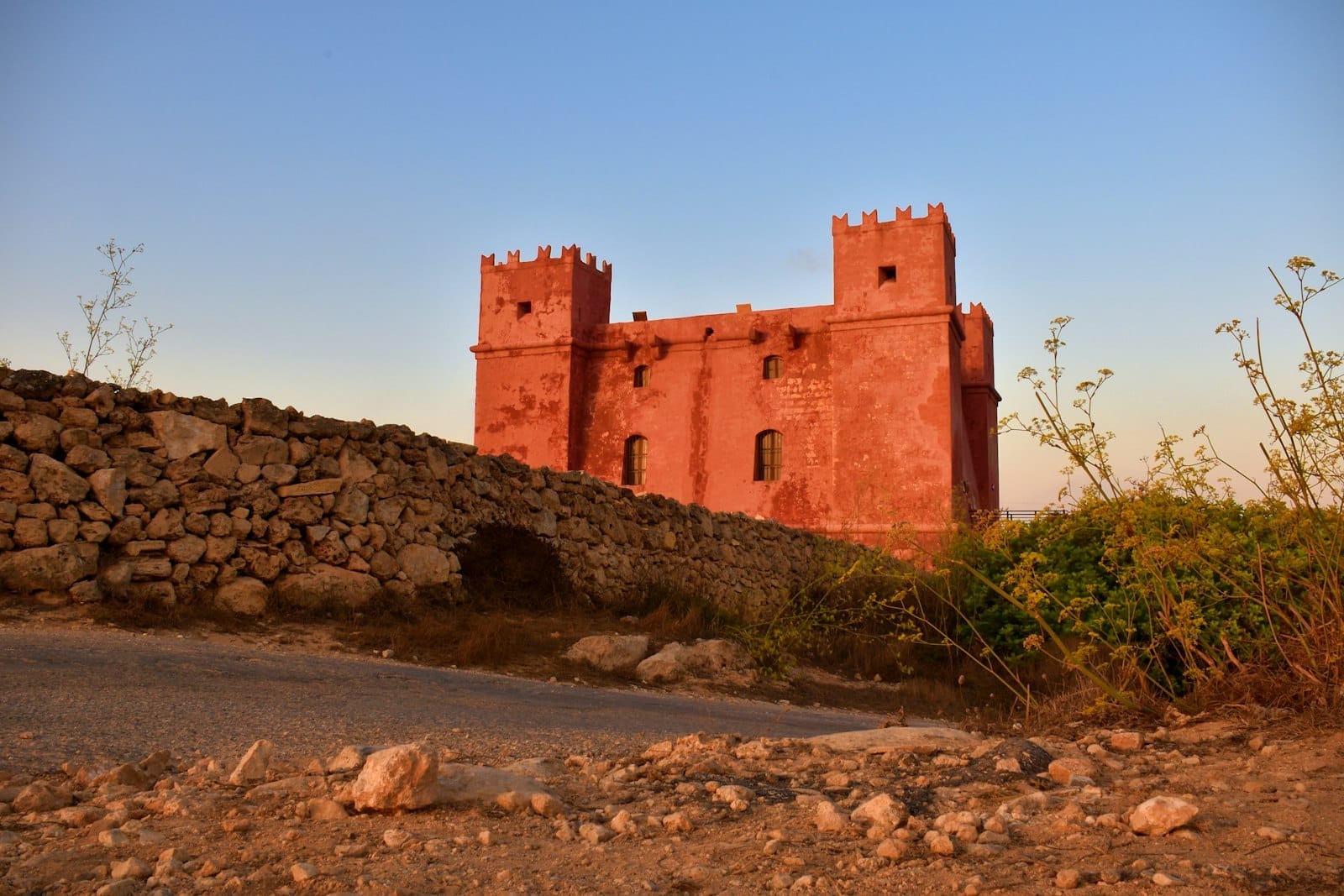
What Is the Red Tower?
Saint Agatha's Tower — officially Torri ta' Sant'Agata in Maltese, though almost everyone calls it the Red Tower or Torri l-Aħmar — stands at the highest point of Marfa Ridge on Malta's northern tip. Built between 1647 and 1649 under Grand Master Jean Paul de Lascaris Castellar, it was the sixth and last of the great bastioned watchtowers erected by the Knights of St John, and by far the largest in scale. Its designer, Antonio Garsin, gave it a square plan with four projecting corner turrets, walls roughly four metres thick, and the capacity to mount four to five cannons pointing seaward.
The tower's name comes from the vivid ochre-red limestone coating its exterior, which catches the afternoon sun and makes it visible from considerable distances across the channel. It was positioned deliberately as the furthest coastal outpost from Valletta, serving as a signal relay between the Maltese mainland and Gozo via Comino — a communication chain that could transmit warnings across the archipelago within minutes using fire and smoke signals.
ℹ️ Good to know
Opening hours vary by season: 10am–4pm from 15 September to 15 June; 10am–5pm from 16 June to 14 September. Closed on Christmas Day, New Year's Day, and Easter Sunday. Managed by Din l-Art Ħelwa, Malta's national heritage trust.
The Experience: Arriving and Getting Inside
The approach along the ridge road already signals that something significant is ahead. The tower rises abruptly from open scrubland, with no modern buildings crowding it. On windy days — and the Marfa Ridge catches wind reliably — the air carries the smell of wild thyme and sea salt. The surrounding ground is dry and stony, typical of Malta's northern coastline, and the silence on a quiet weekday morning can be striking compared to the tourist-heavy south of the island.
Entry is through a steep external staircase that originally led to a drawbridge entrance, a design intended to make forced entry as difficult as possible. There is no lift, and the steps are uneven limestone, so anyone with limited mobility should be aware that the interior is not accessible. That said, the exterior and surrounding views are fully appreciable without going inside. Once through the entrance, the ground floor opens into a compact but atmospheric space where Din l-Art Ħelwa has installed displays covering the tower's military history and its role within the broader coastal defense network.
Tickets & tours
Hand-picked options from our booking partner. Prices are indicative; availability and final rates are confirmed when you complete your booking.
Shared Jet Ski rental in St. Julian's
From 40 €Instant confirmationFree cancellationCity Sightseeing hop-on hop-off bus tour of Gozo
From 20 €Instant confirmationFree cancellationThe Malta Experience Audio-Visual Show and La Sacra Infermeria Tour
From 20 €Instant confirmationFree cancellationLuggage Storage in Malta
From 6 €Instant confirmationFree cancellation
What You See from the Roof
The rooftop is the main event. On a clear day — and clarity is the norm outside winter — you can see the full width of the Comino Channel, with Comino's flat profile sitting directly in front of you and the cliffs of Gozo's southern coast rising behind it. To the east, Mellieħa Bay stretches below in a wide arc. To the west, the sea drops away toward the open Mediterranean. The panorama covers almost every direction, and there are no trees or structures tall enough to interrupt it.
Photographers will want to arrive in the late afternoon, when the low-angle sunlight turns the limestone ridge golden and the shadows across the channel become defined enough to give real depth to the water. Early morning visits offer cooler temperatures and softer light for wide shots, and the Blue Lagoon on Comino is visible in miniature on calm days, its turquoise color distinct even from this distance. A telephoto lens or binoculars make the view significantly more rewarding.
💡 Local tip
Come on a weekday before noon for the fewest visitors. The ridge road sees almost no foot traffic outside summer weekends, so a Tuesday morning in May or October can feel genuinely quiet at this tower.
History and Military Context
The tower was built during a period of genuine anxiety about Ottoman naval raids. The Knights of St John had controlled Malta since 1530, and the coastline was vulnerable to fast corsair attacks that could raid a village and withdraw before any land-based response was possible. The bastioned watchtower network, of which Saint Agatha's Tower was the northern anchor, was designed not to repel full naval assaults but to observe, signal, and buy time for defenses to mobilize.
Grand Master Lascaris, who commissioned the tower, is the same figure commemorated in the Lascaris War Rooms beneath Valletta's Upper Barrakka — a different era, same name. The tower's service did not end with the Knights. During both World Wars it was reactivated for military observation, and at some point it functioned as a radar installation, with the strategic logic of the site remaining unchanged across three centuries.
The restoration by Din l-Art Ħelwa has been careful. The interior stonework is largely original, and the cannon embrasures on the upper level are intact. The displays inside are modest rather than elaborate, which suits the scale of the space — this is a working military structure, not a palazzo, and it reads that way.
Getting There and Combining with Other Stops
The tower sits at the far northern end of Malta, roughly 35 kilometres from Valletta by road. Driving is the most practical option: the Marfa Ridge road leads directly to the tower, and there is limited roadside parking nearby. Bus routes 41 and 42 serve Mellieħa village, but the tower itself requires either a taxi from the village or a 3–4 kilometre walk along the ridge road in full sun, which is uncomfortable in summer.
Most visitors combine the Red Tower with other northern stops. Mellieħa Bay is the largest sandy beach on the main island and lies directly below the ridge. The Marfa coast road also connects to Paradise Bay and Cirkewwa, where the Gozo ferry departs — making the tower a logical first or last stop on a day trip to Gozo. If you are heading across, consider reading up on the Gozo travel guide before you go.
The tower is also a reasonable addition to a broader Mellieħa afternoon, pairing well with the Church of Mellieħa and the ridge-top viewpoints above the bay. Allow 45 to 90 minutes for the tower itself, depending on how long you linger on the roof.
Seasonal Differences and Weather Considerations
Summer visits (June through August) mean heat and direct exposure on the rooftop. There is no shade on the roof terrace, and the limestone reflects heat upward. Bring water, wear a hat, and plan your visit for before 11am or after 4pm if you are going in July or August. The surrounding scrubland turns bone-dry and pale by midsummer, which changes the aesthetic considerably compared to spring.
Spring visits, particularly April and May, offer the most visually complete experience. The ridge vegetation is green, wildflowers appear in the rocky ground around the base, and the light is warm without being harsh. October is similarly rewarding and far less crowded than summer. Winter visits are possible within the seasonal hours, but the channel views can be obscured by low cloud or haze, and strong northerly winds on the ridge make roof-level time uncomfortable. Rain is possible from October through April.
⚠️ What to skip
The rooftop has no guardrails in the traditional sense — the parapet wall is low in sections. Watch children carefully near the edges, and be aware that strong wind is common on the ridge regardless of season.
Is It Worth the Trip?
At €2.50, Saint Agatha's Tower is one of the most straightforward value propositions in Malta. The views alone would justify a modest admission, and the historical context adds real depth for anyone with an interest in the Knights' coastal strategy or military architecture. It is not a full-day destination in itself, but as part of a northern Malta itinerary it earns its place.
Travelers who are short on time and focused on Valletta's concentrated historical core may reasonably skip it — the Upper Barrakka Gardens and Fort St. Elmo cover similar military history themes in a more compact urban context. The Red Tower rewards visitors who specifically want to reach the northern edge of the island, see the full Gozo-Comino panorama, and understand how Malta's coastline was defended before the era of modern fortifications.
Those who struggle with uneven stairs or have significant mobility limitations should note clearly that the interior and roof are not accessible. The exterior setting is still worth stopping for, but the key views require climbing inside.
Insider Tips
- The ridge road running west from the tower leads to a small promontory with unobstructed views toward Gozo — worth a five-minute detour even if the tower itself is closed.
- The ferry terminal at Cirkewwa is less than two kilometres from the tower. If you are catching an early Gozo ferry, the tower opens at 10am and makes a compact morning stop before departure.
- Bring binoculars. The view to Comino's Blue Lagoon is visually striking from the rooftop, but a lens helps you actually read the scale of the boats and water below.
- Weekdays in shoulder season (late September through early November) see almost no visitors. You may have the roof entirely to yourself.
- The tower's ochre-red exterior is most photogenic in the hour before sunset, when the limestone glows against the darkening sea behind it. Shoot from the ridge road slightly west of the structure for the best angle.
Who Is Red Tower / St. Agatha's Tower For?
- History and military architecture enthusiasts interested in Knights of Malta coastal defenses
- Photographers chasing panoramic views of Gozo, Comino, and the northern Maltese coastline
- Travelers building a northern Malta day itinerary that includes Mellieħa Bay and the Gozo ferry
- Budget-conscious visitors looking for a high-quality experience at minimal cost
- Couples or small groups who prefer quiet, uncrowded sites over major tourist circuits
Nearby Attractions
Other things to see while in Mellieħa:
- Armier Bay
Armier Bay sits at Malta's northern tip, split between a wide family-friendly beach and a smaller, rockier cove ideal for snorkeling. The water is clear, the pace is slow, and the views reach across to Comino and Gozo. It rewards visitors who seek something more local than the island's main tourist beaches.
- Sanctuary of Our Lady of Mellieħa
The Sanctuary of Our Lady of Mellieħa is Malta's oldest Marian shrine, built around a natural cave where a Byzantine-style fresco of the Virgin Mary has drawn pilgrims for centuries. Free to enter and steeped in nearly two thousand years of layered history, it sits above Mellieħa Bay and rewards visitors with both spiritual atmosphere and architectural beauty.
- Golden Bay
Golden Bay is widely considered Malta's best sandy beach, tucked into the northwest coastline near Mellieħa. With Blue Flag water quality, summer lifeguards, and a dramatic cliffside backdrop, it earns its reputation — though its relative fame means it fills up fast on summer weekends.
- Imgiebah Bay
Tucked into Malta's north-eastern coastline near Selmun, Imgiebah Bay is a small, sandy cove framed by sheer limestone cliffs. There are no facilities, no bus routes, and no easy road in — which is precisely why it stays quiet when every other beach in Mellieha is packed.