Golden Bay, Malta: What to Know Before You Go
Golden Bay is widely considered Malta's best sandy beach, tucked into the northwest coastline near Mellieħa. With Blue Flag water quality, summer lifeguards, and a dramatic cliffside backdrop, it earns its reputation — though its relative fame means it fills up fast on summer weekends.
Quick Facts
- Location
- northwest Malta, near Manikata and Ghajn Tuffieha
- Getting There
- Bus routes 101, 102, 225, 226 from Valletta and St. Paul's Bay
- Time Needed
- 2–5 hours depending on activities
- Cost
- Free public access; sunbed hire and water sports cost extra
- Best for
- Swimming, snorkelling, sunset views, families with young children
What Golden Bay Actually Is
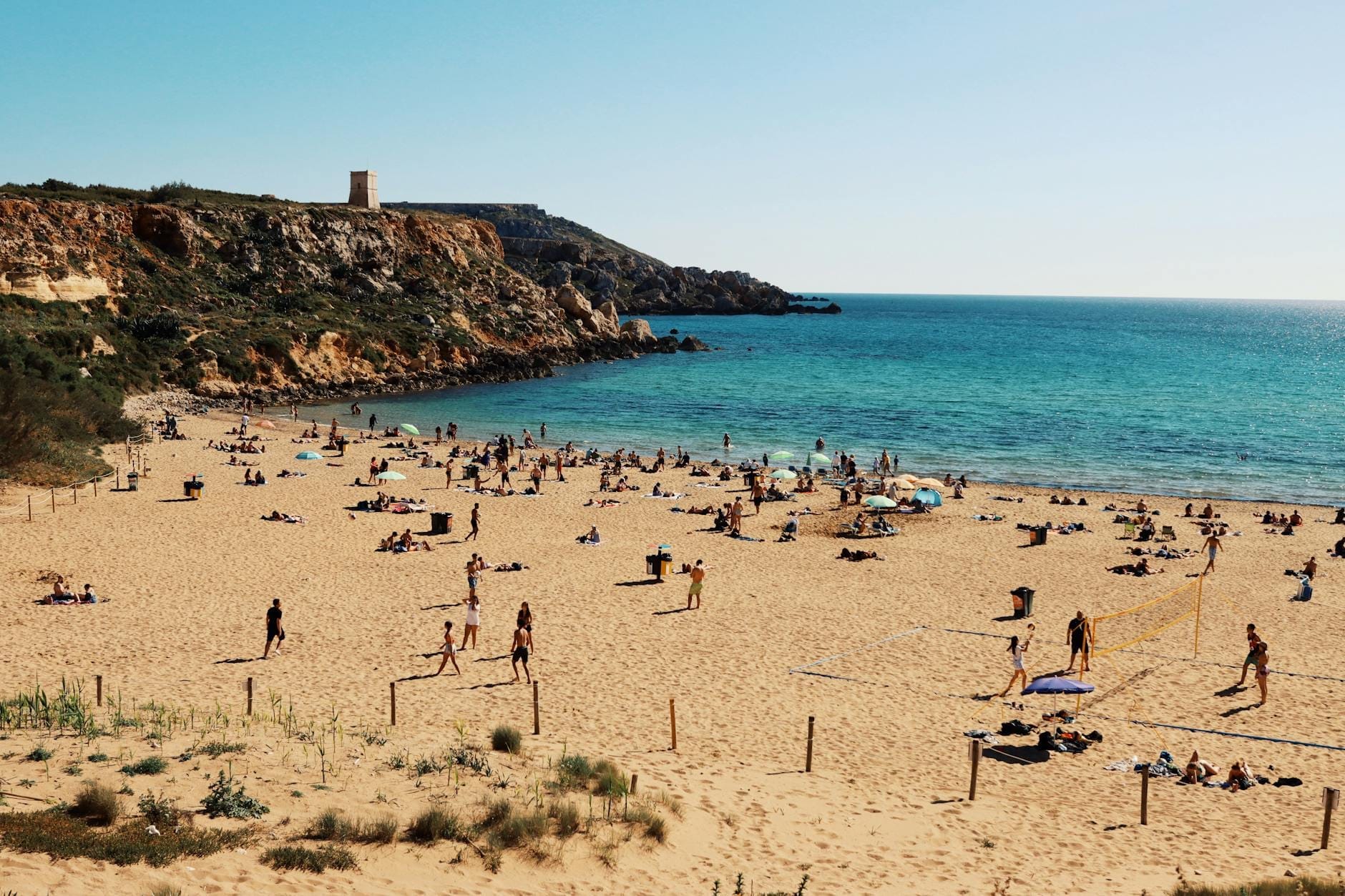
Golden Bay, known in Maltese as Il-Mixquqa or Ir-Ramla tal-Mixquqa, is a compact sandy beach on Malta's northwest coast. At roughly 136 metres wide and 82 metres deep, it is not a vast expanse by Mediterranean standards, but it is one of the largest sandy beaches on the Maltese islands and, critically, one of the few where the sand is genuinely golden rather than pebbly or gravelly. The beach sits in a natural cove framed by soft sandstone cliffs that glow amber in the late afternoon, giving the whole bay a warmth that photographs struggle to capture.
The beach holds a Blue Flag certification, awarded by the Foundation for Environmental Education for water quality, environmental management, safety facilities, and public information standards. The certification requires annual re-assessment and means the water is regularly tested and found clean. For a small island with significant coastal development, that matters.
ℹ️ Good to know
Golden Bay is open 24 hours a day and is free to access year-round. Lifeguards operate between 15 June and 15 September, managed by the Malta Tourism Authority.
How the Experience Changes Through the Day
Arrive before 9am in July or August and you will find the beach in its best state: the sand raked smooth, the light low and golden, the water an almost unbelievable shade of turquoise against the pale limestone cliffs. The temperature at that hour is comfortable rather than punishing, and the handful of early swimmers you will share the water with are almost always locals who have done this for years.
By 11am on a summer weekend, the dynamic shifts completely. Families claim sunbeds (hire from on-site providers), day-trippers from Sliema and St. Julian's arrive by bus, and the car park at the top of the access road begins to fill. The beach is small enough that this concentration becomes noticeable — expect background noise from the beach bar, children, and occasional jet ski engines offshore. The water remains inviting, but the solitude is gone.
The clearest case for visiting outside peak hours is the late afternoon. From around 5pm, the crowds thin as families head back, the cliffs cast long shadows across the western end of the bay, and the light becomes extraordinary for photography. Sunsets here are genuinely dramatic because the beach faces roughly west-northwest, meaning the sun drops toward the open sea rather than behind land. If you are visiting in shoulder season — May, June, or September — the late afternoon is the ideal window in every respect.
⚠️ What to skip
On summer weekends (especially July and August), the beach and its car park reach capacity by mid-morning. If driving, aim to arrive before 9am or after 5pm. Bus services are a more reliable option at peak times.
Tickets & tours
Hand-picked options from our booking partner. Prices are indicative; availability and final rates are confirmed when you complete your booking.
City Sightseeing hop-on hop-off bus tour of Gozo
From 20 €Instant confirmationFree cancellationThe Malta Experience Audio-Visual Show and La Sacra Infermeria Tour
From 20 €Instant confirmationFree cancellationLuggage Storage in Malta
From 6 €Instant confirmationFree cancellation6-day heritage and attractions pass in Malta
From 80 €Instant confirmationFree cancellation
The History Behind the Bay
Golden Bay was formerly known as Military Bay, a name that reflects its use during the British colonial period when the surrounding area of northwest Malta served strategic purposes. The shift to its current name came later, driven more by tourism than any formal renaming process.
On the headland above the northern end of the bay stands Lippija Tower, a small watchtower that forms part of Malta's historic coastal defence network. The tower has been restored by Din l-Art Ħelwa, Malta's national heritage trust, and offers some context for the militarised history of this stretch of coastline. It is not an official tourist attraction with formal access, but it is visible from the beach and easy to reach on foot for those who want to walk the cliff path above the bay.
The wider Mellieħa region, of which Golden Bay forms the coastal highlight, has a layered history that extends well beyond beach tourism. The Church of Mellieħa and the broader Mellieħa area reward those who pair a beach visit with a short exploration inland.
Swimming, Snorkelling, and Water Sports
The seabed at Golden Bay is sandy and gently sloping, which makes it well-suited to families with young children and less confident swimmers. The entry is gradual with no sudden drop, and the bay is sheltered enough that the water is generally calm unless northwest winds are running, at which point waves can build into the cove with more energy than you might expect for a beach this size.
The water clarity varies by season. In spring and early summer, visibility is at its best, and the sandy bottom is visible in depths that would be murky elsewhere. Snorkelling is productive along the rocky edges of the bay where the sand gives way to limestone shelves. You are unlikely to encounter dramatic marine life, but small fish, sea urchins, and octopus are common. Bring your own mask and fins — rental equipment from beach operators tends to be basic.
Water sports including kayaking and pedalos are typically available from concessionaires during the summer season. Jet skis also operate from the beach, which is worth knowing if you are seeking quiet swimming. The safety ropes mark the swimming zone, which is kept clear of motorised craft.
💡 Local tip
For better snorkelling and fewer crowds, consider pairing a Golden Bay visit with a stop at Għajn Tuffieħa Bay, a 15-20 minute walk along the coastal path to the south. The two beaches serve very different moods.
Getting There and Getting Around
Golden Bay is in the northwest of Malta, approximately 20 kilometres from Valletta and around 10 kilometres from Mellieħa town. Bus routes 44, 101, 102, 223, 224, and 225 serve the beach from Valletta and St. Paul's Bay, terminating at the bay itself. Journey time from Valletta is roughly 40-55 minutes depending on the route and traffic. Bus fares on Malta's public transport system are fixed at €2 per single journey for most routes, making this a straightforward and inexpensive option.
If driving, there is a dedicated car park at the top of the access road and additional overflow parking a five-minute walk from the sand. On peak summer days, overflow fills by 10am. Ride-hailing apps including Bolt and Uber operate in Malta, and a taxi from Sliema or St. Julian's is typically in the €15-25 range one-way, though prices vary.
Those combining the beach with broader northwestern Malta exploration should read the guide to getting around Malta before planning routes, especially if coordinating ferry connections to Gozo.
Accessibility is reasonably well provided for: the beach has a ramp for wheelchair and pushchair access, and the gentle sandy gradient makes entry into the water manageable for those with limited mobility. Toilets, showers, and a beach restaurant are all on-site.
What to Bring and What to Expect
Sun protection is non-negotiable on any Malta beach in summer. The combination of intense UV radiation, white sand reflection, and the typical Mediterranean assumption that shade will be available (it largely will not, unless you hire a sunbed with parasol) means sunburn is common among first-time visitors. Bring factor 30 or higher, a hat, and water in a reusable bottle — the tap water across Malta is safe to drink, though the taste varies.
Footwear for the access road is worth considering. The path from the car park and bus stop down to the beach is paved but steep, and in rubber sandals after a few hours in the sun it can be slippery. Sandals with a back strap or closed shoes that you swap for beach footwear at the sand's edge are the practical choice.
Photography is best in the golden hours. A wide lens from the car park lookout captures the full sweep of the bay and the surrounding cliffs. The late afternoon light on those amber sandstone walls is genuinely striking. Avoid midday shots — the harsh overhead sun bleaches out colour and creates unflattering contrast.
If this is your first Malta beach visit, it is worth reading the full guide to Malta's best beaches to understand where Golden Bay fits in relation to alternatives like Ramla Bay in Gozo or Għajn Tuffieħa.
Who This Beach Is Not For
Golden Bay's reputation means it draws volume. Anyone seeking a quiet, uncrowded beach experience in July or August will likely be disappointed by midday. The beach is small, the facilities are functional rather than sophisticated, and the proximity of the hotel above the bay means it never fully escapes a resort feeling, even on quieter days.
Travellers who prefer rocky coves, dramatic sea formations, or completely undeveloped settings will find other parts of Malta more rewarding. The northwest coast of Malta and the Comino channel offer alternatives with more raw character, at the cost of less convenient access and fewer facilities.
Insider Tips
- The coastal path south from Golden Bay to Għajn Tuffieħa Bay takes about 15-20 minutes on foot and passes through undeveloped scrubland. Għajn Tuffieħa is harder to reach by road, so it stays quieter — do the walk one-way and return by bus from Golden Bay if needed.
- The beach restaurant above the sand serves food throughout the day, but prices reflect the captive audience. Bring your own lunch in a cool bag if you are watching costs, or eat in Mellieħa town before or after your visit.
- Weekday mornings in June or September are the sweet spot: the weather is warm enough for swimming, the lifeguards are on duty, and the crowds are a fraction of what you will encounter on a July Saturday.
- The view from the top of the access road — at the car park level — is one of the better vantage points on this stretch of coast. Spend two minutes there before descending to the sand, especially if visiting around sunset.
- If you have your own snorkelling gear, explore the left (north) edge of the bay where the sand meets the limestone rock shelf. This transition zone holds more marine life than the open sandy centre of the bay.
Who Is Golden Bay For?
- Families with young children who need a gently sloping, lifeguarded sandy beach
- First-time visitors to Malta wanting a classic, well-facilitated beach day
- Couples visiting in shoulder season (May or September) seeking a scenic evening swim
- Photographers chasing the late afternoon light on the amber sandstone cliffs
- Budget travellers who want quality without an entry fee
Nearby Attractions
Other things to see while in Mellieħa:
- Armier Bay
Armier Bay sits at Malta's northern tip, split between a wide family-friendly beach and a smaller, rockier cove ideal for snorkeling. The water is clear, the pace is slow, and the views reach across to Comino and Gozo. It rewards visitors who seek something more local than the island's main tourist beaches.
- Sanctuary of Our Lady of Mellieħa
The Sanctuary of Our Lady of Mellieħa is Malta's oldest Marian shrine, built around a natural cave where a Byzantine-style fresco of the Virgin Mary has drawn pilgrims for centuries. Free to enter and steeped in nearly two thousand years of layered history, it sits above Mellieħa Bay and rewards visitors with both spiritual atmosphere and architectural beauty.
- Imgiebah Bay
Tucked into Malta's north-eastern coastline near Selmun, Imgiebah Bay is a small, sandy cove framed by sheer limestone cliffs. There are no facilities, no bus routes, and no easy road in — which is precisely why it stays quiet when every other beach in Mellieha is packed.
- Mellieħa Bay (Għadira)
Mellieħa Bay, also known as Għadira Bay, stretches over a kilometre along Malta's northwestern coast and earns its reputation as the island's finest sandy beach. Shallow, calm waters and a Blue Flag certification make it the go-to destination for families. Right next door, the Għadira Nature Reserve adds a surprising layer of ecological interest to what could otherwise be a straightforward beach visit.