Raohe Street Night Market: Taipei's Most Walkable Food Street
Raohe Street Night Market (饒河街觀光夜市) runs roughly 600 meters through Songshan District, offering some of Taipei's best street food in a compact, pedestrian-only format. Free to enter, open nightly from 5 PM, and two minutes from the Green Line MRT at Songshan Station, it rewards both first-time visitors and repeat eaters.
Quick Facts
- Location
- Raohe St, Songshan District, Taipei City 105, Taiwan
- Getting There
- MRT Songshan Station (Exit 5), approx. 2-minute walk
- Time Needed
- 2 to 3 hours
- Cost
- Free entry; individual food stalls typically cost 50–200 TWD per item
- Best for
- Street food lovers, first-time Taipei visitors, evening explorers
- Official website
- www.travel.taipei/en/attraction/details/1691
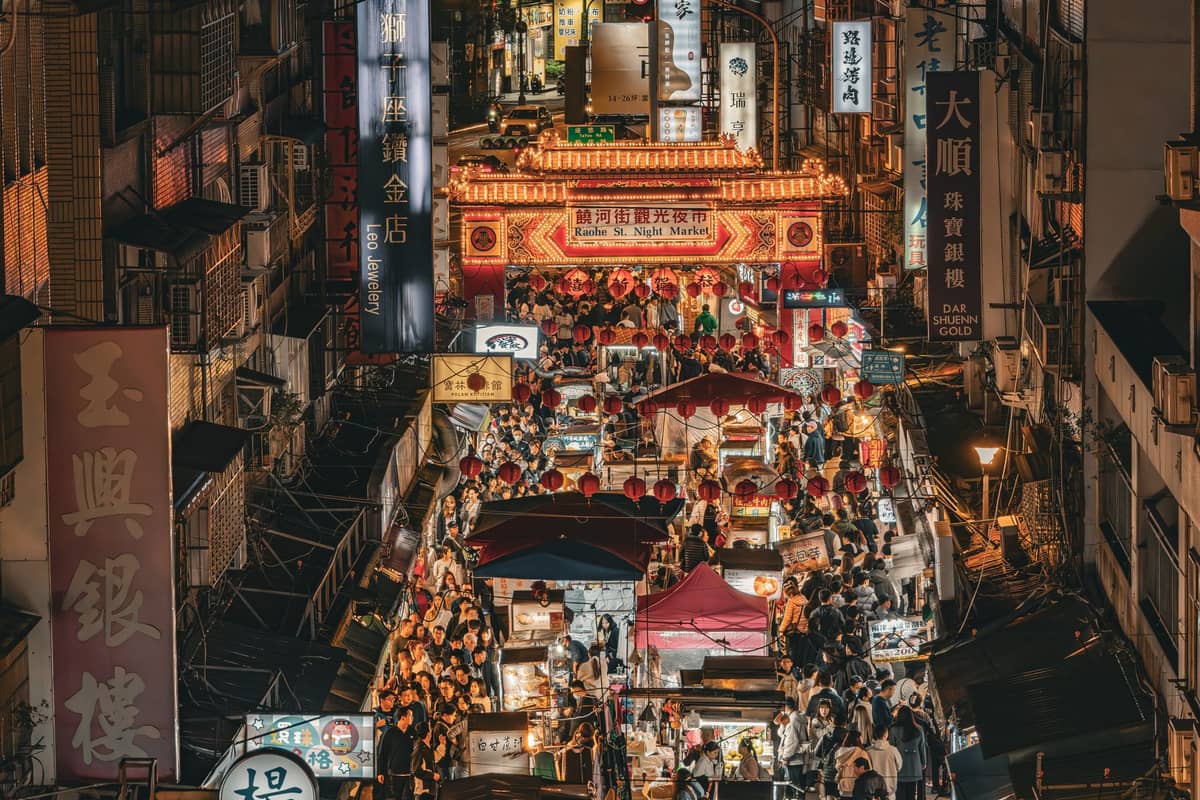
What Is Raohe Street Night Market?
Raohe Street Night Market, officially the Raohe Street Tourist Night Market (饒河街觀光夜市), is one of Taipei's most established and practically designed food markets. Located in Songshan District beside the Keelung River, it occupies a single pedestrianized street roughly 600 meters long. Unlike some of Taipei's sprawling markets, Raohe is compact enough to walk end to end in under ten minutes, yet dense enough with stalls that most visitors spend two hours or more without covering it properly.
The market’s official operating hours are 17:00 to 24:00 every day, though individual stalls may close earlier or continue serving slightly later. Entry is free; there are no gates, no tickets, and no wristbands. Vendors operate independently, and you pay for food and goods stall by stall. The result is a low-friction experience where you can arrive, eat three dishes, and leave in an hour, or settle in for a proper food crawl across an entire evening.
💡 Local tip
Exit 5 of MRT Songshan Station deposits you at the market's main entrance gate within about two minutes. The gate itself, flanked by a Mazu temple, is the most reliable orientation marker for first-time visitors.
The Layout: Two Aisles, One Street
Raohe Street is narrow enough that two rows of stalls face each other across a walkway wide enough for perhaps four people side by side. In peak hours, that space fills completely. The stalls line both sides of the street, with the main food vendors occupying fixed positions and smaller pop-up sellers occasionally setting up in the gaps.
At the eastern end, where the market meets Bade Road Section 4, stands the Ciyou Temple (慈祐宮), a Mazu temple dating to 1753 in the Qing dynasty. It marks the traditional entrance to the market and is worth a brief stop before you eat. The contrast between incense smoke drifting from the temple courtyard and the smell of pepper buns frying thirty meters away is one of the more memorable sensory details of the place.
At the western end, the market reaches Fuyuan Street and the edge of the riverside. Some visitors walk the full length, double back on the opposite side, and use that second pass to order the things they noticed on the first.
What to Eat: The Dishes Raohe Is Known For
The single most famous item at Raohe is the Fuzhou pepper bun (福州胡椒餅). A vendor near the Ciyou Temple entrance has operated here for decades, baking pork-filled dough in a cylindrical wood-fired oven. The buns are sold hot and require a brief wait. The crust blisters in the oven and the filling carries a notable black pepper heat. Expect a queue of ten to twenty people most evenings. It moves quickly.
Beyond the pepper bun, the market covers a broad range of Taiwanese street food. Stinky tofu (臭豆腐) appears in multiple forms, from deep-fried to braised. Oyster vermicelli (蚵仔麵線) shows up in the thick, starchy format typical of older Taipei markets. Scallion pancakes (蔥油餅), grilled corn, taro balls in sweet soup, and various skewered meats round out the savory options. For sweet finishes, vendors sell mango shaved ice, tanghulu (sugar-coated fruit skewers), and sesame-stuffed glutinous rice balls.
The stall variety here is similar to what you find at Ningxia Night Market, though Raohe skews slightly more toward grilled and fried formats and runs a longer street. Both markets reward visitors who take time to walk the full length before committing to a queue.
ℹ️ Good to know
Most stalls are cash-only or accept mobile payment via LINE Pay or Taiwan Pay. Some do not accept international cards. Bring New Taiwan dollars — the nearest ATM options are inside the MRT station.
When to Go: Timing and Crowd Patterns
The market opens at 17:00 and the first hour is noticeably lighter on crowds. The main rush arrives between 19:00 and 22:00, when the street becomes nearly shoulder-to-shoulder and popular stalls develop queues of fifteen minutes or more. If you want to eat efficiently and photograph stalls without people in every frame, arriving between 17:30 and 18:30 gives you the best of both worlds: stalls are fully operational, the light from shop signs begins to glow against the fading sky, and the pepper bun queue is manageable.
Weekends are considerably more crowded than weekdays. If you have flexibility, a Tuesday or Wednesday visit in the early evening is noticeably calmer. The market is quieter around the Lunar New Year period, when some vendors take leave.
Raohe is an evening-only destination. There is no daytime operation. For daytime food and market activity in Taipei, the Dihua Street area in Datong District offers shops and vendors from morning hours, with a very different but worthwhile character.
Weather, Seasons, and What to Wear
Taipei's climate is humid subtropical, meaning summers are hot and muggy and winters are mild but damp. At Raohe, the open-air format means you feel the temperature directly. Summer visits (June to September) involve heat, humidity, and the smell of cooking oil more intensely than cooler months. The market is still enjoyable in summer, but light, breathable clothing is essential.
The October to April window is generally more comfortable for walking a street market. Temperatures drop to the mid-teens at night in January and February, and a light jacket is enough. Rain is possible year-round in Taipei; a compact umbrella is a sensible carry regardless of season, since navigating the market in heavy rain while eating from paper cups requires some preparation.
For broader context on Taipei's seasonal patterns and how they affect outdoor activities, the best time to visit Taipei guide covers monthly conditions in detail.
Getting There and Nearby Context
The most direct route to Raohe is the Taipei Metro. MRT Songshan Station on the Green Line (Songshan–Xindian Line) places you at Exit 5, which opens onto the market's main gate within a two-minute walk. The Green Line crosses Taipei and intersects other main lines at hubs such as Ximen and Chiang Kai-shek Memorial Hall, making Raohe accessible from most of the city with minimal transfers.
Alternatively, City Bus routes serve the Raohe Street area. If you are arriving from the Xinyi District by taxi or ride-share, journey times are typically under fifteen minutes depending on traffic.
Raohe sits in Songshan District. If you are planning a longer evening in the area, the Songshan Cultural and Creative Park is a short distance southwest and can serve as a pre-market stop for its architecture and daytime exhibitions before the market opens.
Photography, Accessibility, and Practical Notes
Raohe is photogenic in the obvious ways: neon sign reflections, food in motion, crowds and steam. The best light comes after 18:30 when the sky darkens enough for the stall signage to pop against it. A phone camera performs well in the conditions. Dedicated camera gear is workable but the street narrows in peak hours to the point where stepping back for a wider composition is genuinely difficult.
The street surface is flat urban pavement, making it one of the more accessible night markets in physical terms. That said, the density of the crowd at peak hours creates a practical challenge for anyone using a wheelchair or pushing a stroller. The earlier in the evening you go, the more navigable the space. There are no official step-free toilet facilities documented for the market; public conveniences in the area are basic.
⚠️ What to skip
Raohe is not a place to linger with a large backpack or wheeled luggage. The narrow passage and crowd density make oversized bags a friction point for you and everyone around you. Travel light.
If you are combining Raohe with a broader Taipei night market itinerary, the Taipei night markets guide covers the major options with honest comparisons of format, food quality, and crowd levels across the city.
Who Might Not Enjoy This
Travelers who prefer quiet dining experiences or structured meal settings will find Raohe Street uncomfortable. The noise level is constant: vendors calling out, cooking equipment running, crowds talking. You eat standing up or on the move. There are almost no seats, and those that exist are attached to specific stalls.
Visitors with significant mobility limitations may find peak-hour crowd density difficult to navigate safely. Anyone with a strong sensitivity to cooking smells, particularly frying oil and fermented tofu, should approach with realistic expectations. Raohe is not subtle in its sensory environment.
Insider Tips
- Walk the full length of the market before buying anything. The best stalls are distributed across the entire street, not concentrated at the entrance, and a first pass helps you prioritize your appetite.
- The pepper bun vendor near the Ciyou Temple entrance often has the longest queue but also the fastest turnover. Get in line, then use the wait time to observe the baking process through the window in the oven wall.
- Stalls on the second half of the street (toward Fuyuan Street) tend to have shorter queues for equivalent food quality. The entrance end gets disproportionate foot traffic simply because visitors arrive and immediately stop.
- If you visit on a weekday between 17:30 and 18:30, you can cover the market at a pace that allows actual conversation and decision-making. Weekend peak hours reduce the experience to controlled shuffling.
- The Ciyou Temple at the eastern entrance is open during market hours and worth a five-minute visit. It is quieter than the market, offers good contrast, and provides a logical starting point before you commit to eating.
Who Is Raohe Street Night Market For?
- First-time visitors to Taipei who want a single evening introduction to Taiwanese street food culture
- Food-focused travelers building a night market comparison across Taipei's different markets
- Families with older children comfortable in crowds and interested in the variety of food formats
- Travelers staying in Songshan or Xinyi District looking for an easy evening walk without needing to cross the city
- Anyone who wants a compact, walkable alternative to larger and more chaotic markets like Shilin
Nearby Attractions
Combine your visit with:
- Bitou Cape Trail
The Bitou Cape Trail (鼻頭角步道) traces a narrow coastal ridge above the Pacific Ocean in Ruifang District, New Taipei City. Free to enter and roughly 3.5 km long, it rewards hikers with some of the most dramatic ocean scenery within striking distance of Taipei. Note that sections have been under reconstruction since 2020, so checking current trail status before visiting is essential.
- Houtong Cat Village
Houtong Cat Village is a retired mining settlement in New Taipei City's Ruifang District where a large resident cat population transformed a fading industrial town into one of Taiwan's most photographed day trips. The village is free to enter, reached by a scenic Taiwan Railways train ride from Taipei, and pairs well with the adjacent Houtong Coal Mine Ecological Park.
- Jinguashi Gold Museum Area
Set high in the mountains of Ruifang District, the Gold Museum in Jinguashi preserves an entire Japanese-era gold and copper mining complex. Expect underground tunnel walks, colonial architecture, a POW camp memorial, and sweeping Pacific coastline views, all within a single open-air park.
- Jiufen Old Street
Jiufen Old Street (Jishan Street) is a narrow, lantern-lit lane winding through a former gold-mining town above Taiwan's northeast coast. Free to enter and accessible by train and bus from Taipei, it rewards visitors who arrive early or stay for dusk, when the red lanterns glow against the mountain fog.