Songshan Cultural and Creative Park: Taipei's Most Thoughtful Creative Campus
Once a Japanese-era tobacco factory, Songshan Cultural and Creative Park is now a thoughtfully preserved creative district. Free to enter and open daily until 10pm, the park blends heritage industrial buildings with contemporary design galleries, independent shops, and a quietly beautiful garden that most visitors walk right past.
Quick Facts
- Location
- No. 133, Guangfu S. Rd., Xinyi District, Taipei
- Getting There
- Sun Yat-Sen Memorial Hall Station, Exit 5 (Blue Line)
- Time Needed
- 1.5 to 3 hours
- Cost
- Free entry (individual exhibitions may charge separately)
- Best for
- Design lovers, architecture buffs, slow afternoon walks
- Official website
- www.songshanculturalpark.org/english
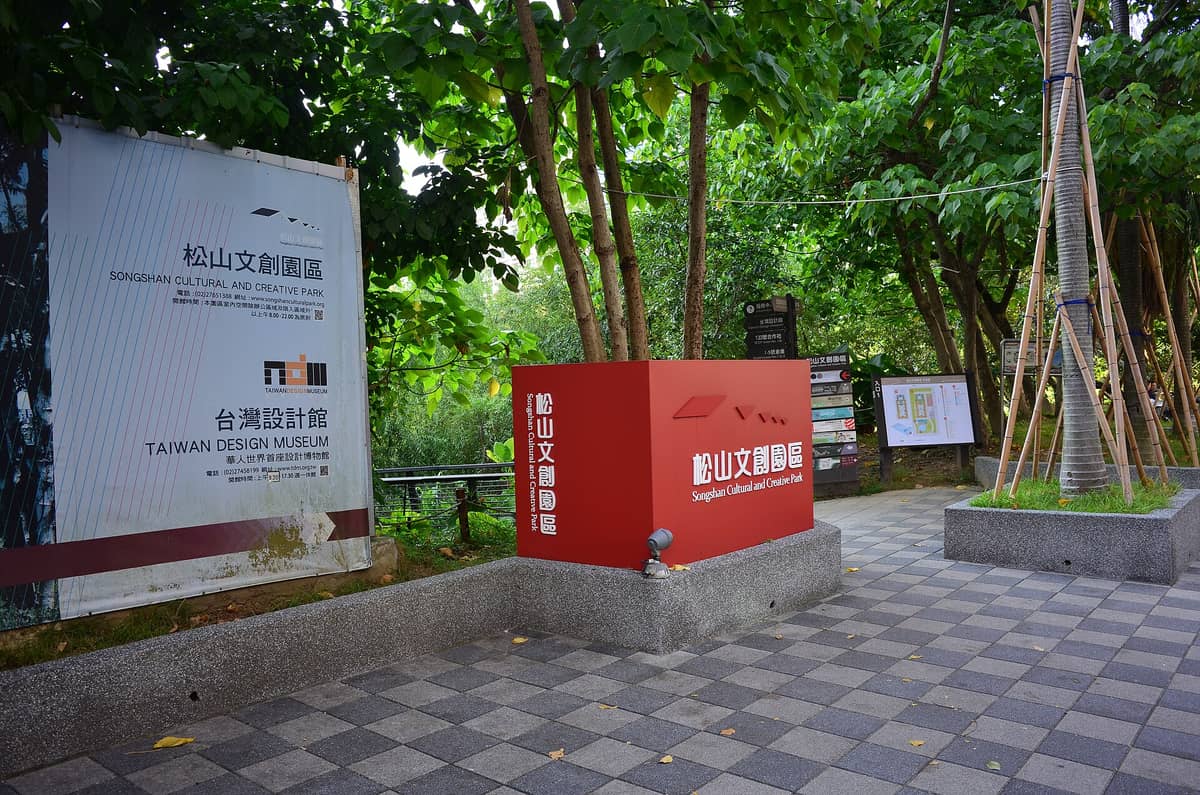
What Songshan Cultural and Creative Park Actually Is
Songshan Cultural and Creative Park occupies a preserved complex of red-brick buildings that Songshan Cultural and Creative Park occupies a preserved complex of red-brick buildings that began life in 1937 as the Songshan Tobacco Factory under Japanese colonial administration. After production ceased, the site was later preserved and, on 15 November 2011, reopened as a public cultural and creative campus. and on 15 November 2011, it reopened as a public cultural and creative campus.
That history matters because it explains why the park feels different from Taipei's other repurposed industrial spaces. The buildings were not stripped back or modernized aggressively. The original factory halls, machine rooms, and administrative structures were carefully rehabilitated, preserving the proportions, materials, and spatial logic of the 1930s complex. What you walk through today is legible as a factory, not merely gestured at as one.
ℹ️ Good to know
Opening hours: daily 08:00–22:00. General admission is free. Opening hours: daily 08:00–22:00. General admission is free. Some exhibitions inside individual halls charge separately — check the official website before visiting if a specific show interests you.
The Architecture: Why the Buildings Are the Main Event
The main factory complex is built in a restrained modernist-industrial style typical of late Japanese colonial public works: long horizontal lines, regular arched windows, deep overhanging eaves, and walls of warm ochre brick. The scale is human without feeling cramped. Corridors are wide enough to move through comfortably, and the ceiling heights in the former production halls create a sense of airy volume you rarely find in Taipei's predominantly vertical urban fabric.
Look for the machine room and boiler house in the western section of the complex. These are among the most intact industrial interiors on the site, with original structural ironwork still in place. The contrast between raw industrial infrastructure and the design installations or gallery work that now occupies the same space is deliberate and worth pausing over.
On overcast days, the brick takes on a deeper reddish tone and the light through the arched windows softens considerably. Mornings before 10am, when the park is quiet and the low-angle light cuts across the facade, are the most visually rewarding time to photograph the exterior.
The Garden: The Part Most Visitors Miss
Behind the main factory halls, a landscaped garden area wraps around a pond and open lawn space. Many visitors arrive, walk through the main building corridor, glance at the shops, and leave without ever finding it. This is the park's most underused section, and on weekday afternoons it can feel almost empty.
The garden works as a genuine decompression space after the density of the surrounding Xinyi district. Trees provide enough canopy to make the temperature noticeably cooler in summer, and the water feature creates consistent ambient sound that blocks out traffic. On weekend mornings, local residents use the lawn area for casual exercise and photography. By early evening, couples and small groups tend to gather here as the light drops.
💡 Local tip
Follow the main building corridor all the way to its far end, then turn toward the rear of the complex. The garden entrance is not prominently signposted from the front approach.
Shops, Galleries, and What to Actually Buy
The tenant mix at Songshan leans heavily toward Taiwanese design: stationery, ceramics, textiles, lifestyle objects, and small-run publications. The quality is generally high and the price points reflect it. If you are looking for the kind of souvenir that will not look out of place in an adult home, this is one of the better places in Taipei to find it.
The resident shops and design studios change periodically, so the exact lineup on any given visit will vary. What remains consistent is the curatorial sensibility: the park management actively selects tenants aligned with Taiwanese creative industries, which keeps the product range coherent and prevents the complex from drifting into generic tourist retail.
Gallery programming rotates throughout the year, with international design exhibitions a recurring feature. The park has hosted branches of the Taipei Fine Arts Museum programming and collaborations with major design institutions. Check the official website for the current exhibition calendar before your visit, particularly if contemporary design is a priority for you.
How the Park Changes Through the Day
Early mornings, between 8am and 10am, the park is primarily used by locals: people cutting through on their way to work, older residents doing slow morning walks in the garden, and the occasional photographer taking advantage of soft light on the brick facades. The shops are closed, the galleries are locked, and the atmosphere is closer to a neighborhood park than a cultural attraction.
Late morning through early afternoon is when visitor numbers build. Weekday afternoons tend to attract students, designers, and freelancers who use the indoor spaces to work or meet. Weekends draw larger groups, including families and tourists from other parts of Taiwan.
Evenings are unexpectedly pleasant. The brick buildings are lit from below after dark, and the garden remains open until 10pm. The crowd thins significantly after 7pm on weekdays, leaving the complex feeling calm and private. If you are in the Xinyi area for dinner, arriving at Songshan around 8pm for a short walk is a reasonable way to extend the evening without much effort.
⚠️ What to skip
During major design festivals and weekend events, the park can become genuinely crowded and some areas may have timed entry. Check the event calendar on the official website if you are visiting on a Saturday or Sunday during peak season (October to April).
Getting There and Practical Notes
The closest MRT access is Sun Yat-Sen Memorial Hall Station (Blue Line), Exit 5. From the exit, the park entrance on Guangfu South Road is roughly a 5-minute walk north. The Sun Yat-Sen Memorial Hall itself is immediately adjacent to the station, making a combined visit straightforward. Taipei 101 is also within walking distance to the south, though the contrast between the park's measured pace and 101's commercial intensity is considerable.
The Xinyi district surroundings are well-served by the MRT, and getting around Taipei by MRT is straightforward with an EasyCard. Taxis and Uber are also readily available in this part of the city.
Wear comfortable shoes with some grip — the courtyard surfaces between buildings are occasionally uneven brick and can be slippery after rain. Taipei's humidity means the site is genuinely hot from June through September; lightweight, breathable clothing and a water bottle are practical necessities in summer. In winter (December to February), temperatures are mild but the damp air makes it feel cooler than the thermometer suggests, so a light layer is worthwhile.
No detailed wheelchair-accessibility specifications are available from the official sources. The ground level of the main complex appears navigable, but the uneven courtyard surfaces between buildings may present challenges. Contact the park directly via the official website if accessibility requirements are a priority before visiting.
Honest Assessment: Who Will Love This and Who Will Not
Songshan Cultural and Creative Park rewards visitors who move slowly and pay attention to materials, light, and space. If you have a genuine interest in architecture, design, or craft, the park will hold your attention for several hours. If you are primarily looking for things to buy or for a concentrated gallery experience, the offering is real but modest compared to a dedicated design museum.
Visitors expecting a scene comparable to a European creative district or a major art complex may find the scale underwhelming. The park is compact, relatively quiet on weekdays, and does not have the density of programming of somewhere like Huashan 1914 Creative Park, which is larger, louder, and more event-driven. Songshan's strength is exactly the opposite: coherent, calm, and architecturally serious.
Travelers with very limited time in Taipei who need to prioritize will find other attractions more immediately spectacular. But if you have an afternoon free in the Xinyi area and your feet are tired of pavement, the park is one of the few places in central Taipei where the pace genuinely slows down.
Insider Tips
- The rear garden is accessed through a corridor that runs the full length of the main building. Walk past all the shops without turning back, and the garden opens up at the far end. Most casual visitors turn around before reaching it.
- Weekday mornings before 10am give you the architecture without the crowds. The shops will not be open, but the light on the brick facade and the quiet of the courtyard are worth the early arrival.
- The park regularly hosts pop-up design markets and international exhibitions that are not always advertised in English-language travel platforms. Check the official website's event calendar directly for the most current programming.
- If you are combining this visit with Sun Yat-Sen Memorial Hall next door, enter the memorial first when it opens, then walk to Songshan as the day warms up. Both are free and the combined visit takes a comfortable half-day.
- Evening visits after 8pm on weekdays offer the complex almost entirely to yourself. The brick is dramatically lit from ground level and the garden remains accessible until 10pm.
Who Is Songshan Cultural and Creative Park For?
- Design and architecture enthusiasts looking for Taipei's most intact Japanese colonial industrial complex
- Shoppers seeking quality Taiwanese-designed goods rather than mass-produced souvenirs
- Travelers wanting a genuine pause from the intensity of the surrounding Xinyi commercial district
- Photographers interested in industrial heritage architecture and natural light
- Anyone with a free afternoon who wants to combine culture, a garden, and a slow walk without paying admission
Nearby Attractions
Other things to see while in Xinyi District:
- Elephant Mountain (Xiangshan) Trail
Elephant Mountain, known in Mandarin as Xiangshan, delivers one of the most photographed skyline views in Asia from just a short walk off the MRT. At 183 meters above Xinyi District, the reward-to-effort ratio is genuinely hard to beat. Here is everything you need to decide if it belongs on your Taipei itinerary.
- Taipei 101
Standing 508 metres above the Xinyi District, Taipei 101 remains the defining landmark of Taiwan's capital. This guide covers the 89th-floor observatory, the mall below, best visiting times, and everything a traveller needs to make the most of the experience.
- Sun Yat-sen Memorial Hall
The National Dr. Sun Yat-sen Memorial Hall is one of Taipei's most recognizable civic landmarks, combining a sweeping classical Chinese-influenced building with open plazas and gardens in the heart of Xinyi District. Admission to the grounds and exhibitions is free, making it a genuinely accessible stop for any itinerary.