Taipei Fine Arts Museum (TFAM): What to Expect Before You Go
Taipei Fine Arts Museum is Taiwan's foremost institution for modern and contemporary art, housed in a striking Brutalist-influenced building in Zhongshan District. With admission starting at NT$30 and free entry after 5pm on Saturdays, it rewards curious visitors with rotating exhibitions, large-scale installations, and a peaceful sculpture garden rarely found in the city center.
Quick Facts
- Location
- No. 181, Sec. 3, Zhongshan N. Rd., Zhongshan Dist., Taipei City 104227, Taiwan
- Getting There
- Yuanshan Station, MRT Red Line (Danshui-Xinyi Line) — short walk south
- Time Needed
- 1.5 to 3 hours depending on current exhibitions
- Cost
- NT$30 general admission; NT$15 discounted; free after 17:00 on Saturdays (Saturday 17:00–20:30)
- Best for
- Contemporary art lovers, architecture buffs, budget travelers, families with older children
- Official website
- english.tfam.gov.taipei
What Is the Taipei Fine Arts Museum?
The Taipei Fine Arts Museum, known locally as TFAM (臺北市立美術館), is Taiwan's principal institution dedicated to modern and contemporary art. It opened on August 8, 1983 as Taiwan's first purpose-built public art museum and opened to the public on December 24, 1983. The planning committee was established as early as 1977, and construction began in October 1980 on a site covering just over 24,000 square meters in Zhongshan District, directly across from Taipei's large riverside park known as the Yuanshan area.
The museum is not a historical curiosity. It remains Taipei's most active venue for large-scale contemporary exhibitions and is the official home of the Taipei Biennial, one of the most significant recurring art events in Asia. The permanent collection runs into the thousands of works, but the rotating temporary exhibitions are what most visitors come for, and the programming calendar regularly brings in international artists alongside major Taiwanese names.
💡 Local tip
Entry is free after 17:00 on Saturday evenings until 20:30. If you want to avoid daytime crowds and save money at the same time, an early Saturday evening visit is the smartest approach.
The Building Itself: Architecture Worth Noticing
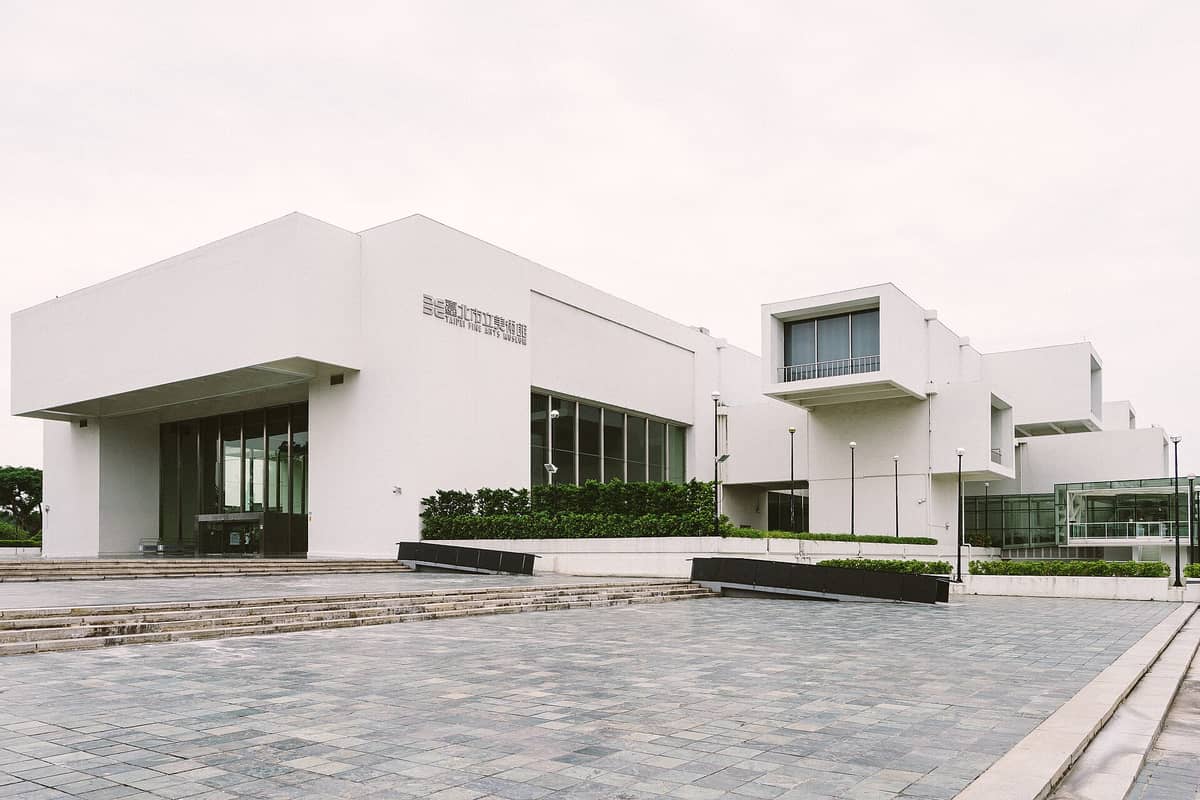
The museum building was designed by Taiwanese architect Kao Er-pan and is often cited as one of the more significant examples of late 20th-century public architecture in Taiwan. The structure uses a white-painted reinforced concrete grid that creates a geometry of interlocking cubes and elevated walkways. From the outside, especially when viewed from across Zhongshan North Road, the building reads as solid and deliberate, more Brutalist-influenced than the ornamental traditionalism common to Taiwanese civic architecture of the same era.
Inside, that grid logic translates into a series of interconnected gallery spaces on multiple levels, connected by ramps and stairs that keep you oriented but also give the building a sense of spatial complexity. Natural light enters through skylights in the upper floors, which changes the quality of certain gallery spaces significantly depending on the time of day. Morning light gives the upper-level rooms a cooler, more diffuse character. By mid-afternoon, the skylights can produce dramatic patches of direct light that occasionally conflict with sensitive artworks, so some exhibitions adjust accordingly.
The outdoor grounds include a sculpture garden that receives far less visitor attention than the interior galleries. This is a quiet spot even on weekends, with large-scale works placed across a landscaped area that connects visually to the Yuanshan greenery nearby. If you are interested in how TFAM's architecture fits into the broader landscape of significant public buildings in Taipei, the Taipei museums guide provides useful context for comparing it with other cultural institutions across the city.
What You Will Actually See Inside
TFAM's permanent collection focuses on Taiwanese art from the 20th century to the present, with particular depth in painting, sculpture, and new media from the postwar period onward. Works from the Japanese colonial era through the martial law period and into contemporary Taiwan provide a coherent, if sometimes politically charged, thread through the collection. That said, the permanent collection is rarely displayed in full at any one time. The museum rotates works into thematic presentations that run alongside the temporary exhibition program.
Temporary exhibitions change several times per year and can vary enormously in scale and medium. TFAM has hosted large survey shows of international figures, group exhibitions drawn from the Asia-Pacific region, and immersive installation works that occupy entire wings. The ground-floor spaces tend to handle the largest installations. Upper floors typically host smaller works, video, and photography. Before you visit, it is worth checking the museum website to see what is currently showing, because the character of a visit shifts substantially depending on the active program.
The Children's Art Education Center operates within the museum complex but has separate scheduling from the main galleries. It closes earlier on Saturday evenings when the main building extends its hours, so families planning a late visit should check in advance. Note also that persons with disabilities and one essential companion receive admission benefits under the museum's accessibility policy.
How the Experience Changes by Time of Day
Mornings on weekdays, particularly Tuesday through Thursday, are when the museum is at its quietest. The galleries feel genuinely spacious, and you can spend time in front of larger works without navigating around other visitors. The smell in the building during these hours is that particular mix of filtered air and fresh paint that signals a working cultural institution rather than a preserved monument.
Weekend afternoons draw the largest crowds, particularly on Sundays when the museum operates on standard hours. Families with children arrive mid-morning and the ground floor can become noticeably noisier. Weekend mornings before noon are a reasonable compromise if weekday visits are not possible. Saturday evenings after 17:00 offer something different: the museum is quieter than the afternoon, admission is free, and the extended hours until 20:30 give the building an atmosphere that sits somewhere between a gallery and an evening cultural event. The lighting shifts subtly as daylight fades and the artificial gallery lighting takes over completely.
ℹ️ Good to know
The museum is closed every Monday and on select public holidays. If you are planning your Taipei itinerary around a Monday, note this in advance to avoid a wasted trip to Zhongshan.
Getting There and Practical Logistics
The most direct public transit route is the MRT Red Line (Danshui-Xinyi Line) to Yuanshan Station. From there, the museum is a short walk south along Zhongshan North Road. The area along this stretch of Zhongshan North Road has a noticeably different character from central Taipei: wider sidewalks, older trees, and a slightly lower density of commercial signage. The walk itself is straightforward and takes under ten minutes from the station exit.
If you are combining TFAM with other stops in the area, the Zhongshan District has a range of options within reasonable walking distance, including the boutique-lined Zhongshan commercial corridor to the south and the Taipei Confucius Temple nearby. The Zhongshan area is also reasonably flat, which makes walking between sites practical without significant effort.
Admission is NT$30 for general visitors, NT$15 for discounted categories (students, seniors, and other groups under official guidelines), NT$21 for groups of more than 20 people, and NT$15 for Taipei residents. Free admission applies after 17:00 on Saturday nights. The museum accepts cash at the ticket counter; verify current card payment options directly with the museum before your visit.
Photography policies vary by exhibition. In the permanent collection spaces, photography without flash is generally permitted. Temporary exhibitions sometimes restrict photography entirely, particularly when works are under rights management agreements with lenders. Look for posted notices at each gallery entrance rather than assuming.
Who This Museum Is For, and Who Might Be Disappointed
TFAM suits visitors who already have some interest in contemporary and modern art, or those willing to engage with work that does not always provide immediate narrative clarity. It is not a spectacle museum in the mode of popular science centers or interactive attractions. If you are traveling with young children hoping for hands-on engagement, the Children's Art Education Center is the relevant section, though it operates on its own schedule. For general family activity ideas in Taipei, the Taipei with kids guide offers more targeted suggestions.
Visitors who come primarily for Taiwanese history or traditional culture may find that TFAM's program, while rooted in Taiwanese artistic identity, addresses those themes through a contemporary lens that requires some art-world familiarity to fully appreciate. The museum is also not a large building by international standards, so anyone expecting a full day's worth of gallery space on the scale of major European institutions will find it modest. A focused visit of two hours covers the active exhibitions comfortably.
On the other hand, travelers who enjoy thoughtful, well-curated spaces that reward attention rather than demand it will find TFAM one of the more rewarding stops in the city. Combined with a walk through the Museum of Contemporary Art Taipei, which sits further south in Zhongshan, a focused contemporary art afternoon in this part of the city is genuinely possible without significant travel between sites.
Rain, Heat, and Seasonal Considerations
TFAM is a fully indoor attraction, which makes it particularly useful during Taipei's rainy season from roughly May through September, when afternoon downpours are frequent. The museum provides covered entry and air-conditioned gallery spaces throughout, making it a logical choice for the hottest and wettest parts of the year. Summer humidity in Taipei is significant, and the contrast between the outdoor heat and the controlled gallery environment is marked.
October through April are generally the more comfortable months to be outdoors in Taipei, with lower humidity and milder temperatures. Visiting the museum during this period allows you to easily combine it with outdoor areas nearby, including the riverside park and the grounds of the Taipei Confucius Temple a short distance away. For a broader view of how weather affects your Taipei planning, the best time to visit Taipei guide breaks down seasonal conditions in detail.
Insider Tips
- The free-after-17:00 policy on Saturdays is genuinely useful, not a token gesture. On Saturday evenings, you can often have entire gallery rooms to yourself for extended stretches.
- Check the Taipei Biennial schedule before planning your trip. When the Biennial is active (it runs every two years), TFAM's programming expands significantly and fills the entire building. It draws larger crowds but the scale of the exhibition is also substantially more impressive.
- The outdoor sculpture garden on the museum grounds is almost always uncrowded. It connects loosely to the riverside park area and is a good place to decompress between galleries without leaving the site.
- The museum bookshop stocks publications related to current and past exhibitions that are difficult to find elsewhere in Taipei. If you are interested in Taiwanese contemporary art publishing, it is worth a few minutes even if you are not buying.
- Saturday nights bring a noticeably different crowd: fewer tourists, more locals treating the museum as a genuine evening activity. The atmosphere in the upper galleries after 18:30 on a Saturday has a calm that is rare in Taipei's weekend social life.
Who Is Taipei Fine Arts Museum For?
- Contemporary art enthusiasts looking for serious programming in Asia
- Architecture-minded travelers interested in late 20th-century Taiwanese public buildings
- Budget travelers who want a cultural afternoon for NT$30 or less
- Visitors seeking an indoor refuge during Taipei's rainy or hot summer months
- Repeat Taipei visitors who want to go beyond the main historical and temple circuit
Nearby Attractions
Other things to see while in Zhongshan District:
- Lin An Tai Historical House
Lin An Tai Historical House is a meticulously preserved Minnan-style courtyard residence dating back roughly 200 years, relocated to Binjiang Park beside the Keelung River in Zhongshan District. Admission is free, the setting is calm, and the architecture offers a rare window into the domestic life of a prosperous Qing-era Taiwanese family.
- Miniatures Museum of Taiwan
Tucked one floor below street level in Taipei's Zhongshan District, the Miniatures Museum of Taiwan houses an extraordinary collection of hand-crafted scale models, from Victorian manor houses to ornate European theaters, each built with obsessive precision. It is a quiet, unhurried attraction that rewards careful looking and suits travelers who want something genuinely different from the usual temple-and-night-market circuit.
- Museum of Contemporary Art Taipei (MOCA)
The Museum of Contemporary Art Taipei (MoCA Taipei) is Taiwan's first museum dedicated solely to contemporary art, set inside a beautifully repurposed Japanese colonial-era building in central Zhongshan. With a remarkably low entry fee and a program that rotates frequently, it rewards both a quick afternoon stop and a deliberate deep dive.
- National Revolutionary Martyrs' Shrine
Modeled on Beijing's Hall of Supreme Harmony and completed in 1969, the National Revolutionary Martyrs' Shrine in Zhongshan District honors approximately 390,000 individuals recognized as national martyrs. Entry is free, the changing of the guard happens on the hour, and the ceremonial scale of the complex makes it one of Taipei's most architecturally striking institutions.