Lin An Tai Historical House: Taipei's Most Complete Minnan Courtyard Residence
Lin An Tai Historical House is a meticulously preserved Minnan-style courtyard residence dating back roughly 200 years, relocated to Binjiang Park beside the Keelung River in Zhongshan District. Admission is free, the setting is calm, and the architecture offers a rare window into the domestic life of a prosperous Qing-era Taiwanese family.
Quick Facts
- Location
- No. 5 Binjiang Street, Zhongshan District, Taipei (Binjiang Park, by the Keelung River)
- Getting There
- Yuanshan Station (Red Line) or Zhongshan Elementary School Station (Orange Line), then a short bus or walk to Xinsheng Park (Lin An-Tai Historic House)
- Time Needed
- 45–90 minutes
- Cost
- Free admission
- Best for
- Architecture lovers, history buffs, families, slow-travel visitors
- Official website
- english.linantai.taipei
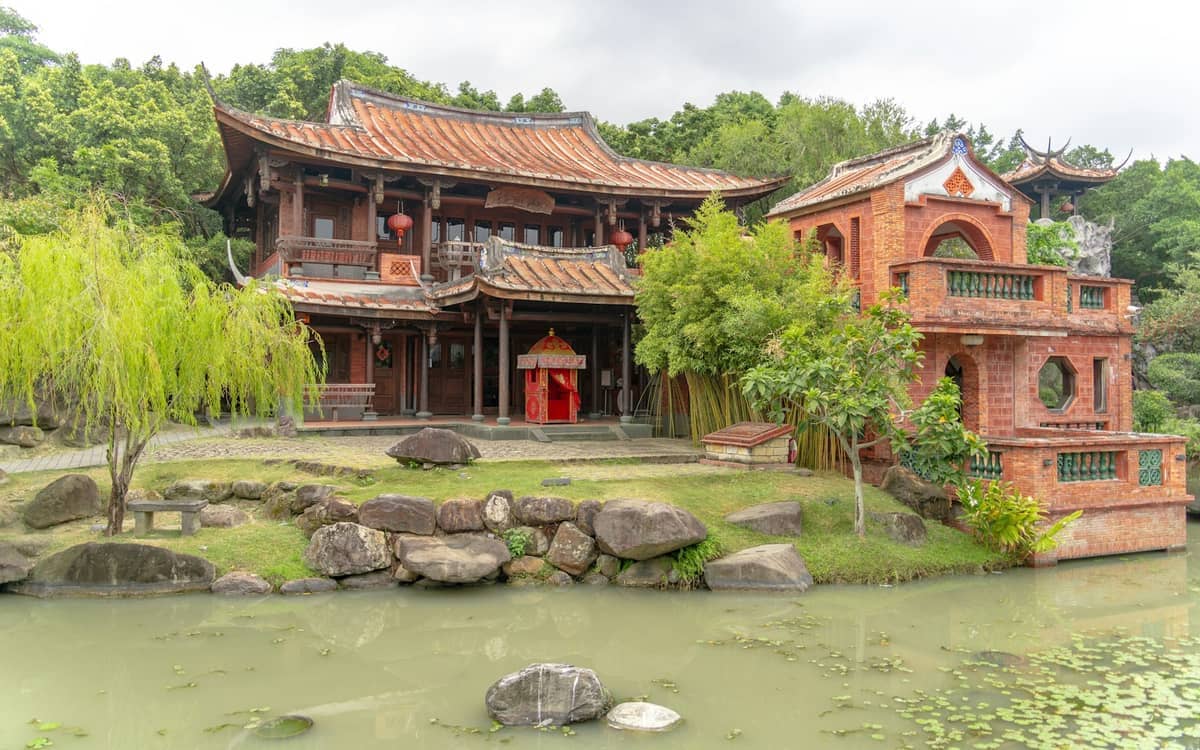
What Is Lin An Tai Historical House?
The Lin An Tai Historical House and Museum is one of Taipei's most intact examples of traditional Minnan architecture, a style rooted in the Fujian coast of southern China that Taiwanese settlers brought across the strait during the Qing dynasty. The house is roughly 200 years old and was originally built by the Lin family as a prosperous private residence. What makes it exceptional is not just its age but its completeness: multiple interconnected halls, interior courtyards, covered walkways, and subsidiary wings have all survived in a form that illustrates how a wealthy family of that era lived, worshipped, and organized domestic space.
The house was not always at its current riverside address. When urban development threatened its original site, city authorities chose to dismantle the structure carefully, catalog each component, and rebuild it at Binjiang Park near the Keelung River. This relocation preserved the building but inevitably placed it in a context that is slightly park-like and curated rather than embedded in a living neighborhood. Visitors should understand this going in: the experience is closer to an open-air museum than a stumbled-upon heritage street. That distinction aside, the quality of the reconstruction and the completeness of the structure make it worth the trip.
ℹ️ Good to know
Opening hours change seasonally. Standard hours are 09:00–17:00 (last entry 16:45). In July and August, the site stays open until 18:00 (last entry 17:45). The house is closed on Mondays and on major traditional folk holidays including Chinese New Year, Tomb Sweeping Festival, Dragon Boat Festival, and Mid-Autumn Festival. Confirm the schedule at english.linantai.taipei before visiting.
The Architecture: What You're Actually Looking At
Minnan architecture follows a strict cosmological logic. The layout of Lin An Tai is oriented along a central axis, with the main ancestral hall at the rear as the spiritual and social heart of the compound. Subsidiary rooms branch symmetrically to the left and right, connected by interior galleries that shelter residents from rain without cutting them off from air and light. The result is a building that breathes: even on hot days, the airflow through the courtyards is noticeable, and the relationship between indoor and outdoor space feels deliberate rather than incidental.
Look carefully at the ridge lines. The swallow-tail roof eaves, curving upward at both ends, are the most visually striking feature and a hallmark of Fujian-influenced construction in Taiwan. The clay figurines and tile carvings along the ridges depict auspicious animals, mythological scenes, and floral motifs, each carrying symbolic meaning related to prosperity, longevity, and protection from fire. The stonework at the base of the walls, the carved wooden brackets supporting the roof overhangs, and the painted panels above doorways reward slow, close observation.
Inside, rooms are furnished with period-appropriate objects: altar tables, wooden chairs with curved backs, brass incense holders, and red lacquered ceremonial items. Informational panels in English explain the function of each space, from the formal reception hall where guests were received according to strict social hierarchy, to the interior rooms where daily domestic life unfolded away from public view.
How the Experience Changes by Time of Day
Weekday mornings, particularly between 09:30 and 11:00, offer the most peaceful conditions. The courtyards are largely empty at that hour, and the quality of the light is good for photography: soft, angled, and without the harsh midday shadows that flatten the roof ornamentation. The stone pathways and pebbled courtyard surfaces, damp from overnight humidity in the wetter months, reflect light in a way that brings out the texture of the materials. Bird calls from the surrounding parkland and the faint sound of water nearby are often all you hear.
By midday, particularly on weekends and school holidays, tour groups and family visitors arrive in larger numbers. The house is not a blockbuster attraction and never truly crowds out, but the intimate scale of the interior halls means that even a dozen visitors in a single room changes the feel significantly. If you prefer to spend time with specific architectural details or take unhurried photographs, morning on a Tuesday through Thursday is noticeably better than a Sunday afternoon.
Late afternoon visits, especially in summer when the site stays open until 18:00, have their own appeal. The light turns warm and amber across the roof tiles, and the surrounding Binjiang Park takes on a quieter, more local character as Taipei residents come out for evening walks. This is a good time to linger in the main courtyard without feeling rushed.
💡 Local tip
Photography tip: The main gate and front courtyard photograph best in the morning when light falls directly on the carved facade details. By afternoon the front elevation is mostly in shade. For the interior roof brackets and hall details, the overcast light of a cloudy day is actually ideal, softening contrast and revealing carving depth more clearly than direct sun.
Getting There: Practical Directions
Lin An Tai is located in Zhongshan District, but it sits at the district's northeastern edge near the Keelung River, which puts it further from the main hotel and MRT corridor than most visitors expect. The nearest MRT stations are Yuanshan on the Red Line or Zhongshan Elementary School on the Orange Line (Zhonghe–Xinlu). From either, take a short bus ride or walk to the Xinsheng Park (Lin An-Tai Historic House) stop, roughly a 3 to 4 minute walk from the house itself.
Walking from Yuanshan or Zhongshan Elementary School takes longer than the bus, and the last stretch along Binjiang Street is flat but exposed. In summer heat or rain, the bus to the Xinsheng Park (Lin An-Tai Historic House) stop is the more comfortable option.
Cycling is also practical: YouBike stations are available in the area, and the riverside cycling path along the Keelung River passes close to the park entrance. Combining a bike ride with a stop at Lin An Tai is a natural pairing, particularly on a weekend morning when the riverside paths see steady recreational use.
Accessibility and Practical Realities
The site does not guarantee full wheelchair accessibility. The house features stone floors, uneven threshold steps between rooms, and a layout typical of 19th-century residential construction: high door sills, narrow covered walkways, and interior spaces that are not designed around modern mobility standards. Visitors with limited mobility can access the main courtyard and observe the exterior architecture without restriction, but expect some interior spaces to be difficult or inaccessible. Official visitor notices do not claim full wheelchair access.
The surrounding Binjiang Park is flat and well-maintained. Restrooms are available at the site. There is no cafe or food service on the premises, so bring water, particularly in summer when the stone-and-tile environment retains heat. The nearest food options are a short bus or bike ride away along Minquan East Road.
⚠️ What to skip
The house is closed on Mondays and on four major folk holidays (Chinese New Year, Tomb Sweeping Festival, Dragon Boat Festival, Mid-Autumn Festival). Planning a visit during a long holiday weekend without checking the official schedule first is a common mistake.
Who Will Get the Most Out of This Visit
Lin An Tai rewards visitors who arrive with some prior context about traditional Taiwanese or Fujian architecture. The English-language interpretive panels are informative but brief, and the full meaning of the spatial hierarchy, symbolic carvings, and ancestral hall arrangements becomes richer if you have read even a little about Minnan domestic culture beforehand. Pairing this visit with a stop at the Bopiliao Historic Block in Wanhua or the Dihua Street area gives a broader sense of how traditional architecture survives across different parts of Taipei.
Families with children who have some interest in history will find the scale of the house approachable and non-overwhelming. The open courtyards give children room to move, and the figurines on the rooflines are immediately engaging. For a broader day out with kids, the site pairs well with Taipei Fine Arts Museum, which is also in Zhongshan and within a manageable distance.
Visitors primarily interested in Taipei's modern energy, food scene, or nightlife will find the experience slow-paced and low-stimulation. That is its value, not a flaw, but it should be calibrated accordingly. If your Taipei itinerary is already full of temple visits and heritage sites, adding Lin An Tai without clear purpose risks visit fatigue. For a well-rounded sense of the city's architectural history, however, it fills a specific gap that few other attractions cover.
For travelers building a broader picture of how to spend their time in the city, the 3-day Taipei itinerary and the Taipei museums guide are useful references for placing this attraction in a logical sequence.
Insider Tips
- The front courtyard wall has a narrow side gate that opens toward the riverbank side of the park. Walking through it after touring the house gives you a different perspective on the exterior wall construction and the roofline sequence, angles that most visitors miss because they exit the way they came in.
- The carved ridge decorations on the secondary wings are often more elaborate than those on the main hall, because craftsmen historically competed to demonstrate skill on the less prominent sections. Take time with the subsidiary rooflines rather than focusing only on the main facade.
- Visit on a cloudy day if you can. Direct tropical sun creates strong shadows that obscure the low-relief carvings in wood and stone. An overcast sky produces flat, even light that reveals surface detail far more clearly and makes for better documentation photographs.
- The surrounding Binjiang Park has a riverside cycling path that connects to a broader network along the Keelung River. Arriving by YouBike from central Zhongshan adds about 15 minutes to the journey but turns the trip into a genuine half-day outing rather than a quick detour.
- Check the folk holiday closure schedule carefully. The four traditional holidays on which the house closes (Chinese New Year, Tomb Sweeping Festival, Dragon Boat Festival, Mid-Autumn Festival) are precisely the periods when many international visitors are exploring Taipei, since they often align with long weekend travel windows.
Who Is Lin An Tai Historical House For?
- Architecture and design travelers who want to understand traditional Minnan spatial logic and ornamentation
- History-focused visitors seeking context for Taiwan's Qing-era settler culture beyond what temples typically show
- Families looking for a calm, visually engaging, and free morning activity away from major tourist crowds
- Slow-travel visitors building a thoughtful day in Zhongshan that combines heritage with the riverside park environment
- Photographers interested in traditional craftsmanship: carved woodwork, clay figurines, and decorative tile work
Nearby Attractions
Other things to see while in Zhongshan District:
- Miniatures Museum of Taiwan
Tucked one floor below street level in Taipei's Zhongshan District, the Miniatures Museum of Taiwan houses an extraordinary collection of hand-crafted scale models, from Victorian manor houses to ornate European theaters, each built with obsessive precision. It is a quiet, unhurried attraction that rewards careful looking and suits travelers who want something genuinely different from the usual temple-and-night-market circuit.
- Museum of Contemporary Art Taipei (MOCA)
The Museum of Contemporary Art Taipei (MoCA Taipei) is Taiwan's first museum dedicated solely to contemporary art, set inside a beautifully repurposed Japanese colonial-era building in central Zhongshan. With a remarkably low entry fee and a program that rotates frequently, it rewards both a quick afternoon stop and a deliberate deep dive.
- National Revolutionary Martyrs' Shrine
Modeled on Beijing's Hall of Supreme Harmony and completed in 1969, the National Revolutionary Martyrs' Shrine in Zhongshan District honors approximately 390,000 individuals recognized as national martyrs. Entry is free, the changing of the guard happens on the hour, and the ceremonial scale of the complex makes it one of Taipei's most architecturally striking institutions.
- Ningxia Night Market
One of Taipei's oldest and most food-focused night markets, Ningxia Night Market runs along a pedestrian-only stretch of Ningxia Road in Datong District. Compact, local, and unpretentious, it rewards visitors who want classic Taiwanese street food without the tourist-oriented carnival atmosphere of larger markets.