Museum of Contemporary Art Taipei (MOCA): What to Expect Before You Go
The Museum of Contemporary Art Taipei (MoCA Taipei) is Taiwan's first museum dedicated solely to contemporary art, set inside a beautifully repurposed Japanese colonial-era building in central Zhongshan. With a remarkably low entry fee and a program that rotates frequently, it rewards both a quick afternoon stop and a deliberate deep dive.
Quick Facts
- Location
- No. 39, Chang'an West Road, Datong District, Taipei City 103, Taiwan
- Getting There
- MRT Zhongshan Station (Red Line / Green Line), short walk along Chang'an West Road
- Time Needed
- 1.5–2.5 hours depending on current exhibition
- Cost
- TWD 100 general admission; TWD 50 concession; free for children under 6, seniors 65+, and visitors with disabilities (verify current rates on-site)
- Best for
- Art lovers, design-curious travelers, architecture enthusiasts, anyone wanting culture without a half-day commitment
- Official website
- www.mocataipei.org.tw/en
Why MOCA Taipei Deserves Your Attention
The Museum of Contemporary Art Taipei, known locally as 台北當代藝術館 (MoCA Taipei), opened in May 2001 and holds a specific distinction: it was Taiwan's first museum dedicated entirely to contemporary art. That milestone has a quiet confidence to it. This isn't a blockbuster institution trying to compete with the grand historical weight of the National Palace Museum up north. Instead, it has carved out a very specific lane, presenting Taiwanese and international contemporary work in a building that is itself a piece of history.
For travelers moving through Zhongshan, the museum makes an excellent counterpoint to the area's hotels, restaurants, and shopping corridors. The entry fee is one of the lowest you'll find for a serious art institution anywhere in Asia, and the program turns over regularly enough that even repeat visitors have reason to check what's on.
💡 Local tip
Check the current exhibition on the official website before visiting. MOCA's program rotates, and the quality of your experience depends significantly on what's showing. The building itself is always worth seeing, but the galleries reward more when the exhibition connects with your interests.
The Building: A Japanese Colonial Schoolhouse Transformed
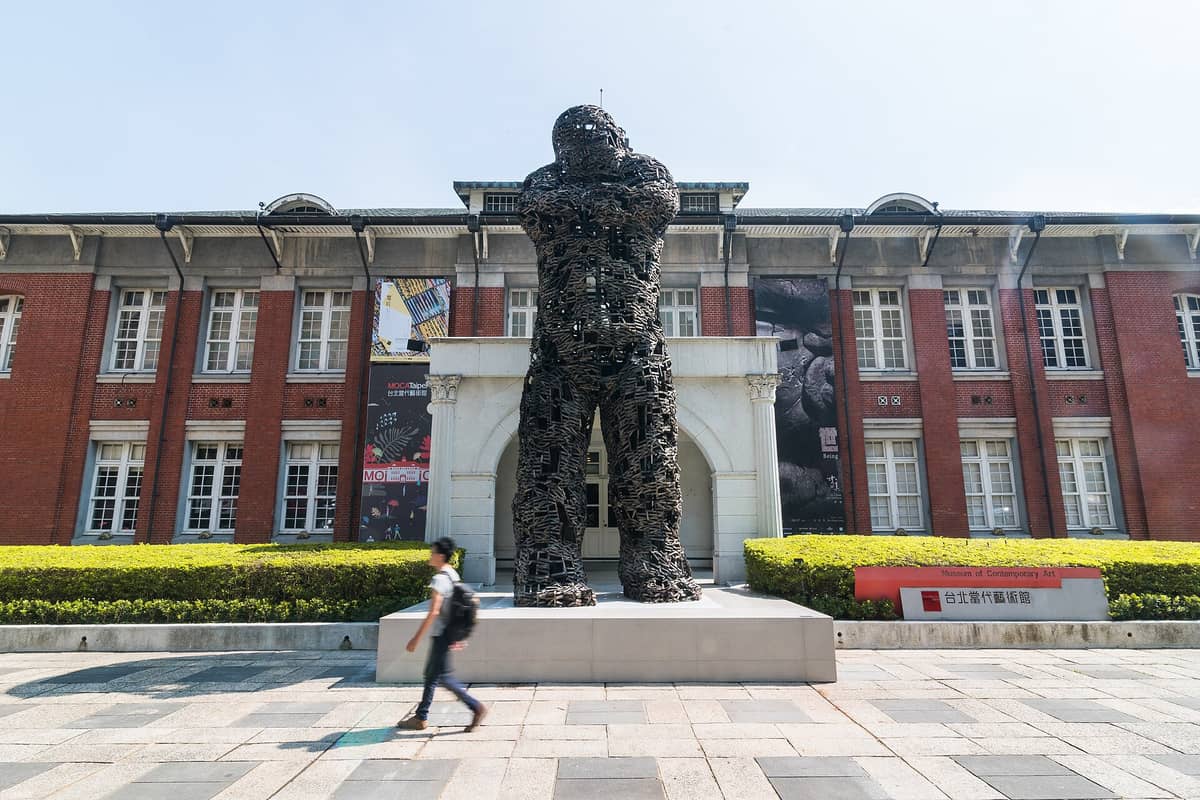
The structure housing MoCA Taipei dates from the Japanese colonial period, when it served as a primary school. The architectural language of that era is unmistakable: red brick, symmetrical facades, wooden interior details, and a formal courtyard logic that feels distinctly different from the glass-and-steel towers surrounding it on Chang'an West Road. Walking toward the entrance, the contrast with the neighborhood is immediate and deliberate.
The repurposing of colonial-era educational buildings into cultural institutions is something Taipei has done thoughtfully in several places across the city, and MOCA is among the most successful examples. The galleries inside balance the original spatial character of the building with the practical demands of contemporary exhibition design: ceiling heights that allow large-scale installations, circulation paths that feel intuitive without being rigid.
The courtyard area between the street and the main entrance is worth pausing in. In the mornings, before the crowds of weekday visitors (which are modest at best), the light on the brick facade is clean and photogenic. The textures of aged masonry against the sharper geometry of newer interventions give the building a layered quality that reinforces what's happening inside.
If you're developing an interest in how Taipei has handled its colonial architectural heritage, this building pairs well with a visit to Huashan 1914 Creative Park and the Songshan Cultural Creative Park, both of which follow a similar adaptive-reuse philosophy but at significantly larger scale.
What the Exhibition Experience Actually Feels Like
Because the program rotates, describing a specific exhibition here would age quickly. What remains consistent is the character of how the museum presents work. MOCA tends toward thematic group shows that blend Taiwanese artists with regional and international voices. The curation is generally concept-driven, which means some exhibitions reward slower looking while others might feel more accessible to casual visitors.
Gallery rooms vary in size, and the older building means certain spatial transitions, a doorway that narrows unexpectedly, a ceiling that drops briefly between wings, add a physical rhythm that a purpose-built museum wouldn't have. Some visitors find this charming. Others find it slightly disorienting. It's worth knowing before you go that this isn't a seamlessly neutral white-cube experience.
Audio guides or printed materials are occasionally available for major exhibitions, but this varies. If you're the type of visitor who needs contextual framing to engage with contemporary art, arriving with some preparation about the current show will improve the experience considerably. The official website publishes exhibition notes in English.
ℹ️ Good to know
Last entry is at 17:30, and the museum closes at 18:00. Budget at least 90 minutes for a proper visit; installations that use sound or video require patience to experience fully.
When to Visit and How to Get There
MOCA Taipei is open Tuesday through Sunday, 10:00 to 18:00, and closed on Mondays. The museum is straightforward to reach by Taipei MRT: take either the Red Line (Tamsui-Xinyi) or the Green Line (Songshan-Xindian) to Zhongshan Station, then walk a short distance along Chang'an West Road. The station exits are well-signposted, and the walk takes under ten minutes on foot.
Weekday mornings, particularly Tuesday through Thursday between 10:00 and noon, are when the museum is least crowded. Weekend afternoons attract more visitors, especially when a high-profile exhibition is running. The galleries are not enormous, and popular shows can feel compressed on a Saturday afternoon. If your schedule allows flexibility, a weekday morning visit offers a more reflective pace.
Taipei's summers are hot and humid, and the museum provides a genuinely air-conditioned respite during the July-to-September heat. In the cooler months between October and April (generally the more comfortable period for visiting Taipei), you can combine MOCA with walking the surrounding streets without the weather penalty. The museum itself is covered, so rain isn't a concern once you're inside, though arriving by MRT keeps the approach dry.
The Zhongshan neighborhood has a strong secondary program of galleries and design shops within walking distance of MOCA. If you're building a full afternoon around contemporary art and design in Taipei, the area around Zhongshan District is the right base. For a broader look at how to structure your time in the city, the Taipei museums guide maps out where MOCA fits relative to the city's other cultural institutions.
Admission, Accessibility, and Practical Details
General admission is currently around TWD 100 with a TWD 50 concession, which at current exchange rates is a minimal cost for a serious cultural institution. Groups of 20 or more receive a 20% discount. Admission is free for children under 6, seniors aged 65 and above, and visitors with disabilities (a companion is also admitted free in this case), provided valid identification is presented. Note that one source indicates a possible NT$100 admission rate subject to on-site announcement, which suggests fees can vary by exhibition. Confirm current pricing at the entrance or on the official website before your visit.
For visitors with accessibility requirements, the museum recognizes free admission for persons with disabilities, but detailed information about physical accessibility features such as ramps, elevators, or audio aids is not comprehensively published in standard attraction listings. Contact the museum directly via the official site at mocataipei.org.tw to confirm specifics before your visit.
⚠️ What to skip
Admission fees at MOCA can change by exhibition. The TWD 100 standard rate is widely cited, but check the official site or confirm at the door before assuming a fixed price applies to the current show.
Photography, What to Bring, and Honest Limitations
Photography policies at MOCA vary by exhibition, as they do at most contemporary art institutions. Generally, personal non-flash photography is permitted in permanent or semi-permanent areas, while specific installations may prohibit it. Signage inside the museum is reasonably clear. The exterior of the building is always photogenic and unrestricted.
There is no large on-site restaurant. A small gift shop or café may operate depending on the season and exhibition, but don't plan a full meal here. The surrounding streets near Zhongshan Station have plenty of lunch options, and the neighborhood has a concentration of cafés well-suited to a post-museum coffee.
Who might not enjoy this visit: travelers who are not interested in contemporary art and are simply ticking off cultural sites will likely find the experience thin, particularly if the current exhibition is conceptually demanding without much visual accessibility. Families with very young children may find the galleries less engaging than, say, a natural history setting. MOCA is a focused, single-discipline institution, not a broad survey museum, and it works best when you bring some curiosity to it.
If you're looking for a broader cultural tour of central Taipei, consider pairing MOCA with the National Taiwan Museum in Zhongzheng District for historical context, or the Taipei Fine Arts Museum in Zhongshan for a larger-scale contemporary program. The two museums have distinct curatorial identities despite both focusing on contemporary practice.
Insider Tips
- The exhibition program rotates entirely, so always check mocataipei.org.tw before visiting. Arriving on the opening week of a new show means you'll find fresh wall text and often a more energized museum atmosphere.
- The building's exterior on Chang'an West Road faces north, which means it receives softer, more diffuse light in the afternoon compared to direct morning sun. For exterior photography, late afternoon on a clear day tends to give the brick facade its best color.
- MOCA occasionally hosts late-night or special event openings tied to exhibition launches. These are listed on the official website and social media channels, and they offer a very different atmosphere from the standard daytime visit.
- At TWD 50 per person, this is one of the genuinely low-cost cultural stops in Taipei. If you're traveling on a budget and want to build a day around affordable cultural institutions, pairing MOCA with nearby free or low-cost sites works well.
- Ticket holders who have a receipt or entry stub from the same day sometimes receive small discounts at partner cafés or bookshops near the museum, though this changes by exhibition. Ask at the front desk when you collect your ticket.
Who Is Museum of Contemporary Art Taipei (MOCA) For?
- Art and design travelers who follow contemporary practice and want to see what Taiwanese artists are making now
- Architecture enthusiasts interested in Japanese colonial buildings adapted for modern use
- Travelers doing a half-day in Zhongshan who want substance beyond shopping and restaurants
- Budget-conscious visitors wanting a serious cultural experience for around TWD 100
- Visitors to Taipei on repeat trips who have already covered the major historical institutions
Nearby Attractions
Other things to see while in Zhongshan District:
- Lin An Tai Historical House
Lin An Tai Historical House is a meticulously preserved Minnan-style courtyard residence dating back roughly 200 years, relocated to Binjiang Park beside the Keelung River in Zhongshan District. Admission is free, the setting is calm, and the architecture offers a rare window into the domestic life of a prosperous Qing-era Taiwanese family.
- Miniatures Museum of Taiwan
Tucked one floor below street level in Taipei's Zhongshan District, the Miniatures Museum of Taiwan houses an extraordinary collection of hand-crafted scale models, from Victorian manor houses to ornate European theaters, each built with obsessive precision. It is a quiet, unhurried attraction that rewards careful looking and suits travelers who want something genuinely different from the usual temple-and-night-market circuit.
- National Revolutionary Martyrs' Shrine
Modeled on Beijing's Hall of Supreme Harmony and completed in 1969, the National Revolutionary Martyrs' Shrine in Zhongshan District honors approximately 390,000 individuals recognized as national martyrs. Entry is free, the changing of the guard happens on the hour, and the ceremonial scale of the complex makes it one of Taipei's most architecturally striking institutions.
- Ningxia Night Market
One of Taipei's oldest and most food-focused night markets, Ningxia Night Market runs along a pedestrian-only stretch of Ningxia Road in Datong District. Compact, local, and unpretentious, it rewards visitors who want classic Taiwanese street food without the tourist-oriented carnival atmosphere of larger markets.