National Revolutionary Martyrs' Shrine: Taipei's Most Solemn Ceremonial Site
Modeled on Beijing's Hall of Supreme Harmony and completed in 1969, the National Revolutionary Martyrs' Shrine in Zhongshan District honors approximately 390,000 individuals recognized as national martyrs. Entry is free, the changing of the guard happens on the hour, and the ceremonial scale of the complex makes it one of Taipei's most architecturally striking institutions.
Quick Facts
- Location
- No. 139, Beian Rd., Zhongshan District, Taipei
- Getting There
- Yuanshan Station (Tamsui–Xinyi Line), then bus 42, 208, 247, 267, 287, or 紅2 to Martyrs' Shrine stop (忠烈祠站)
- Time Needed
- 45–90 minutes
- Cost
- Free admission
- Best for
- Architecture, military history, ceremonial ritual, quiet reflection
- Official website
- afrc.mnd.gov.tw/faith_martyr_en/Content.aspx?MenuID=471
What the National Revolutionary Martyrs' Shrine Actually Is
The National Revolutionary Martyrs' Shrine (國民革命忠烈祠, Guómín Gémìng Zhōngliècí) is a state-sanctioned memorial complex administered by Taiwan's Ministry of National Defense. It sits in the quieter, tree-shaded stretch of Beian Road in Zhongshan District, set slightly apart from the commercial density of central Taipei. The site honors approximately 390,000 individuals recognized as national martyrs who died in conflicts including the Second Sino-Japanese War and the Chinese Civil War, among others. It is not a Buddhist temple, not a tourist theme park, and not primarily a viewing platform. It is a functioning ceremonial institution of the Republic of China government.
That distinction matters for setting expectations. The atmosphere here is formal and deliberate. Guards in full ceremonial dress stand motionless at their posts. Visitors speak quietly without being asked to. The complex is large, the pace is slow, and the purpose is commemoration. First-time visitors sometimes arrive expecting something like Longshan Temple's incense and activity, and find instead a very different kind of gravity.
ℹ️ Good to know
The shrine is closed during the Spring Ceremony (Mar. 28–29, noon) and Autumn Ceremony (Sep. 2–3, noon) for official memorial services. Plan around these dates if visiting in those windows.
Architecture: A Replica of Imperial Scale
The main hall is modeled directly on the Taihe Hall (Hall of Supreme Harmony) inside Beijing's Forbidden City, and the visual resemblance is immediate and striking. Deep yellow-glazed roof tiles, vermilion columns, wide stone courtyards, and a raised ceremonial platform combine to create a space that reads as both imperial and deliberately solemn. Completed on March 25, 1969, the complex was designed to communicate permanence and national legitimacy at a moment when the Republic of China government was asserting its identity in opposition to the People's Republic across the strait.
The proportions of the courtyard reward unhurried attention. The flagstone expanse between the main gate and the central hall is genuinely vast, and the scale makes individual visitors feel small in a way that seems intentional. At the flanks of the main entrance, stone lions and ceremonial archways frame long sight lines. The surrounding walls and secondary structures follow the same classical northern Chinese palatial vocabulary, with bracket-set eaves and painted rafters visible up close.
For architectural context, the shrine fits into a broader tradition of Republican-era institutions that drew on imperial Chinese forms to project continuity and authority. Visitors who have already seen Chiang Kai-shek Memorial Hall or Sun Yat-sen Memorial Hall will recognize a similar design logic at work here, though the Martyrs' Shrine is more overtly militaristic and less visited by general tourists.
The Changing of the Guard
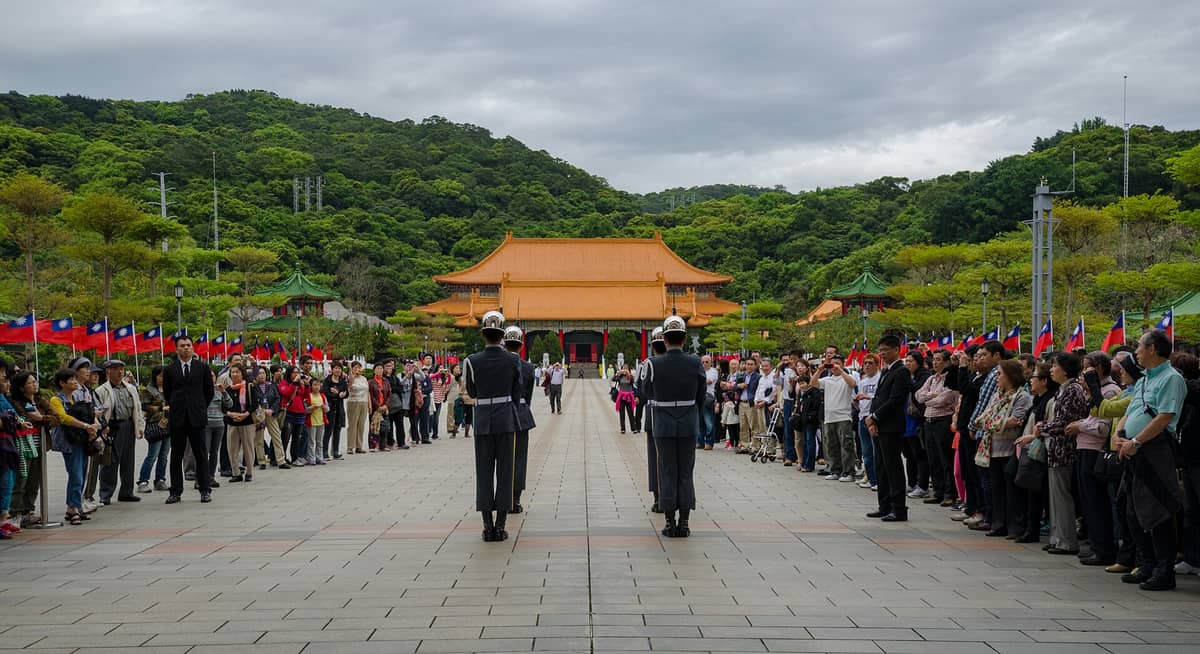
The hourly changing of the guard ceremony is the primary reason most international visitors come here, and it delivers. Honor guards in white dress uniforms with rifles perform a precisely choreographed rotation at the main hall, with synchronized steps, sharp arm movements, and a pace so slow that each footfall seems calibrated to the second. The full ceremony takes roughly 10 minutes from start to finish and happens every hour between 09:00 and 17:00.
Arrive a few minutes before the top of the hour to position yourself near the ceremonial path without blocking other visitors. The guards march in from the entrance gate, cross the full length of the courtyard, and perform the exchange directly in front of the main hall doors. Early morning ceremonies before 11:00 tend to draw smaller crowds and allow for unobstructed viewing and photography. By late morning on weekends, tour groups can cluster at the front, so patience and positioning matter.
💡 Local tip
For photography: shoot from the side of the processional path rather than directly in front, where other visitors tend to crowd. The angle from the eastern flank of the courtyard shows both the guards and the main hall facade in a single frame. Avoid using flash near the guards.
How the Atmosphere Changes Through the Day
The shrine opens at 09:00 and closes at 17:00. Early morning is the most serene window: the light falls at a low angle across the courtyard tiles, the air is cooler, and the only sounds are bird calls from the trees bordering the complex and the occasional distant bus on Beian Road. At this hour, the scale of the place registers most clearly. There are no vendors, no background music, and no amplified announcements. The silence in the courtyard between ceremonies is complete enough to feel unusual for urban Taipei.
Midday in summer brings full sun to the open courtyard, and the heat reflecting off the stone can be intense from June through September. The shade of the covered side galleries provides relief, but the main viewing area in front of the hall is fully exposed. Bring water and wear sun protection if visiting between 11:00 and 14:00 during warm months. Taipei's humid subtropical climate means this is not a minor inconvenience in summer.
Afternoon light in autumn and spring softens the courtyard and gives the yellow roof tiles a warmer tone, making the shoulder season visit more comfortable. For those planning a broader itinerary, the shrine pairs naturally with a walk through the Zhongshan District before or after, or a visit to Taipei Fine Arts Museum, which sits roughly 15 minutes away on foot.
Getting There and Practical Logistics
The shrine does not sit directly on a MRT line, which deters some visitors but keeps the crowds manageable. The most practical approach from central Taipei is to take the Tamsui–Xinyi Line to Yuanshan Station, then board any of several bus routes (42, 208, 247, 267, 287, or 紅2) to the 忠烈祠站 (Martyrs' Shrine) stop. Alternatively, Jiantan Station on the same MRT line connects to buses 267, 287, 646, 677, 902, and 紅3. From Dazhi Station on the Wenhu Line, buses 247, 902, 紅2, and 紅3 serve the same stop. Total journey time from central Taipei is typically 25–40 minutes depending on your starting point.
Taxis and ride-hailing services (Uber operates in Taipei) are straightforward from the city center and take around 15–20 minutes without heavy traffic. This is worth considering in summer heat or if visiting with young children or elderly family members who may find bus transfers inconvenient.
The site includes stairways and broad stone plazas that require walking and some climbing. The terrain is not extreme, but the grounds are not fully level. Visitors with significant mobility limitations should confirm accessibility on arrival, as the official information does not explicitly confirm wheelchair access to all areas of the complex.
⚠️ What to skip
Wear comfortable shoes with grip. The ceremonial stone pavement can be slippery after rain, which in Taipei's humid climate is not rare even in the drier season.
Historical Context Worth Understanding Before You Visit
The approximately 390,000 individuals commemorated here died across several decades of conflict, primarily the Second Sino-Japanese War (1937–1945) and the Chinese Civil War (1927–1949). The shrine was established and expanded as part of the Republic of China government's broader project of national memory-making after relocating to Taiwan. Understanding this context changes the experience from a passive architectural tour to something more layered.
The Spring Ceremony (around March 28–29) and Autumn Ceremony (around September 2–3) are major official memorial events attended by senior government figures. These ceremonies close the shrine to general visitors during the service period, but their existence underlines that this is a living institution rather than a heritage site frozen for tourism. The distinction is worth holding in mind while walking through the grounds.
For travelers interested in Republic of China history and its public memorialization, this site complements the 228 Peace Memorial Park, which addresses a different and more contested chapter of Taiwan's 20th-century history. Together the two sites give a fuller picture of how Taipei handles public memory, differently and sometimes in tension with each other. A broader exploration of Taipei's institutional architecture is well covered in the Taipei walking tours guide.
Who This Attraction Suits, and Who Can Skip It
The National Revolutionary Martyrs' Shrine is best suited to travelers with a genuine interest in architecture, military history, or ceremonial ritual. The changing of the guard is genuinely impressive and unlike anything else in Taipei. The architectural scale of the complex is worth seeing on its own terms. For travelers on a tight itinerary who have already seen Chiang Kai-shek Memorial Hall (which has its own guard ceremony), this shrine adds a different register rather than a redundant one: less tourist infrastructure, quieter, and more austere.
Travelers looking for interactive exhibits, food options, or shopping nearby will find little of that here. The shrine has no on-site café, no significant gift shop, and no interpretive museum within the complex. If your Taipei itinerary is primarily food, markets, or contemporary culture, the shrine may not be worth the transit time unless you have a specific interest in the ceremony or the architecture. Families with very young children may find the long waits between ceremonies and the formal atmosphere difficult to sustain.
Insider Tips
- The 09:00 opening ceremony is the least crowded of the day. Arriving at the gate just before 09:00 means you can watch the first guard deployment with almost no one else present.
- The shrine grounds include shaded gallery walkways along the perimeter that most visitors walk through quickly. Slow down here: the painted ceiling brackets and carved stone balustrades are detailed and deserve close attention.
- If you want the cleanest photographs of the main hall facade without visitors in frame, the 10–15 minutes immediately after a guard change, when the crowd disperses, give you a clear sightline across the courtyard.
- The bus ride from Yuanshan Station passes along the Jilong River embankment with brief views of the water and the hills to the north. It is a pleasant approach that gives a sense of how the shrine sits in relation to the rest of the city.
- Check the official Ministry of National Defense page before visiting if your trip falls in late March or early September, when the Spring and Autumn Ceremonies close the shrine to regular visitors for part of the day.
Who Is National Revolutionary Martyrs' Shrine For?
- Architecture and design travelers interested in Republican-era imperial Chinese forms
- History enthusiasts wanting to understand how Taiwan memorializes its 20th-century conflicts
- Photographers seeking dramatic ceremonial subjects with strong architectural backdrops
- Travelers who have already seen Chiang Kai-shek Memorial Hall and want a quieter, less-touristed counterpart
- Anyone with 60–90 minutes to spare who wants a genuinely solemn and architecturally extraordinary experience at no cost
Nearby Attractions
Other things to see while in Zhongshan District:
- Lin An Tai Historical House
Lin An Tai Historical House is a meticulously preserved Minnan-style courtyard residence dating back roughly 200 years, relocated to Binjiang Park beside the Keelung River in Zhongshan District. Admission is free, the setting is calm, and the architecture offers a rare window into the domestic life of a prosperous Qing-era Taiwanese family.
- Miniatures Museum of Taiwan
Tucked one floor below street level in Taipei's Zhongshan District, the Miniatures Museum of Taiwan houses an extraordinary collection of hand-crafted scale models, from Victorian manor houses to ornate European theaters, each built with obsessive precision. It is a quiet, unhurried attraction that rewards careful looking and suits travelers who want something genuinely different from the usual temple-and-night-market circuit.
- Museum of Contemporary Art Taipei (MOCA)
The Museum of Contemporary Art Taipei (MoCA Taipei) is Taiwan's first museum dedicated solely to contemporary art, set inside a beautifully repurposed Japanese colonial-era building in central Zhongshan. With a remarkably low entry fee and a program that rotates frequently, it rewards both a quick afternoon stop and a deliberate deep dive.
- Ningxia Night Market
One of Taipei's oldest and most food-focused night markets, Ningxia Night Market runs along a pedestrian-only stretch of Ningxia Road in Datong District. Compact, local, and unpretentious, it rewards visitors who want classic Taiwanese street food without the tourist-oriented carnival atmosphere of larger markets.