Rahmi M. Koç Museum: Istanbul's Industrial Treasure on the Golden Horn
Housed in a 12th-century anchor foundry and a historic shipyard on the northern shore of the Golden Horn, the Rahmi M. Koç Museum is Turkey's first major museum dedicated to the history of transport, industry, and communications. From vintage locomotives and submarines to early automobiles and scientific instruments, the collection spans 27,000 m² and rewards several hours of exploration.
Quick Facts
- Location
- Hasköy, Golden Horn (northern shore), Beyoğlu, Istanbul
- Getting There
- Bus 47E from Eminönü/Galata Bridge area toward Hasköy (Istanbulkart accepted)
- Time Needed
- 2.5 to 4 hours for the full complex; allow more if you ride the nostalgic train or take the boat trip
- Cost
- Approx. 900 TRY adults, 450 TRY students (as of 2026); separate tickets for train ride and Golden Horn boat trips. Verify current prices before visiting.
- Best for
- Families with older children, design and engineering enthusiasts, history buffs, and anyone wanting a break from Ottoman-era sightseeing
- Official website
- rmk-museum.org.tr/istanbul/en
What the Rahmi M. Koç Museum Actually Is
The Rahmi M. Koç Museum opened on 13 December 1994, founded by Rahmi M. Koç, the industrialist and honorary chairman of the Koç Group, Turkey's largest industrial conglomerate. The concept was modeled partly on science and industry museums he had visited abroad, but the collection is entirely personal: decades of acquisitions spanning locomotives, warships, biplanes, vintage cars, arcade machines, scientific instruments, and much more.
The museum complex covers approximately 27,000 m² and occupies two landmark structures: the Lengerhane, a Grade II listed building with origins tracing to the 12th century that once served as an Ottoman anchor and chain foundry, and the Hasköy Shipyard, a 19th-century naval facility on the water's edge. Between and around them stretches a large open-air exhibition area running along the Golden Horn shoreline. This layering of medieval, Ottoman, and industrial architecture gives the museum a physical richness most purpose-built institutions cannot replicate.
ℹ️ Good to know
The museum is officially described as Turkey's first and only industrial museum, and the first major institution dedicated to the history of transport, industry, and communications. It predates most comparable museums in the country by a decade or more.
The Buildings and What They Hold
The Lengerhane: Oldest Building, Broadest Collection
The Lengerhane is the heart of the museum. Walking in, your eyes take a moment to adjust. The interior is vast, high-ceilinged, and stone-walled, with the cool, slightly damp smell of old masonry mixing with machine oil and varnished wood. Display cases and full-sized exhibits fill the floor and mezzanine galleries: early radios, telegraph equipment, vintage motorbikes, scientific instruments, navigational tools, and mechanical toys arranged with enough breathing room that you can actually study them rather than just file past them.
The maritime section is particularly strong. Ship models, anchors, diving equipment, and navigation charts cover a broad sweep of Ottoman and early Republican maritime history. There is also a notable collection of early automobiles and motorcycles, some in remarkably preserved condition, displayed alongside period garage equipment that adds context to how these machines were actually used and maintained.
The Shipyard and Outdoor Area: Heavy Metal, Open Sky
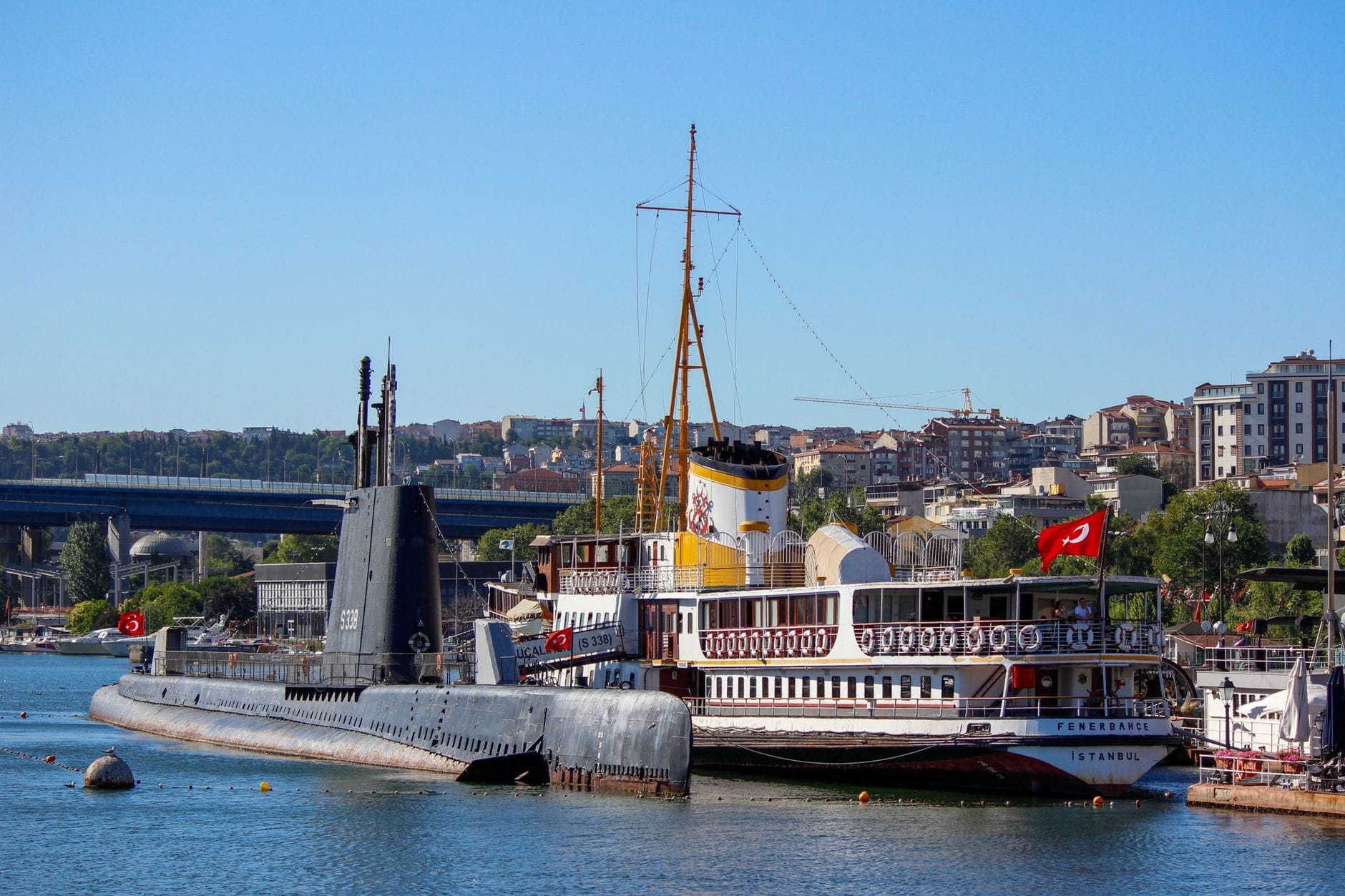
The outdoor grounds hold the largest and most dramatic exhibits. A full-scale submarine, aircraft, a steam locomotive, and heavy industrial machinery are positioned along the waterfront, where you can walk around them, peer inside some, and photograph them against the Golden Horn backdrop. On overcast days the grey water and industrial scale of the exhibits create an unexpectedly atmospheric setting. On sunny afternoons the reflections off the water make this the best photography zone in the complex.
Children are drawn immediately to the outdoor area, and with good reason. Unlike indoor galleries where fragile items demand careful supervision, the outdoor exhibits are robust enough that the atmosphere is relaxed. There is a nostalgic narrow-gauge train that loops through part of the grounds, sold as a separate ticket at the museum counter. It is modest in length but well-suited for younger visitors and for anyone who simply wants to sit down after extensive walking.
Tickets & tours
Hand-picked options from our booking partner. Prices are indicative; availability and final rates are confirmed when you complete your booking.
Bosphorus sunset cruise on luxury yacht with guide
From 55 €Free cancellationIstanbul and Bosphorus cruise on private boat - half day afternoon tour
From 40 €Instant confirmationFree cancellationWhirling Dervishes live show and exhibition
From 29 €Instant confirmationBasilica Cistern fast-track entry ticket and optional audio guide
From 34 €Instant confirmation
How the Experience Changes Through the Day
Arriving when the museum opens (09:30 on weekdays, 10:00 on weekends) gives you the indoor Lengerhane galleries largely to yourself. The stone walls hold the night's cool well into late morning, making it a comfortable start even in summer. Noise levels are low at this hour, which matters in a space full of intricate instruments and detailed labels that repay quiet attention.
By early afternoon, particularly on weekends, school groups and families fill the outdoor areas. The indoor sections remain manageable. If you are primarily interested in the automotive and maritime galleries, the morning-first strategy works well. If the outdoor exhibits and shoreline are your priority, mid-morning on a weekday gives you the best light and the thinnest crowds simultaneously.
💡 Local tip
Weekday mornings are significantly quieter than weekend afternoons. If you are visiting with children who need space to move freely around the outdoor exhibits, a Saturday morning arrival at opening time is the practical compromise between crowd avoidance and keeping adults and kids equally happy.
Late afternoon on a clear day is worth mentioning separately. The Golden Horn catches the low western light around 16:00 to 17:00, and the submarine and locomotive silhouetted against the water make for striking photographs without the midday flatness. Weekday visitors who arrive around 14:30 to 15:00 and plan to finish at closing time often find this the most rewarding order of operations: spend the indoor galleries while light is neutral, then move outdoors as the light improves.
Getting to Hasköy: Practical Transport
Hasköy is not on any metro or tram line. It sits on the northern shore of the Golden Horn, upstream from the Galata Bridge and the Eminönü waterfront. The most practical public route is bus 47E, which can be boarded in the Eminönü area using an Istanbulkart. The ride takes 15 to 25 minutes depending on traffic and drops you close to the museum entrance on Hasköy Caddesi.
Taxis and ride-hailing apps (BiTaksi, iTaksi) are a reasonable alternative if you are coming from a hotel in Beyoğlu or Taksim and want to avoid the bus transfer. The address to use is Rahmi M. Koç Cad. No: 3, Hasköy, Beyoğlu. Traffic on the Golden Horn road can stack up during peak hours; allow extra time if arriving between 08:00 and 09:30 or departing after 17:30 on weekdays.
⚠️ What to skip
The museum is closed on Mondays. Arriving without checking current hours is a common mistake, particularly among visitors combining this with a weekend trip to the Fener-Balat district nearby. Always confirm opening times on the official website before making the journey.
Cultural and Historical Context
The Lengerhane's origins as an anchor foundry are integral to the location's logic. The Golden Horn was Istanbul's primary industrial waterfront for centuries, serving Ottoman naval construction and maritime trade. Hasköy, this stretch of the northern shore, was part of that working waterfront: a place of forges, shipyards, and rope factories rather than the palaces and mosques that dominate the historic peninsula on the southern shore. Visiting the Rahmi M. Koç Museum connects naturally to a broader exploration of the area through the Byzantine and Ottoman layers of Istanbul's history, though the museum itself focuses primarily on the industrial and mechanical rather than the political or religious.
The Fener-Balat neighborhood sits a short distance along the Golden Horn shore. Combining both in a single day gives you an unusual arc through Istanbul's history: from the Greek and Jewish communities of Fener and Balat through the industrial heritage preserved in the Koç collection. The neighborhoods are walkable from each other, though the terrain is uneven and involves some uphill stretches.
Practicalities: What to Know Before You Go
Tickets and Pricing
As of 2026, general admission is approximately 900 TRY for adults and 450 TRY for students, payable in Turkish lira. These prices are subject to change and should be verified via the official Koç Museum website before your visit. The nostalgic train ride and any Golden Horn boat excursions offered by the museum require separate tickets purchased at the museum's own counter, not at the main entrance.
Opening Hours
The museum is generally open Tuesday through Friday from 09:30 to 17:00, and Saturday through Sunday from 10:00 to 19:00. It is closed on Mondays. Public holidays may affect these hours.
Accessibility
The museum complex spans multiple historic structures and open-air areas with different floor levels, ramps, stairs, and uneven surfaces on the grounds. Visitors requiring wheelchair access or with mobility limitations should contact the museum directly to understand the current provision. There is no guarantee from public sources that all sections are fully accessible. Keep your ticket throughout the visit: both the street-side and seaside sections have separate entry points that require ticket presentation.
Photography
Photography is generally permitted throughout the museum. The outdoor exhibits against the Golden Horn offer the most dramatic framing. A wide-angle lens or a phone camera with a wide setting handles the Lengerhane interior well; the stone vaulting and dim corridors mean a steady hand or a high ISO setting produces better results than flash. The best outdoor light is in the morning (southeast-facing) and in the late afternoon (western light catching the waterside exhibits).
What to Wear and Bring
Comfortable walking shoes are essential. The outdoor grounds cover a large area and the ground surfaces vary from paved paths to gravel and uneven stone. In summer, the outdoor sections offer very little shade between late morning and mid-afternoon, so sunscreen and a hat are practical. In winter, the stone interiors of the Lengerhane are cold; bring an extra layer regardless of the outdoor temperature.
Is It Worth the Visit?
For visitors primarily drawn to Istanbul's Ottoman and Byzantine heritage, the Rahmi M. Koç Museum represents a significant detour. Hasköy is not within walking distance of Hagia Sophia or the Topkapı Palace, and reaching it requires a dedicated half-day commitment. If your schedule is tight and you have not yet covered the core historic peninsula, this museum is not the first priority.
For everyone else, and especially for families with children over six, people with professional or personal interest in engineering and technology, and travelers who find most Istanbul museums repetitively imperial in focus, the Rahmi M. Koç Museum is one of the most satisfying afternoon or morning options in the city. The collection is genuinely extensive, the buildings are architecturally interesting, and the scale of the outdoor exhibits creates experiences that photographs cannot fully convey.
The museum fits naturally into the kind of itinerary described in a guide to less-visited Istanbul: it rewards curiosity and rewards visitors who are willing to move away from the established tourist corridors between Sultanahmet and Beyoğlu.
Insider Tips
- Buy tickets for the nostalgic train and any boat excursion at the museum counter as soon as you arrive, not after completing the indoor galleries. Capacity is limited and the sessions can sell out by early afternoon on weekends.
- The museum cafe and restaurant face the Golden Horn waterfront. Even if you are not eating a full meal, the outdoor seating area is one of the better spots on the northern shore to sit with a coffee and watch the city across the water. It is open to non-museum visitors as well, but arriving as a museum guest means you are already inside.
- Retain your entry ticket throughout the visit. The complex has two distinct entrances on different streets, and you will need to present your ticket when crossing between them. This is a detail the signage makes clear only once you are already inside.
- The museum's lighting in the Lengerhane interior is atmospheric but uneven. Bring reading glasses if you rely on them: some label text is small and displayed at low ambient light levels.
- Combine the museum with a walk through Fener and Balat on the same day. Head to Hasköy first (museum opens early), then walk or take a short taxi ride along the Golden Horn shore to the colorful streets of Balat in the afternoon, when the light on the painted facades is at its best.
Who Is Rahmi M. Koç Museum For?
- Families with children aged 6 and above who can engage with vehicles, machines, and hands-on scale exhibits
- Engineering, design, and technology enthusiasts looking for a substantive collection outside the mainstream
- Travelers who have already covered the major Ottoman and Byzantine sites and want something different
- Photographers interested in industrial aesthetics and unusual outdoor compositions against a waterfront backdrop
- Anyone planning a full-day Fener-Balat itinerary who wants a substantial anchor attraction to anchor the morning
Nearby Attractions
Other things to see while in Fener & Balat:
- Ecumenical Patriarchate of Constantinople
Tucked into Istanbul's historic Fener neighborhood along the Golden Horn, the Ecumenical Patriarchate of Constantinople is one of Christianity's oldest and most significant institutions. The complex centers on St George's Cathedral, an active place of worship and pilgrimage that has anchored Eastern Orthodox life in this city for over four centuries.
- Eyüp Sultan Mosque
Built in 1458 over the tomb of Abu Ayyub al-Ansari, a companion of the Prophet Muhammad, Eyüp Sultan Mosque stands as one of the holiest sites in Turkey. Located on the Golden Horn outside the old city walls, it draws both devout pilgrims and curious travelers seeking a side of Istanbul that most tourist itineraries overlook.
- Miniatürk
Miniatürk is an open-air miniature park on Istanbul's Golden Horn shore, displaying 135–139 scale models of Turkey's most significant monuments at 1:25 ratio. Opened in 2003, it spans 60,000 square metres and works as a surprisingly efficient primer on Turkish history and architecture.
- Pierre Loti Hill & Café
Perched 55 metres above the Golden Horn in the Eyüpsultan district, Pierre Loti Hill is a rare place where history, literature, and one of Istanbul's finest panoramas converge. Take the cable car or walk through a centuries-old cemetery to reach a teahouse that became famous after a French novelist's visits in the late 1870s.