Pierre Loti Hill & Café: Istanbul's Most Atmospheric Viewpoint
Perched 55 metres above the Golden Horn in the Eyüpsultan district, Pierre Loti Hill is a rare place where history, literature, and one of Istanbul's finest panoramas converge. Take the cable car or walk through a centuries-old cemetery to reach a teahouse that became famous after a French novelist's visits in the late 1870s.
Quick Facts
- Location
- İdris Köşkü Caddesi, Eyüpsultan, Istanbul (above Eyüp Sultan Mosque)
- Getting There
- Ferry or bus to Eyüp from Eminönü, then cable car (Istanbulkart) or 15–20 min walk through Eyüp Cemetery
- Time Needed
- 1.5–2.5 hours including travel from Eminönü
- Cost
- Free to access the hill; cable car charged via Istanbulkart at standard transit fare; café drinks at typical Istanbul prices
- Best for
- Panoramic views, literary history, quiet contemplation, sunset visits
- Official website
- http://www.pierrelotitepesi.com
What Pierre Loti Hill Actually Is
Pierre Loti Hill, known locally as Piyerloti Tepesi, is a forested hilltop rising about 55 metres above the Golden Horn on the western shore of the inlet, in Istanbul's Eyüpsultan district. At the top sits a historic teahouse and café complex that takes its name from the French naval officer and novelist Julien Viaud, who wrote under the pen name Pierre Loti. He visited Istanbul repeatedly in the 1870s and reportedly spent long hours at teahouses on this hill, gazing down at the water and the minarets below. His debut novel, Aziyadé, published in 1879 and set in Istanbul, drew on a love affair he claimed to have had in the city.
The physical experience divides into three distinct layers: the journey up, the hilltop café terrace, and the view itself. None of these is especially dramatic in isolation, but together they produce something that most visitors find genuinely moving. This is not a polished attraction with queues and ticket counters. It is a real working café on a public hill where locals come to drink tea and stare at the city.
💡 Local tip
The cable car (teleferik) from near Eyüp Sultan Mosque runs approximately 08:00–23:00 in summer and 08:00–22:00 in winter, and is paid using an Istanbulkart. If you plan to walk up through the cemetery instead, wear flat, closed shoes: the stone-paved paths are uneven and can be slippery when wet.
Getting There: Two Very Different Journeys
Most visitors arrive at Eyüp by ferry from Eminönü, a 25-minute ride up the Golden Horn that is pleasant in its own right. The ferry docks a short walk from Eyüp Sultan Mosque. From there, two routes lead to the hill. The cable car departs from near the mosque and delivers you to the café in a few minutes. It is the practical choice and offers good aerial views of the cemetery on the way up.
The walking route through Eyüp Cemetery is the more rewarding option if your legs are up to it. The cemetery is one of the oldest and most significant Islamic burial grounds in Istanbul, filled with Ottoman-era tombstones whose carved turbans and calligraphic inscriptions indicate the rank and profession of the deceased. The path is steep and stone-paved, and takes about 15 to 20 minutes at a relaxed pace. It is also one of the quieter walks you will find on the European side of the city. For context on how this area fits into Istanbul's broader Ottoman heritage, see our Istanbul Ottoman history guide.
If you are coming from the Sultanahmet or Beyoğlu side, buses run to Eyüp from Eminönü. The Fener-Balat neighbourhood sits between Eminönü and Eyüp along the Golden Horn, so it is possible to walk through Balat first, see the colourful streets, and continue to Pierre Loti Hill all in one loop along the water. That combination makes for one of the most layered half-days available in this part of the city.
Tickets & tours
Hand-picked options from our booking partner. Prices are indicative; availability and final rates are confirmed when you complete your booking.
Cruise, Bus Tour and Cable Car to Golden Horn and Pierre Loti Hill
From 37 €Instant confirmationFree cancellationBosphorus sunset cruise on luxury yacht with guide
From 55 €Free cancellationIstanbul and Bosphorus cruise on private boat - half day afternoon tour
From 40 €Instant confirmationFree cancellationWhirling Dervishes live show and exhibition
From 29 €Instant confirmation
The View and What You See From the Top
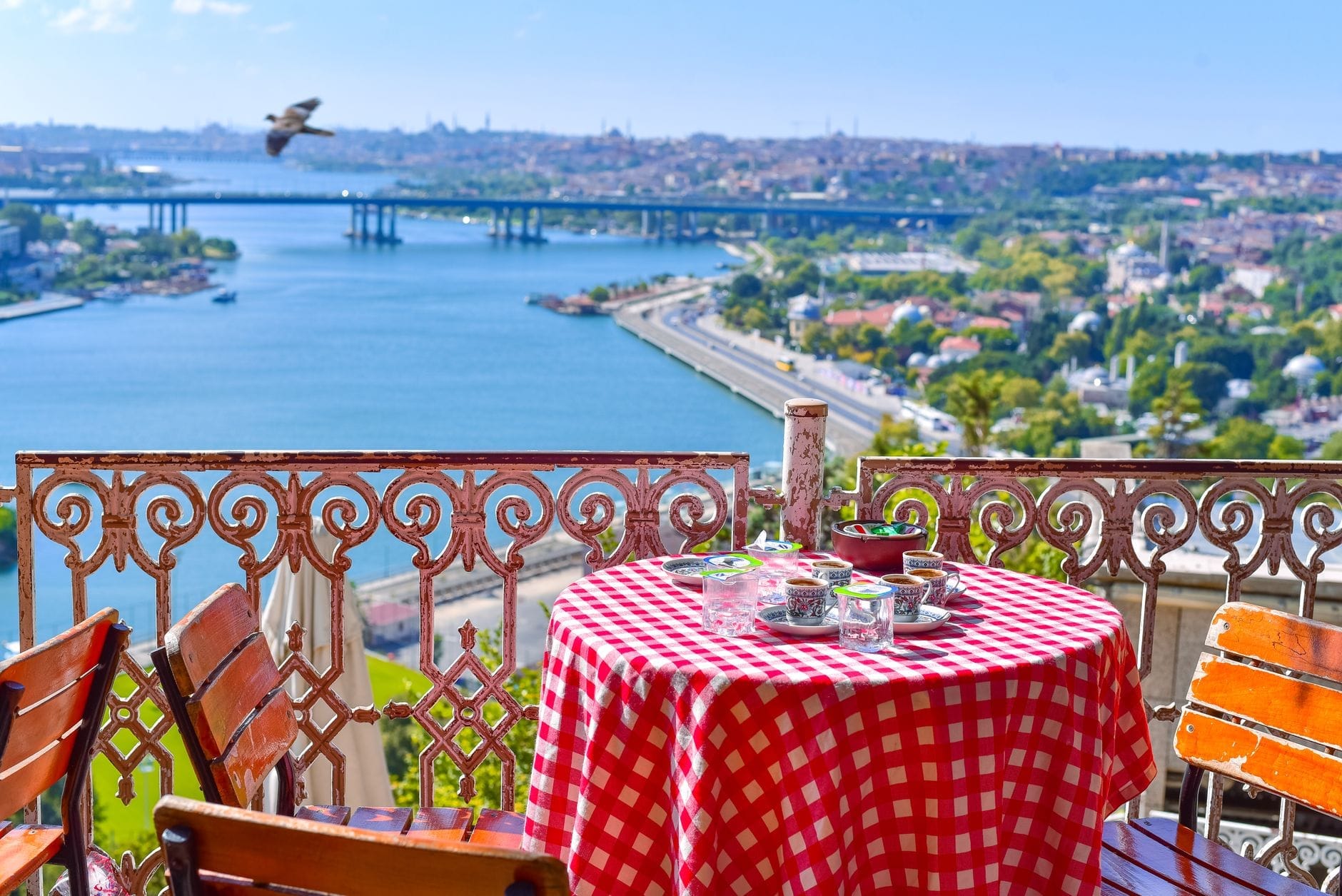
The café terrace faces east and south, looking down over the Golden Horn toward the historic peninsula. On a clear day you can trace the full length of the inlet, with the Süleymaniye Mosque dome rising behind Eminönü and the faint outline of the Bosphorus visible beyond. In the immediate foreground are the rooftops of Eyüp, the minaret of Eyüp Sultan Mosque, and the dense treeline of the cemetery. The combination of water, domes, minarets, and cypress trees is about as concentrated a version of the Istanbul skyline as exists from any public viewpoint.
The view shifts noticeably depending on the time of day. Morning light comes from behind you, illuminating the far shore of the Golden Horn cleanly. Late afternoon turns the water a metallic gold and the white stone of distant mosques a warm amber. Sunset visits are popular precisely because the western-facing hills of Eyüp mean the sun sets behind you, painting the eastern sky over the historic peninsula. If you want to compare this perspective with other elevated viewpoints across Istanbul, the Istanbul viewpoints guide covers the full range of options.
On hazy summer afternoons the view softens considerably, with the far minarets fading into a grey-blue haze. Winter visits, particularly on clear cold days in December or January, can produce the sharpest long-distance visibility, though the terrace seating thins out and the café moves most patrons indoors.
The Café: What to Expect Inside
The hilltop complex, formally called Piyerloti Tepesi ve Tarihi Kahve (Pierre Loti Hill and Historical Café), includes a café terrace, indoor seating areas, and a larger hotel and mansion complex called Turquhouse Hotel, which incorporates seven historic mansions with 67 rooms. The café itself is the draw for day visitors. It serves Turkish tea, Turkish coffee, and light refreshments at prices consistent with a modest Istanbul café. Nobody is rushing you out.
The indoor rooms carry old photographs, Ottoman decorative elements, and framed references to Loti's time here. The atmosphere is part municipal teahouse, part literary shrine, part tourist stop. On weekday mornings it leans more toward the first of those; on weekend afternoons, particularly in spring, it fills with a mix of Turkish families and foreign visitors. The terrace fills up first. If you arrive after about 15:00 on a Saturday in April or May, expect to wait for an outdoor seat.
ℹ️ Good to know
The café serves tea in standard tulip-shaped glasses. Turkish coffee is available but tea is the default order. There is no full kitchen menu: if you want a meal, eat in Eyüp before making the ascent.
Pierre Loti the Man: Why the Name Matters
Julien Viaud (1850–1923) was a French naval officer who visited Istanbul for the first time in 1876 during a posting. He fell for the city with an intensity that shaped his entire literary career. Writing as Pierre Loti, he set his first novel Aziyadé in Istanbul, drawing on a love affair he claimed to have had in the city. The novel is a romanticised portrait of late Ottoman Istanbul, its streets, its Golden Horn teahouses, and its social codes. It was published in France in 1879 and became an influential French novel of the late 19th century about the Ottoman world.
Loti returned to Istanbul several times and was eventually granted honorary Ottoman citizenship. The hill above Eyüp where he reportedly sat and wrote was named after him, a rare instance of a Western literary figure being commemorated in this part of the city. The area around Eyüp is deeply associated with Ottoman religious and civic life: Eyüp Sultan Mosque at the base of the hill is one of the holiest sites in Istanbul, traditionally where Ottoman sultans were girded with the sword of Osman at the start of their reign.
Practical Intelligence: Timing, Weather, and Menschenmengen
Weekday mornings between 09:00 and 12:00 offer the best combination of available terrace seating, clear light for photography, and minimal crowds. The hill is almost never overcrowded by Istanbul standards: even on busy weekend afternoons in spring, the wait for a seat is measured in minutes rather than hours. This is not a place that attracts the same volume of visitors as Hagia Sophia or the Grand Bazaar.
Spring (April to early June) and autumn (September to October) are the most comfortable seasons for the walk through the cemetery and the terrace visit. Summer heat peaks in July and August, and the walk up in full afternoon sun can be tiring. Winter visits are quieter and sometimes dramatically clear, though the unheated terrace means you will want a coat. For a full breakdown of seasonal conditions, see our Istanbul weather guide.
Photography is best before 11:00 in the morning (soft light on the Golden Horn) or in the 45 minutes before sunset. At midday, harsh overhead light flattens the view and the white stone of the mosque domes bleeds out in photographs. A wide-angle lens or the standard smartphone portrait mode both work well from the terrace railing. The angle looking back toward the cistern and dome cluster of the historic peninsula is the classic shot.
⚠️ What to skip
The walking path through Eyüp Cemetery is a functioning burial ground, not a tourist attraction in its own right. Dress modestly, keep voices low, and avoid photographing individual graves or funeral proceedings if any are in progress.
Who Should and Should Not Make the Trip
Pierre Loti Hill rewards visitors who are interested in literary history, Ottoman Istanbul, or simply want a quieter viewpoint away from the crowded tourist core. It pairs naturally with the Eyüp Sultan Mosque below and with a walk through the Fener-Balat neighbourhood along the Golden Horn, making it a logical anchor for a full day on the western European shore.
Visitors whose primary goal is ticking off major Ottoman monuments or Byzantine sites will likely find the detour to Eyüp takes more time than they want to spend. The journey from Sultanahmet is not quick: a ferry to Eminönü, then another ferry up the Golden Horn, or a bus, adds at least 40 minutes each way. If your itinerary is tight around the Topkapı-Hagia Sophia corridor, save Pierre Loti Hill for a second or third day. Travellers with significant mobility limitations should use the cable car: the cemetery walk involves sustained uneven gradients that are not wheelchair-accessible.
Insider Tips
- Take the ferry from Eminönü up the Golden Horn to Eyüp rather than a taxi or bus. The 25-minute boat ride offers a different perspective on the city's waterways and deposits you directly at the base of the hill near the mosque.
- Arrive on a weekday before 11:00 if you want terrace seating without waiting, and to catch the morning light over the Golden Horn before the haze builds.
- Walk up through the cemetery rather than taking the cable car. The Ottoman tombstones, with their carved turbans indicating the deceased's social rank, are worth at least 20 minutes of slow attention. Save the cable car for the descent if your knees prefer it.
- Order tea, not coffee. The tulip-glass tea comes quickly, is cheap, and gives you an excuse to sit for an hour without feeling rushed. The café is not designed for a five-minute stop.
- Combine this visit with the Eyüp Sultan Mosque below and then walk south through the Fener-Balat district along the Golden Horn to Eminönü. The full loop takes about half a day and covers some of the least-touristed but historically richest ground on the European side of the city.
Who Is Pierre Loti Hill & Café For?
- Travellers looking for a quieter panoramic viewpoint away from the Sultanahmet crowds
- Literature and history enthusiasts interested in late Ottoman-era Istanbul and French Orientalist writing
- Photographers wanting Golden Horn views in good morning or late-afternoon light
- Visitors combining a neighbourhood walk through Fener-Balat with a landmark destination
- Anyone wanting a genuine Turkish teahouse experience with a world-class backdrop
Nearby Attractions
Other things to see while in Fener & Balat:
- Ecumenical Patriarchate of Constantinople
Tucked into Istanbul's historic Fener neighborhood along the Golden Horn, the Ecumenical Patriarchate of Constantinople is one of Christianity's oldest and most significant institutions. The complex centers on St George's Cathedral, an active place of worship and pilgrimage that has anchored Eastern Orthodox life in this city for over four centuries.
- Eyüp Sultan Mosque
Built in 1458 over the tomb of Abu Ayyub al-Ansari, a companion of the Prophet Muhammad, Eyüp Sultan Mosque stands as one of the holiest sites in Turkey. Located on the Golden Horn outside the old city walls, it draws both devout pilgrims and curious travelers seeking a side of Istanbul that most tourist itineraries overlook.
- Miniatürk
Miniatürk is an open-air miniature park on Istanbul's Golden Horn shore, displaying 135–139 scale models of Turkey's most significant monuments at 1:25 ratio. Opened in 2003, it spans 60,000 square metres and works as a surprisingly efficient primer on Turkish history and architecture.
- Rahmi M. Koç Museum
Housed in a 12th-century anchor foundry and a historic shipyard on the northern shore of the Golden Horn, the Rahmi M. Koç Museum is Turkey's first major museum dedicated to the history of transport, industry, and communications. From vintage locomotives and submarines to early automobiles and scientific instruments, the collection spans 27,000 m² and rewards several hours of exploration.