Puffing Billy Railway: Victoria's Beloved Steam Train Through the Dandenong Ranges
Puffing Billy Railway is a preserved narrow-gauge steam railway running through the forested hills of the Dandenong Ranges, east of Melbourne. Dating back to 1900, it connects Belgrave to Gembrook across approximately 24 kilometres of mountain scenery. It's one of Victoria's most distinctive day trips, combining heritage rail history with a genuine sense of slow travel through the bush.
Quick Facts
- Location
- Belgrave to Gembrook, Dandenong Ranges, Victoria (Belgrave Station: 1 Old Monbulk Road, Belgrave VIC 3160)
- Getting There
- Metro train on the Belgrave line from Flinders Street Station to Belgrave; the railway station is a short walk from the Metro platform
- Time Needed
- Half day minimum; full day recommended if riding to Gembrook and back
- Cost
- Ticket price varies by journey section; bookings essential — check the official site before travel
- Best for
- Families with young children, rail heritage enthusiasts, day-trippers seeking forest scenery
- Official website
- puffingbillyrailway.org.au
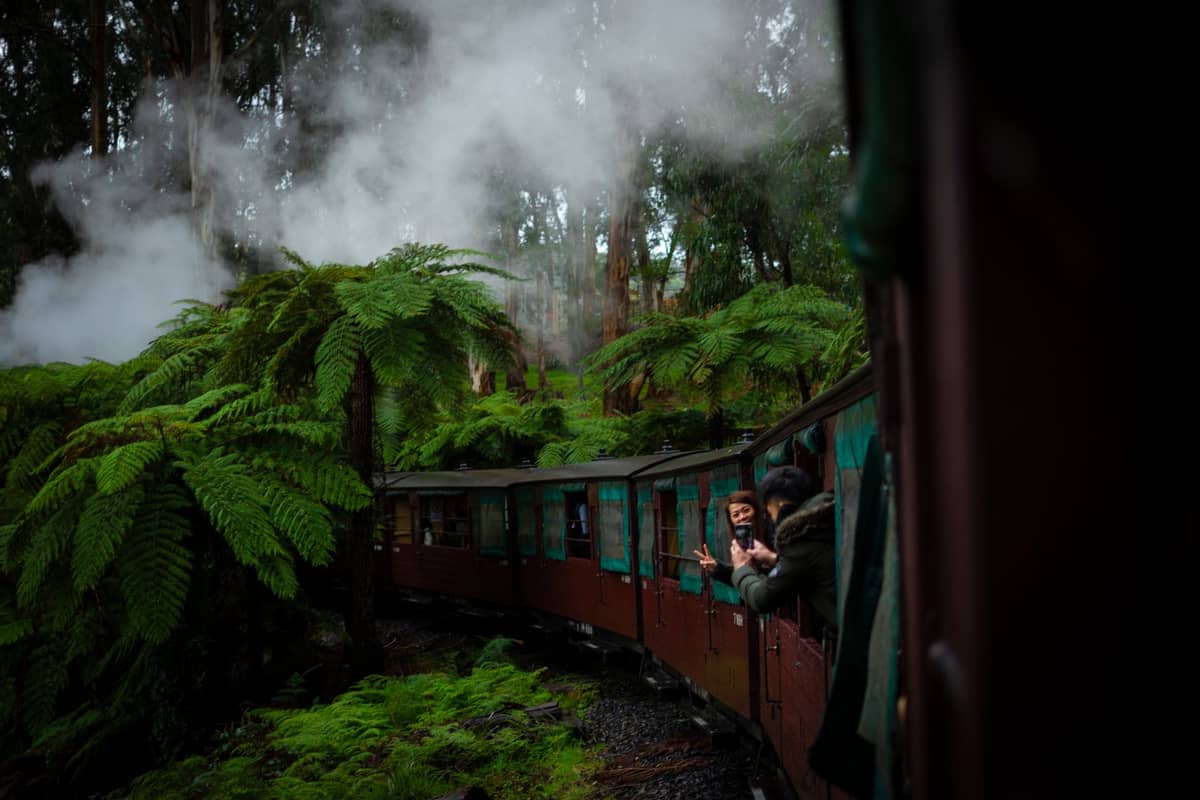
What Is Puffing Billy Railway?
Puffing Billy Railway is a heritage steam railway that has been carrying passengers through the Dandenong Ranges since 18 December 1900. Built on a narrow gauge of 762 mm (2 ft 6 in), the original line ran from Upper Ferntree Gully to Gembrook, serving isolated farming and logging communities in the ranges east of Melbourne. After decades of closure and preservation efforts, the line was restored in stages, with the final section to Gembrook reopening in October 1998, completing a route from Belgrave through Menzies Creek, Emerald, Cockatoo, and on to Gembrook.
What makes Puffing Billy genuinely different from most heritage attractions is that the steam locomotives are not a performance or a prop. Volunteers and paid staff operate fully functional steam engines, and the sound of the whistle bouncing off tree ferns as the train rounds a curve is one of those experiences that lands differently in person than any photograph suggests.
💡 Local tip
Trains do not run on Christmas Day and timetables vary by season. Check the schedule on the official website for your specific visit date before making any transport bookings.
The Journey: What You'll Actually See and Feel
The experience starts at Belgrave Station, which sits at the end of Melbourne's Metro Belgrave line. The heritage station itself signals a shift in pace: red-and-cream timber buildings, locomotive smoke drifting across the platform, and the particular smell of steam, coal, and old timber that no other attraction quite replicates. Passengers cluster on the open-sided carriages, sitting with legs dangling over the edge in the railway's most photographed tradition.
As the train moves out of Belgrave, the suburbs fall away quickly. Within a few minutes, the line is threading through tall eucalypts and temperate rainforest with tree ferns creating a dense green canopy at carriage height. The rocking rhythm, the whistle, and the smell of bush air make the journey itself the event, not merely the transport to one.
The most scenic section is widely considered to be the trestle bridge at Monbulk Creek, where the train crosses a wooden bridge high above a forested gully. It's a brief crossing but worth watching for. Later sections pass through open farmland as the line descends toward Emerald and Cockatoo, and the landscape becomes more patchwork. Gembrook is a small country town, and the station there has a pleasant picnic area and some local facilities.
The full return journey from Belgrave to Gembrook takes several hours, making it a full-day commitment if you're going end to end. Shorter return trips are available from Belgrave to Lakeside (near Emerald Lake Park), which is the most popular stop for families. The Dandenong Ranges as a whole offer considerable walking and nature options around each station, so it's worth combining the train with some time on foot if you have the energy.
Tickets & tours
Live prices and dates from our booking partner. If you book, we may earn a commission at no extra cost to you.
Puffing Billy and Healesville Sanctuary scenic bus tour
From 141 €Instant confirmationFree cancellationPuffing Billy and Phillip Island Penguin Parade Bus Tour
From 143 €Instant confirmationFree cancellationGreat Ocean Road reverse itinerary tour from Melbourne
From 77 €Instant confirmationFree cancellationGreat Ocean Road bus tour with a forest walk
From 90 €Instant confirmationFree cancellation
History and Why It Matters
Victoria once had an extensive network of similar narrow-gauge lines serving regional communities. Most were closed by mid-20th century as road transport made them uneconomical. The Puffing Billy line faced closure too, with sections shut down between 1944 and 1954 after storm damage. Crucially, the Puffing Billy Preservation Society, founded in 1955, campaigned for restoration and eventually took over operation. It was one of the first railway preservation efforts in Australia, and the model it established influenced similar movements worldwide.
The preserved railway is overseen by the Emerald Tourist Railway Board, a statutory authority of the Victorian Government, and operated as Puffing Billy Railway. The locomotive fleet includes original rolling stock and engines dating to the early 20th century, maintained and operated by an extraordinary number of volunteers. The society's longevity and the railway's continued use of genuine steam traction give it a credibility that many 'heritage experiences' lack.
If you're interested in rail history as a wider Melbourne theme, the Flinders Street Station in the city centre is worth a visit for its architectural and historical context before or after your Puffing Billy day trip.
Best Time to Visit and How Weather Changes the Experience
Autumn (March to May) and spring (September to November) are the most comfortable seasons for the journey. Autumn brings golden light through the tree canopy and cooler, clearer air. Spring can be dramatic and unpredictable in the ranges: warm enough to enjoy open carriages but with the possibility of sharp showers. Summer visits are popular but can be hot on open carriages in full sun, and there is a fire risk policy in place during days of high fire danger rating — on declared Total Fire Ban days, Puffing Billy substitutes diesel locomotives for steam, which changes the experience considerably.
Winter mornings can produce mist in the gullies that makes the journey atmospheric and beautiful. The carriage sides are open, so cold-weather visitors should dress in layers. Early departures in winter catch the mist best; later trains on clear days can be just as rewarding.
⚠️ What to skip
On days of Total Fire Ban, Puffing Billy uses diesel traction instead of steam locomotives. If riding a genuine steam-hauled train is the main draw, check fire danger ratings for your travel date — especially November through March.
For context on Melbourne's seasonal patterns before planning your trip, the best time to visit Melbourne guide covers the broader considerations across the city and surrounding regions.
Getting There: Transit, Driving, and Logistics
From central Melbourne, take a Metro train on the Belgrave line to Belgrave. The Puffing Billy station is a short walk from Belgrave Metro Station.
Driving to Belgrave is straightforward via the Eastern Freeway/Eastlink or the Monash Freeway, with paid parking available in the area. Driving gives more flexibility but removes the pleasing continuity of arriving by train, which makes the day feel more like a genuine rail journey end-to-end.
Belgrave Station's accessible entrance has a steep ramped approach; a drop-off area is available at Gate 4 for visitors who need vehicle access. Accessible carriages with boarding ramps can be arranged in advance — contact the railway before visiting if this is required. Accessible toilets are available at several stations along the route.
💡 Local tip
Book tickets online in advance, especially on weekends and school holidays. Puffing Billy can sell out on popular dates, and ticket prices vary by journey section. Visit puffingbillyrailway.org.au for current pricing and booking.
For a broader overview of how to move around Melbourne and its surrounds efficiently, the getting around Melbourne guide has current information on myki, tram zones, and day-trip logistics.
Who Will Love It, and Who Might Not
Puffing Billy is a particularly good choice for families with young children. The trains are slow enough to be unthreatening and the open-sided carriages delight most kids aged four and up. There's enough sensory novelty — the steam, the whistle, the dangling legs — to hold attention without needing any curated entertainment. Lakeside is the popular family stop, with Emerald Lake Park nearby offering a model railway, paddle boats, and picnic grounds.
Rail heritage enthusiasts will find real depth here: the locomotive shed at Menzies Creek includes a museum with exhibits on the railway's history, and some special event days allow closer access to the engines. Photographers get considerable material along the route, especially at the Monbulk Creek trestle bridge and during early morning runs when steam catches the light.
If your primary interest is the destination rather than the journey itself, Puffing Billy may frustrate. Gembrook is a small country town with limited facilities, and the stops between are quiet. This is not an attraction designed around what you find at the other end. If you want dramatic natural scenery as the payoff, the Dandenong Ranges walking tracks accessed from various stations are more rewarding when combined with the train than treated as a secondary activity.
Visitors who have difficulty with cold or prefer enclosed carriages should know that the signature carriages are fully open-sided. There are some enclosed carriages available, but the iconic hanging-legs experience is on the open stock. In strong rain, the open carriages are genuinely wet. Some travellers find the pace too slow for a full-day itinerary if they're aiming to cover more of Melbourne or its surrounds.
Puffing Billy pairs naturally with a broader day trip into the ranges. If you're considering the wider region, the day trips from Melbourne guide covers several options that can be combined with or compared to the Puffing Billy experience.
Insider Tips
- Sit on the left side of the carriage when departing Belgrave for the best view of the Monbulk Creek trestle bridge. The right side gets the view on the return journey, so you won't miss out either way.
- The Menzies Creek station museum and locomotive shed is a worthwhile 20-minute stop if you disembark mid-route. Most visitors stay on the train, so it's quieter here than at the main stations.
- Early morning departures from Belgrave produce the most atmospheric steam effects, especially in winter and early spring when mist sits in the valley gullies.
- On Melbourne Cup day and during Thomas the Tank Engine event weekends, the railway runs themed trains that book out far in advance. Check the events calendar if those experiences appeal — or avoid those dates if you want a quieter ride.
- Check current ticketing options and requirements before travelling by Metro from the city to Belgrave.
Who Is Puffing Billy Railway For?
- Families with children who want a memorable, low-stress day out from Melbourne
- Rail heritage enthusiasts interested in preserved narrow-gauge steam traction
- Visitors wanting a day in temperate forest scenery without heavy hiking
- Photographers looking for early-morning steam and forest light combinations
- Travellers combining Puffing Billy with walking tracks in the Dandenong Ranges
Nearby Attractions
Combine your visit with:
- 1000 Steps Kokoda Track Memorial Walk
The Kokoda Track Memorial Walk, known locally as the 1000 Steps, climbs through fern-filled forest in the Dandenong Ranges east of Melbourne. Free to visit and reached by train, it combines a genuine physical workout with quiet moments of WWII commemoration.
- Albert Park Lake
Albert Park Lake is a vast freshwater reserve just minutes from Melbourne's CBD, offering a 4.7km walking and cycling path around calm water, sports ovals, and open parkland. Free to enter and accessible by tram, it rewards early morning walkers, cycling families, and anyone wanting to understand how Melbourne uses its open spaces.
- Bells Beach
Bells Beach, in Wadawurrung country and also known by its Traditional Owner name Djarrak, is a 48-hectare coastal reserve near Torquay that holds the distinction of being the world's first declared surfing reserve. With its sheer sandstone cliffs, deep bowl-shaped break, and annual Rip Curl Pro competition, it draws surfers and non-surfers alike for one of Victoria's most dramatic coastal experiences.
- Brighton Beach Bathing Boxes
Lined up along Dendy Street Beach in Brighton, Melbourne's 96 privately owned bathing boxes are one of Victoria's most recognisable sights. Free to view from the public beach, they reward visitors who time their arrival with the morning light or an empty tide. Here is what you actually need to know before making the trip.
Planning a trip? Discover personalized activities with the Nomado app.