Brighton Beach Bathing Boxes: Melbourne's Most Photographed Shoreline
Lined up along Dendy Street Beach in Brighton, Melbourne's 96 privately owned bathing boxes are one of Victoria's most recognisable sights. Free to view from the public beach, they reward visitors who time their arrival with the morning light or an empty tide. Here is what you actually need to know before making the trip.
Quick Facts
- Location
- Dendy Street Beach, Brighton, Victoria (near Dendy St & The Esplanade intersection)
- Getting There
- Brighton Beach Station (Sandringham line from Flinders Street), then approx. 500 m walk via Green Point
- Time Needed
- 30–60 minutes to walk the full length and photograph; longer if you combine with a foreshore walk
- Cost
- Free to view from the public beach; boxes are privately owned and not open to visitors
- Best for
- Photography, coastal walks, architecture enthusiasts, families with young children
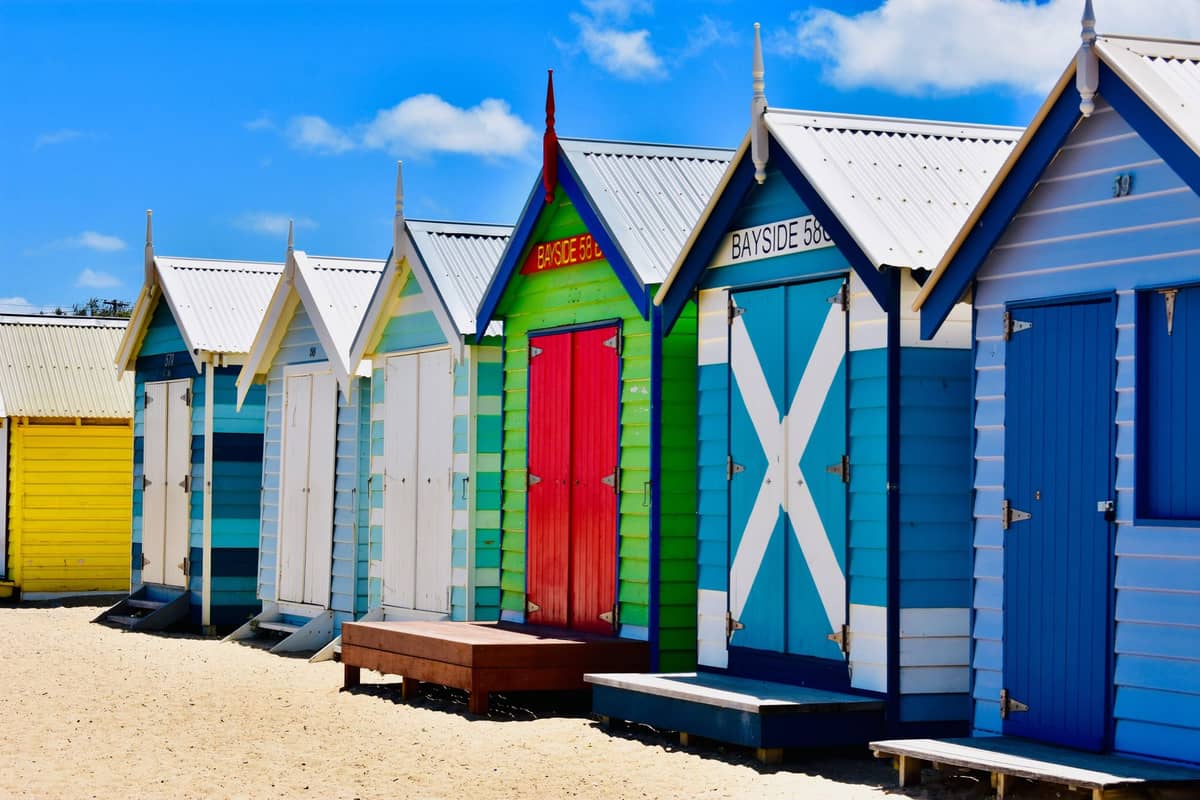
What Are the Brighton Beach Bathing Boxes?
The Brighton Beach Bathing Boxes are 96 small wooden changing sheds lined in a single row along Dendy Street Beach, roughly 11 kilometres south of Melbourne's central business district. Each box is privately owned, painted in a distinct colour scheme or pattern, and has been handed down through families or sold at auction for prices that regularly make local news. They are not a museum, not a public facility, and not an organised attraction with staff or entry procedures. You walk to the beach, you see them, and you walk away. That simplicity is precisely their appeal.
Bathing boxes appeared along Brighton's coast from the 1860s, a period when changing on the beach was not permitted and private boxes provided a place for modest bathing. The boxes at Dendy Beach were brought together in 1934 for easier collective maintenance. The structure of each box is modest, roughly the size of a garden shed, but the collective effect of 96 individually decorated facades stretching along the shore is striking in a way that photographs only partially capture.
ℹ️ Good to know
The boxes are privately owned and closed to the public. You can photograph them freely from the beach, but do not attempt to open or enter any box, and respect owners who are using their property.
What You Actually See When You Arrive
Approaching along the Esplanade path, the boxes appear gradually as you round the slight curve of the bay. From a distance, they read as a band of colour against the grey-green water of Port Phillip Bay, but up close, the individual designs are the real story. Some boxes carry bold geometric patterns in primary colours. Others feature hand-painted murals of local beaches, native birds, or abstract shapes. A few are almost entirely white with thin colour accents, and some owners have changed the design over the years, so the row is never completely static.
The beach itself is narrow sand backed by the esplanade path, so you are never far from the boxes. At low tide, the sand widens and you can get a lower angle for photographs with the bay in the background. The water in Port Phillip Bay is generally calm here, sheltered from ocean swell, which gives the location a mild, almost still quality on windless days. On choppy winter mornings, the same stretch can feel bleak and exposed. Both moods have their appeal, but they are very different experiences.
Tickets & tours
Live prices and dates from our booking partner. If you book, we may earn a commission at no extra cost to you.
Phillip Island wildlife and Brighton Beach Boxes bus tour
From 97 €Instant confirmationFree cancellationPeninsula hot springs and bathing boxes
From 117 €Instant confirmationFree cancellationGreat Ocean Road reverse itinerary tour from Melbourne
From 77 €Instant confirmationFree cancellationGreat Ocean Road bus tour with a forest walk
From 90 €Instant confirmationFree cancellation
Morning vs Afternoon: How Light and Crowds Change Everything
The bathing boxes face roughly east-northeast across the bay, which means the best natural light for photography falls in the morning hours. From around 7 a.m. on clear days, the sun catches the painted facades directly and the shadows fall cleanly behind them. The colour contrast between the boxes, the sand, and the blue-grey water is at its sharpest in the first two hours after sunrise. Serious photographers consistently arrive early for this reason.
By mid-morning on weekends, particularly in summer and on mild autumn days, the esplanade path and the beach in front of the boxes fills steadily with other visitors, families with small children, joggers using the foreshore path, and dog walkers who are common here before 9 a.m. The boxes themselves do not change, but the clean foreground in photographs becomes harder to achieve once the crowd arrives. If your goal is a largely uncluttered shot, plan for a weekday morning in autumn or spring.
Afternoon light produces long shadows and a warmer tone that some find more atmospheric. The western sky behind you can produce interesting reflective light on the boxes in the hour before sunset, though this is less reliable than morning conditions. On overcast days, the flat light actually softens the effect of the brighter box colours and removes the harshness of shadows, which suits a more documentary style of photography.
💡 Local tip
For photography: arrive before 8 a.m. on a clear weekday. Walk the full length of the row before settling on a composition. The tighter the cluster of boxes in the frame, the more impact the image has.
Getting There: Train, Car, and On Foot
The most straightforward route is the Sandringham train line from Flinders Street Station to Brighton Beach Station. The journey takes roughly 25 to 30 minutes. From the station, follow Green Point down to the Esplanade and the beach is approximately 500 metres on foot. The path is flat and straightforward, and the directions are simple enough that a map is rarely needed.
If you are travelling by car, paid parking is available near the Dendy Street and Esplanade intersection. Parking availability varies on weekends and during school holidays. Note that driving from the CBD also gives you the option of combining this visit with a stop at St Kilda Beach or the St Kilda Pier penguin colony on the same afternoon, as both are a short drive north along the bay.
The Bayside Coastal Trail runs along the foreshore and connects several bayside suburbs, so the bathing boxes can also serve as a midpoint on a longer coastal walk rather than a standalone destination. The path surface is sealed along the esplanade section, making it manageable for strollers and wheelchairs, though the beach sand itself is uneven. The nearby Dendy Beach Pavilion car park has two accessible parking spaces, and designated bus parking is available on The Esplanade and at Green Point, according to Bayside City Council.
Historical and Cultural Context
Brighton developed as a wealthy bayside suburb in the nineteenth century, and the bathing boxes were markers of that prosperity. The regulations requiring separate bathing times and changing facilities for men and women were enforced through much of Port Phillip Bay's coastal councils until well into the twentieth century. The boxes at Dendy Beach survived that era and, rather than becoming obsolete, appreciated in value as the foreshore became increasingly desirable real estate.
Today, the boxes trade hands for prices that reflect their scarcity, their location, and their cultural cachet. The boxes are exclusively owned by Bayside residents, and Bayside City Council administers the foreshore. For visitors, the cultural significance is partly in that continuity: these are not a reconstruction or a heritage display, but functional private property in continuous use, which is unusual for a Victorian-era coastal facility.
Brighton sits within Melbourne's inner-bay coastal strip, and its character is distinct from the grittier, more eclectic atmosphere of St Kilda a few kilometres north. If you are interested in how Melbourne's bayside suburbs differ in character and history, the best beaches near Melbourne guide covers the range of coastal options across the metropolitan area.
Practical Details: What to Bring and What to Expect
There is a small café at the Dendy Beach Pavilion near the bathing boxes. The Esplanade in Brighton has several cafes within a short walk north or south, and Bay Street Brighton (a 10-15 minute walk inland) has a wider range of options including coffee shops and brunch spots. If you are arriving on the first train of the day for early light photography, pack your own coffee.
Wear comfortable shoes for walking on sand and sealed paths. In summer, sun exposure on the open beach is significant even in the morning, so sunscreen and a hat are practical. Melbourne's weather is famously variable, and a morning that starts sunny can turn cool and windy within an hour. A light layer is useful in any season.
If you are planning a wider exploration of Melbourne's outdoor and cultural sites, the Melbourne gardens and parks guide and the best views in Melbourne guide both help place the bathing boxes within a broader itinerary of outdoor sights.
⚠️ What to skip
Melbourne's weather can shift quickly at any time of year. The open beachfront offers no shelter from wind or rain. Check the Bureau of Meteorology forecast before an early morning visit, especially between May and August.
Is It Worth the Trip? An Honest Assessment
The Brighton Beach Bathing Boxes are genuinely photogenic and have an architectural interest that goes beyond the social media cliche. Seeing 96 individually decorated wooden facades in a continuous row, against the flat expanse of Port Phillip Bay, is a specific visual experience that does not exist anywhere else in Australia in quite this form.
That said, the experience is brief. Most visitors spend 20 to 40 minutes here before moving on. There is nothing to do beyond walk the row and look at the boxes. If you are travelling under significant time pressure or have limited mobility on sand, the return on investment is lower than for more immersive attractions.
Visitors with more time in Melbourne who want depth over novelty should also look at the Royal Botanic Gardens Victoria or the Heide Museum of Modern Art for contrast. But if you are already spending time on the bayside, the bathing boxes are a logical and rewarding stop that costs nothing and takes less than an hour.
Insider Tips
- Walk the entire row before deciding where to photograph. The boxes at the northern end of the row are often less crowded and give a longer perspective shot with all 96 boxes receding into the distance.
- A polarising filter makes a significant difference on sunny mornings: it deepens the blue of the water and reduces glare from the painted surfaces without washing out the colours.
- If you are visiting on a summer weekend, the beach in front of the boxes can feel busy by 10 a.m. Arriving before 8 a.m. gives you a near-empty stretch of sand and much better light.
- The Sandringham train line runs directly to Brighton Beach Station, but the Bayside Coastal Trail means you can also walk south from St Kilda along the foreshore, which adds context to the surrounding bayside suburbs before you arrive.
- Autumn (March to May) tends to combine mild temperatures, lower visitor numbers, and clean morning light, making it arguably the most comfortable season for this particular visit.
Who Is Brighton Beach Bathing Boxes For?
- Photographers and content creators looking for a distinctively Melbourne image with good natural light early in the day
- Families with young children who want a short, flat, free coastal outing without the crowds of St Kilda
- Architecture and design enthusiasts interested in Victorian-era coastal structures still in functional private use
- Travellers combining a bayside walk with nearby coastal stops along the Sandringham line
- Visitors looking for a free activity that works as a half-morning excursion rather than a full-day commitment
Nearby Attractions
Combine your visit with:
- 1000 Steps Kokoda Track Memorial Walk
The Kokoda Track Memorial Walk, known locally as the 1000 Steps, climbs through fern-filled forest in the Dandenong Ranges east of Melbourne. Free to visit and reached by train, it combines a genuine physical workout with quiet moments of WWII commemoration.
- Albert Park Lake
Albert Park Lake is a vast freshwater reserve just minutes from Melbourne's CBD, offering a 4.7km walking and cycling path around calm water, sports ovals, and open parkland. Free to enter and accessible by tram, it rewards early morning walkers, cycling families, and anyone wanting to understand how Melbourne uses its open spaces.
- Bells Beach
Bells Beach, in Wadawurrung country and also known by its Traditional Owner name Djarrak, is a 48-hectare coastal reserve near Torquay that holds the distinction of being the world's first declared surfing reserve. With its sheer sandstone cliffs, deep bowl-shaped break, and annual Rip Curl Pro competition, it draws surfers and non-surfers alike for one of Victoria's most dramatic coastal experiences.
- Dandenong Ranges
The Dandenong Ranges rise about 40 kilometres east of Melbourne, offering a dramatically different landscape from the city below. Tall mountain ash forests, a celebrated botanic garden, and the Puffing Billy Railway make this one of Victoria's most rewarding day trips. A half-day is possible, but a full day suits the area much better.
Planning a trip? Discover personalized activities with the Nomado app.