Prokop Valley (Prokopské Údolí): Prague's Wild Canyon in the City
Prokop Valley — officially Přírodní rezervace Prokopské údolí — is a 101.5-hectare limestone canyon reserve in southwest Prague, open year-round at no cost. With trails cutting through a gorge up to 70 metres deep, it offers one of the most genuinely wild walking experiences within Prague's city limits.
Quick Facts
- Location
- Prokopské údolí, Jinonice / Hlubočepy, Prague 5 (southwest Prague)
- Getting There
- Hlubočepy railway station (suburban rail, PID network) or nearby bus stops; green hiking trail leads into the valley
- Time Needed
- 1.5 to 3 hours for a trail loop; longer if combining with the Dalejské údolí extension
- Cost
- Free. No admission fee, no gates.
- Best for
- Hikers, cyclists, geology enthusiasts, anyone who wants to escape tourist crowds entirely
What Prokop Valley Actually Is
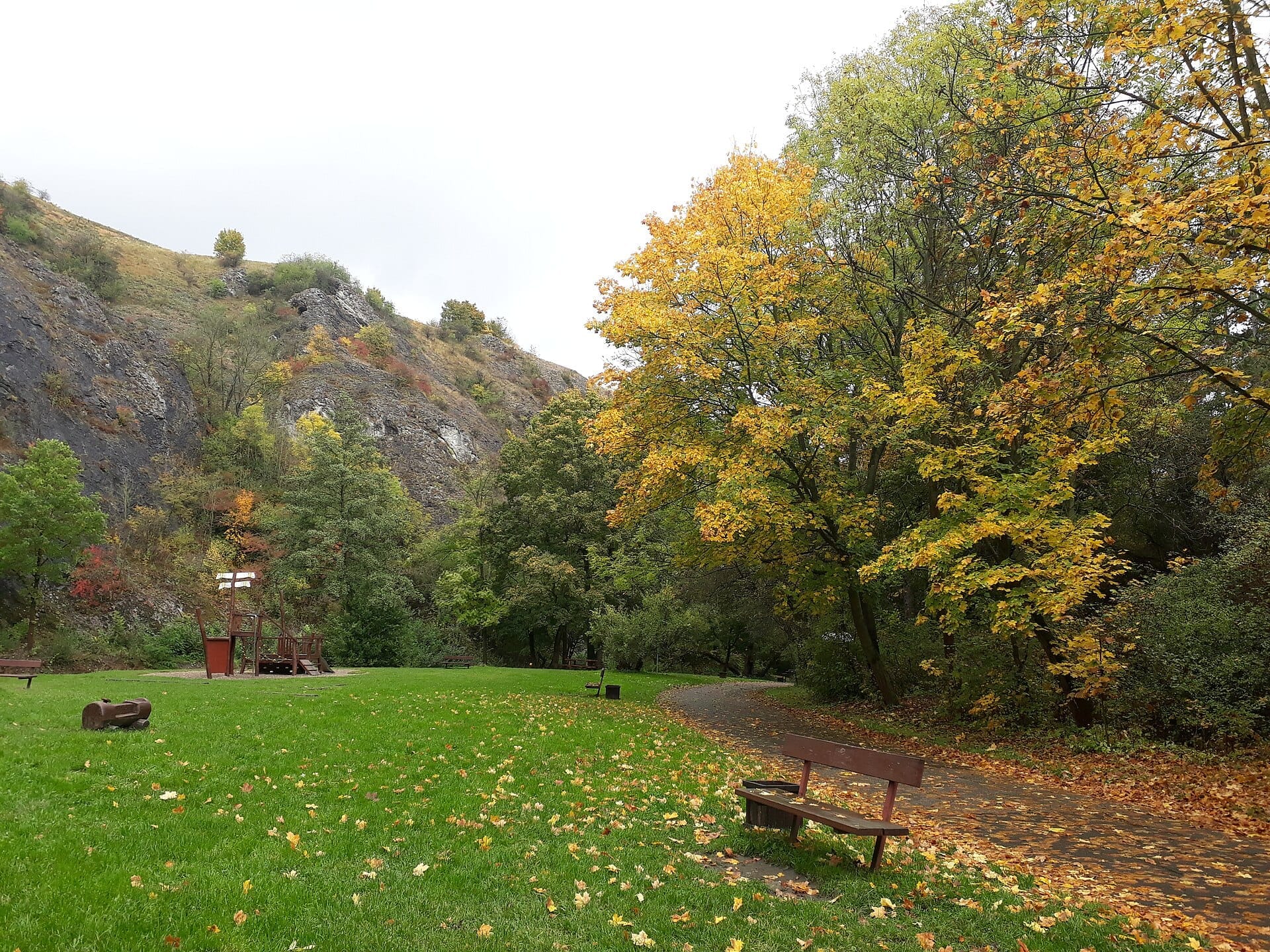
Most visitors to Prague never leave the cobblestones of the Old Town. Prokopské údolí is what they miss: a limestone canyon carved up to 70 metres deep by erosion over roughly the last one million years, sitting inside the city boundaries of Prague 5. The reserve covers 101.5 hectares across the cadastral areas of Jinonice and Hlubočepy, and it was granted official nature reserve status in 1978. Today it forms part of the larger Přírodní park Prokopské a Dalejské údolí, a connected system of valleys extending further southwest.
The scale surprises people. Walking the valley floor, the rock walls rise sharply on both sides, dense with scrub oak, wild grasses, and exposed limestone faces that glow warm yellow in afternoon light. The Prokop stream runs along the bottom, audible before it's visible on quieter days. There is a small lake near the northern end of the main section, a remnant of 19th-century quarrying activity that also destroyed a 120-metre-long cave containing prehistoric fossils — a loss to science, but the quarrying scars have since softened into rough, ecologically rich terrain.
ℹ️ Good to know
Prokop Valley is accessible 24 hours a day, 365 days a year, at no cost. There are no gates, ticket booths, or entry points requiring registration.
The Experience at Different Times of Day
Morning visits, particularly on weekdays, feel almost private. By 8am the valley floor is cool and shaded, the limestone walls still holding the chill of the night. You might hear woodpeckers working the upper tree line and the low whistle of suburban trains on the Hlubočepy line above, a reminder that this canyon exists within a functioning city. The grass along the lower path is often wet with dew well into mid-morning, so waterproof footwear pays off even in summer.
Midday on weekends brings local families, cyclists, and dog walkers. The cycle path along the valley floor is wide enough that foot and bike traffic rarely conflict, but the narrower side trails up the canyon walls are essentially single-file. In summer, the exposed limestone terraces along the upper rim become warm enough to sit on, and the view back down into the gorge from those perches is the most photogenic angle in the reserve: a narrow band of green cutting between pale rock walls, with the city invisible beyond the canyon edges.
Late afternoon light, especially from April through October, hits the western-facing rock faces directly. The limestone takes on an amber tone that landscape photographers seek out. By evening the valley empties quickly; it is not a venue for nightlife, and the trail surfaces are uneven enough that navigation after dark without a headlamp would be genuinely difficult on the steeper sections.
Tickets & tours
Hand-picked options from our booking partner. Prices are indicative; availability and final rates are confirmed when you complete your booking.
Self guided tour with interactive city game of Prague
From 5 €Instant confirmationFree cancellationPrague by night city tour
From 27 €Instant confirmationFree cancellationPrague city tour with Vltava River cruise
From 38 €Instant confirmationFree cancellationPrague Castle online audio guide
From 5 €Instant confirmationFree cancellation
Geology and Ecology: Why the Rock Matters
The canyon walls expose Silurian and Devonian limestone formations, part of the Barrandian basin, one of the best-preserved Palaeozoic geological sequences in central Europe. The fossils extracted here in earlier centuries, along with those from nearby Barrandov and the destroyed Prokop cave, contributed significantly to 19th-century understanding of ancient marine life. The valley’s name is traditionally linked to St. Procopius (sv. Prokop), reflecting the area’s historical and cultural associations rather than its geology.
Ecologically, the reserve supports a mosaic of habitats: thermophilous (heat-loving) grasslands on the south-facing slopes, xerophytic plant communities on the exposed limestone, and riparian vegetation along the stream. This combination supports a notable diversity of butterfly species and, in spring, wildflowers that botanists travel specifically to observe. The steep terrain has protected much of this from urban encroachment that flattened surrounding districts decades ago.
💡 Local tip
Spring (April to early June) is the best season for wildflowers and butterfly activity on the limestone grasslands. The valley is also striking in late October when the deciduous canopy turns, though rain makes the clay sections of trail slippery.
How to Navigate the Valley
The primary access point used by most visitors arriving by public transport is Hlubočepy railway station, served by suburban rail lines integrated into the Prague PID network. From the station, the green hiking trail leads directly into the valley within a few minutes of walking. Bus stops near Jinonice also provide access from the northern end. The valley follows a roughly northwest–southeast alignment, so a straightforward out-and-back walk is easy to plan without a map, though having the Prague hiking trail app or a downloaded offline map helps when exploring the branching side paths.
The valley floor path and cycle route are relatively flat and manageable, but the trails climbing to the canyon rim involve significant gradient changes and loose rock in places. Wear shoes with grip. The terrain is not suitable for standard pushchairs or wheelchairs; the cycle path on the valley floor offers the most accessible route for those with limited mobility, though it remains unpaved gravel in sections.
For a longer outing, the valley connects southwest into the Dalejské údolí, extending the walk considerably. This combination suits the kind of half-day exploration covered in Prague's lesser-known outdoor spaces. Alternatively, the valley makes a natural pairing with Divoká Šárka if you want to compare two contrasting styles of Prague canyon landscape in a single day.
Photography Conditions and Practical Gear
The canyon is at its most photogenic in late afternoon when the low sun hits the limestone walls from the west. A wide-angle lens captures the sense of depth from the upper trail lookouts; a longer focal length isolates the rock textures and the natural arch formations visible in some sections of the canyon walls. Morning fog, which settles in the valley on cool spring and autumn days, produces atmospheric, moody conditions that are worth the early start.
Bring water, particularly in summer. There are no cafes, kiosks, or facilities inside the reserve itself. A light jacket is worth packing even on warm days, as the canyon floor stays noticeably cooler than the city above. In winter, the limestone paths can become icy without any gritting, and some sections of the steeper trails are genuinely treacherous after freezing rain.
⚠️ What to skip
There are no toilets, food vendors, or emergency facilities inside the reserve. Plan accordingly before entering, particularly on longer trail combinations.
How Prokop Valley Fits Into a Prague Itinerary
Prokop Valley is not a substitute for Prague's historic sites; it is a counterpoint to them. After two or three days absorbing Prague Castle and the Old Town Square, the valley offers something fundamentally different: silence, elevation changes, unmanicured terrain, and the specific pleasure of realizing a European capital has preserved something genuinely wild within its limits.
It fits well into a longer stay — a week in Prague gives you enough time to include a half-day here without sacrificing anything essential elsewhere. On shorter trips, it's a considered choice for travelers who specifically prioritize outdoor and geological interest over a further cultural attraction. Those visiting Prague primarily for architecture and nightlife can reasonably skip it.
The reserve is far from the tourist centre, which is part of its appeal. You are unlikely to hear tour group commentary or encounter selfie queues. The trade-off is logistics: getting there by public transport takes meaningful time compared to walking between central attractions. Factor in at least 30 to 40 minutes from the city centre each way. For travelers keen to see how Prague's residents actually use the city's outdoor spaces, this is among the clearest examples — alongside Letná Park and the Náplavka riverfront.
Who Should Skip This
Travelers on a first short trip to Prague who haven't yet seen the medieval core should prioritize the historic centre first. The valley also isn't suitable for anyone with significant mobility limitations on the trail sections, or for visitors expecting a groomed park experience with seating, signage in English, or refreshment options. If rain is forecast, the clay-soil sections of the trail can become unpleasantly muddy, and the limestone rock surfaces become genuinely slippery — conditions experienced hikers manage fine, but casual visitors may find frustrating.
Insider Tips
- The quarrying lake near the northern entry is easy to miss if you stick to the main valley floor path — a short detour left on the green trail reveals it, and its stillness makes a striking contrast to the rough canyon walls above.
- Weekday mornings before 10am are reliably quiet. Weekend afternoons between noon and 4pm see the heaviest local foot and cycle traffic on the valley floor route.
- The south-facing limestone slopes above the valley are among the warmest microclimates in Prague — in early April, plants flower here two to three weeks ahead of the city's flat parks. Worth noting for botanists and photographers alike.
- If you continue through into Dalejské údolí, the trail eventually reaches Dalejský potok stream where the canyon narrows further — less visited and with more dramatic rock formations than the main Prokop section.
- Public transport to Hlubočepy is integrated into the standard PID network, so your existing Prague transit ticket or pass covers the journey. No separate ticket is needed.
Who Is Prokopské Údolí (Prokop Valley) For?
- Hikers and trail walkers looking for ungroomed, genuinely varied terrain within city limits
- Geology enthusiasts interested in Palaeozoic limestone formations and Barrandian basin stratigraphy
- Cyclists wanting a green, traffic-free route away from Prague's main cycling corridors
- Photographers seeking canyon landscape shots, particularly in late afternoon or morning fog conditions
- Repeat visitors to Prague who have already covered the main historic sites and want something entirely different
Nearby Attractions
Combine your visit with:
- Český Krumlov
Český Krumlov is a medieval South Bohemian town wrapped in a horseshoe bend of the Vltava River, home to the second-largest castle complex in the Czech Republic and a UNESCO-protected historic centre. It makes for one of the most rewarding day trips or overnight stays from Prague, though it demands some planning to do properly.
- Divoká Šárka Nature Reserve
Divoká Šárka is a protected nature reserve on Prague's northwestern edge where limestone gorges, steppe grasslands, and a reservoir beach sit just 30 minutes from the city centre. Entry is free, trails are open year-round, and the landscape shifts dramatically with the seasons.
- Karlovy Vary
Karlovy Vary (historically Carlsbad) sits in a steep river valley about 120 km west of Prague, its colonnades and pastel-colored Grand Hotels reflected in the Teplá River. A UNESCO World Heritage site and the oldest spa town in Bohemia, it rewards a full day — or longer — with thermal springs, ornate promenades, and an atmosphere unlike anything in the Czech capital.
- Karlštejn Castle
Founded in 1348 by Holy Roman Emperor Charles IV as a treasury for the Imperial Regalia and Bohemian crown jewels, Karlštejn Castle rises from a limestone ridge above a quiet Bohemian village. Roughly 30 km southwest of Prague and 40 minutes by train, it is one of the most architecturally intact Gothic royal complexes in Central Europe. All interior visits are guided tours only, and the hilltop setting demands a 20-minute uphill walk from the station.