Český Krumlov: The UNESCO Town Worth the Trip from Prague
Český Krumlov is a medieval South Bohemian town wrapped in a horseshoe bend of the Vltava River, home to the second-largest castle complex in the Czech Republic and a UNESCO-protected historic centre. It makes for one of the most rewarding day trips or overnight stays from Prague, though it demands some planning to do properly.
Quick Facts
- Location
- Český Krumlov, South Bohemia — approx. 170 km south of Prague; náměstí Svornosti 1, 381 01 Český Krumlov
- Getting There
- Intercity bus from Prague Florenc or Na Knížecí (approx. 3 hrs); train via České Budějovice (longer). Bus is generally faster and more direct.
- Time Needed
- 6–8 hours minimum for a day trip; overnight stay recommended to see the town at dusk and early morning
- Cost
- Historic centre streets: free. Castle interiors and museums: separate paid tickets (verify current prices at ckrumlov.cz before visiting)
- Best for
- History lovers, architecture enthusiasts, photographers, and anyone who wants to see a complete medieval townscape still largely intact
- Official website
- www.ckrumlov.cz
What Český Krumlov Actually Is
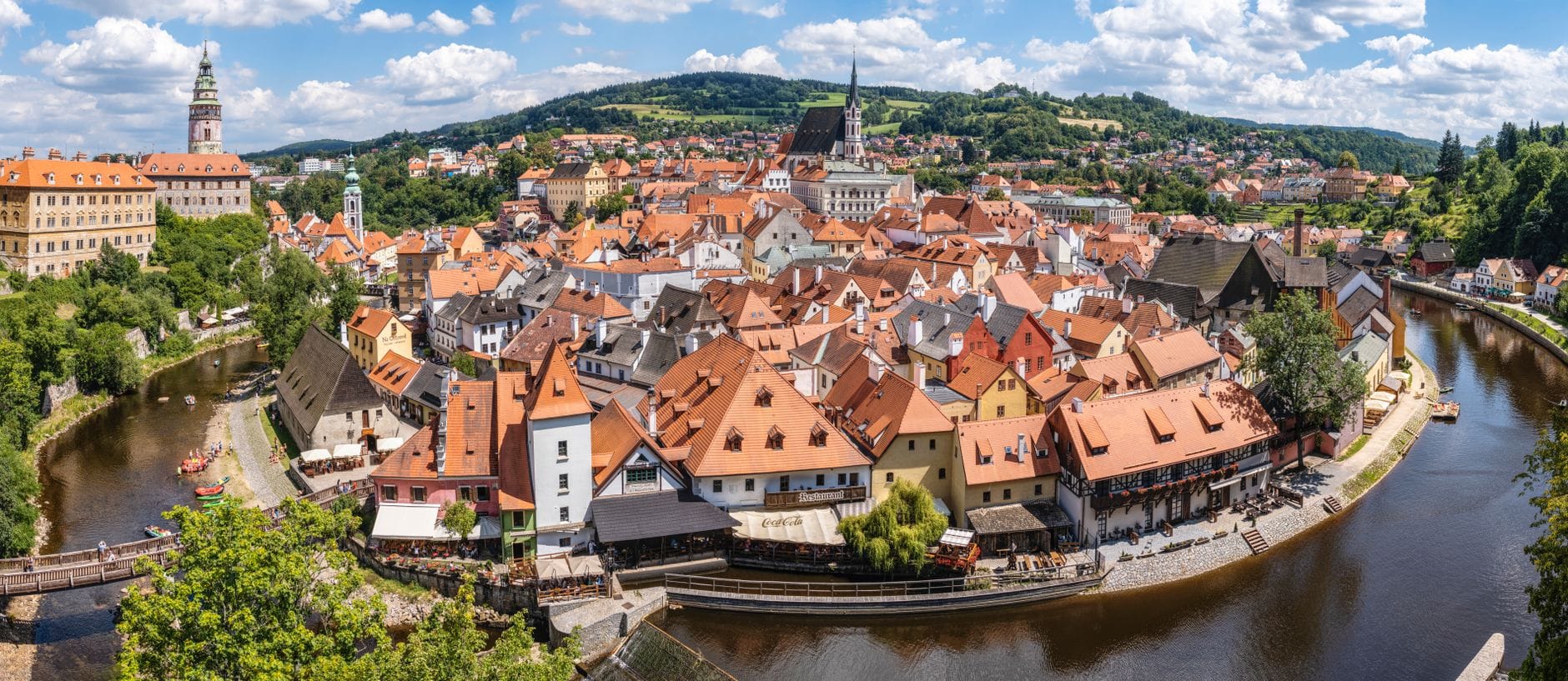
Český Krumlov is not a Prague attraction. It is a functioning South Bohemian town of around 12,800 residents, located roughly 170 kilometres south of Prague by road in a deeply carved loop of the Vltava River. Its historic centre, inscribed as a UNESCO World Heritage Site in 1992 and protected as a municipal heritage reservation since 1963, is one of the best-preserved medieval townscapes in Central Europe. The castle complex dominates a rocky promontory above the river; the old town wraps around the base on the opposite bank, barely changed in its street layout since the 14th and 15th centuries.
The town was first documented around 1253, and control passed through the Rosenbergs, the Eggenbergs, and eventually the Schwarzenbergs over the following centuries. Each dynasty left architectural layers on the castle, which is why the complex reads like a compressed history of Central European noble ambition. The result is the second-largest castle complex in the Czech Republic, after Prague Castle itself.
Travellers who enjoy Prague Castle for its scale and history will likely find Český Krumlov more intimate and easier to read as a single coherent place. The castle here isn't surrounded by a modern city — it overlooks a town that still fits within the medieval footprint.
Getting There from Prague
The most practical option for most visitors is the direct intercity bus, which departs from Prague's Florenc or Na Knížecí bus terminals and takes roughly three hours to reach Český Krumlov's main bus stop, a short walk from the historic centre. Several operators run this route, including RegioJet and FlixBus. Booking in advance is strongly recommended during summer months, when seats fill days ahead.
Train travel is possible but involves a change in České Budějovice and adds considerable time. Unless you have a specific reason to travel by rail, the bus is the better choice for this particular journey. By car, the drive from Prague takes roughly two hours via the D3 motorway south toward České Budějovice, with parking areas available on the periphery of the historic centre — vehicle access inside the old town itself is heavily restricted.
💡 Local tip
Book your bus seat at least a few days ahead in July and August. Capacity is limited and this is one of the most popular day trips from Prague. Returning buses in the evening also fill up — check the last departure time before you leave Prague so you aren't stranded.
For full guidance on combining Český Krumlov with other excursions, see our overview of day trips from Prague, which covers transport options, timing, and which trips are worth pairing together.
Tickets & tours
Hand-picked options from our booking partner. Prices are indicative; availability and final rates are confirmed when you complete your booking.
Cesky Krumlov and Ceske Budejovice day trip
From 98 €Instant confirmationFree cancellationČeský Krumlov guided tour from Prague
From 85 €Instant confirmationFree cancellationSelf guided tour with interactive city game of Prague
From 5 €Instant confirmationFree cancellationPrague by night city tour
From 27 €Instant confirmationFree cancellation
The Castle: What to Expect at Different Hours
The Český Krumlov Castle complex sits on a rocky spur above the Vltava and is reached from the old town via a bridge and a series of steep paths and ramps. The outer castle courtyards, the famous round tower decorated with trompe-l'oeil stonework, and the castle gardens are the immediate visual rewards. The tower is particularly striking in morning light, when the painted surface catches low sun at an angle that makes it appear three-dimensional.
Interior tours require a ticket and are guided only — you cannot wander through the historic rooms independently. Tour Route I covers the baroque apartments used by the Schwarzenberg family; Tour Route II focuses on the Renaissance and baroque ceremonial spaces. Both are worth doing if you have time, but Route II includes the extraordinary baroque theatre, one of the few surviving court theatres in Europe with its original stage machinery, painted scenery, and period costumes still in place. That theatre alone justifies the detour.
The castle gardens stretch across the plateau above the main complex and are free to enter during open season. Early mornings here are remarkably quiet — a sharp contrast to the congested courtyards by mid-morning in summer. The geometric parterre gardens and the summer riding school provide a sense of the estate's original scale, which the crowds in the narrow streets below can make easy to forget.
⚠️ What to skip
Castle interior tours have limited capacity and specific language schedules. English-language tours can sell out by mid-morning in peak season. Arrive early or book ahead through the castle's official website (hrad.ckrumlov.cz). Admission prices vary by route and season — verify current rates before your visit.
The Old Town: Walking the Horseshoe
The historic centre of Český Krumlov occupies a tight peninsula formed by the Vltava's curve, with streets running from náměstí Svornosti (the main square) outward to the water on three sides. The square itself is lined with Gothic and Renaissance burgher houses, many with sgrafitto facades — a decorative plasterwork technique where patterns are scratched through a top layer to reveal a contrasting colour beneath. The technique was common across South Bohemia in the 16th century and is visible across multiple facades in varying states of preservation.
Walking the full old town circuit takes about 45 minutes at a relaxed pace without stopping. Allow considerably more time if you plan to enter churches, visit the Regional Museum on náměstí Svornosti, or stop at any of the galleries. The streets are narrow, surfaced with stone setts, and in parts quite steep, especially on the approaches toward the castle. Comfortable footwear with ankle support is worth wearing, not just because of the gradient but because the stone surfaces can be uneven and slippery after rain.
The river views are best from the footbridge on the east side of the peninsula and from the terraces near the Castle Bridge (Lazebnický most), a covered wooden bridge that connects the castle hill to the old town. In late afternoon, when the light drops behind the castle hill and throws long shadows across the water, the scene from this bridge has a stillness that the daytime crowds obscure.
ℹ️ Good to know
The old town streets and náměstí Svornosti are public space — there is no entry fee to walk the historic centre. However, parking outside the zone and walking in adds time. Most visitors arrive on foot from the bus stop, which is about a 10-minute walk to the main square.
Crowds, Timing, and What Changes by Season
Český Krumlov is one of the most visited towns in the Czech Republic, and that pressure is concentrated in a very small area. In July and August, the main square and the castle courtyards can feel overcrowded by 10am. Tour groups from Austria and Germany arrive by coach; independent visitors from Prague fill the buses. The acoustic quality of the place changes completely between 8am, when it is quiet enough to hear the river, and 11am, when the square is loud and the narrow streets feel like a slow shuffle.
The most effective strategy for a day trip is to catch the earliest possible bus from Prague, reach the castle by 9am, complete the interior tours before lunch, then walk the old town in the early afternoon. By mid-afternoon, some of the coach groups begin to leave, and the town regains some of its character. If you can stay overnight, the evening light on the castle tower and the near-empty streets at 7am the next morning represent the version of Český Krumlov that makes it genuinely exceptional.
May, early June, and September offer the best balance between manageable crowds and reliable weather. Winter brings a different but valid experience — the snow-covered rooflines and the absence of crowds reveal the architecture clearly, though many castle interior tours run reduced schedules or not at all from November through March. For seasonal planning from Prague, see when to visit the Prague region.
Photography, Accessibility, and Practical Notes
The classic view of Český Krumlov — the castle above the river bend with the old town below — is taken from the lookout point above the castle gardens, accessible via the gardens path. This elevated angle gives the full horseshoe panorama and is best in morning light. A second strong viewpoint is from the opposite bank of the Vltava, south of the town, looking back toward the castle hill. Both are free to access.
Accessibility is limited throughout the historic centre. The cobblestone streets and steep gradients between the town level and the castle are difficult for wheelchairs and pushchairs. Some sections have smooth-paved alternatives, but complete wheelchair access through the old town is not feasible. Vehicle access inside the protected zone is restricted and parking is outside the centre, requiring a walk in on foot. Visitors with significant mobility constraints should check current accessibility information with the tourist office before travelling.
Český Krumlov makes a natural pairing with other South Bohemian sites if you are building a longer itinerary beyond Prague. It also fits within a one-week Czech Republic circuit — see the one-week Prague itinerary for how to structure a trip that includes regional excursions.
Who Should Skip This Trip
Český Krumlov is not for everyone. If you have only one or two days in Prague and haven't yet seen the Old Town, Charles Bridge, or Prague Castle, those should take priority — they are closer, more diverse in what they offer, and require no additional transport logistics. The three-hour each-way bus journey means a Český Krumlov day trip consumes the better part of a full travel day.
Travellers who find medieval architecture repetitive, or who are visiting primarily for Prague's food and nightlife scene, are unlikely to find the journey worthwhile. The town itself has restaurants and cafes on the main square, but dining here in summer is expensive relative to Prague, and quality is inconsistent in the most tourist-facing establishments. If you are travelling with very young children, the uneven terrain and steep castle approaches add a layer of physical effort that may outweigh the experience for the adults managing the logistics.
Insider Tips
- The baroque theatre inside the castle is one of the rarest surviving court theatres in Europe, with original 17th-century stage machinery intact. It is included in Tour Route II — if you only do one interior tour, make it this one.
- The view most photographers want is from above the castle gardens looking down over the river horseshoe. Walk up through the gardens past the belvedere — it takes about 15 minutes from the Castle Bridge and the elevated angle is far more dramatic than anything you can capture from street level.
- Bring cash. Several small shops, museums, and food stalls in the historic centre are cash-only. ATMs exist in the town but can have queues during peak season.
- The last buses back to Prague in the evening fill up. Check the return schedule before you leave Prague, and if the last bus looks risky, book your seat for a mid-afternoon departure so you have a confirmed seat regardless of how the day goes.
- The town's most peaceful hour is just after 8am. If you stay overnight, a walk through the old town before most day visitors arrive gives you an entirely different read on the place — quieter, cooler, and with morning mist sometimes sitting over the river.
Who Is Český Krumlov For?
- Architecture and history enthusiasts who want to see a complete medieval townscape in context rather than isolated monuments
- Photographers looking for a UNESCO-protected panorama within reach of Prague
- Travellers spending five or more days in the Czech Republic who want to see South Bohemia beyond the capital
- Couples looking for a slower-paced overnight stay away from Prague's denser tourist infrastructure
- Anyone specifically interested in baroque theatre, court culture, or Schwarzenberg/Rosenberg dynastic history
Nearby Attractions
Combine your visit with:
- Divoká Šárka Nature Reserve
Divoká Šárka is a protected nature reserve on Prague's northwestern edge where limestone gorges, steppe grasslands, and a reservoir beach sit just 30 minutes from the city centre. Entry is free, trails are open year-round, and the landscape shifts dramatically with the seasons.
- Karlovy Vary
Karlovy Vary (historically Carlsbad) sits in a steep river valley about 120 km west of Prague, its colonnades and pastel-colored Grand Hotels reflected in the Teplá River. A UNESCO World Heritage site and the oldest spa town in Bohemia, it rewards a full day — or longer — with thermal springs, ornate promenades, and an atmosphere unlike anything in the Czech capital.
- Karlštejn Castle
Founded in 1348 by Holy Roman Emperor Charles IV as a treasury for the Imperial Regalia and Bohemian crown jewels, Karlštejn Castle rises from a limestone ridge above a quiet Bohemian village. Roughly 30 km southwest of Prague and 40 minutes by train, it is one of the most architecturally intact Gothic royal complexes in Central Europe. All interior visits are guided tours only, and the hilltop setting demands a 20-minute uphill walk from the station.
- Konopiště Castle
Konopiště Castle sits roughly 45 kilometres south of Prague in the Central Bohemian countryside, a Gothic fortress reborn as a Baroque chateau and the final private residence of Archduke Franz Ferdinand d'Este. Its interiors are frozen in the late 19th century, its rose garden is one of the finest in Bohemia, and the train journey from Prague takes under an hour.