Konopiště Castle: The Archduke's Retreat That Changed History
Konopiště Castle sits roughly 45 kilometres south of Prague in the Central Bohemian countryside, a Gothic fortress reborn as a Baroque chateau and the final private residence of Archduke Franz Ferdinand d'Este. Its interiors are frozen in the late 19th century, its rose garden is one of the finest in Bohemia, and the train journey from Prague takes under an hour.
Quick Facts
- Location
- Konopiště 1, 256 01 Benešov, Czech Republic — approx. 45–50 km south of Prague
- Getting There
- Train from Prague's main station (Praha hlavní nádraží) to Benešov u Prahy, then a 2 km walk or taxi to the castle
- Time Needed
- Half day minimum; full day if you explore the park and rose garden
- Cost
- Multiple tour circuits priced in CZK; check zamek-konopiste.cz/en for current admission rates
- Best for
- History enthusiasts, architecture lovers, day-trippers from Prague, couples
- Official website
- www.zamek-konopiste.cz/en
What Konopiště Actually Is
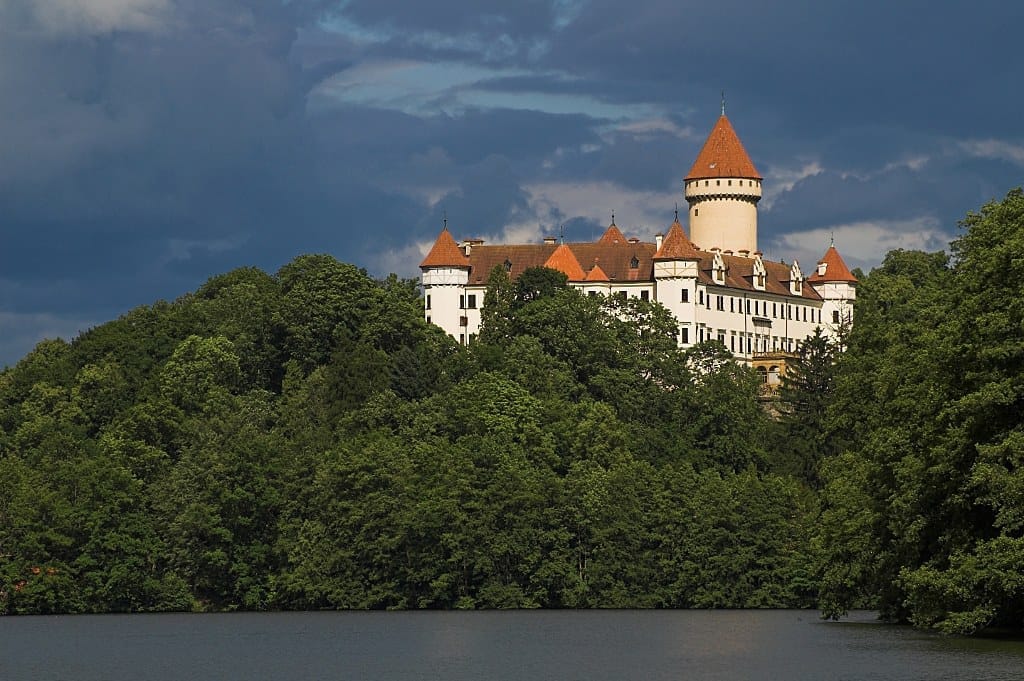
Konopiště Castle (Czech: zámek Konopiště) is a national cultural monument and one of the best-preserved aristocratic residences in the Czech Republic. Founded around 1294 by Prague Bishop Tobias of Benešov as a Gothic military fortress, it was built with cylindrical towers and a drawbridge in the French castle style of the period. Over the following centuries it was converted into a Baroque chateau, and by the late 19th century it had become the personal obsession of Archduke Franz Ferdinand d'Este, heir to the Austro-Hungarian throne.
Franz Ferdinand purchased Konopiště in 1887 and spent the next 27 years pouring money and meticulous attention into it. He modernised it with electricity, running water, and central heating decades before such conveniences were standard in Czech country houses. He also installed an elevator, a mechanical shooting range in the basement, and amassed one of the largest collections of hunting trophies in Europe. The castle holds approximately 30,000 objects in its collections, from medieval weapons and armour to Meissen porcelain and paintings. When he was assassinated in Sarajevo on 28 June 1914, that killing became the fuse for World War I; Konopiště remained his private residence, not the site of the attack.
Today the castle is managed by the National Heritage Institute (Národní památkový ústav) and remains state-owned. The interiors have been carefully maintained to reflect Franz Ferdinand's era, making Konopiště unusual among Central European castles: rather than a series of generic period rooms, you are walking through a specific person's home, with his books still on the shelves and his hunting trophies still on the walls.
ℹ️ Good to know
The castle interiors are accessible only by guided tour. Tour circuits differ in what rooms they cover, and some require advance booking during peak season. Confirm tour availability and current ticket prices at zamek-konopiste.cz/en before you travel.
Getting There from Prague
The most practical and affordable way to reach Konopiště is by train. Fast trains from Praha hlavní nádraží (Prague Main Station) reach Benešov u Prahy in roughly 35 to 45 minutes; slower suburban trains take around 50 to 60 minutes. Trains run frequently throughout the day, making spontaneous trips workable even without pre-booking. The train drops you at Benešov town centre, about 2 kilometres from the castle gates. The walk through the forest path takes 15 to 20 minutes and is pleasant in good weather; taxis are also available outside the station.
By car, the drive from central Prague takes around 35 to 40 minutes via the E55 motorway toward Benešov. Parking is available near the castle entrance. If you are planning a wider circuit of Central Bohemia, Konopiště pairs naturally with Karlštejn Castle, though the two sites are in different directions from Prague and would require a car to combine in a single day.
💡 Local tip
Take the first morning train from Prague (departures typically begin before 7:00) to arrive before tour groups fill the early slots. The castle grounds open before the interiors, so you can walk the park in near-silence before 10:00.
Tickets & tours
Live prices and dates from our booking partner. If you book, we may earn a commission at no extra cost to you.
Prague by night city tour
From 27 €Instant confirmationFree cancellationPrague Castle online audio guide
From 5 €Instant confirmationFree cancellationPrague 6-Hour tour with river boat cruise and lunch
From 89 €Instant confirmationFree cancellationPrague Castle and Orloj with National Museum or Jewish Quarter
From 60 €Instant confirmationFree cancellation
The Grounds and Rose Garden
The castle park covers a substantial area of woodland and formal gardens, and entry to the grounds is free year-round. The rose garden, which Franz Ferdinand cultivated with characteristic obsessiveness, contains thousands of rose bushes arranged in geometric beds below the castle's south terrace. Peak bloom runs roughly from late May through June, when the scent carries across the whole lower garden and the colours range from cream and blush through deep red. Arriving in this period without touring the interiors is a perfectly legitimate visit in its own right.
Outside of rose season, the park still offers good walking through mixed woodland, a small lake with swans, and clear views up to the castle's rounded towers. In autumn, the beech and oak trees colour the hillsides around the approach path a deep amber. In winter, when the interiors are mostly closed, the park feels appropriately austere, though the grounds remain walkable.
The castle also maintains a population of deer and peacocks that wander the estate semi-freely. The peacocks in particular have a habit of positioning themselves on the stone balustrades near the rose garden, which makes for straightforward wildlife photography. Bring a light jacket even in summer: the valley setting and tree cover keep the grounds noticeably cooler than open Prague streets.
The Interior Tours: What You Will Actually See
The castle offers several distinct tour circuits, each covering different sections of the interior. The most commonly booked tour takes visitors through the state rooms and private apartments used by Franz Ferdinand and his family, including the Archduke's study, the dining room, and the bedroom wing. These rooms feel deliberately personal: the wallpaper, furniture placement, and personal objects have been preserved rather than replaced with generic period pieces. The overall effect is more intimate than grand.
A separate tour focuses on the armoury, which holds one of the most extensive private collections of weapons in Central Europe, including Gothic and Renaissance armour, firearms, crossbows, and edged weapons accumulated over generations. For anyone with an interest in military history or decorative metalwork, this is genuinely impressive in scale. The corridors are lined floor to ceiling with mounted hunting trophies, including bear, elk, chamois, and thousands of antlers, a display that reflects both Franz Ferdinand's passion and the sheer volume of animals he shot over his lifetime.
Photography inside the interiors is typically restricted or prohibited on guided tours, so the experience is primarily about observation rather than documentation. Tours are conducted in Czech by default; English-language tours are available but less frequent, and groups are limited in size. Booking ahead online is strongly recommended from May through August.
⚠️ What to skip
The castle's interior tours involve staircases and historic flooring unsuitable for wheelchair access. Visitors with mobility requirements should contact the castle administration directly at konopiste@npu.cz or +420 317 721 366 before visiting to discuss what is accessible.
When to Visit and What to Expect by Season
The castle interiors are open from April through October, with limited weekend openings in November, with tours typically running between 10:00 and 17:00 in peak summer, and shorter hours in October (roughly closing at 15:00). Limited weekend openings occur in November. The grounds are open year-round.
The busiest period is June through August, when Czech school groups and weekend visitors from Prague arrive in large numbers, particularly on Saturday and Sunday mornings. Weekday mornings in May, early June, and September offer the most manageable crowd levels and the most comfortable temperatures for the walk from Benešov station. July and August can be warm and humid; the shaded park walk is pleasant but the castle interiors can feel close during hot afternoons.
Winter visits to the grounds are quiet, occasionally very quiet, but the bare trees reveal the castle's silhouette more clearly against the sky. If you are specifically interested in the historical context of Franz Ferdinand and the events of 1914, pairing Konopiště with Prague's own World War I and Habsburg-era sites adds depth to the visit. The Museum of Communism covers the subsequent century of Czech history if you want a broader sweep of Central European political history in a single trip.
Historical Context: Why Konopiště Matters
Franz Ferdinand chose Konopiště partly because it was remote enough from Vienna to give him privacy, and partly because he could shape it entirely to his taste. His marriage to Sophie Chotek, a Czech noblewoman considered beneath his rank by Viennese court standards, was tolerated but not celebrated in official Habsburg circles. At Konopiště, the family could live relatively normally. The estate became his project, his retreat, and ultimately the place he left for the last time in June 1914 to travel to Sarajevo.
The castle's collections document both Franz Ferdinand's interests and his era. His obsessive hunting is recorded in the trophy displays, but the armoury also contains serious historical artefacts including weapons from the Crusades, the Thirty Years War, and Habsburg military campaigns. The Meissen porcelain collection and the tapestries reflect the broader culture of aristocratic collecting in the 19th century.
For visitors who want to understand Bohemia's position within the Habsburg Empire before diving into what Prague became in the 20th century, Konopiště provides unusually concrete, object-level evidence. The Prague history guide covers the broader arc from medieval Bohemia through the communist era, which helps frame what Konopiště represents in that longer story.
Honest Assessment: Is It Worth the Trip?
Konopiště rewards visitors who have a genuine interest in the Habsburg period, Central European history, or historic interiors. The collections are exceptional in depth, the grounds are attractive in good weather, and the train connection from Prague makes logistics straightforward. If you have half a day to spare and some curiosity about what life looked like for Austro-Hungarian aristocracy in the decade before World War I, this is an excellent way to spend it.
If you are primarily interested in architecture and have limited time in the region, you might weigh Konopiště against other day trips from Prague such as Kutná Hora or Český Krumlov, both of which offer distinct experiences. Konopiště's interior tours are less visually dramatic than Český Krumlov's Baroque theatre or Karlštejn's Gothic chapels, but they offer a more specific narrative and a more personal atmosphere.
The castle is not suited for visitors who are primarily interested in stunning architecture from the outside, those who dislike guided tour formats, or anyone who finds hunting trophies distressing to encounter in quantity. The trophy corridor is extensive and unavoidable on most tour routes.
Insider Tips
- Buy train tickets at Praha hlavní nádraží or through the Czech Railways app (CD.cz) rather than at Benešov station, which can be slower. Fast trains marked 'R' or 'Ex' on the timetable cut the journey to about 35–45 minutes.
- The castle's English-language tours run less frequently than Czech ones and fill quickly in summer. Email the castle directly to check the English tour schedule for your specific visit date before arriving.
- The basement shooting gallery, where Franz Ferdinand practised with various firearms, is covered on specific tour routes and is not always highlighted in general summaries. Ask about it when booking to confirm which circuit includes it.
- The rose garden reaches full bloom roughly between the last week of May and mid-June depending on the year. The castle's social media accounts post photos of current bloom conditions, which is the most reliable guide for timing a rose garden visit.
- The walk from Benešov station to the castle follows a clearly signed forest path. After rain, the path becomes muddy in patches near the park entrance. Shoes with some grip are more comfortable than city footwear.
Who Is Konopiště Castle For?
- History enthusiasts interested in the Habsburg Empire and the origins of World War I
- Couples looking for a half-day escape from Prague with attractive grounds and a clear narrative
- Architecture and interiors visitors who want to see a genuinely preserved aristocratic residence rather than a reconstructed set
- Families with older children (12+) who can engage with the armoury and historical context; young children may find the guided tour format restrictive
- Photographers targeting the rose garden in late May and June, or autumn colour in October
Nearby Attractions
Combine your visit with:
- Český Krumlov
Český Krumlov is a medieval South Bohemian town wrapped in a horseshoe bend of the Vltava River, home to the second-largest castle complex in the Czech Republic and a UNESCO-protected historic centre. It makes for one of the most rewarding day trips or overnight stays from Prague, though it demands some planning to do properly.
- Divoká Šárka Nature Reserve
Divoká Šárka is a protected nature reserve on Prague's northwestern edge where limestone gorges, steppe grasslands, and a reservoir beach sit just 30 minutes from the city centre. Entry is free, trails are open year-round, and the landscape shifts dramatically with the seasons.
- Karlovy Vary
Karlovy Vary (historically Carlsbad) sits in a steep river valley about 120 km west of Prague, its colonnades and pastel-colored Grand Hotels reflected in the Teplá River. A UNESCO World Heritage site and the oldest spa town in Bohemia, it rewards a full day — or longer — with thermal springs, ornate promenades, and an atmosphere unlike anything in the Czech capital.
- Karlštejn Castle
Founded in 1348 by Holy Roman Emperor Charles IV as a treasury for the Imperial Regalia and Bohemian crown jewels, Karlštejn Castle rises from a limestone ridge above a quiet Bohemian village. Roughly 30 km southwest of Prague and 40 minutes by train, it is one of the most architecturally intact Gothic royal complexes in Central Europe. All interior visits are guided tours only, and the hilltop setting demands a 20-minute uphill walk from the station.
Planning a trip? Discover personalized activities with the Nomado app.