Karlštejn Castle: Charles IV's Gothic Fortress Beyond Prague's City Limits
Founded in 1348 by Holy Roman Emperor Charles IV as a treasury for the Imperial Regalia and Bohemian crown jewels, Karlštejn Castle rises from a limestone ridge above a quiet Bohemian village. Roughly 30 km southwest of Prague and 40 minutes by train, it is one of the most architecturally intact Gothic royal complexes in Central Europe. All interior visits are guided tours only, and the hilltop setting demands a 20-minute uphill walk from the station.
Quick Facts
- Location
- Karlštejn 172, 267 18 Karlštejn – approx. 30 km southwest of central Prague
- Getting There
- S7 train from Praha hlavní nádraží (main railway station) to Karlštejn station, approx. 40 min; then about 15–20 min uphill walk through the village
- Time Needed
- Half day minimum, including travel; allow 3–4 hours on site plus transit
- Cost
- Basic guided tour approx. CZK 300; chapel tour from approx. CZK 640. Verify current prices at hrad-karlstejn.cz before visiting
- Best for
- Medieval history enthusiasts, architecture lovers, day-trippers from Prague
- Official website
- www.hrad-karlstejn.cz/en
What Karlštejn Castle Actually Is
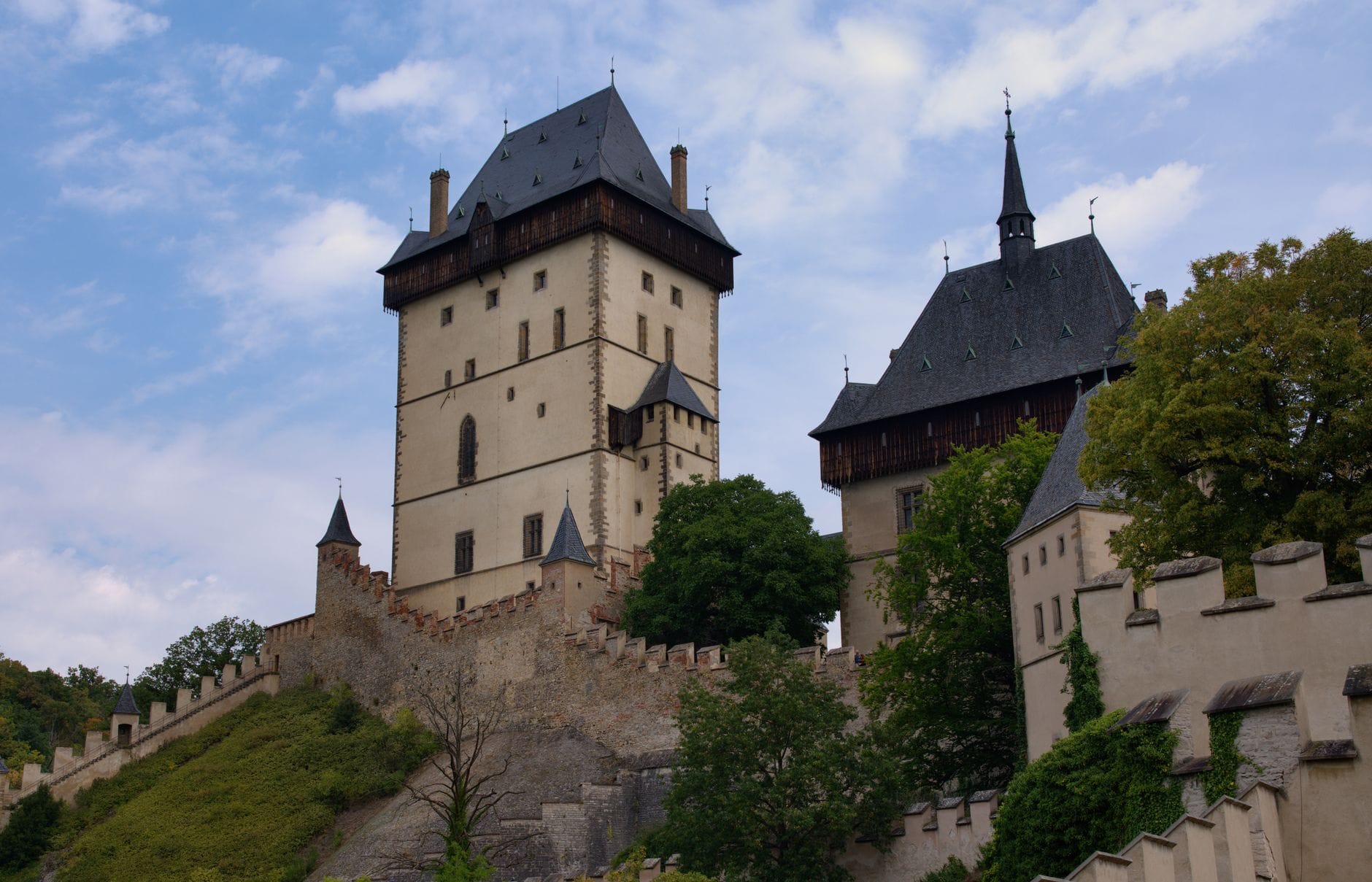
Karlštejn Castle is a large Gothic royal castle founded in 1348 by Charles IV, King of Bohemia and Holy Roman Emperor, on a steep limestone spur above the Berounka river valley. Its primary purpose was not residential comfort but security: the castle was purpose-built to safeguard the Imperial Regalia of the Holy Roman Empire and the Bohemian crown jewels, making it one of the most politically significant strongholds of 14th-century Europe.
The complex is arranged in a stepped hierarchy that physically reflects the importance of each section. The outer fortifications and lower buildings give way, as you climb higher, to the Imperial Palace and then to the Great Tower, which contains the Castle's most sacred space: the Chapel of the Holy Cross, completed and richly decorated by 1365. The walls of that chapel were once encrusted with semi-precious stones and covered in panel paintings by Master Theodoric, court painter to Charles IV. Over 120 of those paintings survive.
In terms of architectural style and historical weight, Karlštejn sits alongside Prague Castle as a defining monument of the Luxemburg dynasty's rule over Bohemia. But where Prague Castle sprawls over a hill within the capital, Karlštejn was always meant to be remote, secure, and nearly impossible to take by force.
Getting There: The Train Is the Right Choice
The S7 suburban train from Praha hlavní nádraží (Prague main railway station) runs regularly to Karlštejn station, with a journey time of approximately 40 minutes. Trains are integrated into the Prague Integrated Transport (PID) system, so a valid PID ticket covering the appropriate zones covers the ride. The station at Karlštejn is small and unmistakable: when the crowd starts heading in one direction up the main street through the village, follow them.
💡 Local tip
Book your guided tour online before you travel, especially between May and September. Interior visit numbers are strictly controlled, and popular time slots sell out well in advance. Walk-up availability is unreliable in summer.
The walk from the station to the castle gate takes about 15–20 minutes and gains significant elevation along a cobbled lane lined with souvenir shops and small cafes. The path is not difficult, but it is sustained uphill, and the final section before the castle entrance involves steps and uneven stone surfaces. Driving to Karlštejn is possible, but parking is limited and the village access road is narrow. The train remains the most practical option.
Organized day tours from Prague also operate to Karlštejn, often combining it with one or two other Central Bohemian sites. If you prefer to plan your own schedule, this excursion pairs well with a broader day trip from Prague itinerary, where Karlštejn is typically listed as one of the most accessible options by rail.
Tickets & tours
Hand-picked options from our booking partner. Prices are indicative; availability and final rates are confirmed when you complete your booking.
Entry ticket and guided tour of Karlstejn Castle in Prague
From 68 €Instant confirmationFree cancellationKarlstejn Castle tour from Prague
From 65 €Instant confirmationFree cancellationPrague by night city tour
From 27 €Instant confirmationFree cancellationPrague Castle online audio guide
From 5 €Instant confirmationFree cancellation
The Uphill Walk: Before You Even Reach the Gate
The walk through the village of Karlštejn is part of the experience, and it tells you something useful about how popular this castle has become. The main street is dense with stalls selling Czech garnets, wooden toys, and smoked meats. On summer weekends, the lane is crowded enough that the pace is set by the slowest group ahead of you. On weekday mornings in shoulder season, the same lane can be almost quiet, with the only sounds being birdsong and the echo of your footsteps on old stone.
The first view of the castle appears above the rooftops partway up the hill: a massive pale stone tower rising from the ridge with no visible way around it. This view, with the Great Tower framed by forest, is the photograph most people take before they reach the gate. Arriving early in the morning means you get this shot without other visitors in the frame and with softer light on the stone facade.
⚠️ What to skip
Visitors with mobility limitations should know that the approach from the train station involves a continuous uphill walk with cobblestones and uneven surfaces, and the interior tour routes include stairs. Contact the castle administration directly via hrad-karlstejn.cz for current accessibility details before visiting.
Inside the Castle: What the Tours Cover
All interior visits to Karlštejn Castle are guided tours. You cannot wander freely. There are different tour routes, ranging from a basic walk through the Imperial Palace to a more expensive exclusive tour that includes access to the Chapel of St. Catherine and the Chapel of the Holy Cross in the Great Tower. The chapel tours operate with strictly limited group sizes and require advance reservation, sometimes weeks ahead during peak season.
The basic tour takes you through the Burgrave's Palace and the Imperial Palace, explaining the castle's political history and the Luxemburg dynasty's ambitions in Central Europe. The spaces are authentically medieval in scale and atmosphere: thick stone walls, narrow windows that frame specific views of the valley, and rooms that make clear how much of the castle's function was symbolic as well as defensive. The lighting is low in places, and the floors in some sections are original stone, uneven underfoot.
The Chapel of the Holy Cross, accessible only on the more expensive exclusive tour, is what most serious visitors come for. The walls were inlaid with over 2,000 semi-precious stones and adorned with 129 panel paintings by Master Theodoric, created between 1357 and 1367. Even by the standards of imperial Gothic chapels, this is an extraordinary interior. The tour group size is kept small, the time inside is limited, and photography is generally not permitted in the most sensitive spaces.
If you are building a trip around Gothic and Romanesque religious architecture in Bohemia, Karlštejn's chapel is a logical complement to Prague's St. Vitus Cathedral, which houses the Bohemian crown jewels that Karlštejn was originally built to protect.
Time of Day and Seasonality: When to Go
Karlštejn receives a very high volume of visitors relative to its size, and the difference between a crowded visit and a comfortable one is mostly determined by when you arrive. The first trains from Prague reach Karlštejn before the tour groups, and the 9 AM opening slot on a Tuesday or Wednesday in May or September represents close to the ideal visit. By midday on summer weekends, the lane through the village is packed and the atmosphere shifts toward something more like a fairground approach than a medieval fortress.
The castle is set in forested hills, and autumn brings genuine color to the surrounding landscape. October visits offer cooler temperatures, smaller crowds, and the visual contrast of orange and gold forest against pale limestone walls. Winter access is more limited, with shorter opening hours and some closure days in December and January, and March and November operating on reduced hours that should be verified on the official website before planning.
For a broader perspective on timing your trip to the Czech countryside, the best time to visit Prague guide covers seasonal crowd patterns and weather conditions that apply equally to day trips in the surrounding region.
What to Expect from the Exterior and the Views
Even without the interior tour, the exterior of Karlštejn Castle and its setting justify the journey for many visitors. The castle sits at about 316 metres above sea level above the valley floor, and the views from the upper courtyard extend over forested hillsides and the winding Berounka river below. On clear days, the landscape has a quality of undisturbed medieval Bohemia that is harder to find closer to Prague.
The exterior stonework was substantially restored in the late 19th century under architect Josef Mocker, which means the current appearance is partly neo-Gothic interpretation rather than purely original medieval fabric. This is a fact worth knowing: the castle looks almost too perfectly Gothic in places precisely because of that 19th-century intervention. The core structure and the towers are genuine 14th-century work, but some of the surface treatment is Victorian-era reconstruction.
Who Should Consider Skipping This
Karlštejn is sometimes treated as an automatic addition to any Prague itinerary, but it is not the right fit for everyone. If your interest in medieval castles is casual rather than deep, and you have already spent time at Prague Castle, you may find the experience repetitive. The guided-tour-only format means you are constrained to a set route and time, which suits some visitors and frustrates others. The village approach is crowded in peak season and the souvenir density is high.
Visitors with limited mobility face real challenges given the uphill approach and interior stairs. Those with only one or two days in Prague may find their time better spent exploring the city itself. The 3-day Prague itinerary offers a realistic framework for deciding whether Karlštejn fits your schedule or whether a shorter city-based excursion makes more sense.
Insider Tips
- Book the exclusive chapel tour several weeks in advance if visiting July or August. The Chapel of the Holy Cross has a strictly limited capacity per day, and this is the feature that distinguishes Karlštejn from any other castle visit in the region.
- Take the earliest train from Praha hlavní nádraží that connects with the 9 AM opening. By 11 AM, tour group coaches begin arriving in volume and the village lane becomes significantly more crowded.
- The best exterior photographs of the castle are taken from partway up the village lane, not from directly below the walls. A moderate telephoto focal length isolates the Great Tower above the rooftops effectively.
- Bring cash in Czech koruna for the village cafes and some souvenir stalls. Card acceptance in the smaller food and drink shops along the approach lane is inconsistent.
- The wooded trails around the castle and along the Berounka river valley offer a quieter extension to your visit. If you time your tour for the morning, a post-tour walk in the surrounding nature reserve makes the trip feel less rushed.
Who Is Karlštejn Castle For?
- Travelers with a specific interest in Gothic architecture and medieval Bohemian history
- Day-trippers who want a clear half-day excursion from Prague by train without needing a car
- Architecture enthusiasts interested in comparing 14th-century royal fortress design with Prague's own castle complex
- Photographers looking for a dramatic hilltop castle exterior in a forested landscape
- Visitors who have already covered Prague's main sites and want to add regional depth to their trip
Nearby Attractions
Combine your visit with:
- Český Krumlov
Český Krumlov is a medieval South Bohemian town wrapped in a horseshoe bend of the Vltava River, home to the second-largest castle complex in the Czech Republic and a UNESCO-protected historic centre. It makes for one of the most rewarding day trips or overnight stays from Prague, though it demands some planning to do properly.
- Divoká Šárka Nature Reserve
Divoká Šárka is a protected nature reserve on Prague's northwestern edge where limestone gorges, steppe grasslands, and a reservoir beach sit just 30 minutes from the city centre. Entry is free, trails are open year-round, and the landscape shifts dramatically with the seasons.
- Karlovy Vary
Karlovy Vary (historically Carlsbad) sits in a steep river valley about 120 km west of Prague, its colonnades and pastel-colored Grand Hotels reflected in the Teplá River. A UNESCO World Heritage site and the oldest spa town in Bohemia, it rewards a full day — or longer — with thermal springs, ornate promenades, and an atmosphere unlike anything in the Czech capital.
- Konopiště Castle
Konopiště Castle sits roughly 45 kilometres south of Prague in the Central Bohemian countryside, a Gothic fortress reborn as a Baroque chateau and the final private residence of Archduke Franz Ferdinand d'Este. Its interiors are frozen in the late 19th century, its rose garden is one of the finest in Bohemia, and the train journey from Prague takes under an hour.