Plaza de Toros de Valencia: The City's Grand Neoclassical Bullring
Built between 1850 and 1859, the Plaza de Toros de Valencia is one of Spain's most architecturally significant bullrings. Whether you come for the history, the attached Museo Taurino, or simply to study the neoclassical facade from the street, it anchors one of the most layered corners of the historic centre.
Quick Facts
- Location
- Carrer de Xàtiva 28, 46004 Valencia — adjacent to Estació del Nord, historic centre
- Getting There
- Metro: Xàtiva station (lines 3, 5, and 9). Bus: lines 5, 6, 7, 8, 14, 19, 35, 40, 62, N1, N7
- Time Needed
- 45–90 minutes for the bullring and Museo Taurino combined
- Cost
- Museo Taurino entry approx. €2 (general), with reduced and free days available; event tickets for the bullring vary by date and seat category, and the bullring has been temporarily closed for construction at time of writing—check current status.
- Best for
- Architecture enthusiasts, history seekers, travellers curious about Spanish cultural traditions
- Official website
- http://www.museotaurinovalencia.es
What You Are Actually Looking At
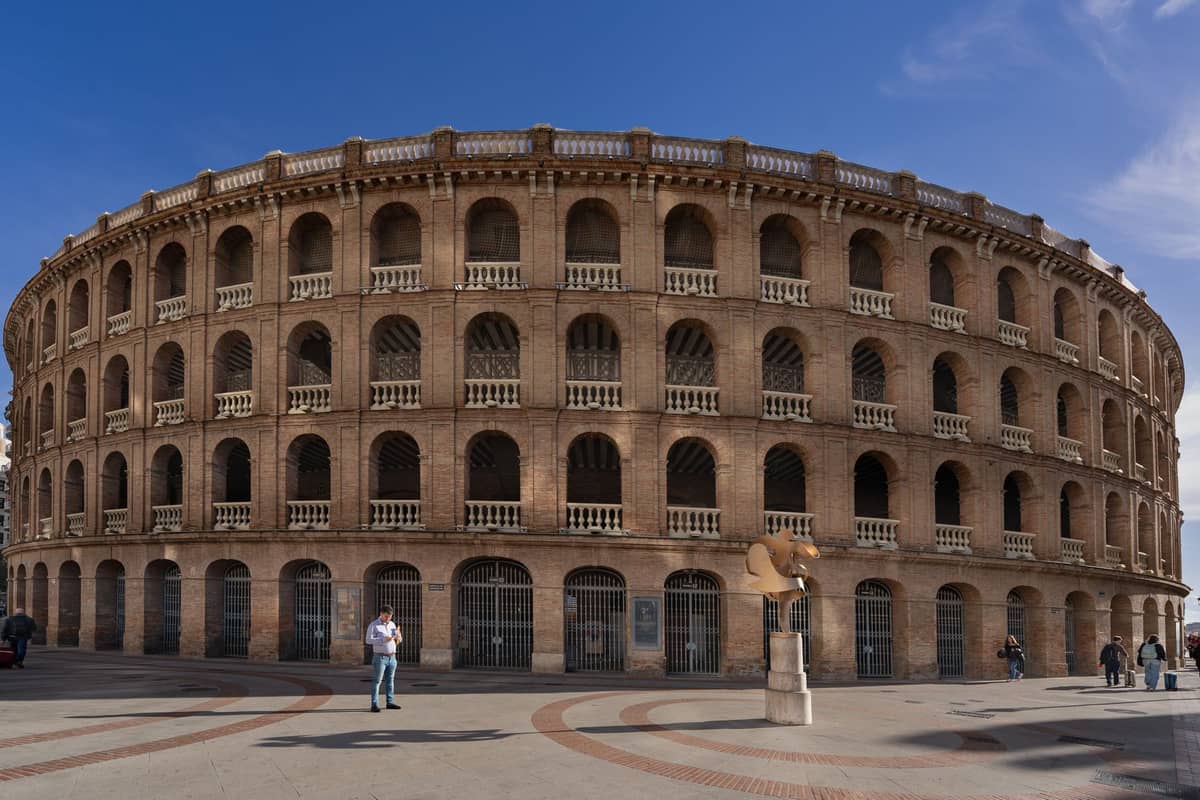
The Plaza de Toros de Valencia occupies a commanding position on Carrer de Xàtiva, directly opposite the ornate facade of Estació del Nord. From the street, the two buildings create an unlikely dialogue: Valencian Art Nouveau railway architecture on one side, severe neoclassical stonework on the other. The bullring was designed by architect Sebastián Monleón Estellés and built between 1850 and 1860. Its design draws consciously from Roman civic architecture, most notably the Colosseum in Rome and the Arena of Nîmes, and the resemblance is not coincidental. Monleón wanted the structure to read as permanent, civic, and monumental.
The building's footprint is a 48-sided polygon, which gives it an almost circular silhouette while allowing the stone courses to read as flat planes from a distance. The arcade of arches running around the exterior gives the facade a rhythmic gravity that rewards slow observation. Up close, you notice that the stone is warm in tone, catching the Valencia sun differently at 9am than at midday, when shadows from the arcade projections fall in sharp horizontal bands across the lower tier.
⚠️ What to skip
The bullring was temporarily closed for construction works at the time this guide was written, while the attached Museo Taurino remained open; confirm current access via the official museum website or Visit València before making a specific trip.
The Museo Taurino: What Is Inside
The Museo Taurino (bullfighting museum) shares visitor facilities with the bullring and is reached via a passage next to the museum entrance on the ground level. General admission has been listed at €2, making it among the cheaper cultural entries in the historic centre. The collection documents Valencia's bullfighting history through costumes, posters, mounted trophy pieces, and historical photographs. For visitors who are not already invested in the tradition, the most interesting objects tend to be the embroidered matador suits, known as trajes de luces, which are displayed close-up and show extraordinary craftsmanship regardless of one's views on the spectacle itself.
The museum also provides access to the bullring seating tiers and the arena floor on non-event days, which is where the visit earns its time. Standing on the sand and looking up at the concentric rows of stone seating, the scale registers in a way it simply cannot from street level. The capacity runs to thousands of spectators, and the acoustic properties of the enclosed oval are striking even when empty.
Opening hours on non-event days (when open) run Tuesday to Saturday 10:00 to 19:00, with last access to the bullring at 18:15 (17:30 in winter) and last museum entry at 18:30. Sundays and public holidays the site closes at 14:00. The bullring is closed on Mondays, 1 January, 1 May, and 25 December. If you are building a morning itinerary around the historic centre, the Mercado Central is roughly ten minutes on foot and makes a logical pairing for a half-day in the area.
Tickets & tours
Hand-picked options from our booking partner. Prices are indicative; availability and final rates are confirmed when you complete your booking.
Valencia Silk Museum tickets and audio guide
From 7 €Instant confirmationFree cancellationHistoric Valencia walking tour
From 27 €Instant confirmationFree cancellationNatural thermal springs and Girlfriend Waterfall tour from Valencia
From 89 €Instant confirmationFree cancellationMontanejos guided hike with natural pools full-day tour from Valencia
From 45 €Instant confirmationFree cancellation
The Neighbourhood Context
The bullring sits at the southern edge of Valencia's historic centre, a few blocks from Plaza del Ayuntamiento and within comfortable walking distance of the old city's main monuments. The surrounding streets between Xàtiva and Gran Via are dense with mid-range hotels, cafes, and the kind of everyday commercial activity that makes this corner feel lived-in rather than purely touristic. Early mornings, the pavement outside the bullring is quiet and the facade is at its most photogenic, with low-angle light picking out the stone texture and minimal foot traffic to work around.
A two-minute walk brings you to the Estació del Nord, Valencia's main central railway station and one of the finest examples of Valencian Art Nouveau in the city. The visual contrast between the two buildings is itself worth the short detour. If you have not yet seen the station's ceramic-tiled interiors, budget an extra 20 minutes.
The Cultural Question: Is Bullfighting Worth Engaging With?
The Plaza de Toros de Valencia is one of Spain's most important active bullrings, and the cultural conversation around bullfighting has shifted considerably in recent decades. Attitudes vary sharply even within Spain, and Valencia itself has seen significant debate. It would be dishonest to present this simply as a neutral architectural attraction without acknowledging that the building's primary purpose is a live event that many travellers find ethically uncomfortable.
That said, the architectural significance, the museum collection, and the spatial experience of the arena are real and considerable. Travellers can engage with the site on purely historical and architectural terms without attending an event, and the Museo Taurino presents the tradition in a way that is educational rather than promotional. Whether to attend a live corrida is a decision each visitor makes individually; the season typically runs through summer and into autumn, with the Feria de Julio in July being the major event calendar fixture.
ℹ️ Good to know
If you find the subject of bullfighting distressing, the exterior facade and its neoclassical arcade are fully visible from the street at no cost and at any hour. The architectural experience alone takes about 15 minutes and pairs well with a walk toward the historic centre.
How to Get There and When to Go
The Xàtiva metro station (lines 3, 5, and 9) deposits you almost directly in front of the bullring, making this one of the easier central attractions to reach without navigating on foot. Numerous bus lines including routes 5, 6, 7, 8, 14, 19, 35, 40, 62, N1, and N7 stop nearby. From Plaza del Ayuntamiento, it is a level five-minute walk south along Carrer de Xàtiva.
For the exterior and photography, early morning from around 8:30 to 10:00 gives you good light and empty pavements. By midday the surrounding streets pick up considerable pedestrian traffic and the facade falls into harsher overhead light. Late afternoon, roughly 17:00 onwards, the western-facing stone picks up warm golden tones that work well photographically. If you are visiting the museum, arrive at least 90 minutes before closing to avoid a rushed experience.
Valencia's Mediterranean climate means the area around the bullring is walkable year-round, though summer afternoons can push temperatures into the mid-thirties Celsius. Combining the bullring with a walk into the adjacent historic centre works well in spring and autumn. For a broader sense of the city's major monuments in a single day, the walking tour of Valencia's old city makes a practical framework.
Photography and Accessibility
Photography inside the bullring is generally permitted during museum visits on non-event days, though specific restrictions may apply inside exhibition rooms. The arena floor, when accessible, produces strong wide-angle compositions looking upward at the tiered seating. A wide or standard lens works better here than a telephoto. The exterior arcade invites detail shots of the arched bays, which read as almost Roman in character.
Detailed accessibility information for visitors with reduced mobility is not clearly specified in public listings. The passage entry point and older stone interiors mean that conditions may not be fully adapted. Visitors who require step-free access or adapted facilities are strongly advised to contact the bullring directly before visiting to confirm current conditions.
Who Should Skip This
Travellers with strong objections to bullfighting culture may find the museum uncomfortable regardless of the architectural merit. The site is also not particularly suited to young children unless they have a specific interest in history. If your focus is contemporary culture or art, Valencia has stronger alternatives: the IVAM contemporary art museum and the Centre del Carme offer considerably more engagement for that audience.
Insider Tips
- The most photogenic angle of the facade is from the Estació del Nord side in morning light, using the station's ornamental entrance as a framing element in the background.
- During the Feria de Julio in July, the area around Carrer de Xàtiva becomes significantly more crowded on event days; if you want a quiet museum visit, avoid these dates unless you intend to attend the corrida.
- The passage entry for museum visits is easy to miss. Look for the signage on the ground-floor arcade level rather than the main gate, which is reserved for events.
- Pair a visit here with the Estació del Nord interior, which takes 20 minutes and is free to enter as a functioning station. The stylistic contrast between the two buildings tells you a great deal about how Valencia thought about civic architecture across two different eras.
- Verify current opening status before visiting — construction closures in recent years have affected access without advance notice on casual tourism platforms.
Who Is Plaza de Toros de Valencia For?
- Architecture enthusiasts interested in 19th-century Spanish neoclassicism and Roman civic references
- History-focused travellers wanting to understand Valencia's cultural traditions in context
- Photographers looking for strong exterior compositions in the historic centre
- Travellers building a half-day itinerary combining the bullring, Estació del Nord, and Mercado Central
- Anyone curious about the ongoing cultural debates around bullfighting in modern Spain
Nearby Attractions
Other things to see while in Centro Histórico:
- Basílica de la Virgen de los Desamparados
The Real Basílica de Nuestra Señora de los Desamparados stands at the heart of Valencia's historic centre, housing the revered image of the city's patron saint. Built between 1652 and 1667, it is free to enter and open every day, making it one of the most accessible and emotionally resonant stops in the old city.
- Catedral de València
Rising above Plaza de la Reina in Valencia's historic centre, the Cathedral of Valencia is a remarkable layered monument built over seven centuries. From a Romanesque doorway to Gothic vaulting, a Baroque facade, and a relic claimed to be the Holy Grail, this is one of Spain's most architecturally complex and historically loaded churches.
- Centre Cultural La Nau
Housed in the University of Valencia's historic headquarters since the late 15th century, Centre Cultural La Nau is a historic landmark in the old town offering free exhibitions, concerts, and theatre. It rewards visitors who slow down and look closely.
- Centre Arqueològic de l'Almoina
Beneath a quiet plaza steps from Valencia Cathedral lies one of Spain's most compelling urban archaeology sites. The Centre Arqueològic de l'Almoina preserves around 2,500 square metres of Roman, Visigothic, and medieval remains, excavated over two decades and now visible through a striking modern structure.