Estación del Norte: Valencia's Modernist Railway Station Worth Slowing Down For
Inaugurated in 1917 and declared a national historic monument, Estación del Norte is Valencia's main railway hub and one of Spain's finest examples of early 20th-century Modernist civil architecture. Entry to the building is free, making it one of the most rewarding stops in the historic centre for anyone who knows what to look for.
Quick Facts
- Location
- Carrer Xàtiva 24, near Ciutat Vella (historic centre), Valencia
- Getting There
- Xàtiva station (Metro lines 3, 5, 9) — directly adjacent
- Time Needed
- 20–40 minutes to explore the architecture; longer if catching a train
- Cost
- Free entry to the station building; train fares vary by route
- Best for
- Architecture lovers, first-time visitors, photography, and convenient city-centre access
- Official website
- www.adif.es/w/65000-val%C3%A8ncia-est.-nord
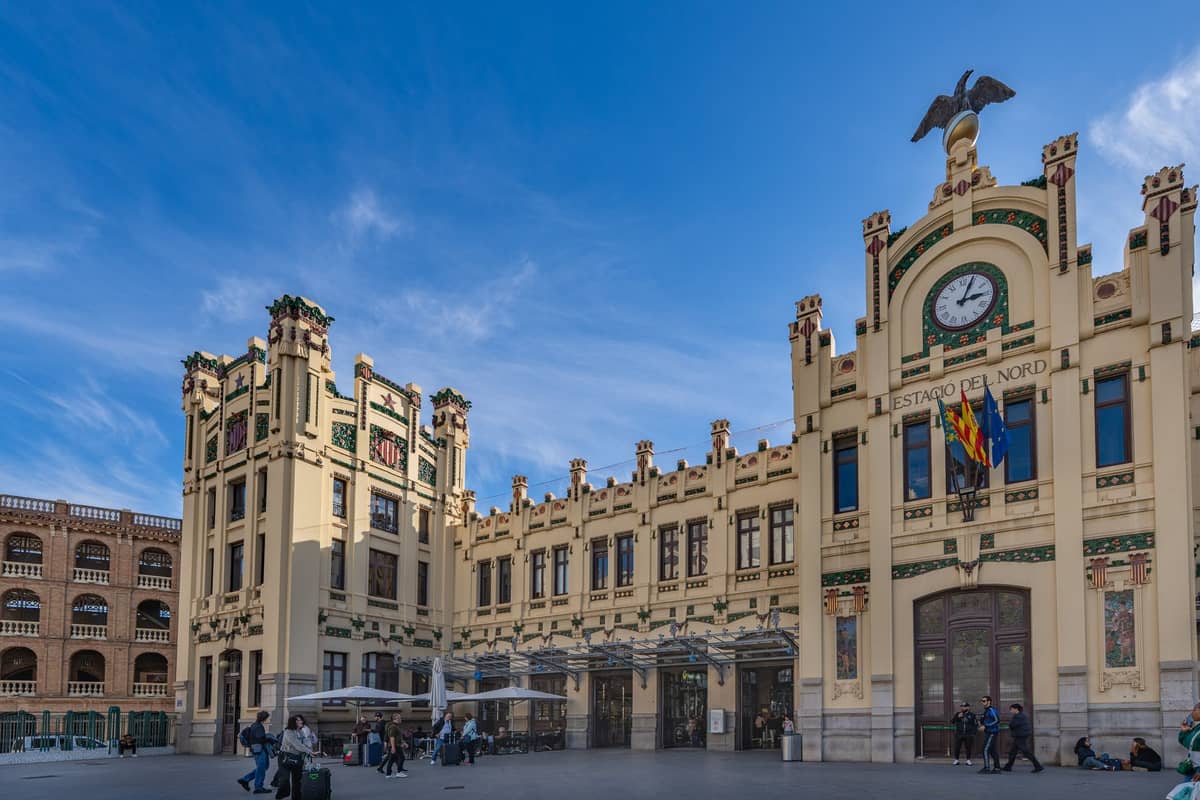
What Is Estación del Norte?
Estación del Norte — officially València Estació del Nord in Valencian — is both the city's principal railway station and one of the most architecturally significant public buildings in Spain. Inaugurated in 1917 and designed by Valencian architect Demetrio Ribes, it was declared a Monumento Histórico-Artístico in 1961 and remains an active, working station handling Cercanías commuter trains, regional services, and medium and long-distance routes.
What makes it unusual among Spanish train stations is the density and quality of its ornamentation. Most civic infrastructure from this period was either purely functional or borrowed loosely from historical styles. Ribes fused Catalan Modernisme with Central European Jugendstil influences, covering the facades, vestibule, and waiting rooms with ceramic tile panels, ironwork, and motifs drawn directly from Valencia's agricultural and commercial identity: oranges, flowers, and wheat sheaves rendered in vivid glazed tile.
💡 Local tip
Entry to the station building is completely free. You do not need a train ticket to walk inside and examine the architecture. Station operating hours are approximately 05:00 to midnight daily, though hours can shift slightly on festival dates including the March Fallas period.
The Architecture: What to Look For
The main facade on Carrer Xàtiva is the logical place to start. The building presents a broad, symmetrical front anchored by a central tower clock and flanked by two lateral wings. The stonework is relatively restrained from a distance, but step closer and the surface breaks into intricate ceramic panels, wrought-iron window grilles, and carved floral reliefs that extend across the entire frontage. The effect is more jeweller's workshop than train station.
Inside, the main vestibule is where Ribes's design earns its reputation. The ceiling vaults are decorated with painted tiles depicting scenes of Valencian rural life: orange harvests, market commerce, and the agricultural landscapes that made the city wealthy in the late 19th and early 20th centuries. The ironwork canopies over the platforms, visible from the concourse, filter light in a way that gives the interior a warm, slightly amber quality on clear mornings.
The waiting room, accessed from the main hall, is particularly worth a look. Its ceramic wall panels and ornate woodwork are in excellent condition and represent one of the more intact examples of Modernist interior design in Valencia. The room still functions as a waiting area, which means you can sit in it without feeling like you are interrupting a museum exhibit.
For broader context on Valencia's architectural landscape, the Art Nouveau architecture guide for Valencia situates Estación del Norte within the city's wider Modernist heritage, including comparisons with other surviving civic and commercial buildings from the same period.
Tickets & tours
Hand-picked options from our booking partner. Prices are indicative; availability and final rates are confirmed when you complete your booking.
Cala del Moraig Hiking and Beach Trip from Valencia
From 32 €Instant confirmationFree cancellationValencia Silk Museum tickets and audio guide
From 7 €Instant confirmationFree cancellationSaint Nicholas Church Entrance Tickets and Audioguide
From 11 €Instant confirmationHistoric Valencia walking tour
From 27 €Instant confirmationFree cancellation
How the Station Changes by Time of Day
Early morning, roughly between 07:00 and 09:00, the station fills with commuters using the Cercanías lines. The pace is purposeful and the light entering the vestibule from the east-facing main doors catches the tile work cleanly. This is arguably the best natural light for photography of the interior, before the midday overhead glare flattens the colours.
By late morning the commuter rush has cleared and the building settles into a steadier rhythm. Tourist visitors tend to drift in between 10:00 and 13:00, but numbers rarely feel overwhelming given the scale of the space. Midday light in summer can be harsh on the exterior, washing out detail in photographs taken from the pavement opposite.
Late afternoon, particularly in spring and autumn when the sun is lower, brings warm directional light across the facade that reveals the three-dimensional relief work in the stonework and ceramic panels with unusual clarity. If photography is part of your reason for visiting, the hour before sunset in the warmer months is worth planning around.
ℹ️ Good to know
During Las Fallas (mid-March), the station is exceptionally busy and operating hours may be extended. Crowds are significant on peak days. Visit early in the morning if you want the building to yourself.
Historical and Cultural Context
Construction of the current station building began in 1906 and was completed in 1917, replacing an earlier, more modest structure. Demetrio Ribes had studied in Vienna, where he absorbed the influence of the Vienna Secession, and the station reflects that dual identity: Mediterranean in its subject matter, Central European in its compositional rigor. The orange motifs that appear throughout are not decorative whimsy but deliberate civic symbolism. Valencia's orange-growing industry was, at the turn of the 20th century, the economic engine of the region, and the railway was the infrastructure that connected those groves to European markets.
The station's 1961 designation as a Monumento Histórico-Artístico was unusual for a functioning civil building and reflected recognition that the structure represented something beyond engineering: a coherent artistic vision applied to everyday public infrastructure. That designation has protected it from the kind of interior modernisation that has stripped most European railway stations of their original character.
The station sits at the edge of Valencia's historic centre, about 200 metres from Plaza del Ayuntamiento and a short walk from the bullring. It is well-positioned as a starting or ending point for any exploration of the centro histórico.
Getting There and Getting Around
Xàtiva metro station sits directly adjacent to the building, served by lines 3, 5, and 9. This makes Estación del Norte one of the most accessible points in the city from virtually any neighbourhood. If you are arriving from the airport, metro lines 3 and 5 connect to the airport station with a journey time of approximately 20–25 minutes, and those same lines terminate at or pass through Xàtiva.
The station itself serves Cercanías commuter lines C1, C2, C3, C4, and C5, plus regional and long-distance Renfe services. If you are planning day trips to nearby towns, Estación del Norte is the departure point for most of them. For high-speed AVE services, note that long-distance trains to Madrid and Barcelona depart from Joaquín Sorolla station, not from here.
If you are considering day trips from Valencia, the station connects you to a range of destinations. The day trips from Valencia guide covers options including coastal towns and inland routes accessible by regional train.
💡 Local tip
Wheelchair access is available throughout the station building and to the platforms. Renfe provides dedicated assistance for passengers with disabilities via their support line (+34 912 140 505). The flat, wide concourse makes this one of the more accessible historic buildings in the city centre.
Photography Tips
The facade is best photographed from directly across Carrer Xàtiva, where there is enough distance to capture the full width of the building. The pavement opposite is narrow, so a wide-angle lens helps. Morning light from the east illuminates the facade well in spring and summer. Avoid midday in summer when overhead light flattens the relief work.
Inside, the main vestibule ceiling and the tile panels in the waiting room are the primary subjects. The interior lighting is a mix of natural light from the skylights and artificial station lighting, which can create mixed colour temperatures. Shoot in RAW if you can and correct white balance in post. The ironwork canopies over the platforms are photographable from the concourse without needing to pass through the ticket barriers.
Honest Assessment: Worth Your Time?
Estación del Norte is one of those places that rewards prior knowledge. If you walk through without knowing what you are looking at, it reads as a nice old train station. If you arrive aware of Demetrio Ribes, the Viennese influence, and the deliberate iconographic programme of the ceramics, the building becomes considerably more interesting. Thirty minutes of reading before you visit will change the experience substantially.
Travellers who prioritise beaches, nightlife, or food-focused itineraries will get less out of a dedicated visit here. It works best as a 20-minute detour incorporated into a walk between Plaza del Ayuntamiento and the Barrio del Carmen, not as a standalone destination. That said, since entry is free and the metro stop is directly outside, the cost of visiting is effectively zero, which changes the calculus.
If architecture is a central interest, combine this stop with Mercado Central, another landmark of early 20th-century Valencia just ten minutes on foot, and La Lonja de la Seda nearby for a full picture of the city's architectural range across different centuries.
Insider Tips
- The waiting room interior is often overlooked by visitors who only glance at the main vestibule. Walk to the far end of the concourse and look for the door leading to the ornate first-class waiting hall — the tile panels inside are among the best-preserved Modernist interiors in the city.
- If you are visiting during Las Fallas in March, the station itself sometimes incorporates decorative elements related to the festival and is used as a key transit hub for the thousands of visitors arriving by train. Book rail tickets well in advance for that week.
- Renfe ticket machines in the station have English-language interfaces. The ticket office queue can be long at peak hours — if you only need a Cercanías ticket, the machines are faster.
- The exterior corner detail at the junction of the two side wings contains some of the finest ceramic tile work on the building and is easily missed because most people photograph the central facade. Walk around the full perimeter before going inside.
- Note that high-speed AVE trains to Madrid and Barcelona depart from Joaquín Sorolla station, a separate terminal about 600 metres south. Estación del Norte handles regional and Cercanías services. Confusing the two is one of the most common logistical errors visitors make.
Who Is Estación del Norte For?
- Architecture enthusiasts and anyone interested in early 20th-century Modernism or Jugendstil design
- First-time visitors to Valencia who want to understand the city's late-19th-century economic history through its buildings
- Photographers looking for interior tile work and ornamental ironwork in a working, non-curated setting
- Travellers using regional trains for day trips who want to make their departure point worth arriving at early
- Budget travellers: free entry, central location, and adjacent to the metro make it a zero-cost cultural stop
Nearby Attractions
Other things to see while in Centro Histórico:
- Basílica de la Virgen de los Desamparados
The Real Basílica de Nuestra Señora de los Desamparados stands at the heart of Valencia's historic centre, housing the revered image of the city's patron saint. Built between 1652 and 1667, it is free to enter and open every day, making it one of the most accessible and emotionally resonant stops in the old city.
- Catedral de València
Rising above Plaza de la Reina in Valencia's historic centre, the Cathedral of Valencia is a remarkable layered monument built over seven centuries. From a Romanesque doorway to Gothic vaulting, a Baroque facade, and a relic claimed to be the Holy Grail, this is one of Spain's most architecturally complex and historically loaded churches.
- Centre Cultural La Nau
Housed in the University of Valencia's historic headquarters since the late 15th century, Centre Cultural La Nau is a historic landmark in the old town offering free exhibitions, concerts, and theatre. It rewards visitors who slow down and look closely.
- Centre Arqueològic de l'Almoina
Beneath a quiet plaza steps from Valencia Cathedral lies one of Spain's most compelling urban archaeology sites. The Centre Arqueològic de l'Almoina preserves around 2,500 square metres of Roman, Visigothic, and medieval remains, excavated over two decades and now visible through a striking modern structure.