Plaza del Ayuntamiento: Valencia's Grand Civic Heart
Plaza del Ayuntamiento is the geographic and ceremonial center of Valencia, Spain. Framed by the neoclassical City Hall and the ornate Post Office building, this wide pedestrian square anchors the historic center and transforms dramatically from a quiet morning meeting point to a packed festival stage during Las Fallas. Entry is free, it never closes, and it rewards visitors who arrive at the right hour.
Quick Facts
- Location
- Plaça de l'Ajuntament, 46002 València, Spain (Centro Histórico)
- Getting There
- EMT bus lines C1, 6, 8, 11, 35, and 70 stop at or adjacent to the square
- Time Needed
- 20–45 minutes for the square itself; longer if entering City Hall or the tourist office
- Cost
- Free. The square and City Hall visits are free of charge; access to the Post Office building depends on current exhibitions and opening policies
- Best for
- First-time visitors, architecture lovers, anyone arriving in Valencia wanting to orient themselves
- Official website
- www.valencia.es
What Is Plaza del Ayuntamiento?
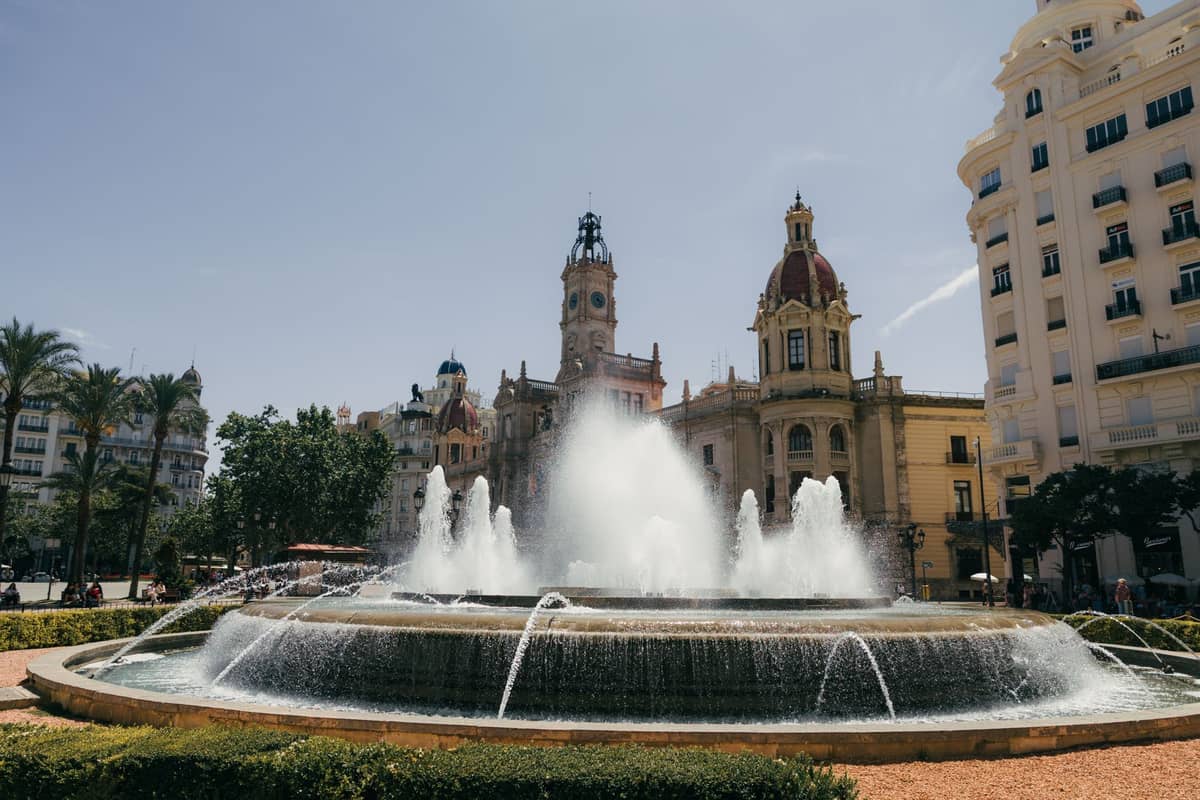
Plaza del Ayuntamiento, known in Valencian as Plaça de l'Ajuntament, is Valencia's principal civic square and the formal center of the city. It anchors the historic center and serves as the official address of both the City Hall (Casa Consistorial) and the grand Post Office building (Palacio de las Comunicaciones). These two flanking structures, both in ornate early 20th-century style, give the square its architectural character: wide, symmetrical, and unambiguously official.
This is not a picturesque medieval square tucked into a warren of alleys. It is broad, open, and exposed to the sky. Fountains run along the central axis. Flower stalls operate near the edges on weekday mornings, their cut blooms visible from twenty meters away in warm weather. The scale of the space is useful to understand before visiting: it feels designed for public gathering on a civic scale, which means it can feel underpopulated on a quiet Tuesday morning and completely transformed during a festival.
💡 Local tip
The square is occasionally pedestrianized for events and selected weekends, when car traffic is partially or fully banned. These periods are the clearest windows to appreciate the architecture without distraction.
The Architecture: Two Buildings Worth Your Attention
The City Hall building, on the north side of the square, was completed in the early 20th century and represents a blend of Spanish baroque revival and early modernist civic design. Its central balcony is the city's main ceremonial stage during Las Fallas. The building's interior, open to visitors on weekday mornings, includes a grand staircase lined with period tilework, ceremonial halls, and a small exhibition space. The tourist information office is located at street level, at Plaza del Ayuntamiento 1.
The Post Office building on the opposite side is equally compelling and often overlooked by travelers focused on the City Hall. Its facade features ornate stone detailing, and the interior retains original decorative elements that recall the era when post offices were civic monuments. The building continues to function as a working post office, which gives a visit an unusual texture: you can send a postcard from one of the most architecturally significant rooms in the city center.
If you find yourself drawn to Valencia's civic and religious architecture, the Estación del Norte is a short walk south and represents the finest example of Valencian Art Nouveau in the city. The two buildings make a natural pairing for an architecture-focused morning.
Tickets & tours
Hand-picked options from our booking partner. Prices are indicative; availability and final rates are confirmed when you complete your booking.
Cala del Moraig Hiking and Beach Trip from Valencia
From 32 €Instant confirmationFree cancellationValencia Silk Museum tickets and audio guide
From 7 €Instant confirmationFree cancellationSaint Nicholas Church Entrance Tickets and Audioguide
From 11 €Instant confirmationHistoric Valencia walking tour
From 27 €Instant confirmationFree cancellation
How the Square Changes Throughout the Day
Early mornings, roughly before 9:00, belong to workers crossing through on their way to the office and delivery trucks making their rounds along the surrounding streets. The fountains are usually running. The flower stalls begin setting up by mid-morning, and the smell of cut stems, particularly carnations and roses in spring, is one of the square's most distinctive sensory details that no photograph captures.
By midday, the square fills with a mix of tourists, office workers on lunch breaks, and locals using it as a transit node. The central benches see steady use. In summer, the open exposure means direct sun with no meaningful shade from trees, so the square can feel punishing between 12:00 and 16:00 from June through August. Carry water, wear a hat, and plan to linger here in the morning or early evening instead.
Late afternoon and early evening are the square's most photogenic hours. The facades of both civic buildings catch the warm western light after 17:00. By 19:00 in the warmer months, the square attracts people simply sitting and watching the city, which is when the social character of the space becomes most apparent. Weekend evenings can see small groups gathering around the fountain and a steady stream of families cutting through toward the shopping streets nearby.
⚠️ What to skip
In high summer (July and August), midday temperatures in the square regularly exceed 35°C with no shade. If you plan to spend time here, the tourist information office inside City Hall provides cool respite and is generally open on weekday mornings.
Las Fallas and the Square's Festival Role
Plaza del Ayuntamiento is at the operational center of Las Fallas, Valencia's extraordinary annual festival held each March. The Fallas season runs through March 19th, and the square hosts the daily Mascletà: a precisely choreographed pyrotechnic explosion, more percussion than firework display, that takes place at exactly 14:00 each day from March 1st through 19th. Standing in the square during a Mascletà is a physical experience. The sound waves are felt in the chest and throat. First-time visitors often describe it as disorienting. It lasts around five to seven minutes and draws crowds so dense that arriving 30 minutes early is necessary to get within the main viewing area.
The Fallas festival is one of the most significant cultural events in Spain and a UNESCO Intangible Cultural Heritage. A complete guide to Las Fallas in Valencia is worth reading before planning a visit around the festival period, as the entire city center including this square operates on a completely different rhythm in March.
Getting There and Navigating the Area
The square is served by a large number of EMT bus lines: routes 4, 6, 8, 9, 11, 16, 28, 36, 70, and 71 all stop at or adjacent to Plaza del Ayuntamiento. If you are coming from the train station at Estación del Norte, it is a five-minute walk north along Calle Xàtiva. From the central market, it is a similar walking distance heading south through the old town streets.
The square sits at the southern edge of the historic center, making it an efficient starting point for a walking tour. From here, the major monuments of the old town are all within ten to fifteen minutes on foot: the Cathedral, La Lonja, and the Carmen neighborhood are all accessible without navigating any complicated routing.
ℹ️ Good to know
The tourist information office inside City Hall (Plaza del Ayuntamiento 1, ground floor) is generally open Monday–Friday in the morning and afternoon, Saturday in the morning, and Sunday/holidays in the morning only, with closures on certain public holidays and reduced hours during Fallas. Check current hours before your visit.
Practical Notes for Visitors
The square is entirely flat and paved, making it straightforward for visitors with mobility limitations. The City Hall visitor entrance at street level implies step-free access from the square itself, though detailed information on internal accessibility features such as lifts and adapted facilities is best confirmed directly with the City Hall before visiting.
Photography from the square is unrestricted. The best angle for the City Hall facade is from the south end of the central axis, ideally in the hour before sunset when shadows fall away from the building's front. A wide lens is useful given the scale of both buildings. The fountains along the central walkway provide a foreground element and tend to be running during daylight hours on most days.
Travelers on a tight budget will find Plaza del Ayuntamiento useful as a free orientation point. For more free options in the city, a guide to free things to do in Valencia covers attractions and experiences that cost nothing throughout the city.
Who Might Want to Skip It
If you are visiting Valencia primarily for its beaches, the old quarter's medieval churches, or the futuristic architecture of the Ciudad de las Artes y las Ciencias, Plaza del Ayuntamiento may not rank highly on your list. It is not an intimate space, it has no museum content in itself, and outside of festival periods it can feel like a transit hub with attractive buildings rather than a destination in its own right. Travelers who have already visited comparable central squares in Madrid (Puerta del Sol) or other major Spanish cities may find the experience familiar rather than revelatory.
That said, because it is free, central, and on the route between the train station and the old town, most visitors pass through naturally without needing to plan a dedicated trip.
Insider Tips
- The flower stalls along the square's perimeter operate primarily on weekday mornings. Vendors typically set up by 10:00 and pack away by early afternoon. The selection is widest on Thursday and Friday mornings when fresh deliveries arrive.
- If you want a photograph of the City Hall facade without crowds in the frame, arrive before 08:30 on a weekday. The square is nearly empty at that hour and the eastern morning light falls cleanly on the building front.
- The tourist information office inside City Hall is one of the best-stocked in the city and its staff are accustomed to helping visitors plan broader itineraries. It is quieter than the office near the Cathedral and worth using if you have questions about opening hours or transport.
- During Las Fallas, claim your Mascletà spot by 13:20 at the latest, ideally standing on the central walkway axis facing the City Hall balcony. The sound is most intense in the center of the square and noticeably weaker near the outer edges.
- The Post Office building interior, often missed by visitors focused on City Hall, is worth a few minutes. The main hall retains original ironwork and tiled details. It functions as a working post office, so stamps and posting services are available, which makes it a practical stop as well as a visual one.
Who Is Plaza del Ayuntamiento For?
- First-time visitors to Valencia wanting a geographic and civic anchor for their orientation
- Architecture enthusiasts interested in early 20th-century Spanish civic design
- Travelers visiting during Las Fallas who want to experience the daily afternoon Mascletà at its source
- Anyone combining the square with a walking tour of the historic center, using it as a practical start or endpoint
- Budget travelers who want to understand the city's layout without spending money on a tour or attraction
Nearby Attractions
Other things to see while in Centro Histórico:
- Basílica de la Virgen de los Desamparados
The Real Basílica de Nuestra Señora de los Desamparados stands at the heart of Valencia's historic centre, housing the revered image of the city's patron saint. Built between 1652 and 1667, it is free to enter and open every day, making it one of the most accessible and emotionally resonant stops in the old city.
- Catedral de València
Rising above Plaza de la Reina in Valencia's historic centre, the Cathedral of Valencia is a remarkable layered monument built over seven centuries. From a Romanesque doorway to Gothic vaulting, a Baroque facade, and a relic claimed to be the Holy Grail, this is one of Spain's most architecturally complex and historically loaded churches.
- Centre Cultural La Nau
Housed in the University of Valencia's historic headquarters since the late 15th century, Centre Cultural La Nau is a historic landmark in the old town offering free exhibitions, concerts, and theatre. It rewards visitors who slow down and look closely.
- Centre Arqueològic de l'Almoina
Beneath a quiet plaza steps from Valencia Cathedral lies one of Spain's most compelling urban archaeology sites. The Centre Arqueològic de l'Almoina preserves around 2,500 square metres of Roman, Visigothic, and medieval remains, excavated over two decades and now visible through a striking modern structure.