Plaza de España and the Monument to the Constitution of 1812
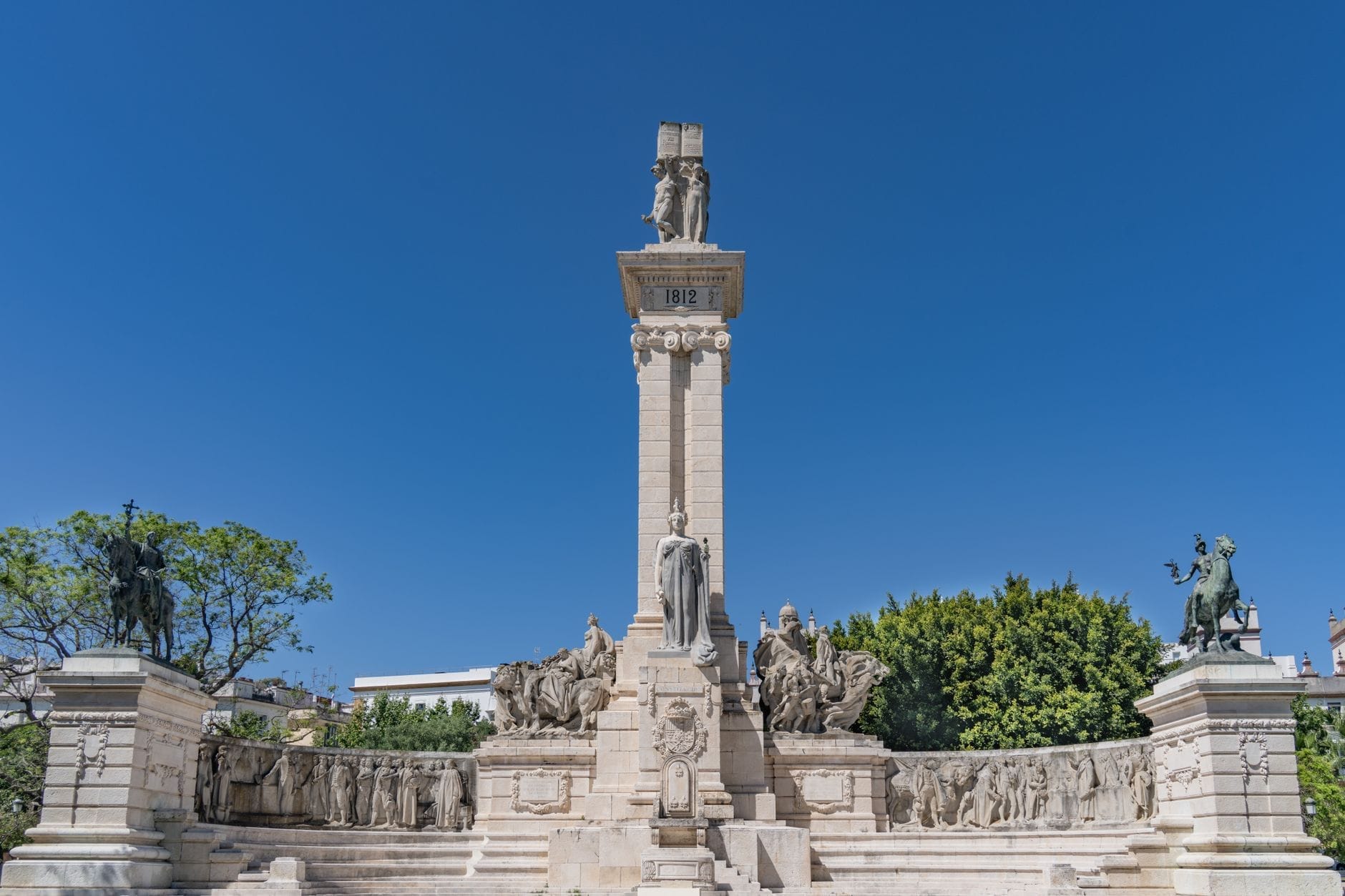
Plaza de España anchors the northeastern edge of Cádiz's historic centre with a sweeping semicircular monument completed in 1929. Free to visit at any hour, it commemorates the 1812 Constitution and offers a quiet counterpoint to the city's more tourist-heavy squares.
Quick Facts
- Location
- Plaza de España, 11006 Cádiz — northeastern edge of the historic centre, near the port
- Getting There
- Short walk from the port (Avenida del Puerto) or city bus routes along the nearby avenues; the old town is fully walkable
- Time Needed
- 20–40 minutes for the square itself; easily combined with a longer old-town walk
- Cost
- Free — public square, no admission fee
- Best for
- History enthusiasts, architecture lovers, morning walkers, photographers
- Official website
- josecelestinomutis.cadiz.es/en/portfolio/plaza-de-espana-2/
What Is Plaza de España?
Plaza de España is a public square in the historic centre of Cádiz, dominated by the Monumento a la Constitución de 1812, also known as the Monumento a las Cortes de Cádiz. The monument is a large hemicycle of pale stone with a central sculptural body, commissioned to mark the centenary of Spain's first liberal constitution and completed in 1929 after nearly two decades of work. It stands on the northeastern edge of the old town, where the city's dense medieval fabric opens up toward the bay.
The square itself replaced the much smaller Plazuela del Carbón after a stretch of the old city walls was demolished at the start of the 20th century. That demolition gave Cádiz one of its few genuinely spacious open areas, and the decision to fill it with a constitutional monument was both civic pride and historical statement. The Constitution of 1812, drafted and ratified in Cádiz while much of Spain was under Napoleonic occupation, was a landmark document in the history of Spanish liberalism.
ℹ️ Good to know
The square is open 24 hours a day, every day of the year. Entry is free. No booking, ticket, or guided tour is required to visit.
The Monument: Architecture and Symbolism
The Monumento a la Constitución de 1812 was designed by architect Modesto López Otero, with sculpture by Aniceto Marinas. Work began around 1912 on the centenary of the constitution, and the monument was inaugurated in 1929. The central element is a tall column topped by a female allegory representing the Constitution, flanked by a curved colonnade that forms the hemicycle. Decorative panels and figurative reliefs reference the liberal deputies who gathered in Cádiz to draft the document.
The scale is more civic than grandiose. Compared to the bombastic triumphal monuments of the same era in other European capitals, this one reads as measured and somewhat understated, which suits the square's atmosphere. The stonework is off-white limestone that takes on a warm gold tone in afternoon sun and a pale grey wash under overcast Atlantic skies. Up close, the relief sculpture rewards attention: the detailing is fine, and the allegorical figures around the base reflect early 20th-century academic style at its most competent.
The square underwent a pedestrianization process beginning in 2022, which significantly reduced traffic around its perimeter and made it considerably more pleasant to approach on foot from the Ayuntamiento de Cádiz and the port area.
Tickets & tours
Hand-picked options from our booking partner. Prices are indicative; availability and final rates are confirmed when you complete your booking.
Historical Roman Cadiz guided walking tour
From 22 €Instant confirmationFree cancellationDay trip to Tarifa, Vejer, and the Bolonia beach from the Cadiz Bay
From 59 €Instant confirmationFree cancellationWinery tour and wine tasting in Chiclana de la Frontera in Cadiz
From 25 €Instant confirmationFree cancellationGuided tour of medieval Cadiz landmarks and history
From 30 €Instant confirmationFree cancellation
The Constitution of 1812: Why This Matters
The reason Cádiz has a large monument to a constitution rather than a king or a military victory says something important about how the city sees itself. In 1810 and 1812, while Madrid was occupied by French troops, the Spanish Cortes (parliament) convened in Cádiz, one of the few cities still under Spanish control thanks to its natural defenses as a peninsula city. The constitution they produced, known informally as La Pepa, was one of the first liberal constitutions in the world and established principles of popular sovereignty, freedom of the press, and limits on royal power.
The constitution was short-lived in practice, abolished and reinstated multiple times through the 19th century, but its symbolic weight for Spanish liberalism was immense. Visiting Plaza de España without knowing this context means missing the reason the square exists at all. The monument is not decorative architecture; it is Cádiz's most direct statement about its own place in political history.
For a fuller picture of this history, the Cádiz history guide covers the city's role from Phoenician trading post to constitutional city in detail.
What to Expect at Different Times of Day
In the early morning, Plaza de España is one of the quieter corners of the old town. Dog walkers cross it, office workers cut through, and the monument stands in cool shadow if you arrive before around 9am on a summer day. The light at this hour is flat and even, which suits wide-angle photography of the hemicycle without harsh shadows splitting the colonnade.
By mid-morning, especially from April through October, small clusters of visitors begin arriving, typically people who have walked from the port after arriving on a day-trip ferry from Seville or El Puerto de Santa María. The square never gets genuinely crowded in the way that the area around the cathedral does. There are benches in the garden areas, and the space has a pleasant unhurried quality even at peak tourist hours.
Late afternoon is the best time for photography. From roughly 4pm to 6pm, the sun comes around from the southwest at an angle that catches the relief sculpture and the column's vertical surface, pulling out texture that is invisible at midday. In summer, the heat in the square can be significant around noon since there is limited tree shade immediately around the monument. Coming in the morning or late afternoon is the practical as well as the aesthetic choice.
💡 Local tip
For the best light on the monument's stonework, aim for late afternoon in spring or autumn. In summer, the midday heat on the exposed square is real — bring water if you are combining this with a longer walk around the historic centre.
Practical Walkthrough: How to Visit
Plaza de España sits close to the northeastern tip of the old town peninsula, near the port entrance. If you are arriving from the ferry terminal or the bus station near the port, the square is one of the first major landmarks you encounter on foot, roughly a five-minute walk into the old town. From the Alameda de Apodaca or the seafront promenade, it is a similarly short walk. The square is flat and the paths around the monument are paved; it is accessible for most mobility needs, though detailed accessible infrastructure information is not confirmed in official sources.
The square works naturally as part of a broader walk through the historic centre. A logical route starts here, continues west toward the Catedral de Cádiz, and loops back through the old town's narrow streets before finishing at the Mercado Central de Abastos for lunch. The full circuit takes around two to three hours at a relaxed pace.
There are no facilities inside the square itself — no café, no ticket desk, no toilets. The nearest options are along the surrounding streets and the port-adjacent avenues. It is worth having water with you, particularly in summer.
Honest Assessment: Is It Worth Your Time?
Plaza de España is not the kind of attraction that generates strong reactions. It will not stop you in your tracks. What it offers is something subtler: a well-proportioned public space with a monument that genuinely means something to the city, in a part of the old town that is less saturated with tour groups than the cathedral area. If your interest in Cádiz extends to its political and constitutional history, this square is a direct and tangible expression of that story.
If you are on a very short visit and prioritising only the most visually spectacular stops, the square might reasonably be skipped in favour of the cathedral's tower or the sunset views from the bastions. But for anyone spending a full day or more in Cádiz, it earns its 20-minute stop, and the walk around its perimeter gives you a different angle on the city than the tighter lanes of the interior.
Travellers who want to combine this with more of the old town's architectural highlights should look at the Oratorio de San Felipe Neri, which also has direct ties to the 1812 Cortes: the deputies actually voted on the constitution inside that church, making the two sites a complementary pair.
Insider Tips
- Pair this square with a visit to the Oratorio de San Felipe Neri, where the Constitution of 1812 was actually ratified. The two sites are a 10-minute walk apart and together give a complete picture of the constitutional moment.
- The pedestrianization begun in 2022 is ongoing — approach from the port side or along Calle San Juan de Dios for the easiest and most pleasant pedestrian access.
- The monument's relief panels are worth examining closely at eye level. Most visitors photograph the full hemicycle from a distance and miss the figurative detail in the lower sections.
- On public holidays and during Carnival, the square can serve as a gathering point for processions or events. Check local listings if you are visiting in February or during national holidays.
- The Diputación Provincial building (the former Aduana, or customs house) frames the square on one side and is worth noting architecturally, even though it is not open to general visitors.
Who Is Plaza de España & Monumento a la Constitución For?
- History and politics enthusiasts who want to understand Spain's constitutional heritage
- Architecture walkers doing a circuit of the historic centre
- Photographers looking for a large sculptural subject with good afternoon light
- Travellers arriving by ferry who want a first landmark within easy walking distance of the port
- Anyone spending a full day in Cádiz and wanting to cover the northeast end of the old town
Nearby Attractions
Other things to see while in Centro Histórico (Old Town):
- Alameda Apodaca
Alameda Apodaca is a protected Romantic-era promenade running along the northern sea wall of Cádiz's old town. Free, open at all hours, and overlooking the Bay of Cádiz, it offers one of the most atmospheric walks in the city — with very little effort required.
- Antiguo Hospital de Mujeres
Founded in 1677 and rebuilt in grand 18th-century baroque style, the Antiguo Hospital de Mujeres is one of Cádiz's most architecturally significant buildings. Today it is managed as a visitable monument linked to the Diocese of Cádiz y Ceuta, opening its twin patios and chapel to visitors for a modest entry fee, offering a rare glimpse into the city's golden-age ambitions.
- Ayuntamiento de Cádiz (City Hall)
The Ayuntamiento de Cádiz stands as one of the most photographed facades in Andalusia's oldest provincial capital. Begun in 1799 and shaped by two distinct architectural phases, it anchors the central plaza of Cádiz's historic core and speaks directly to the city's 19th-century ambitions. This guide covers what to see, when to go, and how the building fits into a walk through the old town.
- Calle Ancha
Calle Ancha cuts through the historic center of Cádiz as its widest and most storied street. Free to walk at any hour, it offers a concentrated dose of Baroque architecture, political history, and the kind of unhurried street life that defines this Atlantic city.