Plaza de Colón (Columbus Square): Madrid's Monument to Discovery
Plaza de Colón anchors the northern end of Paseo de Recoletos with a towering Neo-Gothic Columbus monument, one of Madrid's largest Spanish flags, and the open-air Discovery Gardens. Access is free and around the clock, making it a natural pause point between the Salamanca district and the city's grand boulevard.
Quick Facts
- Location
- Between Paseo de la Castellana and Paseo de Recoletos, 28001 Madrid
- Getting There
- Metro Colón (Line 4); EMT buses 5, 14, 27, 45, 150
- Time Needed
- 20–40 minutes for the square; longer if exploring the gardens
- Cost
- Free. Open 24 hours.
- Best for
- Architecture lovers, walkers on the Paseo de Recoletos route, history enthusiasts
- Official website
- www.esmadrid.com/en/tourist-information/plaza-colon
What Plaza de Colón Actually Is
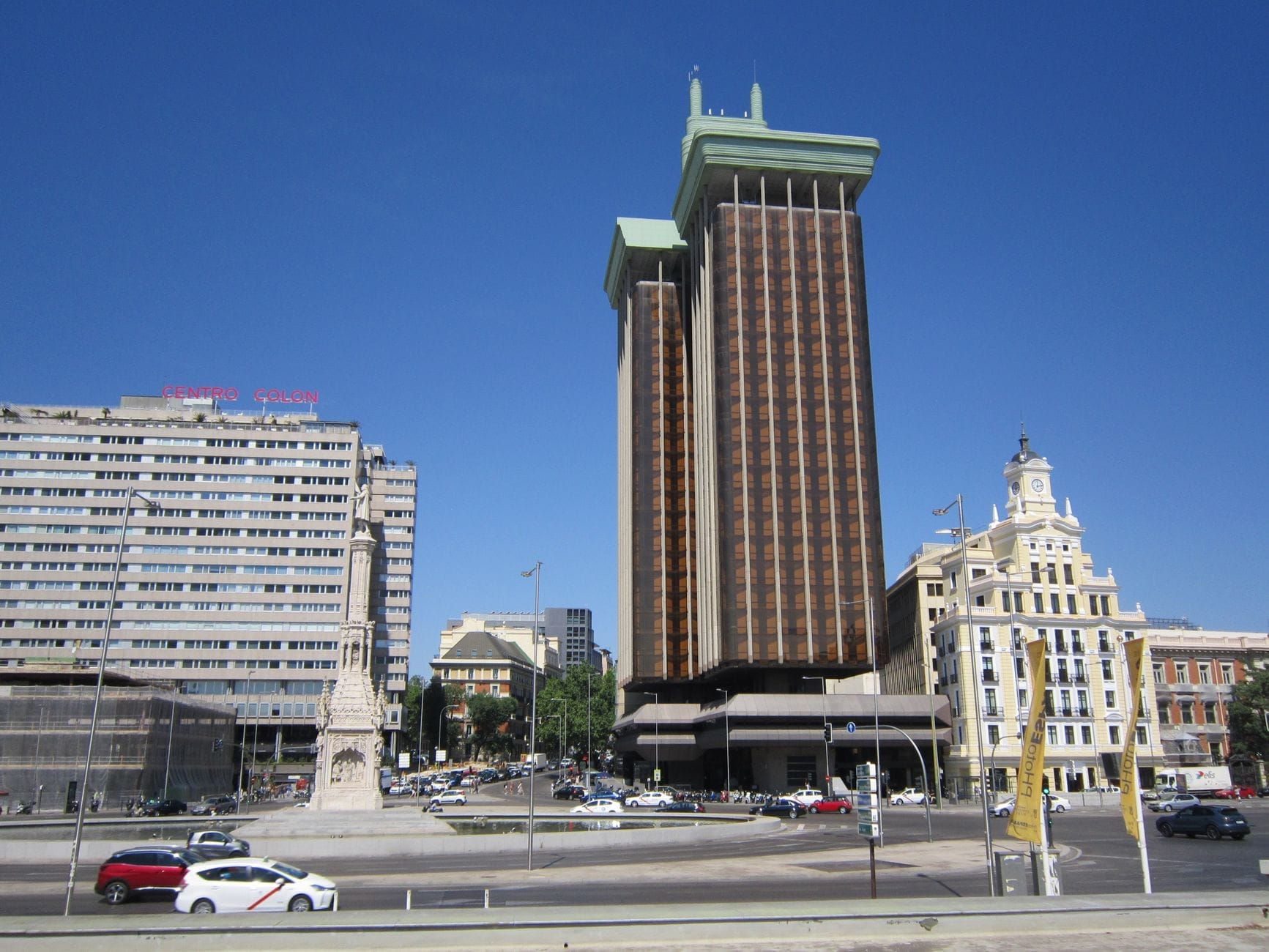
Plaza de Colón is a large urban square sitting at the convergence of three of Madrid's most prestigious districts: Salamanca, Chamberí, and Centro. It marks the point where Paseo de Recoletos transitions into Paseo de la Castellana, the city's central spine. The name honors Christopher Columbus, and the square has carried it since 1893, when it was renamed from its original designation as Plaza de Santiago.
The square is not a quiet garden retreat. It sits above a busy underground traffic tunnel, flanked by lanes of fast-moving vehicles and bookended by institutional facades. What it offers instead is scale, symbolism, and a specific kind of urban grandeur that Madrid does better than almost anywhere: wide, open, unapologetically monumental. Come expecting a civic landmark rather than a peaceful square, and you will read it correctly.
💡 Local tip
The square is most photogenic in the early morning, before traffic builds and tour groups arrive. The Columbus monument catches good light from the east in the first two hours after sunrise.
The Columbus Monument and the Giant Flag
The centrepiece of the square is a Neo-Gothic white marble monument to Christopher Columbus, completed in 1885. Standing 20 metres tall including its pedestal, the statue was originally commissioned to mark the marriage of King Alfonso XII. Columbus is depicted pointing westward, the direction of his 1492 voyage, from atop an elaborate sculpted column. The style is ornate and somewhat theatrical, more commemorative than naturalistic, and it holds up well as a piece of 19th-century civic sculpture.
The other dominant feature is the Spanish flag. At roughly 12 metres wide and 14 metres tall, flying from a 50-metre flagpole, it is one of the largest flags displayed in Madrid and visible from considerable distance down Paseo de la Castellana. On clear days with a reasonable breeze, the flag unfurls dramatically against a blue sky. It is a deliberate statement of national presence at one of the city's most prominent intersections.
Tickets & tours
Hand-picked options from our booking partner. Prices are indicative; availability and final rates are confirmed when you complete your booking.
Royal Monastery of El Escorial and the Valley of the Fallen trip from Madrid
From 64 €Instant confirmationFree cancellationFlexible time Real Madrid: Bernabeu Stadium & Museum Entry
From 42 €Instant confirmationMuseum of Senses Madrid entrance ticket
From 19 €Instant confirmationAvila and Segovia full-day tour from Madrid
From 50 €Instant confirmationFree cancellation
The Jardines del Descubrimiento (Discovery Gardens)
Opened in 1970, the Jardines del Descubrimiento flank the Columbus monument and extend across the eastern side of the square toward Calle Serrano. The gardens contain three large sculptural blocks etched with maps, historical texts, and imagery relating to Columbus's voyages and the Spanish discovery of the Americas. These are not decorative in the typical sense: they read more like oversized architectural inscriptions, monumental in scale and deliberately didactic in tone.
The gardens are pleasant enough for a short walk, with benches that fill with locals on mild afternoons. They are not comparable in size or atmosphere to Parque del Retiro and should not be treated as a substitute for Madrid's proper parks. What they do offer is a coherent open-air historical narrative, free and accessible, that most visitors walk through in under twenty minutes.
ℹ️ Good to know
The gardens are wheelchair accessible via broad paved paths. The surrounding square sits above an underground vehicle tunnel; street-level crossings connect the gardens to the monument and the wider plaza without requiring underground access.
How the Square Changes Through the Day
Early morning, before 8am, Plaza de Colón belongs to joggers and dog walkers moving between the Recoletos promenade and the Salamanca streets. The traffic is light, the light is soft, and the monument reflects the morning sun without competition from crowds. It is the best time to take photographs and to stand quietly with the scale of the place.
By mid-morning, tour groups begin to filter through as part of walking circuits that often combine the square with nearby institutions. By midday in summer, the exposed stonework radiates heat and there is little shade at the monument itself. The gardens offer more shelter, but the square is uncomfortable during Madrid's peak summer hours, typically between noon and 4pm, when temperatures frequently exceed 30 degrees Celsius.
In the evening, the square takes on a different register. The monument is illuminated, and Madrileños heading north along the Castellana or cutting through toward Chueca and Salamanca pass through in numbers. It is a thoroughfare as much as a destination, but an atmospheric one after dark.
Getting There and Getting Around
The most direct metro access is at Colón station on Line 4, a short exit directly onto the square. The station connects easily with Serrano to the south and Goya further into the Barrio de Salamanca. EMT bus lines 5, 14, 27, 45, and 150 stop nearby, making the square reachable from most central Madrid neighborhoods without requiring a transfer.
On foot, Plaza de Colón sits naturally along the Paseo del Prado and Recoletos walking axis. From Cibeles, the walk north along Recoletos takes roughly 10 minutes at a normal pace. Continuing north from Colón along the Castellana brings you into the banking and embassy corridor of the city. The square is an easy logical waypoint rather than a standalone destination requiring special routing.
Historical and Cultural Context
The renaming of the square in 1893 came several years before the 400th anniversary of Columbus's 1492 voyage, as Spain was still reckoning with its imperial history and managing declining global influence. The square became one of several public spaces in Madrid used to assert a narrative of Spanish discovery and civilizational reach. The 1885 monument predated the renaming and was built originally for a royal occasion, which gives the site a slightly layered symbolic history: royal patronage repurposed for national mythology.
The square sits close to cultural institutions that engage with Spanish history more critically and thoroughly. If historical context is your primary interest, the Museo Arqueológico Nacional is a short walk to the southeast, and the Museo de América in Moncloa-Argüelles provides significant depth on the colonization of the Americas. Plaza de Colón is the monument; those museums are the argument.
Photography and Practical Notes
For photography, morning light from the east works best for the Columbus monument. The flag photographs well in any direction when fully extended by wind; still days reduce its visual impact considerably. The gardens' sculptural blocks are best captured in late afternoon light, when the carved text and reliefs cast strong shadows.
There is no shade structure at the monument itself. In summer, bring water and plan the visit for before 10am or after 6pm. The square is entirely free, with no queues or tickets at any point. It is also covered under any walking itinerary of the Recoletos-Castellana corridor. If you are planning a broader walk through the area, the Madrid walking tour routes typically pass through the square en route between the Retiro area and the northern districts.
⚠️ What to skip
The square is exposed and offers minimal shade. In July and August, visiting between noon and 4pm is genuinely uncomfortable. Plan accordingly, or treat the square as an early-morning or evening stop during summer trips.
Insider Tips
- The underground space beneath the plaza contains the Teatro Fernán Gómez (Centro Cultural de la Villa). If you are interested in Madrid's contemporary theatre and arts scene, check its programme separately; it is independent from the square above and easy to miss entirely.
- Stand at the southern end of the Jardines del Descubrimiento and look south toward Cibeles for one of the cleaner long-lens shots of the Castellana boulevard axis. Most visitors photograph only the monument close-up and miss this perspective.
- The EMT bus stop near Colón is a useful point for catching buses northward along the Castellana if you are continuing toward Cuatro Torres or the Bernabéu area, avoiding the need to backtrack to a metro station.
- The sculptural blocks in the Discovery Gardens contain etched historical text in Spanish. Bring a translation app if you want to read them: they include excerpts from Columbus's logs and records of the 1492 voyage, which add genuine context to the monument.
- On national holidays and during major football celebrations, the square becomes a gathering point for crowds and flag-waving, which adds atmosphere but also significant congestion. Factor this in if your visit coincides with a major event.
Who Is Plaza de Colón For?
- Walkers doing the full Recoletos to Castellana boulevard route
- Architecture and civic monument enthusiasts interested in 19th-century Spanish neogothic
- Visitors wanting a free, no-queue landmark on the border of Salamanca and the city centre
- Photographers working in early morning light along the Castellana axis
- Travellers combining a visit with the Museo Arqueológico Nacional nearby
Nearby Attractions
Other things to see while in Barrio de Salamanca:
- Calle de Serrano
Calle de Serrano is Madrid's most prestigious shopping corridor, stretching roughly 4 kilometers through the elegant Barrio de Salamanca and into Chamartín. From international luxury flagship stores near Puerta de Alcalá to local Spanish designers and fine food markets further north, the street offers a complete portrait of how Madrid's wealthiest neighborhood shops, eats, and moves.
- Fundación Mapfre – Sala Recoletos
Tucked into a beautifully restored 1880s building on one of Madrid's most elegant boulevards, Fundación MAPFRE Sala Recoletos is a compact, carefully programmed gallery that consistently delivers exhibitions rivalling much larger institutions. With roughly 1,000 square metres across three rooms, it focuses on photography, modern art, and overlooked masters — and it is free every non-holiday Monday afternoon.
- Plaza de Toros de Las Ventas
Plaza de Toros de Las Ventas is one of Europe's most architecturally striking arenas, a Neo-Mudéjar landmark with a capacity of 23,798 seats and a history stretching back to 1931. Whether you attend a corrida or simply take the guided tour, the scale and detail of this place are genuinely arresting.
- Mercado de La Paz
Opened in 1882 and still going strong, Mercado de La Paz is the working neighborhood market at the heart of Madrid's upscale Salamanca district. With around 35 stalls selling everything from Iberian ham to fresh fish, it offers a grounded, local counterpoint to the area's designer boutiques — and it costs nothing to walk in.