Plaza de Toros de Las Ventas: Madrid's Grand Bullring Explained
Plaza de Toros de Las Ventas is one of Europe's most architecturally striking arenas, a Neo-Mudéjar landmark with a capacity of 23,798 seats and a history stretching back to 1931. Whether you attend a corrida or simply take the guided tour, the scale and detail of this place are genuinely arresting.
Quick Facts
- Location
- C/ Alcalá 237, Madrid (Salamanca district, Guindalera quarter)
- Getting There
- Metro Ventas (Lines 2 and 5)
- Time Needed
- 1.5 to 2.5 hours for the tour; longer if attending a corrida
- Cost
- Paid entry for tours and events; check official site for current prices
- Best for
- Architecture lovers, cultural history seekers, photographers
- Official website
- www.las-ventas.com
What Is Plaza de Toros de Las Ventas?
Plaza de Toros de Las Ventas is Madrid's principal bullring and the most prestigious bullfighting venue in the world by reputation. Situated on Calle de Alcalá at number 237, in the Guindalera quarter of the Salamanca district, the arena seats approximately 23,798 spectators and has hosted the San Isidro Festival corridas every May since its inauguration. Even for visitors who have no interest in the sport itself, the building is a serious architectural statement that rewards close attention.
Construction began in 1922, designed by architect José Espeliú and later continued by Manuel Muñoz Monasterio. The arena was inaugurated in 1931, though it was not fully completed until 1934. That twelve-year span between groundbreaking and completion is visible in the building: the decorative ambition grew as the project progressed, and the final structure is considerably more ornate than early plans suggested.
ℹ️ Good to know
Visitor tours generally run daily, with hours varying by season (typically 10:00–19:00 from April to October and 10:00–18:00 from November to March, with last entry an hour before closing and earlier closure on fight days). Corrida schedules are seasonal, concentrated from March to October, with the San Isidro Festival in May being the peak. Verify current ticket prices and tour availability at las-ventas.com before visiting.
The Architecture: Neo-Mudéjar at Its Most Ambitious
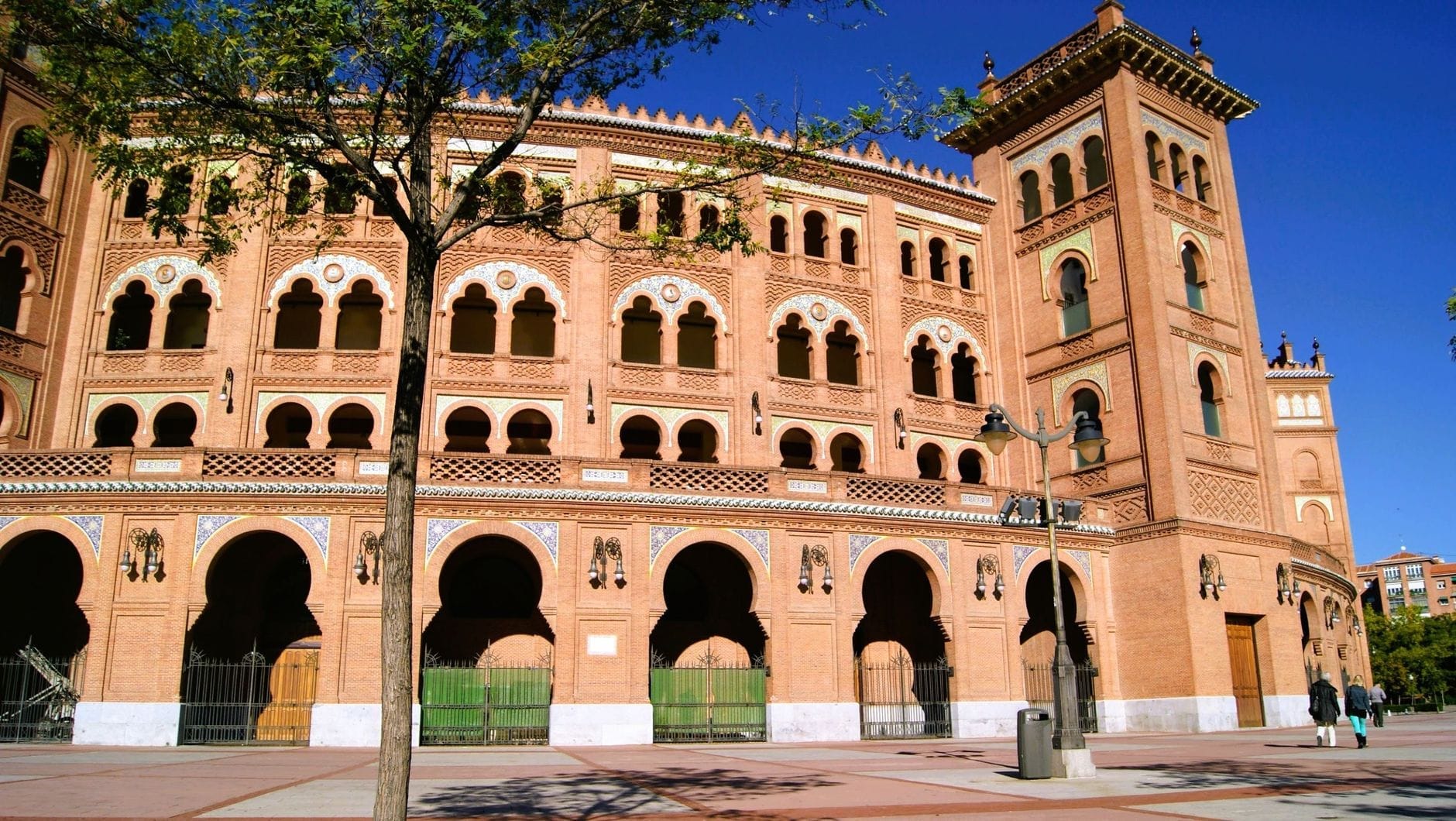
The style is Neo-Mudéjar, a 19th and early 20th-century Spanish revival movement that drew on the Islamic-influenced architecture of medieval Castile and Andalusia. At Las Ventas, this translates into elaborate brickwork, horseshoe arches, ceramic tile inlays in deep greens and blues, and an exterior that reads almost like a palace rather than a sports venue. The three main façades are studded with decorative panels, and the gate structure, the Puerta Grande through which triumphant matadors are carried, is one of the most photographed doorways in Madrid.
The interior is equally considered. The stands rise steeply around a circular arena (the ruedo) measuring approximately 60 metres in diameter. The gradient of the seating means that even upper-tier spectators have a clear view of the sand below. Stone and brick predominate throughout, and there is almost no material that feels temporary or makeshift. This was built to last, and it shows.
If the Neo-Mudéjar style interests you beyond this building, Madrid has several other examples worth tracking down. The Madrid architecture guide covers the movement in broader context and points to other examples across the city.
Tickets & tours
Hand-picked options from our booking partner. Prices are indicative; availability and final rates are confirmed when you complete your booking.
Las Ventas bullring and museum visit with audio guide
From 16 €Instant confirmationElectric tuk-tuk tour of Madrid's historic center
From 53 €Instant confirmationFree cancellation10 Tapas cooking class
From 60 €Instant confirmationFree cancellationSpanish cooking class and visit to a local Madrid's market
From 95 €Instant confirmationFree cancellation
The Tour Experience: What You Actually See
The self-guided and guided tours take visitors through areas that are off-limits on event days: the ring itself, the bull pens, the toreros' entrance, the chapel where matadors pray before entering the arena, and selected internal circulation areas. Each of these spaces tells a different part of the story.
Standing on the sand of the ruedo is a disorienting experience. The amphitheatre rises sharply on all sides, and the geometry of the space becomes immediately legible in a way it cannot from a photograph. The ground is raked and maintained with precision. The smell is faintly of earth and sawdust, occasionally stronger near the corrals. In the morning, when tour groups are thin and the light comes in at a low angle through the upper openings, the arena feels hauntingly ancient, though it is barely a century old.
The Museo Taurino, located within the complex, holds costumes worn by celebrated matadors, along with portraits, mounted bull heads (trophies awarded after exceptional fights), and documents tracing the history of bullfighting in Spain. The collection is dense and well-labelled, though the labels are primarily in Spanish. Visitors with no prior knowledge of the sport will benefit from reading a brief background before arriving.
💡 Local tip
Arrive at or shortly after 10:00 on weekdays to have the ring largely to yourself. Weekend mornings draw larger tour groups, and the narrow corridors beneath the stands can feel cramped when crowded.
Attending a Corrida: What to Know Before You Go
Bullfighting is a deeply contested subject, and this page will not argue its merits either way. What can be said objectively is that a corrida at Las Ventas is a specific cultural experience with its own rituals, vocabulary, and aesthetic logic that takes time to understand. First-time attendees who arrive without any background often find it confusing rather than dramatic; those who have read even a short primer on the structure of a fight tend to have a more engaged experience.
The San Isidro Festival in May is the most important bullfighting event in the calendar, with fights on consecutive days drawing the most prominent figures in contemporary tauromachy. Tickets for the best seats during this period sell out well in advance. For the rest of the season, tickets are generally more accessible, though popular fights, especially those featuring well-known matadors, can go quickly.
The San Isidro Festival extends well beyond the bullring, with processions, markets, and outdoor events across the city. The Madrid San Isidro Festival guide has a full breakdown of what happens and when.
Seating is divided into sol (sun) and sombra (shade). Sol seats on the sunny side of the ring are cheaper but can be uncomfortably hot in summer, when afternoon temperatures in Madrid frequently exceed 30°C. Sombra seats cost more and are considerably more comfortable. There is also a distinction between covered and uncovered sections. For a first visit, sombra is worth the price difference.
⚠️ What to skip
Corridas involve the injury and death of bulls and, occasionally, serious injury to matadors. If this is likely to cause distress, the museum and arena tour offer a complete architectural and cultural visit without attending an event.
Getting There and the Surrounding Area
The metro is the easiest approach. Ventas station, served by both Line 2 (red) and Line 5 (green), deposits you directly at the main entrance on Calle de Alcalá. The journey from central Sol station is around 10–15 minutes on Line 2. By car, the M-30 ring road has an exit at Puente de Ventas, though parking in the immediate area on event days is extremely difficult.
The arena sits at the boundary of the Barrio de Salamanca, Madrid's most affluent inner-city district. The streets immediately surrounding Las Ventas are residential and unremarkable, but heading west along Calle de Alcalá brings you quickly into the wealthier stretches of Barrio de Salamanca, with its broad avenues, upmarket shops, and cafés worth stopping at before or after your visit.
The walk from the Retiro park to Las Ventas along Calle de Alcalá takes roughly 35 to 45 minutes and passes several notable buildings, making it a reasonable approach if you are combining visits. Alternatively, the bullring can be paired with a morning at the Museo Lázaro Galdiano, which is about 15 minutes north on foot.
Photography, Timing, and Practical Considerations
The exterior of Las Ventas is best photographed in the late morning, when the sun comes around to illuminate the south-facing main façade. The tilework and brickwork detail are rich enough to fill a wide-angle frame, but the building's scale also means that stepping back across Calle de Alcalá gives you a full-width composition. A standard zoom lens covers most scenarios adequately.
Inside, the Museo Taurino is reasonably lit and in most areas typically allows photography without flash. The ring itself, when accessible during tours, offers strong light from above and interesting shadow geometry in the morning. On event days, photography rules in the seating areas are generally permissive for personal cameras, but flash is often considered rude and disruptive.
Wear comfortable shoes. The tour covers a considerable amount of ground across different levels, including some cobbled passages and stairs with no lift access in older sections. The arena is partially exposed to the elements, so in winter, a layer is advisable even on clear days. Summer visits during event times, when the afternoon sun is intense, warrant sunscreen and water, particularly if you have sol-side seats.
For those planning a wider cultural itinerary, Madrid's trio of world-class art museums is within reasonable distance. The best museums in Madrid guide covers the full picture, from the Prado to the Reina Sofía, with practical visitor tips for each.
Who Will Not Enjoy This
Visitors who are strongly opposed to bullfighting on ethical grounds will find the Museo Taurino and the trophy displays in the museum uncomfortable, even without attending a corrida. The institution does not present the activity in a neutral or conflicted way. It celebrates it, and the framing throughout is unambiguously pro-tauromachy.
Travelers primarily interested in contemporary art or modern Madrid will find little here to engage them beyond the architecture. The building is remarkable, but the visit is essentially about a traditional practice and its history. If your time in Madrid is limited to two or three days and your priorities lie elsewhere, there are stronger candidates for your afternoon.
Insider Tips
- The Puerta Grande, the main ceremonial gate at ground level, is the most photogenic element of the exterior but is often blocked by parked vehicles on non-event days. Visit on a Sunday morning when traffic is lightest for an unobstructed view.
- The museum within the complex is included in the general tour ticket and should not be rushed. The matador costumes (trajes de luces) are extraordinarily detailed up close, with hand-sewn gold thread work that photographs well in natural light from the nearby windows.
- If you want to attend a corrida but find the main season overwhelming, September and early October offer fights with shorter lead times for tickets and slightly cooler temperatures than the peak summer dates.
- The area directly outside the main entrance on Calle de Alcalá has several traditional bars that fill with aficionados before and after fights. The conversation is specific and animated, and even non-Spanish speakers can absorb the atmosphere.
- Tours run daily, but staff presence in some sections of the museum can be minimal on weekday mornings. If you have specific questions about exhibits, the early afternoon tends to have more guides available.
Who Is Plaza de Toros de Las Ventas For?
- Architecture enthusiasts interested in Neo-Mudéjar design and early 20th-century Spanish civic buildings
- Travelers curious about Spanish cultural traditions and wanting context beyond a surface impression
- Photographers looking for strong exterior geometry and rich decorative detail
- Anyone attending the San Isidro Festival who wants to understand the central venue before the fights begin
- History-focused visitors who appreciate museums with genuine artifacts rather than reconstructions
Nearby Attractions
Other things to see while in Barrio de Salamanca:
- Calle de Serrano
Calle de Serrano is Madrid's most prestigious shopping corridor, stretching roughly 4 kilometers through the elegant Barrio de Salamanca and into Chamartín. From international luxury flagship stores near Puerta de Alcalá to local Spanish designers and fine food markets further north, the street offers a complete portrait of how Madrid's wealthiest neighborhood shops, eats, and moves.
- Fundación Mapfre – Sala Recoletos
Tucked into a beautifully restored 1880s building on one of Madrid's most elegant boulevards, Fundación MAPFRE Sala Recoletos is a compact, carefully programmed gallery that consistently delivers exhibitions rivalling much larger institutions. With roughly 1,000 square metres across three rooms, it focuses on photography, modern art, and overlooked masters — and it is free every non-holiday Monday afternoon.
- Mercado de La Paz
Opened in 1882 and still going strong, Mercado de La Paz is the working neighborhood market at the heart of Madrid's upscale Salamanca district. With around 35 stalls selling everything from Iberian ham to fresh fish, it offers a grounded, local counterpoint to the area's designer boutiques — and it costs nothing to walk in.
- Museo Arqueológico Nacional
The Museo Arqueológico Nacional (MAN) holds Spain's most comprehensive collection of archaeological treasures, from prehistoric cave art reproductions to Roman mosaics and medieval Islamic goldwork. Located in the Barrio de Salamanca, it is one of the most substantive and undervisited museum experiences in Madrid.