Museo de América: Madrid's Window on the Pre-Columbian World
The Museo de América holds more than 25,000 objects spanning pre-Columbian civilizations, colonial history, and indigenous cultures of the Americas. Located in the Moncloa-Argüelles district, it is one of Europe's most significant collections of American heritage — and one of Madrid's most overlooked major museums.
Quick Facts
- Location
- Avenida Reyes Católicos 6, 28040 Madrid (Moncloa-Argüelles)
- Getting There
- Metro: Moncloa (Lines 3 & 6) or Islas Filipinas (Line 7); Bus: 1, 44, 62, 82, 132, 138
- Time Needed
- 1.5 to 2.5 hours
- Cost
- €3 general / €1.50 reduced / Free on Sundays and Thursday afternoons from 14:00 (plus additional free categories; see official site)
- Best for
- History lovers, Latin American heritage travelers, families with older children
- Official website
- www.cultura.gob.es/museodeamerica/en/portada.html
What the Museo de América Actually Is
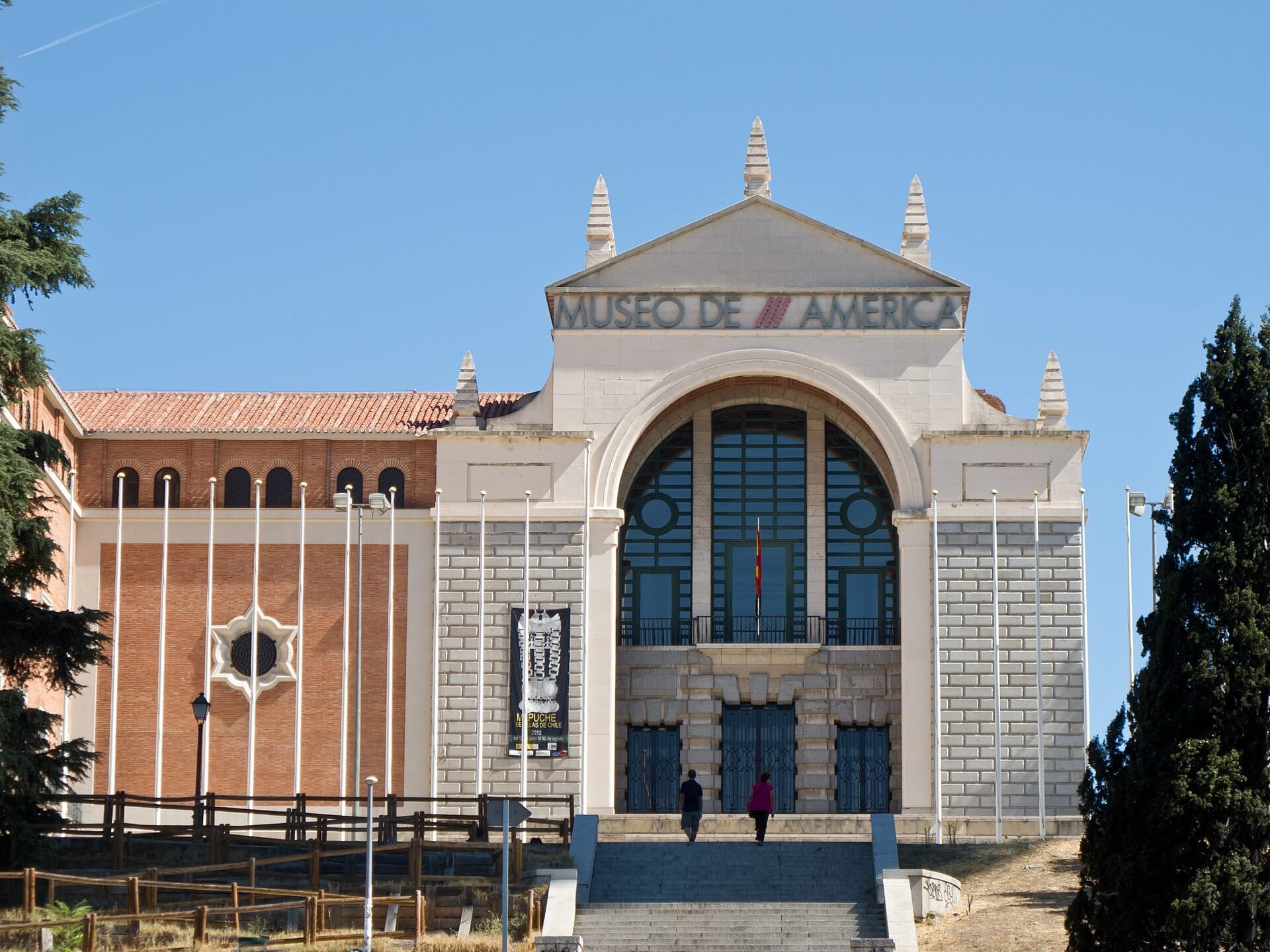
The Museo de América is Spain's national museum dedicated entirely to the cultures, peoples, and histories of the American continent. Housed in a formal 1954 building on Avenida Reyes Católicos, the museum holds more than 25,000 objects ranging from pre-Columbian goldwork and Maya codices to colonial-era religious paintings and 20th-century ethnographic material. The collection represents the breadth of what Spain encountered, documented, and brought back from the Americas over five centuries.
Founded in 1941 and operated under Spain's Ministry of Culture, this is not a regional curiosity. It is one of the most significant repositories of American-origin objects in Europe. Yet it draws a fraction of the visitors who queue each morning outside the Prado or the Reina Sofía. That combination of depth and quietness makes it worth understanding before you visit.
ℹ️ Good to know
Free admission: every Sunday, Thursdays from 14:00, and on 18 April (International Day for Monuments and Sites), 18 May (International Museum Day), and 12 October (Spain's National Day); additional free-entry categories apply, so check the official site for full details.
The Collection: Five Rooms, Five Themes
The permanent exhibition is organized thematically rather than chronologically, which rewards attentive visitors and can confuse those expecting a straightforward timeline. The five rooms follow the themes of Knowledge of America, Reality of America, Society, Religion, and Communication. Each room draws on different object types, mixing pre-Columbian artifacts with colonial-era maps, manuscripts, and ceremonial objects.
Among the highlights is the Tudela Codex, a post-conquest illustrated manuscript from the 16th century that documents Aztec religious and calendrical systems. It is displayed under low, protective lighting, and standing close to it produces a particular kind of stillness — the recognition that you are looking at a primary document of a civilization that no longer exists in the form it once took. Equally striking are the pieces of pre-Columbian gold and featherwork, materials that rarely survive in other collections due to their fragility.
The ethnographic sections, which cover indigenous cultures from across South America, the Caribbean, and North America, are less celebrated but genuinely interesting. Ceramic vessels, textiles, and ceremonial items from cultures that are not commonly represented in European museums appear here with reasonable contextual signage, though some labels remain primarily in Spanish.
💡 Local tip
English-language labels are present throughout but not universal. If you read Spanish at any level, you will get significantly more from the exhibition text. An English-language audio guide option is worth checking at the front desk on arrival.
Tickets & tours
Hand-picked options from our booking partner. Prices are indicative; availability and final rates are confirmed when you complete your booking.
Art & Brunch at Museo Nacional Thyssen-Bornemisza tickets
From 50 €Instant confirmationFree cancellationPaseo del Arte pass for Museo Nacional Thyssen-Bornemisza, Reina Sofia Museum and Prado Museum
From 37 €Instant confirmationMuseo Nacional Thyssen-Bornemisza Skip-the-Line Tickets
From 14 €Instant confirmationMuseo Nacional Thyssen-Bornemisza skip-the-line tickets with audio guide
From 19 €Instant confirmation
The Building and Its Surroundings
The museum occupies an imposing building in the historicist style common to Spanish institutional architecture of the mid-20th century. The facade is heavy and symmetrical, and the interior has high ceilings and a slightly cool, dim quality that feels appropriate for the material inside. The building sits on a raised position near the Moncloa transport interchange, with the Arco de la Victoria — a triumphal arch built in 1956 — visible nearby.
The surrounding area is the Moncloa-Argüelles district, a neighborhood shaped by the Complutense University campus and several significant public buildings. The Mirador de Moncloa observation tower is a five-minute walk away, making a combined visit practical. The area feels less tourist-saturated than central Madrid, which gives the whole visit a more composed tempo.
Morning light enters the upper-floor gallery windows from the east, creating reasonable natural illumination in the first two hours after opening. By midday the interior is predominantly artificially lit, which affects photography conditions but keeps the temperature comfortable, an advantage in summer when Madrid's heat becomes a factor.
Visiting by Time of Day
Opening time (09:30 Tuesday to Saturday; 10:00 on Sundays and public holidays) is the quietest period. Arrive within the first 30 minutes and you will likely have entire rooms to yourself. School groups are common on weekday mornings, particularly in spring, and they tend to move quickly through the earlier thematic rooms. If you are visiting midweek and prefer a slower pace, arriving just after 11:00 often catches a lull between group visits.
Thursday evenings (the museum stays open until 19:30) attract a different crowd: students, local residents, and people combining the museum with dinner in the neighborhood. The extended Thursday hours also coincide with the free entry window from 14:00, which means the afternoon is busier than usual on that day. Sunday mornings are consistently the most crowded free-entry window — arriving at 10:00 on the dot helps.
⚠️ What to skip
The museum is closed on Mondays and on 1 January, 6 January, 1 May, and 24, 25, and 31 December. Check the official site for local holiday closures before planning your visit.
Practical Walkthrough: Getting There and Getting Around Inside
From central Madrid, the Metro is the cleanest option. Take Line 3 (yellow) or Line 6 (grey circular) to Moncloa station, then walk uphill on Avenida Reyes Católicos for about eight minutes. The walk involves a noticeable incline — worth knowing if you are traveling with a stroller or have mobility considerations. Alternatively, Metro Line 7 to Islas Filipinas places you on the opposite side, with a slightly longer but flatter approach.
Bus routes 1, 44, 62, 82, 132, and 138 all stop near the museum. The bus approach is useful if you are already in the Argüelles or Ciudad Universitaria area and want to avoid backtracking to a Metro station.
Inside the museum, the layout is spread across two main floors connected by a broad staircase. The rooms flow in a reasonably logical sequence if you follow the numbered thematic order. Allow 90 minutes for a focused visit covering the highlights; give yourself 2.5 hours if you read most of the label text and want time to sit in front of the larger exhibits. There is a cloakroom near the entrance for bags and coats.
For detailed accessibility information including step-free access routes and sensory accommodations, contact the museum directly via the official website before your visit. The surrounding streets include slopes that may affect wheelchair access from the Metro.
Who Should Come, and Who Might Not Get Much From It
This museum rewards visitors who arrive with some curiosity about Latin American history, indigenous cultures, or the colonial encounter. If you are building an itinerary around Madrid's major art collections, the Museo de América fits naturally alongside a visit to the Museo del Prado for context on the broader Spanish imperial period, or next to the Real Monasterio de las Descalzas Reales for a different angle on Spanish colonial-era religious culture.
Visitors who prefer purely visual art experiences — paintings, sculpture, contemporary work — may find the ethnographic and documentary focus less engaging. The museum is not designed as a spectacle. It is a research-quality collection presented with scholarly seriousness. Families with young children will find some objects truly captivating (the gold, the masks, the scale models), but there are no interactive elements designed specifically for young visitors.
For travelers who want to understand how Spain and the Americas intersected over five centuries, this is one of the clearest and most direct places to do that in Madrid. Pair it with a walk through the architectural heritage of the Moncloa area and the afternoon becomes a coherent exploration of Spain's relationship with history and empire.
Photography and Practical Notes
Photography without flash is generally permitted in the permanent collection. The lighting conditions vary considerably by room: the gold and metalwork rooms use low, focused display lighting that makes close-up photography challenging without a steady hand. The larger ethnographic objects are better lit and photograph more easily. Avoid using flash near the codices and textile pieces.
The museum has a small gift shop near the exit with publications, reproductions, and items related to Latin American art and culture. The selection is modest but more considered than typical museum shops. There is no café inside the building, so plan accordingly — the Moncloa interchange area has cafes and bars within a short walk if you want to debrief over coffee after your visit.
Insider Tips
- Thursday afternoon free entry (from 14:00) is the best compromise between cost and crowd level — it is busier than a paid morning visit but far less crowded than Sunday free entry.
- The Tudela Codex display is in a low-lit case that can be hard to see if there is a school group in the room. Arrive early or wait for groups to pass — it is worth spending five minutes with it undisturbed.
- Combine the museum with the Mirador de Moncloa observation tower, a five-minute walk away. The two visits together take a half-day and cover completely different ground without overlap.
- The museum building sits on a slope and the main entrance is at the top. If you arrive via Metro Moncloa, the uphill walk is short but real — wear comfortable shoes, particularly in summer.
- The annual museum pass (Abono Pase Anual Museos Estatales, currently around €36) covers unlimited entries across a year and is worth considering if you plan to return or visit other Spanish national museums during your trip.
Who Is Museo de América For?
- Travelers with a genuine interest in pre-Columbian civilizations and Latin American history
- Visitors of Latin American heritage looking to see objects from their cultural background in a European context
- History and anthropology enthusiasts who want a quieter, more scholarly museum experience
- Travelers visiting Madrid on a budget, particularly on free-entry days
- Anyone building a half-day itinerary around the Moncloa-Argüelles area
Nearby Attractions
Other things to see while in Moncloa & Argüelles:
- Casa de Campo
Once a royal hunting ground reserved for Spanish kings, Casa de Campo is now Madrid's largest public park, covering 1,535.52 hectares west of the Royal Palace. Free to enter year-round, it offers a lake, forest trails, a cable car connection, and two family attractions, all within reach of the city centre.
- Ermita de San Antonio de la Florida
A small neoclassical hermitage beside the Manzanares River holds one of the most extraordinary ceiling fresco cycles in Spain, painted by Francisco de Goya in 1798. Entry is free, crowds are light, and the painter himself is buried beneath the dome he decorated.
- Madrid Río
Madrid Río is a roughly 150-hectare linear park stretching about 7 kilometres along the Manzanares River, built on top of the buried M-30 motorway. Free to enter and open around the clock, it offers cycling paths, playgrounds, riverside promenades, and views of the Royal Palace — all within walking distance of central Madrid.
- Faro de Moncloa
At 92 metres above street level, the Faro de Moncloa observation deck delivers sweeping 360-degree views of Madrid for as little as €4. Built in 1992, this slender 110-metre tower is one of the most affordable viewpoints in the city, and one of the least crowded.