Real Monasterio de las Descalzas Reales: Madrid's Most Surprising Sacred Interior
Founded in 1559 by Juana de Austria, sister of Philip II, the Real Monasterio de las Descalzas Reales is an active Franciscan convent and one of Madrid's most quietly spectacular cultural sites. Its plain exterior conceals a layered interior of Renaissance frescoes, royal tapestries, and a chapel still used by the resident Poor Clare nuns today.
Quick Facts
- Location
- Calle de la Misericordia 2, 28013 Madrid (near Plaza de las Descalzas, Sol-Centro)
- Getting There
- Metro: Ópera (Lines 2 & 5), Sol, or Callao; Cercanías: Sol (C3, C4)
- Time Needed
- 1 to 1.5 hours (guided tour only)
- Cost
- €9 standard; free Wed & Thu 16:00–18:30 (last entry 17:30)
- Best for
- Art and history lovers, those curious about royal Spain, travelers wanting a crowd-free cultural experience
What You're Walking Into
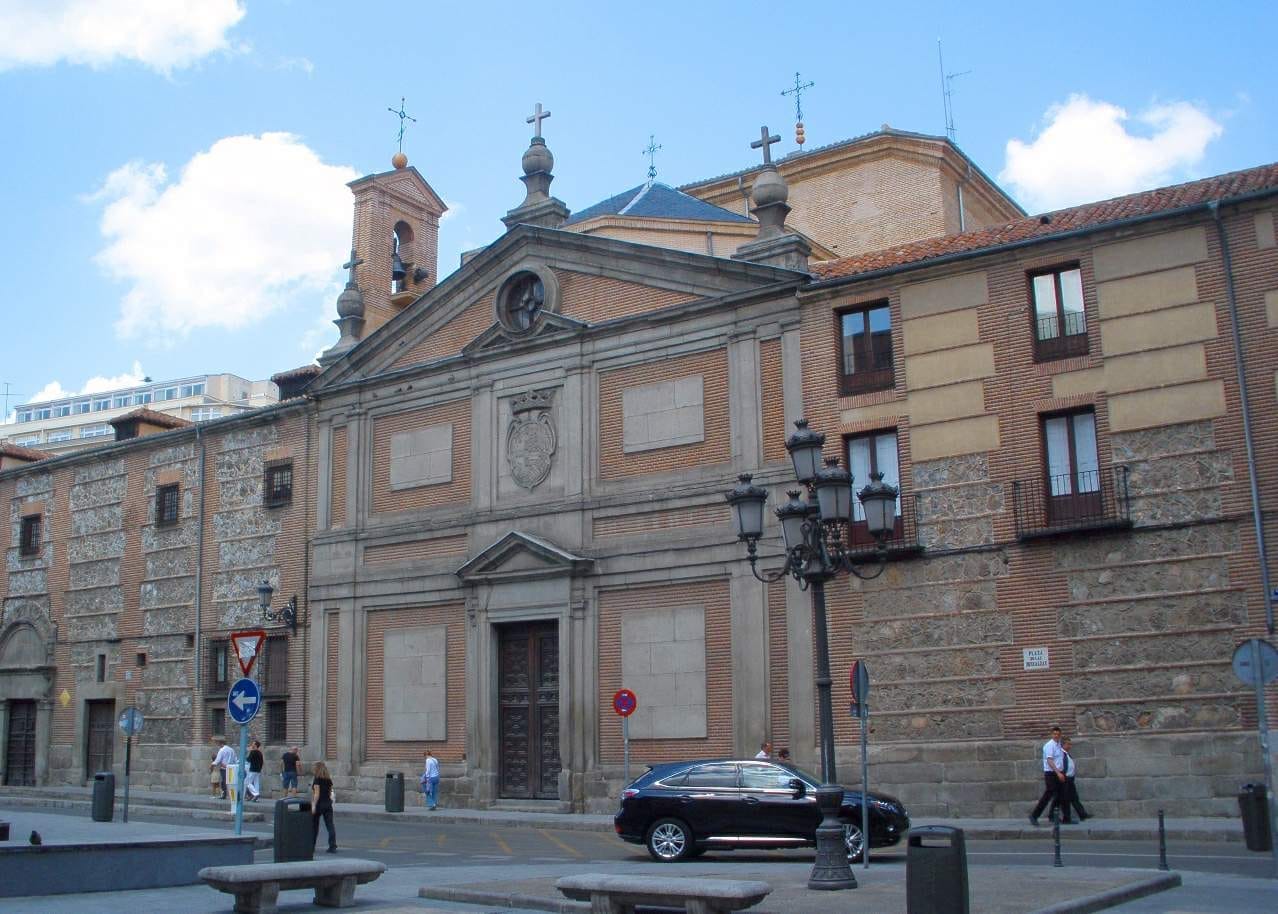
From the outside, the Real Monasterio de las Descalzas Reales gives almost nothing away. The façade along Calle de la Misericordia is austere stone, understated to the point of severity, and the square it anchors sits just a few minutes' walk from the noise of Puerta del Sol. Nothing about the exterior signals what waits inside: a nearly intact 16th-century royal convent whose walls are hung with Flemish tapestries, whose staircase ceiling is covered in dynastic frescoes, and whose chapels hold works by Rubens, Zurbarán, Brueghel the Elder, and Titian.
The convent was founded in 1559 by Juana de Austria, the youngest daughter of Emperor Charles V and sister of King Philip II. Juana chose to establish it in the very palace where she was born, commissioning a conversion from royal residence to religious house. She joined the community herself, living there under a vow of poverty with the Poor Clare sisters (the 'Descalzas Reales' means 'Royal Barefoot Ones,' a reference to the Franciscan order) until her death in 1573. She is buried here, along with a number of other royal women who entered the convent over the following centuries.
ℹ️ Good to know
The monastery is still an active convent. Around 20 Poor Clare nuns live here today, in cloistered areas not accessible to visitors. You may occasionally hear the bells that mark their liturgical hours during your tour.
The Architecture and Its Layers
The church at the heart of the complex is a 16th-century classicist structure: a single nave, Latin-cross plan, and barrel-vaulted ceilings. It was built in the restrained, ordered idiom that Philip II favored, visible elsewhere in the Escorial. Inside the monastery proper, however, the visual register shifts considerably. The main staircase is where the decorative ambition first becomes fully legible. Its ceiling and upper walls are covered in frescoes attributed to Claudio Coello and other court painters, depicting a fictional open sky populated with members of the royal family and allegorical figures. The effect is theatrical, even slightly dizzying in a space that is physically compact.
The two cloisters connect a sequence of chapels and galleries that grew in richness as successive generations of aristocratic women entered the convent. Entry required both a religious vocation and, typically, a substantial dowry, which often took the form of artworks, religious relics, and luxury furnishings. The result is less a single coherent decorative scheme and more an accumulated archive of high-quality religious patronage spanning nearly three centuries.
This concentration of art in a small working convent led to the monastery being awarded the European Museum of the Year Award in 1987, a recognition that sits oddly with its intimate scale but becomes entirely understandable once you have seen the chapels. The building is classified as a Bien de Interés Cultural, Spain's highest domestic heritage designation.
Tickets & tours
Hand-picked options from our booking partner. Prices are indicative; availability and final rates are confirmed when you complete your booking.
Monasterio de las Descalzas Reales guided tour
From 13 €Instant confirmationMonasterio de las Descalzas tickets and guided tour
From 19 €Instant confirmationFree cancellationGuided tour of the Monastery of Las Descalzas Reales
From 65 €Instant confirmationFree cancellationDescalzas Reales Monastery and Madrid of the Austrias guided tour
From 85 €Instant confirmationFree cancellation
What the Guided Tour Actually Shows You
Access is strictly by guided tour, and this is not a formality. Large sections of the monastery are closed to independent visitors. The guide controls the pace and the doors, which means you see rooms that would otherwise be sealed. Tours are conducted in Spanish by default, with English-language tours available on specific days; check the Patrimonio Nacional website before booking if language matters to you.
The tour typically covers the grand staircase, several of the principal chapels, the gallery of tapestries, the chapter house, and parts of the cloister. The tapestry gallery is arguably the highlight for most visitors: a series of enormous 17th-century Flemish tapestries based on cartoons by Rubens, depicting the Triumph of the Eucharist. They were commissioned by the Infanta Isabel Clara Eugenia, daughter of Philip II, and their scale and condition are extraordinary given that they have been displayed in the same rooms, in the same light, for four centuries.
Individual chapels along the tour contain works that in many major cities would anchor an entire museum room. A Zurbarán, a panel attributed to Brueghel, fragments of sculpture and goldwork from royal collections. The density is high, the interpretive signage is sparse, and the guided commentary is consequently essential. If you are visiting on a free afternoon entry and the tour moves quickly, note that you can always return on a paid visit when it may be less crowded.
💡 Local tip
Book tickets in advance through the Patrimonio Nacional website. Tour group sizes are small and morning slots on weekends sell out several days ahead, especially in spring and autumn.
When to Visit and How the Experience Changes
The monastery is open Tuesday through Saturday from 10:00 to 14:00, then again from 16:00 to 18:30, with last entry one hour before closing. On Sundays and public holidays it opens 10:00 to 15:00. It is closed on Mondays, and on several major public holidays including 1 January, 6 January, 1 May, and 24, 25, and 31 December, as well as specific days during Holy Week. Always verify the current holiday closure calendar on the official website before planning a visit around these periods.
Morning visits are quieter and the light in the church is cooler and less harsh, which benefits the frescoes. The free entry windows on Wednesday and Thursday afternoons (16:00 to 18:30, last entry 17:30) draw noticeably larger groups, and the guide must move at a pace that accommodates everyone. If your priority is a slower, more contemplative experience, a paid morning visit on a Tuesday or Thursday works better.
The monastery sits in the Sol-Centro district, and the square outside is busiest in late morning when tour groups funnel through from the nearby Puerta del Sol. Arriving shortly after the 10:00 opening gives you the first tour slot before the pedestrian traffic on the surrounding streets reaches its peak. In high summer, the thick stone walls make the interior meaningfully cooler than the street, which is its own practical argument for a midday visit.
The location puts it naturally alongside other major sites. The Palacio Real is about 15 minutes on foot to the west, and the Almudena Cathedral is in the same direction. A half-day circuit combining all three covers the core of royal Habsburg Madrid without requiring any metro travel.
Practical Notes for Getting There
The visitor entrance is at Calle de la Misericordia 2, off the Plaza de las Descalzas. The nearest metro station is Ópera, served by Lines 2 and 5, approximately a five-minute walk. Sol station, on Lines 1, 2, and 3, as well as Cercanías lines C3 and C4, is also walkable in under ten minutes. Callao (Lines 3 and 5) is another reasonable option if you are coming from the Gran Vía area. Bus lines 3, 25, 39, and 148 all serve the surrounding streets.
On accessibility: the monastery is a historic building with stairs and uneven stone surfaces throughout. The Madrid City Council notes that specific accessibility information for people with reduced mobility is not publicly confirmed for this site. If accessibility is a concern, contact Patrimonio Nacional directly before your visit to get current information on what is and is not navigable.
If you are planning a broader day around Madrid's historic centre, the Madrid architecture guide covers the concentration of 16th and 17th-century buildings in this part of the city, several of which are within easy walking distance.
Is It Worth Your Time?
For visitors with a strong interest in European religious art, Habsburg history, or the particular world of royal female patronage in Counter-Reformation Spain, this is one of the most rewarding sites in Madrid, full stop. The combination of architectural integrity, quality of individual works, and the fact that it remains a functioning convent gives it a texture that fully restored palace-museums often lack.
For visitors who find guided tours restrictive, or who are primarily looking for an open, browsable museum experience, the format may feel limiting. You cannot linger independently in front of a particular painting, and the tour moves at a collective pace. The lack of English signage in many areas means that without a guide, the context for what you are seeing is minimal.
It is also, , one of Madrid's less crowded major cultural sites. That is partly a consequence of the guided-tour-only format limiting throughput, and partly because its profile remains lower than the major museums of the Prado or the Reina Sofía. On a quiet Tuesday morning, you may find yourself in a group of five or six people moving through rooms that would be mobbed in any other European capital. That relative tranquility is, for many visitors, precisely the point.
For a fuller picture of Madrid's museum landscape before deciding how to allocate your time, the best museums in Madrid guide compares this and other collections across the city.
Insider Tips
- The free entry windows on Wednesday and Thursday afternoons are legitimate and well worth using, but arrive at least 15 minutes before the 16:00 opening to secure a spot in the first tour group. Later arrivals may wait for the next slot or find it full.
- The tour guide's commentary in Spanish is often richer than what is offered in English translation slots. If your Spanish is functional, a Spanish-language tour on a weekday morning is frequently the combination of best commentary and smallest group size.
- Photography is not permitted inside the monastery. This is enforced, not advisory. Do not plan your visit around capturing the interior.
- The square outside, Plaza de las Descalzas, is one of the calmer open spaces in the Sol-Centro area. It is worth sitting in for a few minutes before or after your visit, particularly in the late afternoon light when the stone of the monastery façade takes on a warmer tone.
- If you are combining this with a visit to the Palacio Real on the same day, the Patrimonio Nacional website offers a combined ticket. Verify current pricing and availability directly on their site before buying, as bundled offers can change seasonally.
Who Is Real Monasterio de las Descalzas Reales For?
- Travelers with a serious interest in Habsburg Spain, Counter-Reformation art, or royal patronage history
- Visitors who want a genuinely quiet cultural experience away from the larger museum crowds
- Those who appreciate religious architecture and want to see an active convent rather than a fully deaccessioned museum
- Art lovers interested in Flemish painting and tapestry, including works connected to Rubens and Brueghel the Elder
- Anyone following the free-entry options across Madrid's Patrimonio Nacional sites on a tight budget
Nearby Attractions
Other things to see while in Sol & Centro:
- Catedral de la Almudena
The Almudena Cathedral took more than a century from the laying of its foundation stone to its consecration in 1993, making it one of Europe's newest major cathedrals. Free to enter and directly opposite the Royal Palace, it rewards visitors who look beyond its mismatched facade to discover a surprisingly bold and colorful interior.
- Campo del Moro Gardens
The Jardines del Campo del Moro spread across more than 20 hectares directly behind the Royal Palace, offering one of the most dramatic views of the Palacio Real in Madrid. Admission is free, crowds are thin compared to the palace itself, and the romantic English-style landscape feels worlds away from the city streets above.
- Círculo de Bellas Artes
Few buildings in central Madrid earn attention on multiple levels at once. The Círculo de Bellas Artes delivers: a landmark Palacios-designed tower within the Paisaje de la Luz UNESCO World Heritage area with a rooftop terrace above the Gran Vía skyline, rotating art exhibitions, and one of the city's most atmospheric cafés. Entry to the building and La Pecera café is free; the rooftop, exhibitions, and combined tickets have separate fees starting from around €6.
- Edificio Metrópolis
Standing at the junction of Calle de Alcalá and Gran Vía, the Edificio Metrópolis is Madrid's most iconic piece of Belle Époque architecture. Its slate dome, gilded detailing, and winged Victory statue make it a landmark that rewards careful observation, even though the building itself is not a public museum. Here is everything you need to know before you go.