Plac Zbawiciela: Warsaw's Most Social Square
Plac Zbawiciela, or Savior Square, is a circular roundabout in central Warsaw that doubles as one of the city's most atmospheric gathering spots. Ringed by café terraces, a grand early 20th-century church, and art deco townhouses, it draws locals for coffee and conversation far more reliably than tourists. Free to visit, easy to reach, and worth at least an hour of your time.
Quick Facts
- Location
- Plac Zbawiciela, 00-584 Warsaw (Śródmieście district)
- Getting There
- Multiple tram and bus lines stop directly on the square; check Warsaw ZTM network for current routes
- Time Needed
- 45 minutes to 2 hours depending on café stops
- Cost
- Free entry; café prices average 15–25 PLN per drink
- Best for
- Local atmosphere, café culture, street photography, evening socializing
What Plac Zbawiciela Actually Is
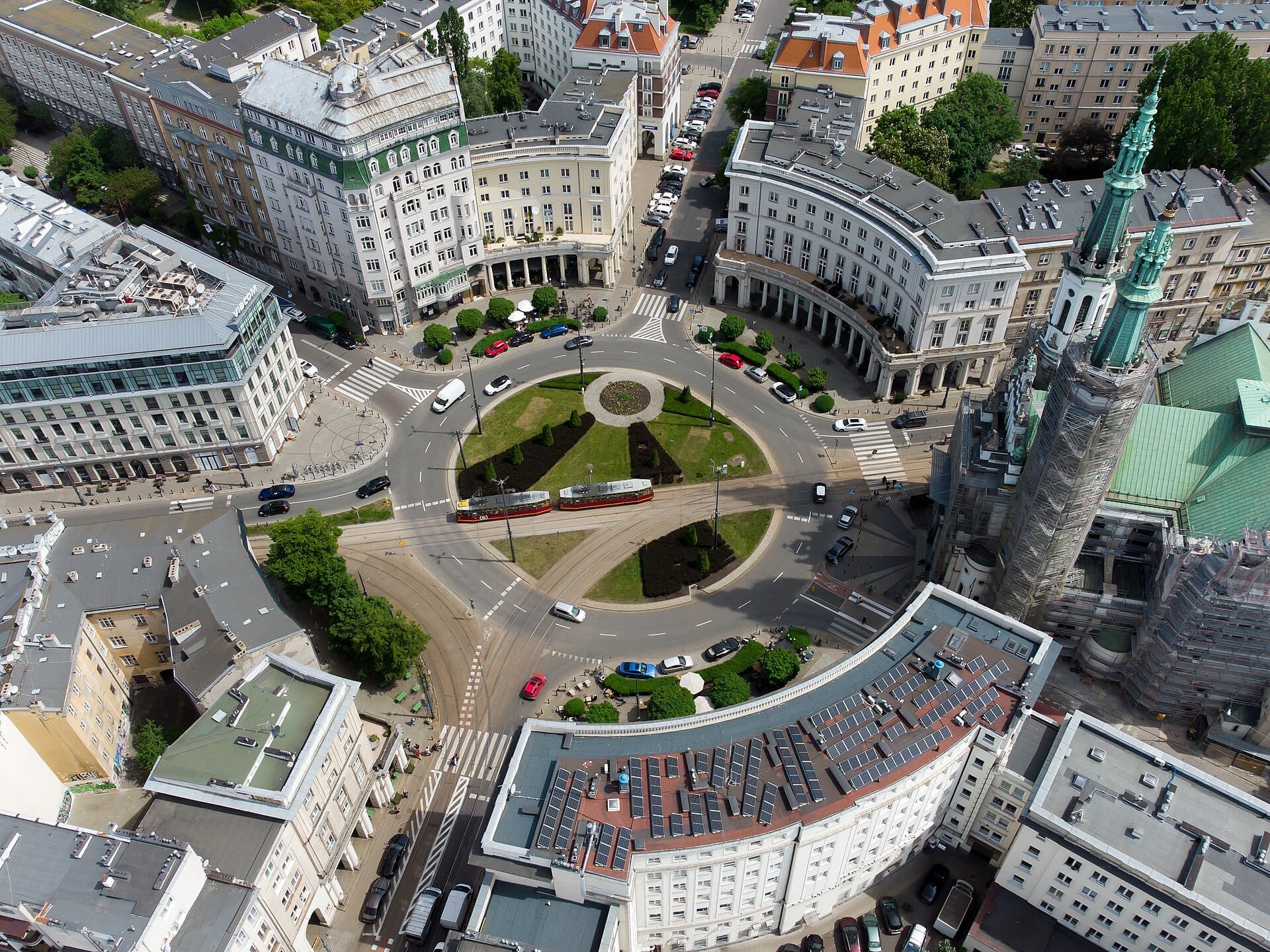
Plac Zbawiciela, which translates directly as Savior Square, is a circular traffic roundabout in the Śródmieście district of central Warsaw. That description sells it short. What you actually encounter is one of the few squares in the city that functions like a genuine neighborhood focal point: a place where people come not because a guidebook sent them, but because this is simply where Warsaw residents go.
The square's form is defined by a ring of early 20th-century tenement buildings and a pair of low ornamental fountains at its center. Dominating the southern edge is the Church of the Holiest Saviour, a large neo-Romanesque church constructed between 1901 and 1927, whose twin towers are visible from several blocks away. The church gives the square its name, its scale, and a certain architectural seriousness that contrasts with the relaxed energy of the café terraces lining the opposite side.
ℹ️ Good to know
Plac Zbawiciela is a functioning roundabout. Trams and buses pass through it regularly, so cross at marked pedestrian points and stay alert to traffic when moving between the central island and the surrounding ring of cafes.
The Architecture: What to Look At
The Church of the Holiest Saviour is the square's architectural anchor. Built in brick with Romanesque Revival detailing, its facade is imposing without being ornate: thick columns, round arches, and twin bell towers that are more substantial than decorative. Construction stretched across nearly three decades, which explains some inconsistency in the detailing, but the overall effect is commanding. Mass is held regularly, and the interior is worth a brief visit if the doors are open.
The surrounding tenement buildings date mostly from the interwar period and earlier. Their facades show the kind of layered architectural history common in Warsaw's inner districts: original prewar stucco work on some buildings, postwar repairs on others, and the occasional modernist intrusion where a gap in the wartime destruction was filled with something utilitarian. Look up at the upper floors rather than just the shopfronts at street level. The cornice lines, window proportions, and surviving decorative plasterwork tell a quieter story about what this part of Warsaw looked like before 1939.
For a broader picture of Warsaw's architectural layers, the communist-era Warsaw guide provides useful context on how the city was rebuilt and what survived.
Tickets & tours
Hand-picked options from our booking partner. Prices are indicative; availability and final rates are confirmed when you complete your booking.
Museum of John Paul II and Primate Wyszyński entrance ticket
From 8 €Instant confirmationPub crawl in Warsaw
From 28 €Instant confirmationFree cancellationWarsaw Museum of Modern Art entrance ticket
From 8 €Instant confirmationSafe and Convenient Luggage Storage in Warsaw Old Town
From 6 €Instant confirmationFree cancellation
How the Square Changes Through the Day
Mornings here are quieter than you might expect. The café terraces set up early, and you will find regulars with laptops and coffee around 8am, but the roundabout itself is mostly in motion: trams passing, commuters cutting through on foot. The light in the morning hits the church facade at a low angle and the brick takes on a richer color than it shows later in the day. This is the best time for photography of the church without crowds or harsh midday shadows.
By midday, the square fills with office workers from the nearby central business corridors. The terrace seating turns over quickly and noise levels rise noticeably. If you are hoping to sit and absorb the atmosphere at a relaxed pace, midday on a weekday is probably the least pleasant window.
Evenings, particularly Thursday through Saturday, are when Plac Zbawiciela earns its local reputation. The café and bar terraces are full by 7pm in summer, and the crowd skews young and social. There is no single dominant venue: instead, several bars and cafes operating around the ring each attract a slightly different crowd. The noise is convivial rather than aggressive. By 9pm in summer, the square has a density of people that feels genuinely urban without tipping into the kind of tourist-driven chaos that affects squares closer to the Old Town.
💡 Local tip
Visit on a warm weekday evening between 6pm and 8pm for the most authentic local atmosphere. Weekend evenings can get crowded enough that terrace seating requires patience, particularly in July and August.
The 2015 Rainbow and Its Cultural Significance
Plac Zbawiciela attracted international attention in the first half of the 2010s when a large rainbow-shaped art installation was displayed in the square. The installation, which had first been erected in 2012 and was repeatedly damaged and rebuilt before its final removal in 2015, became a focal point for public debate about art, religion, and tolerance in Poland. It was not a neutral decoration: its placement in front of a Catholic church generated sustained controversy and turned the square briefly into a kind of contested public space.
The rainbow is no longer there. But its history illustrates something real about Plac Zbawiciela's character: this is a square that has genuinely mattered to Warsaw's cultural life, not just as background scenery. Understanding that history adds a layer of meaning to what might otherwise look like a pleasant but unremarkable roundabout.
Cafes, Bars, and What to Order
The food and drink scene around the square is one of the strongest arguments for spending time here. Several well-regarded cafes have anchored the square for years, and the turnover that has affected other parts of central Warsaw has been less dramatic here. You will find specialty coffee served seriously, natural wine bars, and at least one spot with a credible menu of Polish small plates alongside a longer drinks list.
Prices are reasonable relative to comparable venues in Berlin or Vienna but are not budget-level by Warsaw standards. Expect to pay 15 to 20 PLN for a flat white and upward of 20 to 30 PLN for a glass of wine. In summer, the terrace seating fills fast. Arriving before 6pm on a Friday gives you a realistic chance of sitting outside without waiting.
If café-hopping across Warsaw's inner neighborhoods is part of your plan, the broader city centre area has enough variety to justify a half-day walk between spots.
Practical Information for Visitors
Plac Zbawiciela is a public square with no admission charge and no formal opening hours. It operates as a traffic roundabout and neighborhood gathering point around the clock. Warsaw's ZTM tram and bus network serves the square directly; check the current route map before visiting as specific line numbers are subject to change. The square is roughly a 15-minute walk from the central axis of Nowy Świat to the northwest and a similar distance from the Pole Mokotowskie park to the southwest.
If you are building a walking route through the city centre, the square connects naturally with Nowy Świat Street to the north and the green spaces around Pole Mokotowskie to the south.
The square is flat and at street level, making it physically accessible. The café and bar terraces are privately operated and accessibility will vary by venue. There is no dedicated accessibility infrastructure documented for the square itself, so visitors with specific mobility needs should check individual venues directly.
⚠️ What to skip
The square is a working roundabout. Central island access requires crossing active tram and vehicle lanes at designated crossing points. Exercise standard urban caution, particularly at night when tram frequency changes.
Who This Square Is Not For
If your Warsaw itinerary is focused on monuments, museums, and formal historical sites, Plac Zbawiciela will probably feel like a detour. It does not have a ticket booth, an audio guide, or a clear narrative to follow. The church is interesting but not among Warsaw's most significant historically. The square's value is atmospheric and social, which means it rewards visitors who are willing to slow down and sit with a drink rather than those working through a checklist.
For a more structured historical experience nearby, the Warsaw Uprising Museum is one of the most powerful museum experiences in the city and sits within reasonable distance to the west.
Insider Tips
- The church facade photographs best in the morning when low-angle light hits the brick directly. By noon, the front elevation is in flat overhead light and loses much of its texture.
- Several of the bars around the square have interior spaces that are considerably larger than their terraces suggest. If the terrace is full, ask about interior seating before assuming the venue is at capacity.
- Tram stops at Plac Zbawiciela serve multiple lines connecting toward the Old Town, Mokotów, and the central rail corridor. Learning these connections saves significant walking time if you are exploring multiple neighborhoods in one day.
- The square is significantly quieter on Sunday mornings, when many of the café terraces have reduced hours. If you want the square to yourself for photography or quiet walking, Sunday before 10am is ideal.
- Polish residents typically reserve outdoor terrace tables by placing a jacket or bag on the chair rather than by speaking to staff. Observing this unspoken custom avoids awkward misunderstandings during busy periods.
Who Is Plac Zbawiciela For?
- Travelers who want to experience Warsaw as a lived-in city rather than a series of monuments
- Evening socializers looking for a relaxed outdoor atmosphere with good coffee and drinks
- Architecture enthusiasts interested in early 20th-century Warsaw urban fabric
- Street and documentary photographers seeking authentic non-tourist scenes
- Visitors building a walking route through central Warsaw's inner neighborhoods
Nearby Attractions
Other things to see while in City Centre (Śródmieście):
- Fryderyk Chopin Museum
Housed inside the 17th-century Ostrogski Palace near Warsaw's Royal Route, the Fryderyk Chopin Museum holds one of the world's richest collections of Chopin memorabilia. Closed for full renovation throughout 2026; reopening is planned for 2027 — plan post-renovation visits and confirm dates on the official site.
- Grand Theatre – National Opera
The Grand Theatre – National Opera (Teatr Wielki – Opera Narodowa) is one of the largest opera houses in Europe, anchoring Theatre Square in central Warsaw with a neoclassical facade that survived war and rebuilding. Whether you attend a full opera, a ballet, or simply walk across the square to take in the architecture, this institution rewards both serious culture-seekers and curious first-time visitors.
- Hala Koszyki Food Hall
Built in 1909 and reborn in 2016, Hala Koszyki is a restored Art Nouveau market hall in central Warsaw where locals actually eat, drink, and shop. Free to enter, open daily until 1am, and genuinely good.
- Holy Cross Church (Kościół Świętego Krzyża)
One of Warsaw's most historically charged sites, Holy Cross Church on Krakowskie Przedmieście holds the preserved heart of Frédéric Chopin in a nave pillar. A Minor Basilica with a Baroque facade, 17th-century origins, and free entry, it rewards visitors who take the time to look closely.