Pole Mokotowskie Park: Warsaw's Great Green Escape with an Aviation Past
Sprawling across roughly 68 hectares between Mokotów, Ochota, and the city centre, Pole Mokotowskie is one of Warsaw's most-used everyday parks. Free to enter, easy to reach by metro, and layered with unexpected history, it rewards visitors who want to see Warsaw as residents actually live it.
Quick Facts
- Location
- Between Mokotów, Ochota and Śródmieście districts; edge address Rokitnicka, 02-131 Warsaw
- Getting There
- Pole Mokotowskie metro station (M1 line), approx. 10-minute walk to the park interior
- Time Needed
- 1–3 hours depending on pace; a relaxed circuit of the park takes under 45 minutes on foot
- Cost
- Free; no admission fee for the park itself
- Best for
- Joggers, families, picnickers, anyone wanting to observe Warsaw without tourist crowds
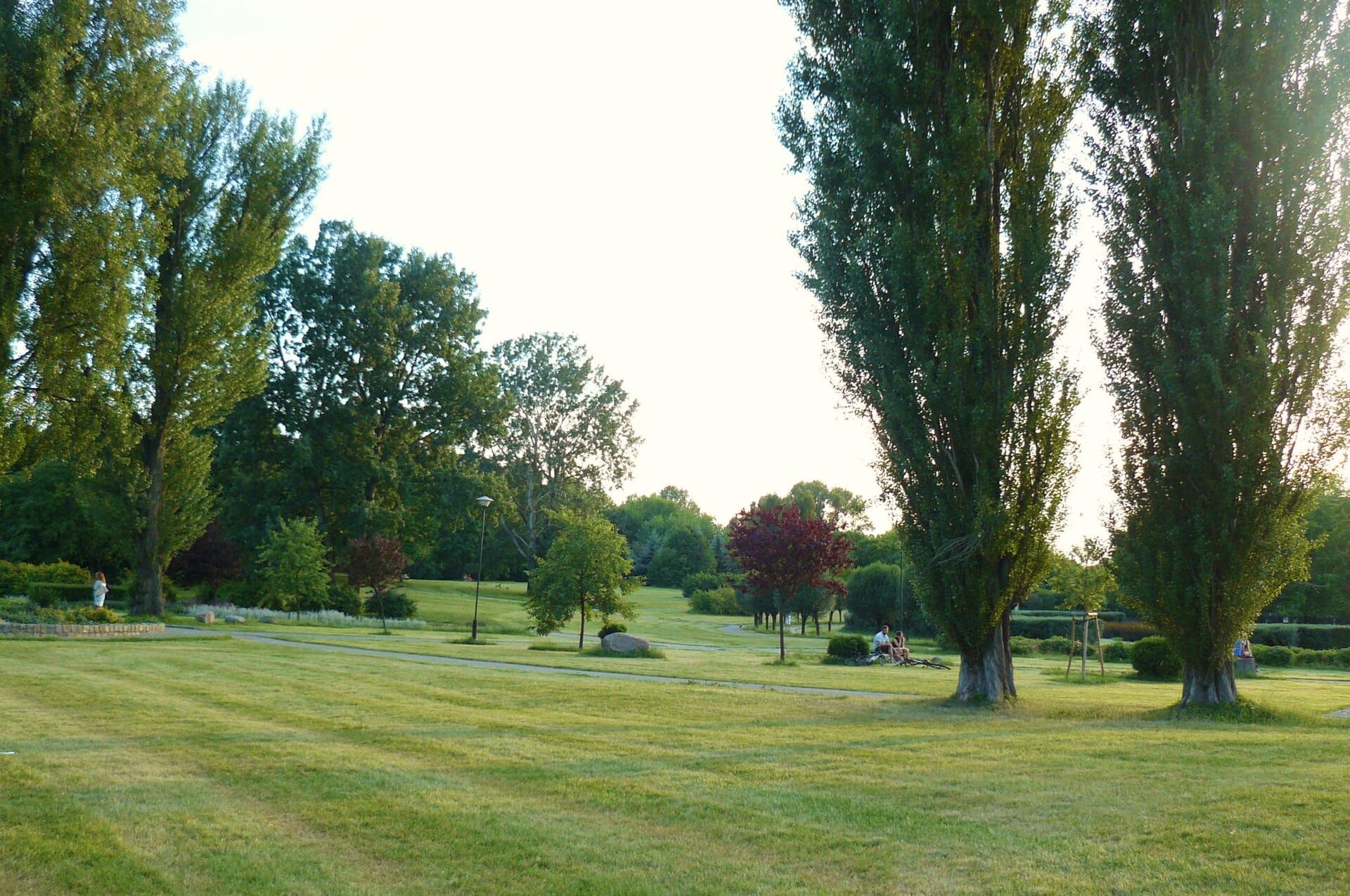
What Pole Mokotowskie Actually Is
Pole Mokotowskie is a large, flat, open-lawn park in the south-central part of Warsaw, covering roughly 68 hectares. Unlike the more formal Łazienki or the palace grounds at Wilanów, this is an unmanicured, working park: wide grass fields that fill up with footballers and frisbee players in good weather, broad cycling and skating paths, scattered benches and playgrounds, and a general atmosphere that belongs to the people who live nearby rather than to tourists passing through.
Its scale is what distinguishes it. You can walk for twenty minutes in a single direction without reaching the edge. The open sky above the flat meadows gives Warsaw a sense of horizontal space that the city centre rarely offers, and on clear days the skyline of high-rises to the north forms an unexpectedly photogenic backdrop.
💡 Local tip
The park is accessible 24 hours from multiple street entrances including al. Niepodległości, Żwirki i Wigury, Rostafińskich, Batorego, and Rokitnicka. There are no gates. The nearest metro station, Pole Mokotowskie on Line M1, puts you at the park's edge in about 10 minutes on foot.
A Former Airport at the Heart of the City
The history of this place is more dramatic than the flat grass suggests. In the early years of the 20th century, the Mokotów Field was Warsaw's first aviation site. Aviation workshops were established here in 1910, followed by a pilot school. By the early 1920s, the field was operating as a civilian airport with regular passenger flights. The runways were eventually decommissioned and activity moved to Okęcie Airport in 1933, which later became today's Warsaw Chopin Airport.
The field originally covered well over 100 hectares before surrounding urban development reduced it to its current roughly 68 hectares. That shrinkage is worth keeping in mind as you walk: the residential streets pressing against the park's edges on all sides are a direct consequence of the land being gradually absorbed into the city. What remains is essentially the protected core of a much larger open space.
The aviation chapter is not heavily marked on the ground, but it gives the park a peculiar resonance if you know it. Standing in the middle of the open fields and imagining biplanes lifting off from the same grass is one of those small details that shifts the experience of a place. If you enjoy that kind of historical layering, Warsaw has plenty more of it — the Warsaw Uprising Museum and POLIN Museum of the History of Polish Jews both offer deeper dives into the city's 20th-century story.
Tickets & tours
Hand-picked options from our booking partner. Prices are indicative; availability and final rates are confirmed when you complete your booking.
Museum of John Paul II and Primate Wyszyński entrance ticket
From 8 €Instant confirmationPub crawl in Warsaw
From 28 €Instant confirmationFree cancellationWarsaw Museum of Modern Art entrance ticket
From 8 €Instant confirmationSafe and Convenient Luggage Storage in Warsaw Old Town
From 6 €Instant confirmationFree cancellation
How the Park Changes Through the Day
Weekday mornings at Pole Mokotowskie belong to joggers and dog walkers. The main loop paths see a steady flow of runners from around 7am, and the smell of cut grass and damp soil on a summer morning is about as far as you can get from the city's traffic. The park is quiet enough at this hour that you can hear birds over the distant hum of al. Niepodległości.
By midday in warmer months, the open lawns fill quickly with office workers from nearby business districts eating lunch on the grass, students from the adjacent university area, and parents with young children using the playgrounds. The atmosphere is relaxed and local. There is no hawking of food or tours, no souvenir stalls. A few small kiosks and cafes operate near the edges of the park on warmer days, but supply is limited enough that bringing your own food and drink is the sensible approach.
Late afternoon on weekends is the park at its most lively: informal football matches, skateboarding, picnics with speakers playing music at considerate volumes, and a general sense of a neighbourhood using its shared space well. The golden-hour light across the open meadows, when the city skyline catches the low sun to the north, is the best photography window the park offers. Come in the hour before sunset.
⚠️ What to skip
In winter, Pole Mokotowskie loses much of its draw. The paths are walkable and the park is used by hardy joggers, but the bare landscape offers little to hold a visitor's attention for long. If you are visiting Warsaw in colder months, this park is lower priority than indoor attractions.
The Recent Modernization
The City of Warsaw undertook a significant modernization of Pole Mokotowskie, managed through the Warsaw Greenery Authority and designed by architects WXCA. The project introduced new surfaced paths suitable for cycling and skating, upgraded public toilets, new landscaping, and improved lighting. The work was widely covered in architectural publications including ArchDaily and has been recognized in design awards.
In practical terms, the modernization makes the park more navigable. The main circulation routes are now clearly defined, the transition between paved paths and grass areas is smooth enough for strollers and wheelchairs in most sections, and the new toilet facilities are a meaningful improvement on what was there before. The park still has the uneven quality of any large urban green space that serves different user groups, but the core infrastructure is now much more functional.
Photography note: the contrast between the low-lying meadow landscape and the Warsaw skyline visible from within the park is most effective from the northern edge, where the tower blocks of the city centre appear above the treeline. The park itself is not architecturally dramatic, so context shots incorporating the surrounding city tend to work better than isolated close-ups.
Practical Walkthrough: Getting There and Around
The easiest approach by public transport is Metro Line M1 to Pole Mokotowskie station. From the station it is about a 10-minute walk to the park's interior. Trams and buses on al. Niepodległości also stop near the park's edge. Warsaw's public transport is well-integrated and a single city ticket covers trams, buses, and metro; the guide to getting around Warsaw covers ticketing and route-planning in detail.
The park has no single main entrance. The most convenient entry points are from al. Niepodległości to the east, Żwirki i Wigury to the west, and Batorego or Rostafińskich to the north and south. All are at street level and step-free. If you enter from the metro side via al. Niepodległości, you arrive at the eastern edge near the playground and sports areas. If you enter from Żwirki i Wigury, you come into the broader open meadows on the western side.
Wear comfortable walking shoes; most of the modernized paths are paved but there are grass sections that become soft after rain. The park is large and flat enough that a bicycle makes sense for a longer visit: Warsaw's bike-sharing network (Veturilo) has docking stations near the park, making it easy to cycle in from the centre.
ℹ️ Good to know
No formal parking within the park. Street parking on surrounding roads is limited during peak hours. Public transport or cycling is strongly recommended.
Who This Park Is and Isn't For
Pole Mokotowskie earns its place in a Warsaw visit for travellers who want to experience the city outside its historic core. If your itinerary is focused on history and architecture — the Royal Castle, the Old Town, the museums of Śródmieście — this park adds texture rather than content. It shows you what Warsaw does on a normal afternoon.
Travellers who should give it a pass: anyone with very limited time (say, one or two days) who is prioritising major cultural sites. The park contains no exhibitions, no historical monuments of note, no guided experiences, and no food scene to speak of. It is green space, and it requires some investment of time to feel rewarding. If the weather is bad, that calculus tips further against it.
For families with children, however, it is genuinely useful. The playgrounds are good, the paths are safe for kids on bikes and scooters, and the open meadows are exactly what children need after a day of museums. Pair it with a visit to the nearby Copernicus Science Centre for a full family day away from the Old Town. The Warsaw parks guide is worth reading if you want to compare this park against Łazienki and other green areas before deciding how to allocate your time.
Insider Tips
- The northern edge of the park, closest to al. Niepodległości, gives the best view of the Warsaw skyline framed by trees — come in late afternoon for the light.
- The park's aviation history is almost entirely unmarked on the ground; if you want context before visiting, look up the history of Pole Mokotowskie airport before you go rather than expecting signage.
- Veturilo bike-share stations near the park allow you to cycle here from the city centre and explore the surrounding Mokotów streets as part of the same trip — the residential streets south of the park have some of the best interwar apartment architecture in Warsaw.
- On summer evenings, informal outdoor fitness classes and group yoga sometimes take place on the open meadows; there is no schedule, but if you arrive around 6–7pm on a weekday in warm months you are likely to encounter them.
- The park connects on foot to the university district to the north, making it a natural end point or starting point for a longer walk along Nowy Świat and Krakowskie Przedmieście.
Who Is Pole Mokotowskie Park For?
- Joggers and cyclists looking for a flat, traffic-free route in central Warsaw
- Families with young children who need open space after a day of sightseeing
- Travellers wanting to observe Warsaw's everyday residential life rather than its tourist circuit
- Photographers looking for skyline shots with green foreground in golden-hour light
- Anyone visiting on a warm afternoon who needs a break from the city's noise and traffic
Nearby Attractions
Combine your visit with:
- Katyń Museum
The Katyń Museum in Warsaw confronts one of World War II's darkest chapters: the Soviet massacre of over 22,000 Polish officers, intellectuals, and civilians in 1940. Housed since 2015 within the historic Warsaw Citadel, the museum is free to enter and demands at least two hours of genuine attention.
- Warsaw Citadel
Built by Tsar Nicholas I after the failed 1830 uprising, the Warsaw Citadel is a 36-hectare pentagonal fortress on the Vistula escarpment that once symbolized Russian domination. Today it houses the relocated Polish Army Museum and the haunting Museum of the Tenth Pavilion, where political prisoners were held before execution. Few sites in Warsaw pack this much layered history into one visit.