Pile Gate (Vrata od Pila): Dubrovnik's Grand Western Entrance
Pile Gate is the principal gateway into Dubrovnik's UNESCO-listed Old Town, a double-gate fortress complex built between 1460 and 1537. Free to pass through at any hour, it marks the threshold between the modern city and one of Europe's best-preserved medieval urban cores.
Quick Facts
- Location
- Western entrance to Old Town, Dubrovnik (Grad)
- Getting There
- City buses 1, 1A, 1B, 3, 6 — stop: Pile (2-min walk)
- Time Needed
- 15–30 min to explore; you'll pass through repeatedly
- Cost
- Free — no ticket required, open 24 hours
- Best for
- First-time visitors, history lovers, photographers
What Is Pile Gate?
Pile Gate, or Vrata od Pila in Croatian, is the main western entrance to Dubrovnik's Old Town and arguably the most photographed structure in the city that isn't a church or a stretch of wall. It is a double-gate fortification complex: an outer gate completed in 1537 paired with an inner gate dating to 1460. Together, they form a short stone passageway that once defined the boundary between the Republic of Ragusa and the outside world.
The outer gate is the one most visitors photograph from the stone bridge approach. Above its arch sits a relief statue of St. Blaise, the patron saint of Dubrovnik, carved by the celebrated Croatian sculptor Ivan Meštrović in the 20th century as a replacement for an older figure. The calm, watchful saint presiding over the gate entrance is a deliberate symbol: St. Blaise appears throughout the city, but here, at the main threshold, the message is pointed. You are entering a place that took its identity seriously.
ℹ️ Good to know
Pile Gate is free to walk through and never closes. However, the area directly outside the gate is one of the busiest points in Dubrovnik from approximately 9am to 7pm, especially in July and August. Cruise ship passengers and tour groups concentrate here. If you want a calm passage, arrive before 8am or after 8pm.
The Architecture and Fortification Logic
The double-gate design was not decorative — it was tactical. The outer gate, accessed via a stone arched bridge spanning what was once a moat with a drawbridge, funneled arrivals into a confined courtyard between the two gates. This killing zone, as military architects called it, meant that anyone who breached the outer gate could be contained and attacked from above before reaching the inner gate and the city proper. The transition from a wooden drawbridge to a fixed stone bridge happened when the Republic of Ragusa felt sufficiently secure, though the fortifications themselves were never significantly tested.
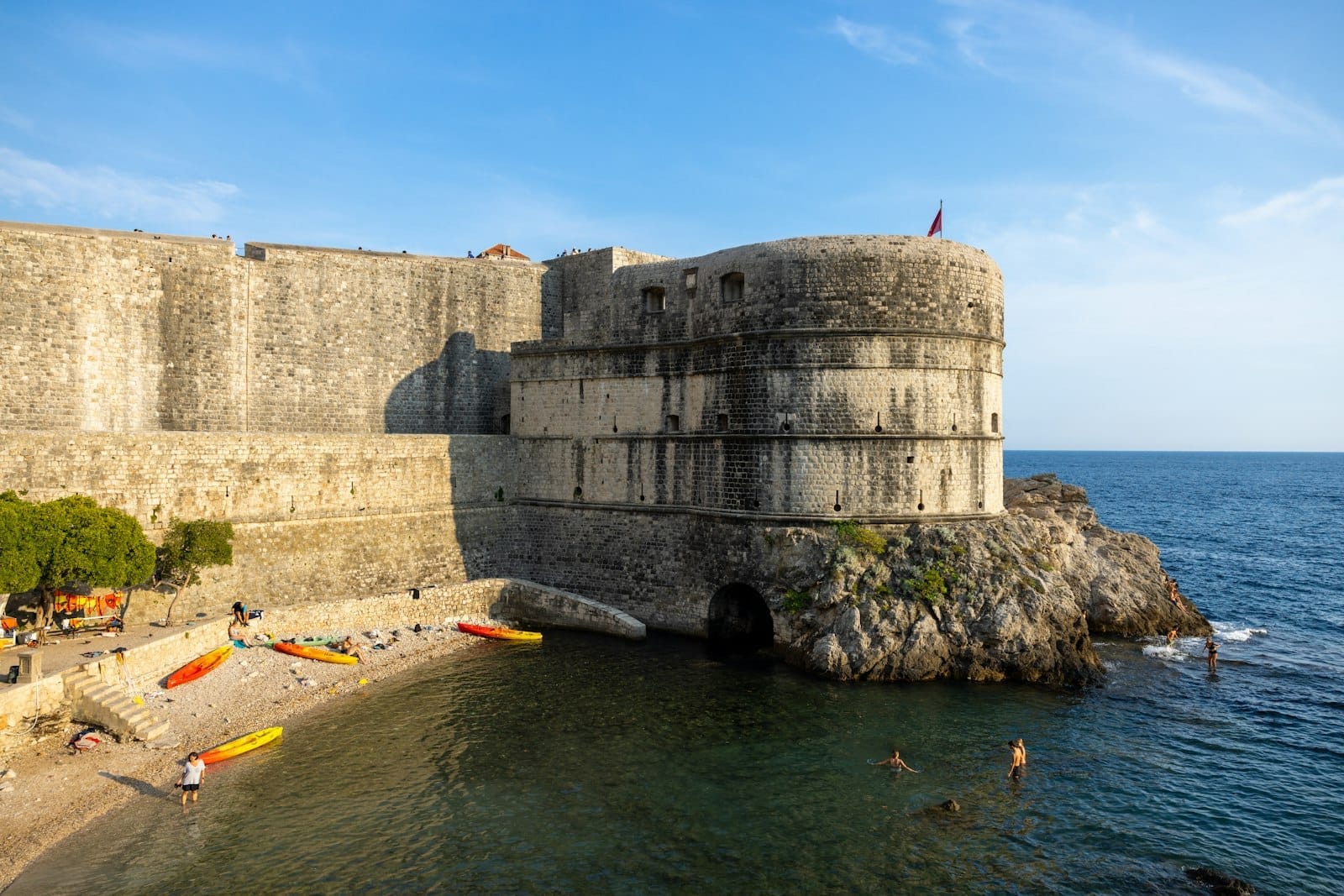
The gate connects directly to the broader western wall system, which includes Fort Bokar, the circular bastion visible to the south as you approach from the Pile bus stop. Fort Bokar, designed by Michelozzo di Bartolommeo in the mid-15th century, was built specifically to protect this western approach. Standing on the bridge before the outer gate, you can see the relationship clearly: the fort sits on a low cliff to your left, angled to deliver fire across the moat and the land approach. The gate and fort were designed as a single defensive system.
For a deeper understanding of how Pile Gate fits into Dubrovnik's broader fortification network, the Dubrovnik City Walls walkway begins just inside the inner gate and allows you to trace the entire perimeter — about 2km of ramparts with direct views back over the Pile approach.
Tickets & tours
Live prices and dates from our booking partner. If you book, we may earn a commission at no extra cost to you.
Mostar and Kravice Waterfalls excursion from Dubrovnik
From 120 €Instant confirmationFree cancellationDubrovnik Old Town Tour ith Cable Car Ride
From 56 €Instant confirmationFree cancellationMostar and Kravice Waterfalls full-day tour with pickup from Dubrovnik
From 66 €Instant confirmationFree cancellationSea kayaking experience in Dubrovnik
From 46 €Instant confirmationFree cancellation
How the Experience Changes Through the Day
Early morning, before 8am, Pile Gate is a different place. The stone glows amber in the low light, the bridge is empty, and the sound is mostly seabirds and the occasional delivery scooter. The inner courtyard smells faintly of damp limestone, a mineral coolness that the stone retains from the night. This is when the gate reads as a genuine medieval threshold rather than a tourist choke point.
By mid-morning in high season, the approach road fills with people streaming off buses and from the nearby parking area at Dvořak. Tour groups assemble on the bridge for orientation talks. The space is not unpleasant, but it is crowded, and the photographic possibilities narrow significantly. Midday in July is arguably the worst time to linger here — the stone reflects heat, the crowds are at their densest, and the queue for the city walls entrance just inside runs long.
Evening changes things again. After dinner, locals and visitors pass through at a relaxed pace. The gate is lit from below, the Meštrović relief of St. Blaise casting a soft shadow, and the inner archway frames the lit-up Stradun at the end of its short tunnel. It is worth walking through simply for that framed view. Photography in this light, with a tripod or a steady hand on a wall, produces results that daytime shooting cannot.
💡 Local tip
Photography tip: Stand on the stone bridge at dusk, shoot through the outer arch toward the inner arch, and you'll frame a layered composition of two archways with the Stradun beyond. Use a 28–35mm equivalent focal length. The gate is lit from late evening, so exposures of 1–2 seconds on a stable surface work well.
Walking Through: What to Expect
Approaching from the Pile bus stop, you descend a short road past souvenir kiosks and the terrace of a café. The stone bridge comes into view at the end of this approach, spanning a dry moat now planted with trees. The bridge has low walls on either side and is wide enough for four or five people to walk abreast, but in peak season it often feels narrower because of the foot traffic moving in both directions.
Passing through the outer gate, you enter a small courtyard. To your right is the ticket office and entrance for the city walls walk. To your left is the entrance to the Large Fountain of Onofrio, one of the first things visible once you step fully through the inner gate. The inner gate itself is slightly smaller than the outer, with a wooden door that is no longer used as a barrier but remains in place. The transition from outer to inner gate takes about 20 seconds on foot — just long enough to notice the temperature drop slightly in the shade of the covered passage.
Once through the inner gate, you are on the Stradun, Dubrovnik's main limestone promenade. The Large Fountain of Onofrio sits immediately to your right, a 15th-century domed structure that once marked the end of the city's aqueduct system. Most visitors stop here, which creates a predictable bottleneck. If you are moving through purposefully, keep left along the Stradun and the crowd thins within 30 meters.
⚠️ What to skip
Accessibility note: The stone bridge approach and the gate passageways involve uneven limestone surfaces. There are no ramps into the gate complex itself. Visitors using wheelchairs or mobility aids should be aware that entry into the Old Town via Pile Gate is difficult. The Ploče Gate on the eastern side of Old Town has slightly different terrain — check current conditions locally before visiting.
Historical Context: The Republic of Ragusa
Pile Gate was built during the height of the Republic of Ragusa, the independent city-state that controlled Dubrovnik and a significant stretch of Dalmatian coastline from the 14th century until Napoleon dissolved it in 1808. The Republic maintained its independence for centuries through a combination of diplomatic skill, strategic trade relationships, and genuine military fortification. The walls and gates were the physical expression of this independence.
The Republic of Ragusa was, for its era, unusually progressive: it abolished the slave trade in 1416, established one of Europe's earliest quarantine systems during the plague years, and maintained a functioning republican government when most of Europe was ruled by monarchies. The gates and walls that surrounded the city were not just defenses against outside armies — they were the tangible boundary of a distinct political entity that prided itself on its difference from the surrounding powers.
This history is best absorbed by also visiting Sponza Palace and the Rector's Palace inside the Old Town, both of which contain archival material and exhibits on the Republic's governance and trade networks.
Getting There and Practical Details
Pile Gate is served by Dubrovnik's Libertas bus network. Buses 1, 1A, 1B, 3, and 6 all stop at Pile, the terminus for routes coming from Gruž harbor and Lapad. If you are arriving by ferry at the Port of Gruž, take bus 1A or 1B directly to Pile — the journey takes approximately 15 minutes depending on traffic. In July and August, buses on this route run frequently but fill quickly; allow extra time.
Taxis and ride-hailing services drop passengers at the Pile parking area, a short walk from the gate. There is no vehicle access through the gate itself — the Old Town is pedestrian-only. If you are staying in a hotel inside the Old Town, note that luggage deliveries and check-ins happen via specific access windows, and Pile Gate is the most common entry point for guests on foot.
Pile Gate is also the standard starting point for walking tours of the Old Town and for the city walls circuit. If you have purchased a Dubrovnik City Pass, the walls entrance just inside the gate is one of the key inclusions.
Who Might Want to Skip Lingering Here
Pile Gate is unavoidable if you are entering the Old Town from the western side, and you will pass through it multiple times in a day without noticing. As a deliberate sightseeing stop, however, it rewards those with an interest in military architecture, Ragusan history, or photography. If you are primarily interested in beaches, nightlife, or island day trips, Pile Gate is simply the door you walk through — worth a glance upward at the Meštrović relief, but not a destination in itself.
Visitors with limited mobility should be aware that the approach and passage involve uneven stone surfaces and no ramp access, which can make the experience uncomfortable or impractical. Planning an alternative entry point or arriving by taxi with a drop-off close to the gate may reduce difficulty.
Insider Tips
- The best unobstructed photographs of the outer gate are taken from the far end of the stone bridge approach, roughly 15 meters back, using the bridge walls to frame the composition. Mid-morning in shoulder season (May or October), the light hits the gate face cleanly without the harsh midday bleaching of summer.
- The dry moat below the bridge is planted with trees that form a dense green canopy in summer. Looking down over the bridge wall gives an unexpectedly good view of this sunken garden, rarely photographed because most visitors are focused on what is ahead rather than below.
- The city walls entrance just inside the inner gate is the western starting point for the ramparts walk. Starting here and walking clockwise puts the best sea views in front of you early in the circuit. Starting from the Ploče Gate entrance does the opposite.
- If you are visiting in summer and the Pile area feels overwhelming, walk south along the road outside the walls toward Fort Lovrijenac. The crowd drops off sharply after 100 meters, and the views back toward the gate and sea walls are some of the best in the area.
- The inner gate's wooden door is original hardware, not a replica. Few people notice it because they are looking at the archway above. Look at the door itself: the iron fittings and timber construction give you a direct physical connection to the 15th-century building.
Who Is Pile Gate For?
- First-time visitors to Dubrovnik orienting themselves before exploring Old Town
- History and architecture enthusiasts interested in Ragusan fortification design
- Photographers working on dawn or dusk shots of the Old Town entrance
- Travelers starting the city walls walk from the western Pile entrance
- Anyone following a Game of Thrones filming location route through Old Town
Nearby Attractions
Other things to see while in Old Town (Stari Grad):
- Banje Beach
Banje Beach is Dubrovnik's closest and most photographed beach, sitting just east of the Old Town walls with direct views of the medieval fortifications and Lokrum Island. It's a pebbly, organized beach with free public access, paid lounger rentals, and a restaurant-bar that runs well into the night. Convenient, yes. Quiet, no.
- Buža Bar
Buža Bar is a no-frills open-air bar carved into a gap in Dubrovnik's ancient city walls, perched directly above the Adriatic Sea. Reached through a low iron-gated hole in the stonework, it offers cold drinks, cliff-jumping, and some of the most dramatic coastal views in the Mediterranean. There is no admission charge, no kitchen, and no pretense.
- Cathedral of the Assumption of the Virgin Mary
Rising from the rubble of a 1667 earthquake, the Cathedral of the Assumption of the Virgin Mary anchors the heart of Dubrovnik's Old Town with its commanding Baroque dome and a treasury that holds relics spanning a millennium. It's quieter than the city walls and more revealing than most visitors expect.
- Dominican Monastery & Museum
Built from 1225 and shaped through the 15th century, the Dominican Monastery in Dubrovnik's eastern Old Town holds one of Dalmatia's finest collections of medieval and Renaissance art. The Gothic-Renaissance cloister, a Titian altarpiece from 1554, and works by the Dubrovnik School of painters make this one of the most intellectually rewarding stops in the city.
Planning a trip? Discover personalized activities with the Nomado app.