Piazza Venezia: Rome's Grand Crossroads and the Monument That Divides Opinion
Piazza Venezia sits at the geographical heart of Rome, where six roads converge beneath the overwhelming marble facade of the Vittoriano monument. Free to enter and open around the clock, it functions simultaneously as a traffic hub, a ceremonial stage, and one of the city's most layered historical addresses.
Quick Facts
- Location
- Piazza Venezia, 00186 Rome (Centro Storico)
- Getting There
- Bus lines 40, 64, 70, 81, 170 or Tram 8 to Piazza Venezia stop; 10-min walk from Colosseum, 15 min from Trevi Fountain
- Time Needed
- 30 min (square only) to 2-3 hours (including Vittoriano and Palazzo Venezia museum)
- Cost
- Square: free, 24/7. Combined ticket (Palazzo Venezia museum + Vittoriano terrace): €15 full, €2 reduced (18-25), free under 18
- Best for
- Architecture lovers, history buffs, panoramic views of Rome, first-time visitors orienting themselves in the city
- Official website
- vive.cultura.gov.it/en/visit
What Is Piazza Venezia, Exactly?
Piazza Venezia is not a square in the traditional sense. There are no fountains to sit beside, no cafe terraces spilling onto the pavement, no shaded corners where you linger over an espresso. Instead, it is a vast, open confluence point where the Via del Corso, Via dei Fori Imperiali, Via delle Botteghe Oscure, and three other major roads all meet. Traffic moves through it constantly, directed by white-gloved officers standing on an elevated platform at its center, a ritual that has become a spectacle in itself.
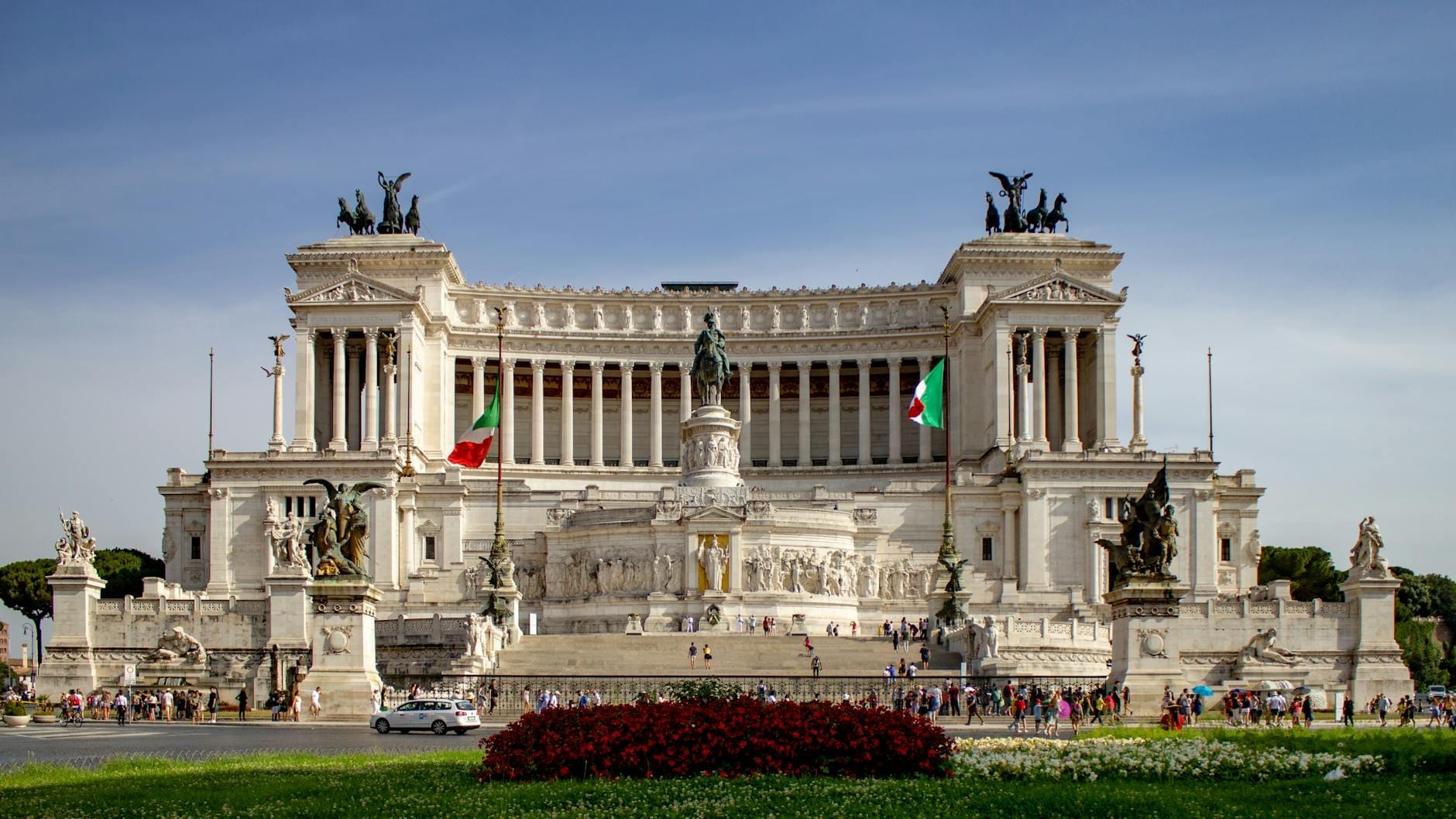
The square is defined by two dominant structures. On its western flank stands Palazzo Venezia, one of the earliest Renaissance palaces in Rome, built between 1455 and 1467. Facing it from the southern edge of the Capitoline Hill is the Vittoriano, the vast white marble monument inaugurated in 1911 to honor King Victor Emmanuel II and Italian unification. These two buildings could not be more different in age, style, or scale, and the contrast between them tells you something essential about Rome: that 500 years of architecture can coexist on the same block without anyone finding it unusual.
💡 Local tip
Piazza Venezia itself is free and open 24 hours. If you want to climb to the Vittoriano's panoramic terrace or visit the Palazzo Venezia National Museum, you'll need a combined ticket (€15 full price). Tickets are sold at the Palazzo Venezia ticket office at Via del Plebiscito 118.
The Vittoriano: Rome's Most Polarizing Monument
Romans have a fondness for irreverent nicknames, and the Vittoriano has accumulated several over the decades: the Wedding Cake, the Typewriter, the Dentures. The affectionate mockery reflects the building's sheer excess. Designed by Giuseppe Sacconi in Brescian marble and completed in stages between 1885 and 1955, it is enormous even by Roman standards, rising 81 meters and stretching 135 meters across. Everything about it is maximalist: the equestrian statue of Victor Emmanuel II at its center weighs 50 tons, and the king's moustache alone is reportedly large enough for two people to stand inside.
Despite the jokes, the Vittoriano carries real civic weight. At its base lies the Tomb of the Unknown Soldier, guarded around the clock by an Italian military honor guard. The eternal flame beside it has burned since 1921. Watching the hourly changing of the guard is worth pausing for, a brief, formal ceremony that draws a small crowd of locals and visitors alike. The monument also houses the Museo Centrale del Risorgimento, dedicated to Italian unification, and the Sacrario delle Bandiere, a repository of military flags.
For most visitors, the main draw is the panoramic terrace at the very top, reached by a glass elevator on the rear of the structure. The view from up there is genuinely one of the finest in Rome, sweeping from the Colosseum and Roman Forum in the east to the dome of St. Peter's in the west, with the Tiber glinting in the distance on clear days. It is a view that orients you in the city in a way that maps cannot. Unlike the Pincio Terrace or Gianicolo Hill, this terrace places you directly above the ancient core of the city.
Tickets & tours
Live prices and dates from our booking partner. If you book, we may earn a commission at no extra cost to you.
Semi-private evening walking tour of Rome's piazzas and fountains
From 81 €Instant confirmationFree cancellationPalazzo Venezia reserved entrance with the Museum of the Risorgimento
From 33 €Instant confirmationFree cancellationRome's underground and piazzas guided walking tour
From 95 €Instant confirmationFree cancellationReserved Entrance Ticket to Rome's Palazzo Altemps
From 30 €Instant confirmationFree cancellation
Palazzo Venezia: The Older, Quieter Story
Palazzo Venezia predates the Vittoriano by four and a half centuries, and it operates on an entirely different frequency. Built in 1455 for Cardinal Pietro Barbo (who later became Pope Paul II), it was subsequently donated to the Venetian Republic, hence the square's name. The building passed through Venetian, papal, Austrian, and Italian state hands before becoming, infamously, the headquarters from which Benito Mussolini delivered his speeches between 1929 and 1943. The balcony facing the square, from which he addressed enormous crowds, is still there.
Today, Palazzo Venezia houses the Museo Nazionale di Palazzo Venezia, a national museum with collections spanning medieval and Renaissance decorative arts: tapestries, arms and armor, silverware, majolica ceramics, bronzes, and paintings from the 14th to 18th centuries. It is consistently less crowded than Rome's headline museums, which means you can actually stand in front of objects and read the labels without being jostled. The museum's courtyard garden, Giardino del Palazzetto Venezia, is a calm space that rarely appears in travel itineraries.
ℹ️ Good to know
Museum hours: 8:30 AM to 7:30 PM (last entry 6:30 PM). Closed December 25. Present 15 minutes early at the ticket office on Via del Plebiscito 118 if you have accessibility requirements. Disabled visitors enter free.
How the Square Changes Through the Day
Early morning, around 7 to 8 AM, Piazza Venezia belongs almost entirely to Romans. Delivery trucks navigate the perimeter, workers cross through on foot, and the traffic officers change shifts. The Vittoriano catches the first light on its eastern face, and the white marble takes on a faint gold tone that photographs extremely well. This is the moment before the tour groups arrive, when the scale of the architecture reads most clearly against an uncrowded foreground.
By mid-morning, tour buses begin parking along Via dei Fori Imperiali and the square fills with groups moving between the Vittoriano steps and the nearby Roman Forum entrance. The noise level rises considerably; the square has no natural acoustic buffer, and the surrounding stone surfaces amplify sound. If you are planning to simply walk through and take photographs, mid-morning is workable but expect crowds around the Vittoriano's main staircase.
Late afternoon, particularly from 4 PM onward, the light moves to illuminate the western face of the Vittoriano and the Renaissance facade of Palazzo Venezia. The traffic does not ease, but foot traffic thins slightly as visitors migrate toward dinner neighborhoods. The square takes on a different atmosphere after dark: floodlit, emptier, and considerably easier to photograph without crowds. The Vittoriano is lit at night, and its reflection in the wet cobblestones after rain is one of the more memorable images Rome produces.
Getting There and Moving On
Piazza Venezia has no metro station of its own, but it is served by several major bus lines: 40, 64, 70, and 170 all stop directly at the square. Tram 8 connects it to Trastevere and the Jewish Ghetto. From Termini station, buses 40 and 64 run direct and take roughly 20 minutes depending on traffic.
On foot, the square sits at a natural hub for several of Rome's major walking routes. The Capitoline Hill is immediately adjacent, accessible via the ramp to the left of the Vittoriano. The Via dei Fori Imperiali leads directly southeast to the Colosseum in about 10 minutes. North along Via del Corso, you reach the city's main shopping street, and northwest, a 15-minute walk brings you to the Pantheon. Because of this central position, most visitors pass through Piazza Venezia at least once during a Rome trip, whether they plan to or not.
If you are planning a full day in the historic center, consider pairing Piazza Venezia with the Capitoline Museums next door, which house the world's oldest public museum collection and connect directly to a terrace overlooking the Roman Forum. The combination covers Roman civic history from antiquity to unification within a single walkable block. For broader context on how to structure your time in the area, the Rome in 3 days itinerary maps out a logical sequence.
Photography, Practicalities, and Who Should Skip It
For photography, the best position for capturing the Vittoriano's full facade is from the far end of Via del Corso looking south, ideally in the morning when the light falls across the front. Wide-angle lenses are almost essential given the building's scale. The view from the panoramic terrace elevator rewards a longer lens for picking out distant landmarks.
Regarding what to wear: the square itself has no dress code. If you plan to enter the Palazzo Venezia museum, standard museum etiquette applies, but shoulders and knees do not need to be covered as they would in a church. Comfortable shoes matter here, because the cobblestones around the Vittoriano are uneven, and the main staircase involves a significant number of steps if you walk up rather than take the elevator.
Who should skip it: travelers who have limited time and want to prioritize experiential or atmospheric spaces over monumental civic architecture. Piazza Venezia does not offer the intimacy of Piazza Navona or the sculptural detail of the Trevi Fountain. It is a square built for occasions of state, not for lingering, and visitors who find themselves exhausted by grand gestures may feel little pull here. That said, skipping it entirely means missing the Vittoriano's terrace, which is, practically speaking, the best free-of-crowds panorama in central Rome.
⚠️ What to skip
The traffic at Piazza Venezia is intense and crossing the square on foot requires caution. Pedestrian crossings exist but are not always predictable. Keep children close, and do not assume vehicles will stop.
Insider Tips
- The Vittoriano's panoramic terrace elevator operates independently from the museum ticket. Check the combined ticket validity on arrival, as pricing and inclusions may be updated periodically.
- The museum inside Palazzo Venezia is genuinely undervisited. On most weekday mornings you will have entire rooms to yourself, a rarity in central Rome.
- If you want to photograph the changing of the guard at the Tomb of the Unknown Soldier without a crowd in front of you, arrive a few minutes before the hour, as the ceremony is brief.
- The Giardino del Palazzetto Venezia, the small garden courtyard between Palazzo Venezia and the adjacent Palazzetto, is accessible with a museum ticket and offers one of the quieter sitting spots in this part of the city.
- The traffic officer directing vehicles from the elevated central platform is a Rome institution. The tradition dates back generations and the gestures are surprisingly theatrical. Give it two minutes of attention before you move on.
Who Is Piazza Venezia For?
- First-time visitors to Rome who want a central orientation point connecting the ancient city to the modern
- Architecture and history enthusiasts interested in both Renaissance palaces and 20th-century monumental design
- Photographers looking for wide panoramic views from the Vittoriano terrace without the queues of Rome's other viewpoints
- Museum-goers who want to explore a national collection of decorative arts without the crowds of the Vatican or Borghese
- Travelers building a full-day walking route through the historic center, using the square as a natural hub
Nearby Attractions
Other things to see while in Centro Storico:
- Ara Pacis
Commissioned in 13 BC to celebrate Augustus's campaigns in Gaul and Spain, the Ara Pacis Augustae is one of the best-preserved monuments of ancient Rome. Today it sits inside a striking modern pavilion on the Tiber's east bank, offering an unusually intimate encounter with imperial-era marble carving at near eye level.
- Campo de' Fiori
Campo de' Fiori is one of Rome's most recognizable piazzas, running a daily produce and flower market Monday through Saturday before reinventing itself as a lively social square after dark. Its paving stones have witnessed public executions, papal power, and centuries of commerce.
- Capitoline Hill
Capitoline Hill sits at the symbolic center of Rome, where Michelangelo's perfectly proportioned piazza crowns a site inhabited since the Bronze Age. Today it holds the world's oldest public museums, Rome's city hall, and some of the most striking views over the Roman Forum in the city.
- Capitoline Museums
Perched atop Capitoline Hill overlooking the Roman Forum, the Musei Capitolini hold some of antiquity's greatest sculptures and paintings across three interconnected palaces. Founded in 1471, they predate the Louvre by more than three centuries and reward visitors with both iconic works and panoramic views that few Rome attractions can match.
Planning a trip? Discover personalized activities with the Nomado app.