Appartement Témoin Perret: Inside Le Havre's Postwar Modernist Apartment
The Appartement Témoin Perret is a meticulously preserved show flat from Le Havre's postwar reconstruction, offering guided access into the living spaces Auguste Perret designed to define modern French housing after World War II. Set on the first floor of a UNESCO-listed block on rue de Paris, it is one of the most specific and illuminating things you can do in Le Havre.
Quick Facts
- Location
- 181 rue de Paris, 76600 Le Havre (Maison du Patrimoine, centre-ville)
- Getting There
- Tram and bus stops nearby; check the official network for the best route
- Time Needed
- About 50 minutes (guided tour, fixed schedule)
- Cost
- €7 adult / €5 reduced / Free under 26, jobseekers & minimum-benefit recipients; free for all first Saturday of each month
- Best for
- Architecture enthusiasts, design history lovers, UNESCO World Heritage visitors
What This Place Actually Is
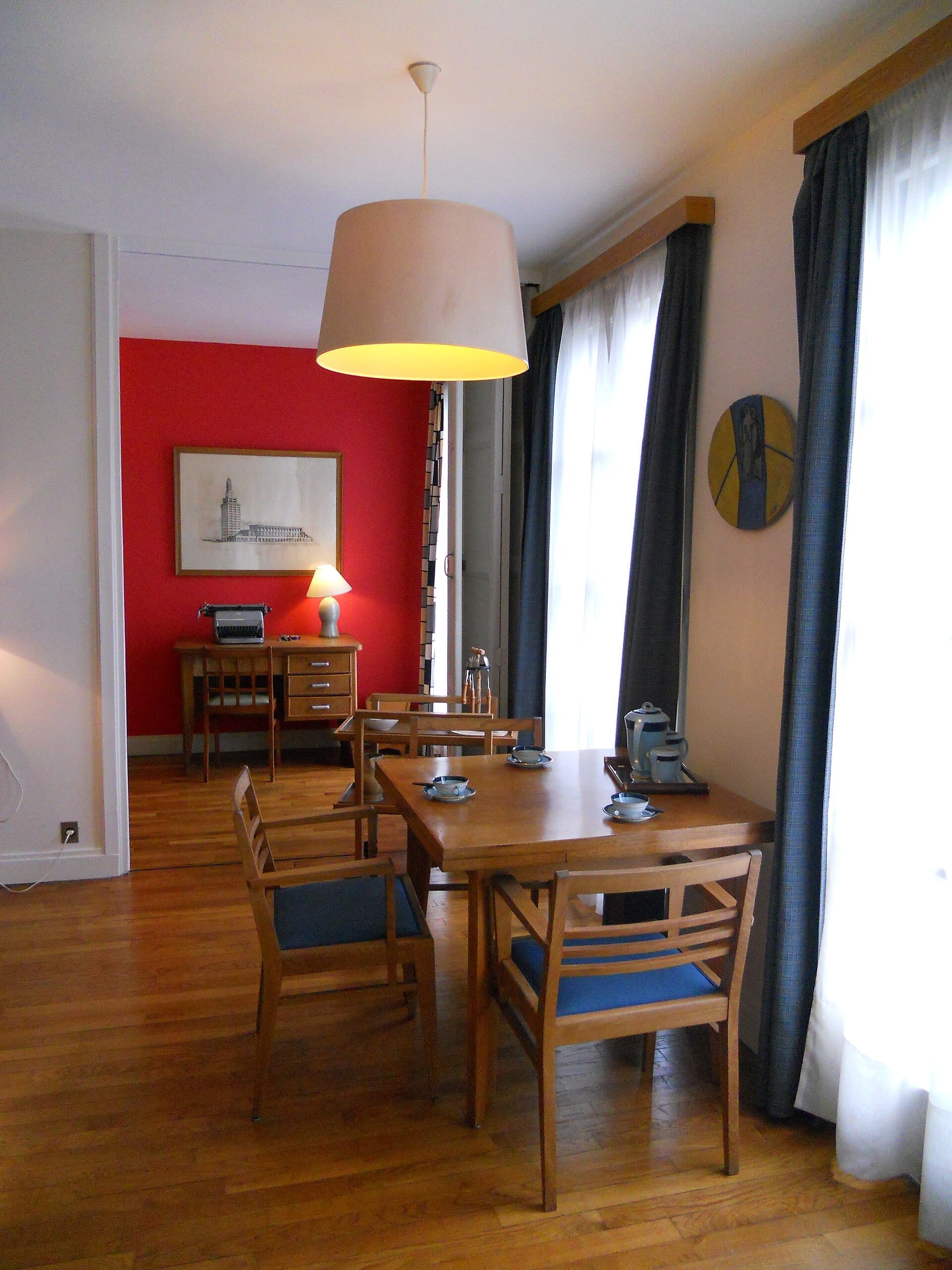
The Appartement Témoin Perret is not a museum in the conventional sense. There are no vitrines, no interpretive panels explaining what you are looking at, no recreated mannequins in period clothing. Instead, you walk through a first-floor apartment that has been restored to the state it would have occupied when Le Havre's reconstruction was still fresh: the 1940s and 50s palette of colors on the walls, the original layout of rooms, the proportions Perret calculated to flood interiors with northern light. What you encounter feels more like an inhabited space than an exhibit, which is precisely the point.
Auguste Perret, the reinforced concrete pioneer who rebuilt Le Havre between 1945 and 1964, presented model apartments in Paris in 1947 and then in Le Havre itself between 1949 and 1953. These were not merely architectural demonstrations. They were arguments: that postwar urban housing could be dignified, considered, and generous in light and proportion. The Appartement Témoin Perret sits within one of the first Immeubles Sans Affectation Individuelle (ISAI), the standardized residential blocks that form the backbone of the city's UNESCO-listed reconstruction district.
⚠️ What to skip
Reservation is mandatory. You cannot turn up and join a tour on the day without a booking. Reserve through the Le Havre Seine Métropole online portal before you travel, especially for weekend visits in summer when spaces fill quickly.
The Guided Tour: Room by Room
Tours run to a fixed schedule and last roughly 45 to 60 minutes. Groups are small enough that you can ask questions, and the guides employed by the Pays d'art et d'histoire service know both the architectural details and the social history behind them. The tour moves through the main living spaces, the kitchen, and the bedrooms, pausing to explain decisions that might otherwise seem simply decorative but were in fact structural and ideological.
The ceiling heights immediately register as generous by postwar social housing standards. Perret insisted on 2.7-metre ceilings throughout the ISAI blocks, a specification that resisted the pressures to compress floor-to-floor heights that plagued reconstruction projects elsewhere in France. The windows are wide and placed with deliberate care relative to the rooms they serve. In the main living space, the interplay between natural light and the pale interior surfaces gives the apartment a calm that is not accidental.
The kitchen and service areas are particularly interesting because they reveal how Perret's team thought about domestic practicality, not only aesthetic theory. The fitted elements, the passage widths, and the storage logic reflect the model layouts that were shown to prospective residents of the reconstruction in those early years. These were spaces designed to persuade skeptical Havrais that modern concrete housing was not a step down from what had been lost to the bombing.
Tickets & tours
Hand-picked options from our booking partner. Prices are indicative; availability and final rates are confirmed when you complete your booking.
Customized private D-day Normandy landing excursion from Le Havre
From 1.300 €Instant confirmationFree cancellationFull-day trip to Giverny and Rouen from Le Havre
From 1.200 €Instant confirmationFree cancellation
Historical Weight: Rebuilding a Destroyed City
Le Havre was among the most heavily damaged cities in Western Europe during World War II. Allied bombing raids targeting the German-occupied port reduced much of the city centre to rubble. When Perret received the commission to rebuild, the scale was unprecedented: a 150-hectare urban canvas, largely cleared, to be remade from first principles. The result, completed through the 1950s, earned Le Havre inscription on the UNESCO World Heritage List in 2005, recognising the reconstruction as an outstanding example of postwar modernist urbanism.
The Appartement Témoin was inaugurated in 2006 to give visitors a legible way into the abstract idea of the reconstruction. Walking through the flat makes concrete (in every sense) what it meant to live inside Perret's plan. You stop reading about module grids and facade rhythms and start understanding them from inside the space they created.
For travelers following the broader arc of Le Havre's postwar story, the apartment works well as a starting point before visiting the Église Saint-Joseph, Perret's most theatrically ambitious building in the city, or the Hôtel de Ville, which anchors the civic heart of the grid.
When to Visit and What to Expect at Different Times
The apartment is only accessible on guided tours during a seasonal window, from 1 April to 30 September. In July and August, tours run every day at 10:00, 11:00, 14:30, 15:30, and 16:30. In April, May, June, and September, the schedule is afternoons on weekdays, with fuller schedules on weekends and public holidays. The 10:00 morning tour in summer is the most comfortable: group sizes tend to be smaller, the light entering from the street side of the building is at its most legible, and you have the rest of the day free for the wider Perret district.
Weekend morning tours attract a mix of architecture students, UNESCO heritage tourists, and French visitors revisiting postwar history. If you prefer a quieter experience, the 15:30 slot on a weekday afternoon in June or September often draws smaller groups. The first Saturday of each month offers free entry for all visitors, which is worth planning around if your budget is tight, though expect demand to be higher.
💡 Local tip
The apartment is on the first floor with approximately 40 steps and no elevator. If you or anyone in your group has significant mobility limitations, this visit will not be possible. Contact the heritage office in advance if you have questions about access.
Practical Information for Your Visit
The flat is located within the Maison du Patrimoine at 181 rue de Paris, a short walk from the commercial centre of the Perret grid. Tram and bus stops are nearby, making it straightforward to reach without a car. Le Havre railway station is also within easy reach by public transport or on foot.
Admission in 2026 is €7 for adults and €5 for reduced-rate visitors. Entry is free for those under 26, for jobseekers, and for recipients of minimum social benefits (proof required). All visits are guided, and all bookings must be made in advance through the Le Havre Seine Métropole online booking portal. The tour is conducted in French; if you need English commentary, it is worth contacting the heritage service ahead of your visit to check availability.
Photography inside the apartment may be limited during tours; check with your guide at the start. If you want to photograph the exterior of the ISAI block and the rue de Paris streetscape, the late afternoon light from the west catches the concrete facades at a flattering angle. For a broader sense of how the apartment fits into the reconstructed city, the Le Havre walking tour covering the Perret district is an effective companion.
Who Should Skip This
If your interest in Le Havre is primarily coastal, the Appartement Témoin Perret will feel peripheral to your trip. The visit is cerebral and detail-focused; there are no panoramic views, no dramatic set pieces, and the experience depends heavily on being genuinely curious about how postwar housing policy and architectural theory intersect in everyday domestic space. Visitors who find architecture lectures dull or who are traveling with young children may find the format difficult to sustain for an hour.
Equally, visitors who are interested in impressionism, the port, or Le Havre's natural surroundings are better served by other parts of the city. The apartment rewards a specific kind of attention, and it asks for patience with a subject that has no obvious visual spectacle.
Placing the Apartment Within a Wider Le Havre Day
The Appartement Témoin Perret works best as part of a morning or afternoon devoted to the Perret reconstruction. Start with the apartment tour, then walk south along rue de Paris toward the port to read the facade rhythms of the ISAI blocks in context. The Bassin du Commerce is close enough to reach on foot and provides a waterfront counterpoint to the residential streets. If you have an afternoon tour, the Église Saint-Joseph interior is worth the short walk afterward, as the tower's amber light changes substantially through the day.
For visitors with a dedicated interest in Le Havre's postwar history and architecture, combining the apartment visit with the Le Havre World War II history narrative gives the tour a much richer frame. Understanding what the city looked like before and immediately after the bombing makes the deliberate optimism of Perret's model apartment genuinely affecting.
Insider Tips
- Book the 10:00 July or August tour for the most comfortable daytime visit. Afternoon tours occasionally run close to capacity in peak summer.
- The first Saturday of each month is free for everyone, but book online as soon as the slot opens. These sessions fill faster than paid tours.
- Ask the guide specifically about the ceiling height specification and the module system. The numbers alone reveal a great deal about Perret's priorities versus those of contemporaneous social housing projects elsewhere in France.
- Combine this visit with a stop at the Maison du Patrimoine itself, which often has additional exhibition material about the reconstruction that is free to browse before or after your tour.
- If you read French, the Le Havre Seine Patrimoine website has detailed archival material about the ISAI typology that makes the apartment visit considerably richer. Read it the evening before rather than after.
Who Is Appartement Témoin Perret (Perret Show Flat) For?
- Architecture and design enthusiasts who want to understand modernist urbanism from the inside out
- UNESCO World Heritage travelers building a complete picture of the Le Havre reconstruction
- History visitors with a specific interest in postwar France and reconstruction policy
- Students and researchers of 20th-century European architecture and housing
- Slow travelers willing to spend focused time on a single subject rather than covering multiple sites
Nearby Attractions
Other things to see while in Centre Ville Perret (UNESCO District):
- Bassin du Commerce
The Bassin du Commerce is a 500-metre historic dock at the centre of Le Havre's UNESCO-listed rebuild, where post-war concrete architecture meets open water. Free to visit during public hours, it serves as the city's most photogenic public space and a genuine crossroads of daily life.
- Cathédrale Notre-Dame du Havre
Standing on rue de Paris in central Le Havre, the Cathédrale Notre-Dame du Havre is a rare pre-war survivor in a city rebuilt almost entirely from concrete after 1944. Its layered Gothic and Renaissance architecture tells a longer story than the modernist grid surrounding it. Entry is free, and the contrast with Auguste Perret's rebuilt city makes it one of the most thought-provoking stops in the centre.
- Église Saint-Joseph
Designed by Auguste Perret and structurally completed in 1957 (with consecration in 1964), Église Saint-Joseph is the defining monument of Le Havre's UNESCO-listed city centre. Its 107-metre lantern tower and 12,768 panels of coloured glass make it one of the most architecturally significant post-war churches in Europe. Entry is free.
- Halles Centrales
Built between 1958 and 1960 as part of Auguste Perret's post-war reconstruction, the Halles Centrales is Le Havre's working food market. Free to enter and open seven days a week, it offers fresh produce, local traders, and a ground-level view of everyday city life inside a landmark modernist concrete shell.