Parque Doramas: Las Palmas de Gran Canaria's Living Room in Green
Parque Doramas is the centrepiece of Las Palmas de Gran Canaria's Ciudad Jardín district: a shaded, palm-lined park with free entry, century-old atmosphere, and the remarkable Pueblo Canario cultural complex at its heart. Whether you want a quiet morning walk or a window into Canarian architecture and folklore, this park delivers substance without the tourist fanfare.
Quick Facts
- Location
- Ciudad Jardín district, Las Palmas de Gran Canaria. Main entrance on Calle Emilio Ley s/n, 35005.
- Getting There
- Urban buses (guaguas) lines 2, 10, 22, 25, and 81 all serve the park area. Verify current schedules with the Guaguas Municipales network.
- Time Needed
- 45 minutes for a casual walk; 2 hours if you explore Pueblo Canario and sit at the terrace café.
- Cost
- Free. No admission fee. The central area of the park is open daily 07:00–23:00.
- Best for
- Families, architecture lovers, slow-travel mornings, and anyone wanting a local experience away from the beach promenade.
What Parque Doramas Actually Is
Parque Doramas is a public urban park in the Ciudad Jardín neighbourhood of Las Palmas de Gran Canaria, set within the broader residential fabric of one of the city's most architecturally refined districts. Named after a legendary Guanche chieftain who led resistance against the Spanish conquest in the late 15th century, the park carries a certain civic pride alongside its greenery. It is not a themed botanical garden or a manicured tourist showpiece. It is, fundamentally, where people from the surrounding streets come to breathe.
At its core sits the Pueblo Canario, a cultural ensemble designed in the early 20th century to celebrate traditional Canarian architecture. The complex of buildings, courtyards, and covered galleries was conceived by the architect Néstor Martín-Fernández de la Torre and realised largely by his brother Miguel. The result is something rare: a purpose-built 'village within a park' that feels neither artificial nor neglected, and which houses a museum dedicated to Néstor's symbolist paintings alongside a terrace café and a small artisan market area.
💡 Local tip
The central area of the park opens at 07:00 every day. Arriving between 07:30 and 09:00 on a weekday means you will share it mostly with dog walkers and joggers, not tour groups. The light through the palm canopy at that hour is worth setting an early alarm for.
How the Park Changes Through the Day
In the early morning, Parque Doramas belongs to the neighbourhood. The air carries the faint sweetness of subtropical vegetation, a mix of frangipani and cut grass, and the stone paths are cool underfoot. Elderly residents occupy the benches along the main promenade. A few runners loop through on their way to work. The Pueblo Canario courtyard is quiet, the café chairs still stacked.
By late morning, particularly on weekends, the atmosphere shifts. Families arrive with pushchairs. School groups appear near the statue of the Guanche chieftain. The café opens and the smell of coffee mixes with the damp earth after any overnight moisture. This is when the park most clearly shows its function as a social anchor for Ciudad Jardín: not a destination in itself, but a shared space that holds a neighbourhood together.
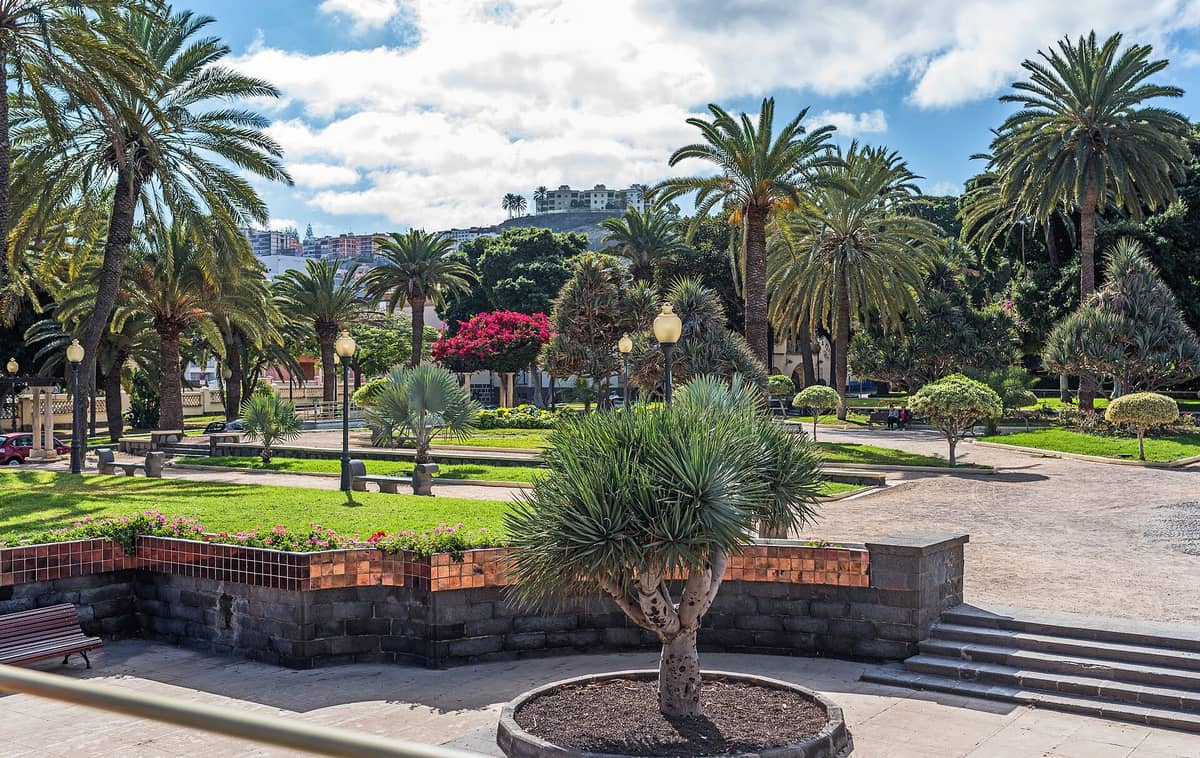
Midday in summer can push temperatures into the high 20s Celsius along Las Palmas' coast, but the tree canopy inside Parque Doramas, dense with dragon trees, palms, and tropical species, keeps the interior noticeably cooler than the surrounding streets. The park does not have the dramatic cliff-side shade of interior Canarian landscapes, but it provides enough relief to make a lunchtime visit comfortable even in July or August. By late afternoon, the benches fill again and the light turns amber through the upper fronds.
The Pueblo Canario: What to Expect Inside
The Pueblo Canario complex is the single most architecturally interesting feature within Parque Doramas and, arguably, one of the more underappreciated cultural sites in Las Palmas. The buildings draw on traditional Canarian vernacular design: whitewashed walls, timber balconies with carved wooden railings in the style seen across the island's historic centres, and terracotta-tiled roofs arranged around a central courtyard. The effect, particularly from the main open plaza, is convincingly coherent.
Inside the complex, the Museo Néstor displays the symbolist and decorative work of Néstor Martín-Fernández de la Torre, whose paintings blend Art Nouveau influence with Canarian identity. His ambitious, large-scale work is rarely encountered outside of Gran Canaria, making this small museum meaningful rather than perfunctory. Before visiting, it is worth checking the museum's own opening schedule separately, as it differs from the park's general hours. The surrounding Casa de Colón in Vegueta is the island's other major cultural museum (paid entry most days; Sundays are typically free) and makes a logical companion visit for anyone spending a day focused on Las Palmas' heritage.
On Sunday mornings, the Pueblo Canario courtyard occasionally hosts folk music and dance performances in traditional Canarian dress. These are not ticketed events and times can vary, so checking the Las Palmas tourism board (lpavisit.com) for the current schedule before your visit is advisable. If you happen to arrive during one, the experience is genuine: musicians playing timples (a small Canarian stringed instrument) in an architecturally appropriate courtyard is the kind of thing that stays with you.
The Gardens: Vegetation and Layout
Parque Doramas is not a botanical garden with labelled specimens and prescribed circuits. The plantings are lush but informal, with a subtropical density that makes the interior feel enclosed and sheltered even though the park sits within a dense urban grid. Dragon trees (Dracaena draco), the iconic species native to the Canary Islands and the Macaronesian region more broadly, appear throughout alongside tall palms, ornamental figs, and flowering shrubs. In spring, colour builds through the flowerbeds flanking the main paths.
The park's layout is relatively simple to navigate: a central promenade connects the main entrance to the Pueblo Canario, with secondary paths branching into quieter garden areas. A small decorative pond or fountain feature and the large central statue of the Guanche chieftain Doramas serve as orientation points. There are no significant gradients, which makes the park accessible on foot for most visitors regardless of mobility level, though detailed wheelchair-specific infrastructure information should be confirmed directly with the Las Palmas parks department.
ℹ️ Good to know
Ciudad Jardín, the residential district surrounding the park, is itself architecturally notable. The neighbourhood developed in the early 20th century as Las Palmas expanded northward, and it contains some of the city's finest examples of early modernist and Art Deco residential architecture. A slow walk through the surrounding streets before or after the park adds real context.
Getting There and Practical Details
The park's main entrance is on Calle Emilio Ley, in the Ciudad Jardín district. A secondary address often cited is Calle León y Castillo 227, which sits on the park's perimeter. Both work as navigation targets. The surrounding area is walkable from the Alcaravaneras beach promenade and from the Hotel Santa Catalina, a historic property on the park's edge.
Municipal bus lines 2, 10, 22, 25, and 81 all stop within reasonable walking distance of the park. Urban bus fares in Las Palmas are around €1.40 for a single ticket, with reduced fares using the rechargeable TransGC card. Verify current fares before travel, as prices update periodically. If you are staying near Santa Catalina, the park is a manageable 15-to-20-minute walk through the residential streets heading northeast.
No special clothing or equipment is required. The paths are paved and shaded, so the park works in almost any weather. Las Palmas receives very little rain, particularly between May and September, but on the rare overcast winter day the park takes on a different, quieter character that some visitors actually prefer. Sunscreen is advisable in summer if you intend to spend time in the more open sections near the Pueblo Canario plaza.
Photography, Context, and Honest Limitations
For photography, the Pueblo Canario courtyard is the most rewarding subject: the whitewashed walls, carved timber balconies, and terracotta rooflines photograph well in soft morning light before midday shadows fragment the facade. The dragon trees in the main garden area can produce striking compositions if you shoot upward through the canopy. The park's perimeter, where old residential buildings face the garden fence, also offers good architectural framing.
It is worth being honest about what Parque Doramas is not. It does not have the dramatic scale of a major city park. It does not offer the ecological spectacle of something like the Jardín Botánico Viera y Clavijo, which is Gran Canaria's dedicated botanical garden and contains one of the most significant collections of Macaronesian flora in the world. Visitors who come to Parque Doramas expecting a major natural attraction may feel underwhelmed. Those who come expecting a good neighbourhood park with a genuinely interesting cultural complex at its centre will leave satisfied.
Travellers focused exclusively on Gran Canaria's southern beach resorts, or those with only a few hours in Las Palmas, might reasonably prioritise other sites. But for anyone spending more than a day in the city, the park fits naturally into a morning that combines it with the surrounding Ciudad Jardín architecture and perhaps continues toward the Alcaravaneras beachfront.
⚠️ What to skip
The Museo Néstor inside the Pueblo Canario has its own opening hours that do not match the park's 07:00–23:00 schedule. Check the museum's current timetable and any closure days at lpavisit.com before planning your visit around it.
Parque Doramas in the Wider Context of Las Palmas
Las Palmas de Gran Canaria is a large, complex city with a well-developed cultural identity that extends far beyond its beaches. Parque Doramas sits in the residential middle of that city, between the historic Vegueta district to the south and the Alcaravaneras port area to the east. Understanding the park as part of a walkable urban circuit, rather than as a standalone destination, is the key to getting the most from it.
For visitors structuring a day in Las Palmas, the park works well as a mid-morning stop between a Vegueta heritage walk and an afternoon at Las Canteras beach. The distances are manageable by bus or taxi, and the contrast between the old city, the garden district, and the urban beach captures something genuinely representative of how Las Palmas actually functions as a place. A full day structured around these three areas covers more of the real city than most itineraries suggest.
Insider Tips
- The terrace café inside the Pueblo Canario courtyard is one of the more pleasant places in Las Palmas to have a mid-morning coffee. It receives almost no tourist foot traffic before 10:00 on weekdays.
- Sunday folk music performances in the Pueblo Canario courtyard are free and informal, but they are not guaranteed every week. Check the Las Palmas tourism board calendar at lpavisit.com in the days before your visit rather than assuming they will be on.
- The Hotel Santa Catalina, which sits directly adjacent to the park, is a historically significant property inaugurated in 1890 and worth a brief interior look. The lobby and terrace bar are accessible to non-guests and provide a different view across the park canopy.
- If you want photographs of the Pueblo Canario without other visitors in frame, arrive at park opening (07:00) or within the first hour. By 10:30 on weekends the courtyard has consistent foot traffic.
- The surrounding Ciudad Jardín streets, particularly those between the park and the Alcaravaneras waterfront, contain some of the finest early 20th-century residential architecture in Las Palmas. Extending your walk by 20 minutes through these blocks adds real architectural interest to the visit.
Who Is Parque Doramas For?
- Families with young children looking for shaded open space in central Las Palmas
- Architecture and design enthusiasts interested in Canarian vernacular building traditions and the Pueblo Canario complex
- Travellers who want a slow, unhurried morning in a local neighbourhood rather than another tourist queue
- Photography-focused visitors seeking compositions that combine subtropical vegetation with early 20th-century architecture
- Anyone building a full-day Las Palmas itinerary who wants a natural green pause between Vegueta and Las Canteras
Nearby Attractions
Combine your visit with:
- Arteara Necropolis
The Arteara Necropolis is the most extensive aboriginal cemetery on Gran Canaria, with 809 stone burial mounds spread across 13 hectares inside the dramatic Barranco de Fataga gorge. It offers a rare, unhurried encounter with the island's pre-Hispanic Canarii people, well away from the resort crowds of the south.
- Bandama Caldera & Crater Viewpoint
Rising 574 metres above sea level, the Pico de Bandama offers the most striking volcanic panorama on Gran Canaria. Below stretches the Caldera de Bandama, a crater around 200 metres deep and about 1,000 metres across, formed by one of the island's most recent volcanic episodes. It is free to visit, takes under an hour from Las Palmas, and rewards visitors with views that stretch from the island's green interior to the Atlantic coastline.
- Barranco de los Cernícalos
Barranco de los Cernícalos is a 7 km round-trip ravine hike in central-eastern Gran Canaria where a year-round stream cuts through laurel forest, fern-draped cliffs, and small waterfalls. It is free to enter, requires no booking, and remains genuinely quiet compared to the island's more promoted highland routes.
- Cactualdea Park
Cactualdea Park sits in the remote western municipality of La Aldea de San Nicolás, where an extraordinary collection of cacti and succulents grows against a backdrop of volcanic rock and Atlantic light. It rewards visitors who make the journey with something genuinely unusual: a curated desert landscape that feels nothing like the resort south of the island.