Parque de las Ciencias Granada: What to Expect Before You Go
Parque de las Ciencias de Andalucía is Granada's flagship science museum, one of the largest in Spain. Spread across multiple buildings and outdoor areas, it covers everything from human biology to tropical ecosystems, with a planetarium, an observation tower, and a living BioDomo that houses real animals. It works well for families and for adults with a genuine interest in science, and it earns its admission price on a rainy afternoon or a scorching summer day.
Quick Facts
- Location
- Avenida de la Ciencia, s/n, 18006 Granada (southwest of city centre)
- Getting There
- City bus to Avenida de la Ciencia stop; roughly 15-20 min walk from the historic centre
- Time Needed
- 3-5 hours for the museum; add 1-2 hours if visiting the BioDomo and planetarium
- Cost
- Museum: €10 general, €8 reduced. BioDomo add-on: €7 general. Planetarium: €3.50. Under-3s free. Verify current prices at parqueciencias.com before visiting.
- Best for
- Families with children, science enthusiasts, hot or rainy day alternatives to outdoor sightseeing
- Official website
- www.parqueciencias.com
What Is Parque de las Ciencias?
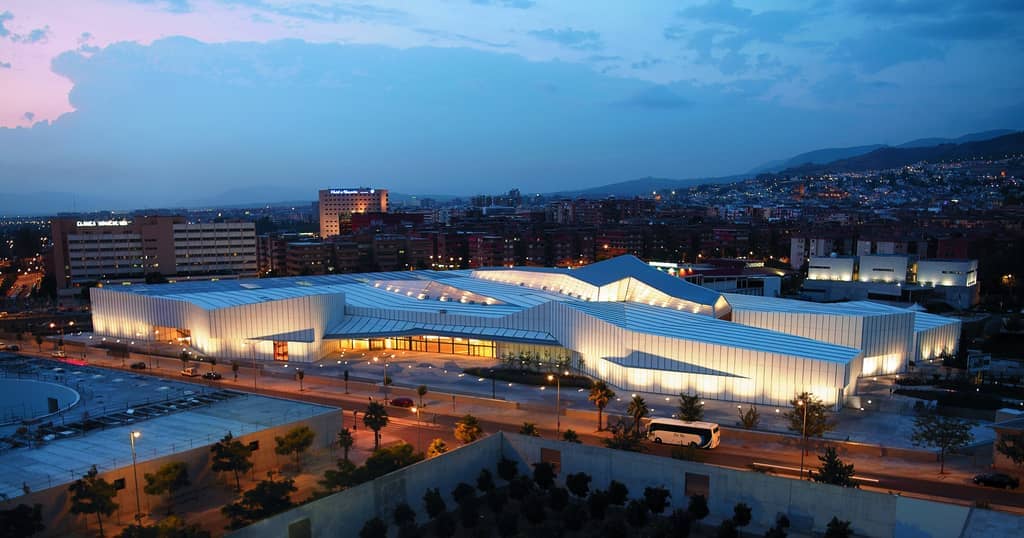
Parque de las Ciencias de Andalucía, known in English as the Science Park, is the largest interactive science museum in southern Spain. The complex sits on Avenida de la Ciencia in the southwest of Granada, about fifteen to twenty minutes on foot from the cathedral district, and it occupies a footprint large enough to absorb several hours without feeling rushed. It is not a compact urban museum where you dart between rooms. It is closer to a campus, with multiple pavilions, outdoor science installations, a botanical garden area, an observation tower, and the BioDomo, a climate-controlled tropical habitat that houses live animals.
The museum has grown in stages since opening in the 1990s and is now recognised as the primary science institution in Andalusia. That expansion is visible in the architecture: the original pavilions feel slightly older in their fit and finish, while the BioDomo and more recent additions have a contemporary, polished feel. The result is a complex that rewards exploration rather than linear progression through rooms.
💡 Local tip
Book planetarium tickets at the desk when you arrive. Sessions sell out by early afternoon on weekends and during school holidays.
Opening Hours and Admission
The museum opens Tuesday to Saturday from 10:00 to 19:00, and on Sundays and public holidays from 10:00 to 15:00. It is closed on Mondays (with occasional exceptions during public holiday periods) and on 1 and 6 January, 1 May, and 25 December. The BioDomo operates Tuesday to Saturday from 10:15 to 19:00, with last entry at 18:00 and restricted standalone visits only in the final hour of each session block.
General museum admission is €10, with a reduced rate of €8 for visitors under 18, those over 65, groups of 15 or more, and youth cardholders. Children under three enter free. The BioDomo requires a supplement of €7 at the general rate, or can be bought within combined tickets. Planetarium sessions cost €3.50 per person at the general rate. Entry is free on specific dates, including 28 February (Andalusia Day) and the museum's anniversary day. Prices listed here were verified in 2026 sources but should be confirmed on the official website before your visit, as institutional pricing changes periodically.
⚠️ What to skip
The Sunday closure at 15:00 catches visitors off guard. If you arrive after noon on a Sunday, you will not have enough time for the full complex. Plan for a weekday or Saturday visit instead.
Tickets & tours
Live prices and dates from our booking partner. If you book, we may earn a commission at no extra cost to you.
Alhambra guided tour in Italian
From 49 €Instant confirmationFree cancellationAlhambra guided group tour with Nasrid Palaces and Generalife Palace
From 40 €Alhambra guided tour with Carlos V Palace, Generalife and Alcazaba
From 35 €Alhambra and Generalife skip-the-line private tour
From 65 €Instant confirmation
What You Actually See Inside
The permanent exhibitions are organised across themed pavilions. Subjects covered include human biology and perception, the cosmos and astronomy, the history of science and technology, ecology, and the physics of motion. Many exhibits are hands-on: you adjust mirrors to test optical illusions, step onto scales that show your weight on other planets, or watch mechanical demonstrations of wave propagation. The interactivity is designed to work for adults as well as older children, and most of the explanatory text is present in Spanish with English summaries on many panels.
The observation tower, the Torre Observatorio, gives elevated views across the city toward the Sierra Nevada on clear days. It is worth the climb in the morning before haze builds, and it provides a useful orientation point for visitors who have just arrived in Granada and want to understand how the city sits in relation to the mountains.
Outdoors, the grounds include science-themed sculptures and installations spread across a garden area. On spring mornings, when temperatures sit in the low twenties, these exterior spaces are genuinely pleasant. In July and August, when daytime highs regularly exceed 35°C in Granada, most visitors move through the outdoor sections quickly and spend the bulk of their time inside the air-conditioned pavilions. If you are visiting in summer, the park becomes one of the most sensible ways to spend a midday block. For broader context on timing, see the best time to visit Granada guide.
The BioDomo: A Separate Ecosystem
The BioDomo is the most distinctive element of the complex and the reason many visitors add extra time to their visit. It is a large enclosed tropical habitat with controlled temperature and humidity, housing live animals including birds, reptiles, amphibians, and fish in recreated ecosystems. The noise shifts as you walk between zones: from the soft drip of a rainforest canopy section to the drier, quieter areas representing Mediterranean scrub. The air inside is noticeably warm and humid compared to the rest of the museum.
This is not a zoo with large mammals or dramatic enclosures. The animals are small-to-medium species, and the experience is closer to a well-designed vivarium walk than a safari. That said, the level of ecological interpretation is high, and the concept of connecting live animals to conservation science gives it a different register from the rest of the museum. Visitors who expect something spectacular may be mildly underwhelmed; visitors who engage with the interpretive signage tend to find it worthwhile.
ℹ️ Good to know
The BioDomo requires a separate or combined ticket. If you are visiting with children who are interested in animals, the combined ticket offers good value. Adult visitors with limited time may find the standard museum alone sufficient.
How the Experience Changes by Time of Day
Arriving at opening time (10:00) on a weekday gives you a noticeably quieter experience for the first ninety minutes. The hands-on exhibits are unoccupied, the observation tower is uncrowded, and planetarium seats are easy to secure. The museum begins to fill from around 11:30, and midday on weekends or school holidays can feel genuinely congested in the more popular pavilions. School groups tend to arrive in the morning and thin out by early afternoon.
On Sunday mornings, the combination of a 10:00 opening and a 15:00 closure creates a concentrated rush. The most efficient Sunday visit starts at 10:00, priorities the BioDomo and planetarium first, then uses the final hour for the outdoor installations. Do not attempt to see everything on a Sunday; choose two or three areas.
Light in the outdoor areas is best in the morning. By afternoon in spring and autumn, the sun is strong and slightly low, creating glare. If photography of the exterior architecture or the tower interests you, aim for the first hour after opening.
Getting There and Practical Logistics
The museum address is Avenida de la Ciencia, s/n, 18006 Granada. Several city bus lines stop near the complex; check the Transportes Rober network for current routes, as lines and stops are subject to change. On foot from the historic centre, the walk takes fifteen to twenty minutes through mostly flat streets, passing through a residential and commercial corridor. It is not a scenic route, so walking is practical rather than pleasurable. For general orientation around the city, the getting around Granada guide covers your options in detail.
The complex has a paid on-site car park, which is useful if you are arriving from outside the city centre. Taxis and ride-hailing services (including Cabify, which operates in Granada; verify availability at time of visit) drop off at the main entrance without issue.
The entire site is fully accessible for visitors with reduced mobility, with ramps and elevators serving all floors and adapted restrooms throughout. Visitors with visual impairments are accommodated through specific accessibility measures, including obstacle-free circulation routes in designated areas. Pushchairs and prams are straightforward throughout the site.
Is It Worth It?
Parque de las Ciencias is a genuinely good museum by any regional standard, and it fills a clear gap in Granada's otherwise heritage-heavy offering. The city's main draw is the Alhambra and its medieval architecture, and a full day there leaves little appetite for more history. The science park is a useful counterpoint, particularly for multi-day visitors who want variety.
That said, it is not a world-class science museum in the category of institutions like London's Science Museum or Barcelona's CosmoCaixa. Some exhibits show their age, and the translation quality in English varies between pavilions. Visitors who have recently been to a major metropolitan science museum may find parts of the permanent collection familiar. First-time visitors to this type of institution, and families with children between six and sixteen, will get the most from it.
Solo travellers focused purely on Granada's cultural and architectural heritage may prefer to invest their limited time in the Nasrid Palaces or exploring the Albaicín neighbourhood. The science park is best treated as a full half-day destination, not a brief stop.
Insider Tips
- Planetarium sessions fill up fast on weekends and during Andalusian school holidays. Head to the ticket desk first thing on arrival and secure your session time before exploring anything else.
- Entry is free on 28 February (Andalusia Day) and on the museum's anniversary day. These dates see notably higher visitor numbers, so arrive at opening time if you plan to visit on a free-entry day.
- The museum café and restaurant are on-site and reasonably priced by Granada standards, but the outdoor seating area is only comfortable between October and May. In summer, eat indoors or bring water and snacks for the outdoor sections.
- The Torre Observatorio offers some of the clearest views of the Sierra Nevada available from within the city, without the crowds of the Albaicín viewpoints. Go up in the morning before haze develops on warm days.
- If you are visiting with children under six, the hands-on exhibits are mostly designed for older ages. The BioDomo tends to hold younger children's attention better than the scientific pavilions.
Who Is Parque de las Ciencias (Science Park) For?
- Families with children aged 6 to 16 looking for an engaging, interactive full-day outing
- Visitors on multi-day trips who want a break from Granada's concentration of historical and religious monuments
- Travellers visiting in July or August who need a substantive air-conditioned destination during the midday heat
- Adults with a genuine interest in ecology, astronomy, or physics who enjoy museum-style learning
- Rainy-day visits when outdoor sightseeing in the Albaicín or Alhambra gardens is less appealing
Nearby Attractions
Other things to see while in Centro-Sagrario (City Centre):
- Alcaicería (Arab Bazaar)
The Alcaicería is Granada's reconstructed Arab silk market, a tight labyrinth of narrow lanes packed with craft and souvenir shops steps from the cathedral. Free to enter and open most days, it offers one of the most atmospheric walking experiences in the city centre, though visitors should know its history before they arrive.
- Basílica de San Juan de Dios
The Basílica de San Juan de Dios is Granada's most extravagantly decorated Baroque church, a 18th-century pilgrimage site housing the relics of the saint who founded the Brothers Hospitallers. Most visitors walk past its understated facade without a second glance — which makes the gold-drenched interior all the more astonishing when you step inside.
- Capilla Real de Granada (Royal Chapel)
The Capilla Real de Granada is the funerary chapel commissioned by the Catholic Monarchs to house their remains in the city where they completed the Reconquista. Inside, behind an extraordinary wrought-iron screen, lie the tombs of Isabella I, Ferdinand II, Juana la Loca, and Felipe el Hermoso, alongside a small but remarkable collection of royal art and personal relics.
- Corral del Carbón
The Corral del Carbón is a 14th-century Nasrid alhóndiga — a combined grain warehouse and merchant inn — standing in Granada's historic centre. It is the last surviving Nasrid alhóndiga in the city, admission is free, and most visitors spend around 30 minutes exploring its layered courtyard architecture before continuing to the nearby Alcaicería or Cathedral.
Planning a trip? Discover personalized activities with the Nomado app.