Parque de la 93: Bogotá's Favorite Urban Gathering Place
A free, open-air park surrounded by some of Bogotá's best restaurants, bars, and cafes, Parque de la 93 is the social heart of the city's northern districts. Whether you come for a lazy Sunday brunch, an evening cocktail, or a weekday lunchtime walk, the park delivers a relaxed slice of modern Bogotá life.
Quick Facts
- Location
- Between Cra. 11A and Cra. 13, Calles 93A–93B, El Chicó, Bogotá
- Getting There
- TransMilenio stations Virrey and Calle 100 on the Autopista Norte corridor (services including B18, B26, B27 and other trunk routes)
- Time Needed
- 30 min in the park; 2–3 hrs if dining or bar-hopping the surrounding area
- Cost
- Free to enter the park; restaurants and bars range from moderate to upscale
- Best for
- Dining, evening drinks, family walks, people-watching, weekend leisure
- Official website
- parque93.com
What Parque de la 93 Actually Is
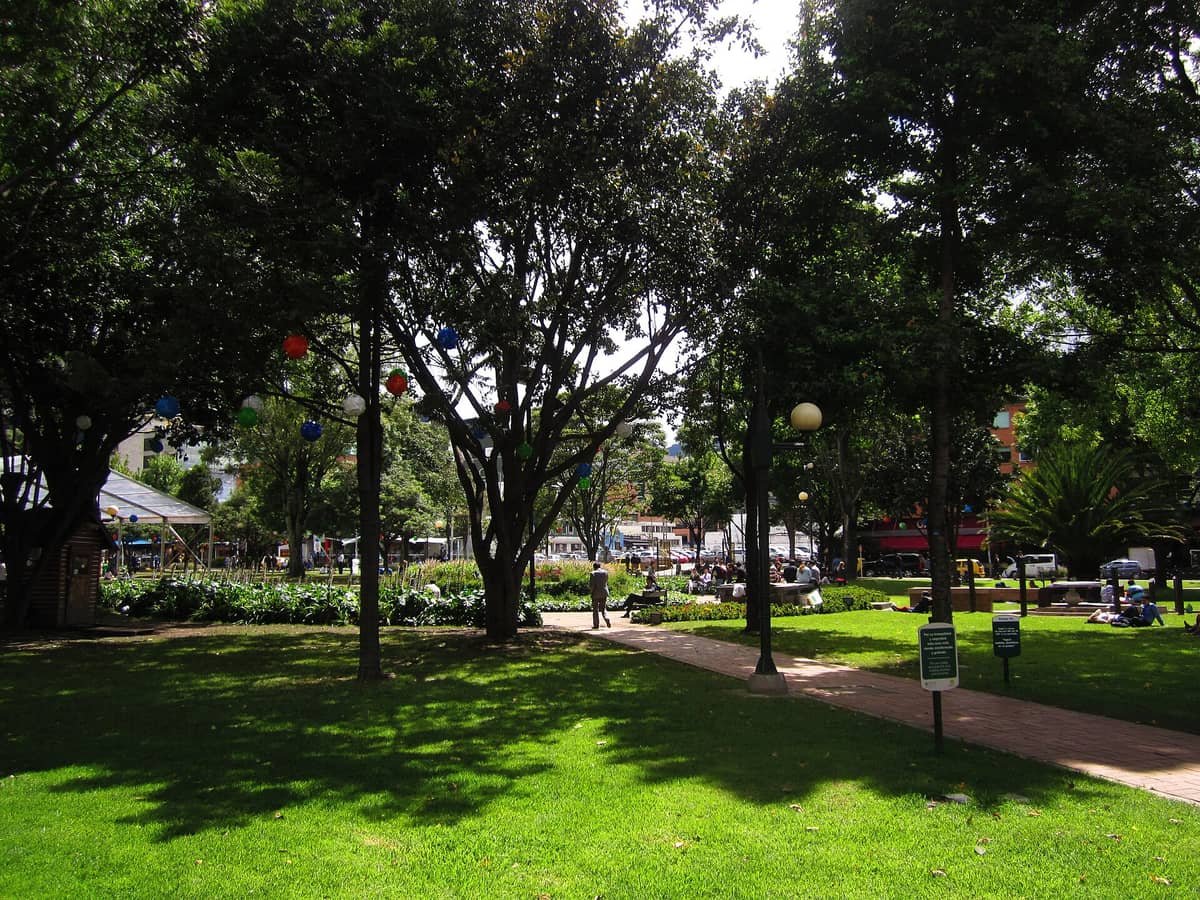
Parque de la 93 is a compact, well-maintained public park at the center of one of Bogotá's most polished commercial neighborhoods. The park itself is modest in size: a rectangle of manicured lawn, mature trees, pedestrian paths, and open plazas framed on all sides by a dense ring of restaurants, bars, cafes, and boutique hotels. What draws people here is not the greenery alone, but the entire ecosystem around it.
The park sits between Carreras 11A and 13 and Calles 93A and 93B, in the El Chicó area of northern Bogotá, a district associated with business travelers, expats, and the city's upper-middle-class dining scene. This is not a place to experience colonial Bogotá or street art culture. It is, instead, a window into how contemporary Bogotá socializes: over long lunches, weekend brunches, and post-work drinks in the open air.
ℹ️ Good to know
Parque de la 93 is an unfenced public park open to the public throughout the year, and admission is free. The surrounding restaurants and bars set their own hours, typically from midday through late evening.
From Vacant Lot to City Landmark: The Park's History
The site was not always this orderly. Before 1995, the land was a neglected, informal dumping ground in what was already an upscale residential corridor. Local residents, dissatisfied with years of deterioration, organized and formed a Comité de Vecinos in the early 1990s; that resident-led initiative eventually became the Asociación Amigos del Parque 93, formally established in October 1994.
After roughly ten months of coordinated works, the rehabilitated park was officially inaugurated on 15 June 1995. Since 2009, day-to-day management and maintenance have been handled by the Asociación Amigos del Parque 93 under a formal agreement with Bogotá's Defensoría del Espacio Público (DADEP), the city body responsible for public space, which helps explain why the park looks notably cleaner and better maintained than many comparable green spaces in the city.
The association also organizes cultural events, outdoor concerts, seasonal markets, and wellness activities in the park throughout the year, which gives the space a programmed feel beyond simple passive recreation. Check the official site at parque93.com before visiting to see what is scheduled during your stay.
Tickets & tours
Hand-picked options from our booking partner. Prices are indicative; availability and final rates are confirmed when you complete your booking.
Candelaria walking tour
From 35 €Instant confirmationFree cancellationCoffee farm guided tour
From 114 €Instant confirmationFree cancellationZipaquira Salt Cathedral guided tour
From 86 €Instant confirmationFree cancellationBogota full-day bike rental
From 19 €Instant confirmationFree cancellation
How the Park Changes Through the Day
Weekday mornings are the quietest window. By around 8 a.m., you will find joggers looping the perimeter paths, dog walkers moving through the shaded central areas, and a scattering of office workers cutting through on their commute. The air at this hour carries the smell of damp grass and fresh bread from nearby bakeries, and the noise is mostly birdsong and distant traffic from Carrera 11.
By midday, the park transforms into a lunch destination. Restaurants surrounding all four sides fill up with business lunches and the kind of extended weekday meals that Bogotá's professional class treats as non-negotiable. Outdoor terraces get claimed early, particularly on dry days, and the paths through the park itself become a corridor between offices and eateries. This is a practical lunchtime scene, not a tourist spectacle.
Weekend afternoons, particularly Saturday, represent the park at its most socially layered. Families claim the central lawn. Young couples sit on benches. A group might be photographing a quinceañera near the fountains. Meanwhile, the bar terraces begin filling from around 2 p.m. onward, and by 5 p.m., the outdoor tables are almost entirely occupied. The energy is relaxed rather than frenetic, with conversations running long and no particular pressure to move on.
After dark, the character shifts again. The park's lighting keeps the paths safe and occupied until well past midnight, and the surrounding restaurants and bars run late, particularly on Friday and Saturday. The crowd skews younger at this hour, and the ambient noise level rises considerably. If you are looking for a quiet evening, arrive before 7 p.m. or seek out the calmer side streets branching off from the park's main perimeter.
💡 Local tip
The best time to visit for a relaxed experience without crowds is a weekday morning between 8 and 11 a.m. For the full social atmosphere, arrive on a Saturday afternoon around 3 p.m. and stay through sunset.
Eating and Drinking Around the Park
The ring of establishments around Parque de la 93 represents a significant slice of Bogotá's upscale restaurant scene. You will find international cuisines alongside Colombian cooking, and the quality standard is generally high relative to the rest of the city. This is the kind of neighborhood where chefs open their flagship locations. For a broader look at the city's food culture, the Bogotá food guide covers neighborhoods and dishes across the full range of budgets.
Prices here run moderate to expensive by Colombian standards. A sit-down lunch at a mid-range spot might cost 35,000–70,000 COP per person before drinks; upscale dinner options can run considerably higher. Coffee shops and casual spots on the park's edge offer more accessible pricing and are useful for an afternoon break between sightseeing.
The food and drink offer changes regularly as restaurants open, close, or reinvent themselves, so any specific recommendation list dates quickly. The practical approach is to walk the park's four sides before committing, look at the menu boards posted outside, and choose based on what looks active. A half-empty terrace in this neighborhood is usually a signal worth heeding.
Getting There and Getting Around
The most direct public transit approach is via TransMilenio. The nearest stations are Virrey and Calle 100 on the Autopista Norte corridor, served by trunk routes such as B18, B26, B27 and others. From either station, the park is a 10 to 15 minute walk through residential and commercial streets. The walk itself is straightforward and well-lit during daylight.
Ride-hailing is the most convenient option for most visitors. Uber, Cabify, and Didi all operate in Bogotá, and drop-off on Carrera 11 or Carrera 15 puts you immediately adjacent to the park's main entrances. If you are already in the northern part of the city, such as in Usaquén, the park is a short 10-minute ride south.
Parking is available in structures on surrounding streets, but weekend afternoons are congested and finding street parking in this corridor is frustrating. Arriving by app-based transport on busy days is genuinely simpler.
💡 Local tip
Bogotá sits at about 2,640 meters above sea level. If you have just arrived in the city, keep your first afternoon calm. Walking around Parque de la 93 is gentle enough, but combining it with alcohol before you have acclimatized will accelerate any altitude effects.
Practical Details: What to Bring, Photography, and Accessibility
Bogotá's highland climate means the park experience varies considerably by weather. On a dry, clear afternoon in July or January, the outdoor terraces and central lawn are genuinely pleasant, with temperatures typically in the high teens to low 20s Celsius. On a rainy afternoon during the March–May or September–November wet seasons, much of the park's outdoor appeal disappears, though covered terraces remain functional. Bring a light rain layer any time of year.
Layering is the practical dress code for this neighborhood. The park's social environment is urban and polished rather than casual, so most visitors dress accordingly, particularly in the evening. For broader guidance on packing and climate expectations, the Bogotá weather and climate guide is worth reading before you pack.
For photography, the park offers the best light in the late afternoon when low sun filters through the tree canopy and catches the outdoor terraces. The central lawn photographs well from the raised walkways on the park's edges. Evening shots of the illuminated restaurant facades are straightforward and do not require special equipment.
Accessibility is good for a Bogotá urban park. The paths are paved and level, the entrances are at street grade, and there are no significant obstacles for wheelchair users or strollers. The surrounding restaurants vary in their interior accessibility, so checking specific venues in advance is worthwhile if this is a priority.
Putting Parque de la 93 Into a Wider Bogotá Itinerary
Parque de la 93 works best as an anchor for a half-day in northern Bogotá rather than a standalone destination. Pair it with a morning visit to the Usaquén flea market (active on Sundays), then move south to the park for lunch. Alternatively, combine it with a late afternoon visit to a nearby gallery or boutique, then stay for dinner and drinks into the evening.
If your Bogotá time is limited, be clear-eyed about priorities. The park is a pleasant place to eat and drink in a well-maintained setting, but it does not offer the historical depth of Museo del Oro or the sweeping city views from Cerro de Monserrate. It earns its place in an itinerary as a social experience and as a base for one of Bogotá's better dining concentrations, not as a sightseeing attraction in the conventional sense.
Travelers building their first Bogotá trip from scratch can find a structured framework in the 3 days in Bogotá itinerary, which places the park in context alongside the city's heavier-hitting cultural attractions.
Who Should Skip This, and Why
If you are in Bogotá on a short trip with limited time and your priorities are history, museums, street art, or natural landscapes, Parque de la 93 should sit low on your list. The park is not a cultural institution or a scenic landmark. It is a dining and social district organized around a green space, and its appeal is heavily tied to spending money in the surrounding establishments.
Budget travelers will also find the neighborhood generally expensive by Bogotá standards. The park itself costs nothing to enter, but sitting at a restaurant terrace with a drink and watching the world go by, which is essentially what you are here for, adds up quickly. There are better value neighborhoods for the same style of people-watching.
Visitors expecting a quiet nature experience, a large green expanse, or a historically rich environment will be disappointed. This is a small urban park in a commercial neighborhood. Know that going in, and it delivers exactly what it promises.
Insider Tips
- The park association (Asociación Amigos del Parque 93) runs regular outdoor events including concerts, markets, and fitness sessions. Check parque93.com before your visit to see what is scheduled, since these events dramatically change the park's atmosphere.
- Weekday lunch between noon and 2 p.m. is when many restaurants offer set-menu deals (ejecutivo menus) at significantly lower prices than à la carte dinner. This is the best value window if you want to eat well here without a large bill.
- On rainy days, the covered interior sections of restaurants facing the park remain full of local professionals. This is actually a good moment to observe the neighborhood's regular crowd rather than the weekend tourist-heavy version.
- If you are using TransMilenio, buy or top up your tullave card before reaching the park area. There are no card purchase points immediately adjacent, and ride-hailing surge pricing on weekend evenings can be significant.
- The park's northwestern corner, closest to Carrera 15, tends to be quieter than the Carrera 11 side, which faces the heaviest vehicle and foot traffic. If you want a bench with some relative calm, start there.
Who Is Parque de la 93 For?
- Travelers who want to experience Bogotá's contemporary dining and social scene rather than its colonial history
- Business travelers looking for a reliable cluster of good restaurants within walking distance of northern Bogotá hotels
- Families with young children who need a flat, safe outdoor space for an afternoon break
- Evening diners and cocktail seekers who want an outdoor terrace atmosphere in a well-lit, active neighborhood
- Weekend visitors combining the park with the Usaquén area for a full northern Bogotá day