Parliament House Helsinki: What to Expect on a Guided Visit
Helsinki's Parliament House, known in Finnish as Eduskuntatalo, is the seat of Finland's 200-member legislature and one of the city's most architecturally striking public buildings. Free guided tours offer rare access to the ceremonial halls and working chambers behind those 14 Corinthian columns. Advance booking is required.
Quick Facts
- Location
- Mannerheimintie 30, Töölö, Helsinki
- Getting There
- Trams 4, 7, 10 and multiple bus lines stop along Mannerheimintie directly outside
- Time Needed
- 45 minutes for a standard guided tour
- Cost
- Free; advance reservation required
- Best for
- Architecture lovers, history buffs, civically curious travelers
What Parliament House Actually Is
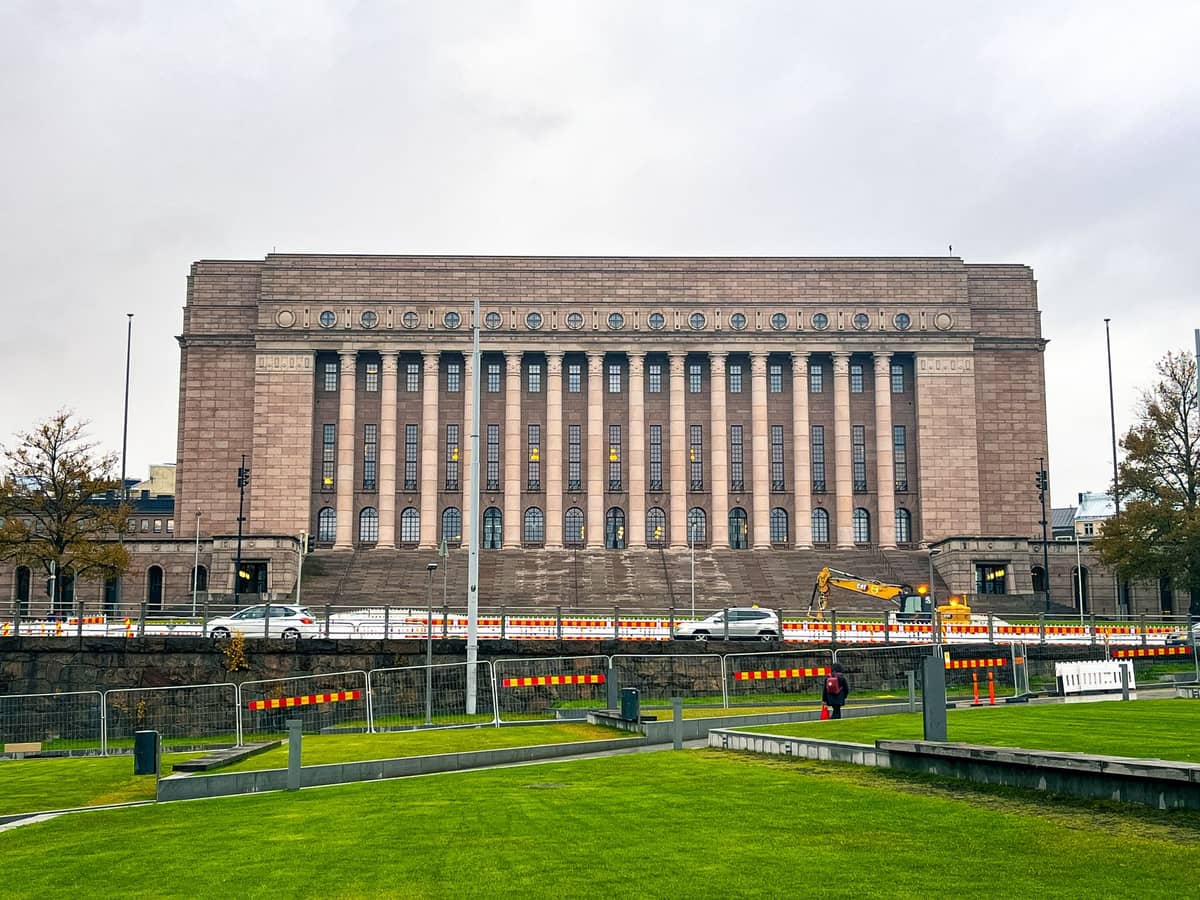
Parliament House, Eduskuntatalo in Finnish and Riksdagshuset in Swedish, is the working seat of Finland's unicameral legislature. It stands on Arkadianmäki hill in the Töölö district, facing the wide boulevard of Mannerheimintie. This is not a decommissioned heritage building repurposed for tourism. Parliament sits here for real, and the tours are built around that fact, which makes the experience considerably more gripping than a typical monument visit.
The building was the result of a 1924 architectural competition won by J. S. Sirén. Construction ran from 1926 to 1931, and the house was inaugurated that same year. Sirén's design occupies an interesting stylistic position: it pairs neoclassical grandeur, most visible in the row of 14 Corinthian columns running across the main façade, with the cleaner interior volumes of early 20th-century modernism. The result reads as authoritative from the street without tipping into heaviness.
ℹ️ Good to know
Guided tours and all public access to Parliament House are free of charge, but advance reservation is required through the official online booking system. Guided tours usually last about 45 minutes, and tour availability shifts significantly during parliamentary sessions versus recess periods, so check current schedules on the official site before planning your visit.
The Façade: What You See Before You Go In
The exterior makes its impression from a distance. Walking north along Mannerheimintie from the city centre, the colonnade appears gradually above the tree line before the full building comes into view. Up close, the columns are imposing rather than decorative, built from Finnish granite in a shade that shifts from pale grey to warm ochre depending on the light. On sunny mornings the façade catches the low northern sun directly, which makes it worth approaching from the south side of the street for the best visual effect.
The broad stone staircase leading up to the main entrance is a common resting point for locals, particularly on warm days. The steps face west, catching afternoon light, and are positioned near the intersection of several major transit routes, making this a natural pause point on any walk through central Helsinki. The surrounding area connects the political and cultural cores of the city: Finlandia Hall sits a short walk north along the bay, and Kiasma is visible to the south.
The neighborhood gives useful context. Töölö is primarily a residential district of early 20th-century apartment blocks, and Parliament House anchors its southern edge. Visitors combining this stop with the nearby Töölönlahti Bay walking loop or a visit to Finlandia Hall will find the area rewards a half-day rather than a quick look.
Tickets & tours
Hand-picked options from our booking partner. Prices are indicative; availability and final rates are confirmed when you complete your booking.
Helsinki Beautiful Canal Route, archipelago cruise
From 26 €Instant confirmationFree cancellationHelsinki Panorama Sightseeing Bus Tour With Audio Guide
From 35 €Instant confirmationFree cancellationHelsinki Pasila Street art district tour with a local
From 99 €Instant confirmationFree cancellationSurvival suit floating experience
From 125 €Instant confirmationFree cancellation
Getting In: The Visitor Entrance and Security
The public entrance is not through the main ceremonial doors at the top of the staircase. Visitors use the B-door at the north end of the building on the Mannerheimintie side, to the right of the main stairs when facing the building. It is clearly signposted but easy to miss on a first visit if you walk straight up the central steps.
Security screening at the entrance is standard for an active government building: bags through an X-ray machine, personal items checked. Photography is prohibited at the entrance and security checkpoint area specifically. Once you clear security and meet your guide, you are free to photograph inside the building, with the standard courtesy of not photographing individuals without their permission.
💡 Local tip
Arrive five to ten minutes before your booked tour time. Security processing can take a few minutes, and tours start on schedule. Late arrivals may not be admitted to an in-progress group.
Inside the Building: What the Tour Covers
The guided tour moves through spaces that range from the solemn to the surprisingly functional. The plenary hall, where the 200 members of parliament sit and debate, is the centerpiece of any visit. The hall is designed with careful attention to acoustics and sightlines, and seeing it in person reveals proportions that photographs rarely capture accurately. The seating arrangement and the ceremonial speaker's position communicate something specific about how Finnish parliamentary democracy was conceived to operate.
Beyond the chamber, tours typically include corridors lined with portraits of former speakers, committee rooms, and public areas decorated with Finnish art collected over decades. The building functions as an informal national gallery as much as a political institution. The stone floors, heavy wooden paneling, and the particular quality of light through tall windows give the interior a gravity that is consistent throughout.
Guides are knowledgeable and accustomed to mixed audiences, including school groups and international visitors. Tours are offered in Finnish, Swedish, and English, though English-language tour schedules may be less frequent. The official site has current language options and availability.
⚠️ What to skip
Tour availability differs significantly when parliament is in session versus during recess. During active session periods, some areas may be restricted or entire tour dates unavailable. Check the official booking calendar well in advance, particularly if visiting between January and May or September and November.
Practical Details: Getting There, Timing, and Accessibility
Parliament House sits directly on Mannerheimintie, Helsinki's main north-south artery, which is served by multiple tram and bus lines. Trams 4, 7, and 10 stop close to the building, and the walk from Helsinki Central Railway Station takes roughly 15 minutes on foot along Mannerheimintie, passing through the city's civic and cultural corridor; allow around 45 minutes for the guided tour itself.
If you are combining Parliament House with other central Helsinki landmarks, the area along Mannerheimintie makes a coherent walking route. The Kiasma Museum of Contemporary Art is a few minutes south, and Helsinki Central Railway Station is a natural starting or ending point for the walk. The Helsinki walking tour covers this corridor in detail.
On accessibility: the standard tour route involves multiple staircases, which means it is not fully step-free by default. However, an accessible route using lifts can be arranged when booking. Visitors with mobility needs are encouraged to note this requirement at the time of reservation and to contact the guide service in advance if they require specific assistance. Given that staff resources for individual physical assistance are limited, visitors who need significant physical support are advised to bring a companion.
Honest Assessment: Who This Is For and Who Might Pass
Parliament House is genuinely interesting if you care about architecture, political history, or how democratic institutions are physically designed. The building repays careful attention, and the free guided tour is one of the better-value experiences in central Helsinki, particularly given that it offers access to spaces that function daily as the engine of Finnish governance.
It is not the right stop for visitors primarily chasing sensory variety or who find civic institutions uninteresting on principle. Children old enough to engage with explanations of how parliament works will likely find the plenary hall impressive; younger children may find the pace and content difficult to sustain for the full tour length. The building also has no permanent café or visitor retail space accessible to tour groups, so plan surrounding logistics accordingly.
Travelers focused on contemporary Finnish art or design are better served by nearby alternatives like Kiasma or the Design Museum Helsinki. Parliament House is a specific experience rather than a broad one.
Insider Tips
- Book your tour slot as soon as you have confirmed travel dates. English-language tours in particular can fill up days in advance, and the booking system closes slots quickly around popular periods.
- The staircase façade facing Mannerheimintie is best photographed in the morning when the low Finnish sun hits the granite columns from the east. By midday the light flattens considerably.
- If you arrive early and have time before your tour, walk around the north side of the building to see the scale of the structure from ground level rather than from the street across the boulevard.
- During parliamentary recess in summer, tour availability often increases and waiting times at security tend to be shorter. If flexibility exists in your schedule, July is typically one of the quieter periods for visitor traffic.
- The visitor entrance B-door sits to the right of the main staircase at street level. First-time visitors consistently walk up the grand steps and then have to retrace their steps. Save yourself the detour and head for the north end of the building from the start.
Who Is Parliament House For?
- Architecture enthusiasts drawn to early 20th-century Nordic neoclassicism
- Travelers interested in Scandinavian political systems and democratic institutions
- First-time Helsinki visitors wanting to understand the civic geography of the city centre
- History-focused travelers tracing Finland's path to independence and institution-building in the 1920s and 1930s
- Budget-conscious travelers looking for high-quality, free indoor experiences
Nearby Attractions
Other things to see while in Töölö:
- Finlandia Hall
Finlandia Hall is Helsinki's most architecturally significant congress and concert venue, designed by Alvar Aalto and completed on the western shore of Töölönlahti Bay. Whether you come for the permanent Aalto exhibition, a concert evening, or simply to study the building's striking white marble facade up close, the hall sits at the intersection of Finnish cultural identity and modernist design.
- Finnish National Opera and Ballet
The Finnish National Opera and Ballet, known locally as Kansallisooppera ja -baletti, is Finland's foremost performing arts institution, occupying a purpose-built house on the edge of Töölönlahti Bay. Whether you are new to opera or a longtime ballet devotee, the venue delivers a polished, accessible experience at the heart of Helsinki's cultural calendar.
- Helsinki Central Library Oodi
Opened on 5 December 2018, Helsinki Central Library Oodi is a landmark public building at Kansalaistori Square, steps from the Central Railway Station. It combines a working library with makerspaces, a cinema, a rooftop terrace, and a cafe, all free to enter. The architecture alone justifies a visit, but the building earns its reputation by being genuinely useful.
- Helsinki Olympic Stadium
Built for the 1952 Summer Olympics, the Helsinki Olympic Stadium in Töölö is Finland's most storied sports venue. Visitors can climb its landmark tower for sweeping city views, tour the TAHTO Sports Museum, and walk the same track that once hosted the world's greatest athletes.