Oslofjord Islands: A Guide to Hovedøya, Gressholmen, and Lindøya
Three islands sit a short ferry ride from Oslo's city hall pier, each with a distinct character. Hovedøya holds 1147 monastery ruins and cannon batteries. Gressholmen is a quiet nature reserve on the site of Norway's first airport. Lindøya is a summer colony of painted wooden cabins where Norwegians have retreated for generations.
Quick Facts
- Location
- Inner Oslofjord, Oslo, Norway — ferries from Rådhusbrygge 4 (City Hall Pier 4), Aker Brygge
- Getting There
- Ferry line B1 from Rådhusbrygge 4; covered by standard Ruter tickets and Oslo Pass. Tram lines 12 and 13 stop near Aker Brygge.
- Time Needed
- 2–3 hours for one island; full day for island-hopping all three
- Cost
- No island admission fee. A standard Ruter single or day ticket covers the ferry. Day ticket price varies — verify before visiting. Oslo Pass holders travel free.
- Best for
- Summer picnics, swimming, history walks, photography, families, and anyone wanting to escape the city without leaving Oslo
- Official website
- ruter.no/en/planlegg-reise/rutetabeller-og-linjekart/ferry
Why These Islands Belong on Your Oslo Itinerary
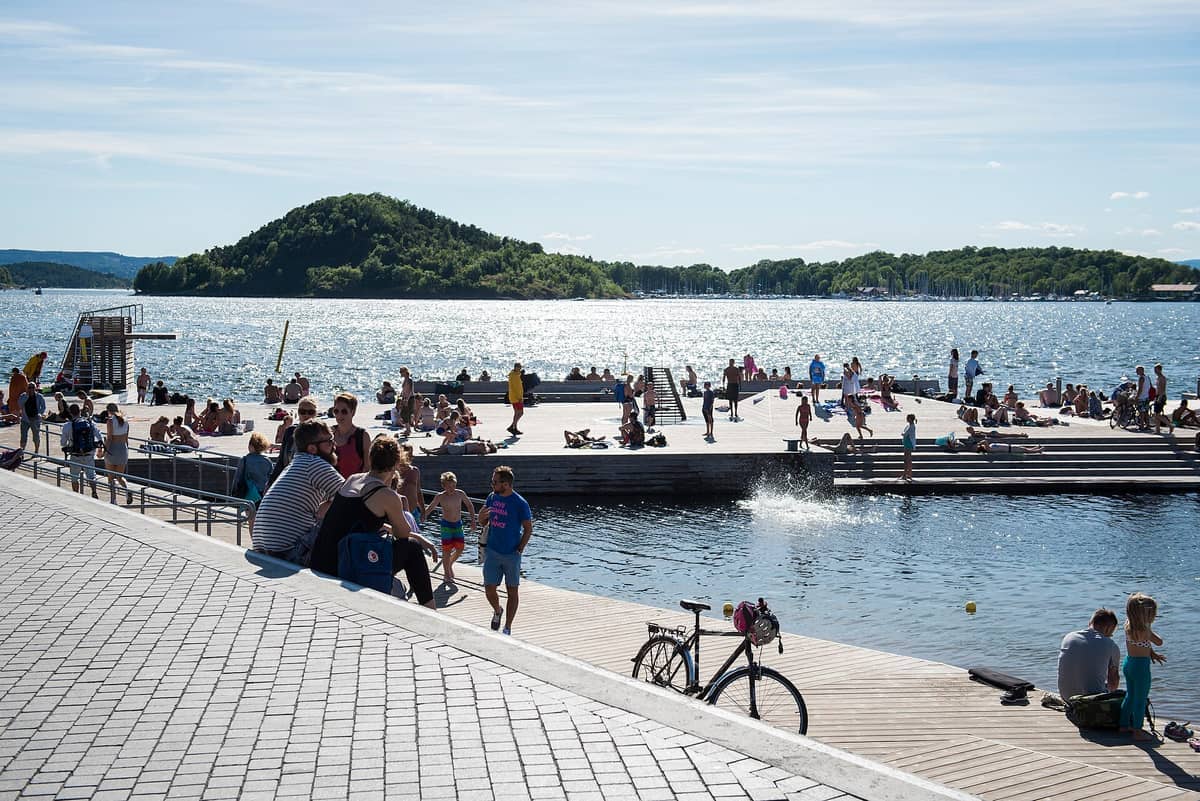
The Oslofjord islands — Hovedøya, Gressholmen, and Lindøya — are among the most underused assets in central Oslo. From the city hall pier at Aker Brygge, the crossing to Hovedøya takes about seven minutes. That short ride shifts the atmosphere completely: the sound of traffic disappears, replaced by seagulls and the low wash of the ferry wake. The air smells of salt water and sun-warmed grass rather than diesel. For a city of over 700,000 people, the stillness on these islands in the middle of the working week can feel almost implausible.Each island rewards a different kind of visit. Hovedøya is the richest historically, with Cistercian ruins dating to 1147 and cannon fortifications from 1808 still standing among birch trees. Gressholmen is the quietest, a protected nature reserve built on the unlikely legacy of Norway's first airport. Lindøya is the most alive in summer, its shoreline ringed with colorful wooden summer cabins occupied by Oslo families who hold generations-long plots. Together they form a single afternoon or a full day depending on your pace.What makes this genuinely good value is that the ferry is not a tourist boat — it is public transport. You board with the same Ruter ticket you used on the tram. If you hold an Oslo Pass, the ferry is included at no extra cost.
💡 Local tip
Ferry line B1 runs a circular route from Rådhusbrygge 4, stopping at Hovedøya first, then continuing to Lindøya and Gressholmen. Check the Ruter app for the current timetable before you go, especially outside peak summer months when departures thin out to roughly 7–8 per day.
Hovedøya: Monastery Ruins and Cannon Batteries
Covering approximately 0.47 square kilometres, Hovedøya is the closest island to the mainland and the most visited of the three. The ferry docks at a small wooden pier on the north shore, and soon after stepping off, the stone walls of a Cistercian monastery founded in 1147 appear through the trees. The monks of the Lyse Abbey order arrived here from Kirkstead in England, and the ruins that remain — arched window frames, low stone courses, a partly preserved cloister walk — retain a quiet gravity even when surrounded by picnicking families. The contrast between crumbling medieval stonework and children building sandcastles on the beach thirty metres away is distinctly Oslo.
The island's military history layers on top of the monastic one. In 1808, Norwegian forces built a battery of cannons facing the fjord approach, and a powder magazine from that period also remains near the southern shore. During World War II, German forces used the island and left behind barracks buildings that have since been preserved as part of the historical record rather than demolished. Walking the main trail that loops around the island's perimeter takes roughly 45 minutes at a relaxed pace, and the route passes each of these sites.
The island's south-facing beach is one of the better swimming spots in the inner fjord, sheltered from the open water and catching afternoon sun from around 1 p.m. onward. The seabed is rocky rather than sandy, so water shoes are worth bringing. On a warm Saturday in July, the beach and grassy lawns above it will be genuinely crowded — towels staked out, the smell of sunscreen and charcoal from portable grills. On a weekday morning in June or August, the same space can feel private. The island has a small café near the pier that operates in summer months; verify current opening before relying on it for lunch.
Tickets & tours
Live prices and dates from our booking partner. If you book, we may earn a commission at no extra cost to you.
Island hopping in Oslofjord
From 49 €Instant confirmationFree cancellationPrivate best view hike in Oslofjord
From 73 €Instant confirmationFree cancellationThree islands in three hours guided tour in Oslo
From 39 €Instant confirmationFree cancellationThe five pearls of the Oslofjord full-day guided tour
From 78 €Instant confirmationFree cancellation
Gressholmen: Norway's First Airport, Now a Nature Reserve
Gressholmen sits further from the city than Hovedøya and includes the connected islets of Rambergøya and Heggholmen. What most visitors don't know when they arrive is that they are standing on the site of Norway's first commercial airport, which opened in 1927 and served as the country's primary air hub until 1939 when Fornebu took over. The planes were seaplanes and floatplanes using the fjord surface as their runway. Nothing visible remains of the airport infrastructure, which is precisely what makes Gressholmen unusual: an island absorbed by nature so completely that its aviation history reads as myth.
Today, most of Gressholmen is a designated nature reserve. The vegetation is denser and wilder than on Hovedøya — nettles, elder bushes, tall grasses in the interior, and smooth granite slabs along the southern waterline where cormorants dry their wings in the morning. The trail network is minimal, and paths can become muddy after rain. This is not the island for a Sunday stroll in clean trainers. It rewards visitors who want to sit on a rock above the water with no particular agenda.
ℹ️ Good to know
Because Gressholmen is a protected nature reserve, camping and open fires are prohibited. Dogs must be kept on a lead. These rules are enforced seriously in Norwegian outdoor culture — visitors are expected to follow them without prompting.
Lindøya: The Summer Cabin Island
Lindøya operates on its own social logic. The island is covered in small, brightly painted wooden summer cabins — red, yellow, white, blue — that have been passed down through Oslo families for generations. The plots are leased from the municipality, and the community has a deeply rooted, members-only quality to it. Visitors are welcome on the paths and shoreline, but this is not a place that has been designed for tourism. You will walk past people hanging laundry, tending vegetable patches, and playing cards on small verandas, and they will barely register your presence. That normalcy is, oddly, the island's most appealing quality.
The crossing from the city to Lindøya takes around 20 minutes. There is no café, no visitor center, no entrance fee, and no interpretive signage. The island is at its best in the late afternoon when the light comes from the west and the cabins glow in it. If you visit in late June or early July, the cabins are fully occupied and the social hum of the place — children cycling the narrow paths, neighbours talking across fences — gives the island a village-scale life that feels genuinely apart from the capital city visible across the water.
Getting There and How to Plan Your Day
All three islands are served by Ruter ferry line B1, which departs from Rådhusbrygge 4 at Aker Brygge in central Oslo. The pier is a short walk from the Oslo City Hall and the Nobel Peace Center. Tram lines 12 and 13 stop near Aker Brygge. The route runs circular: Rådhusbrygge → Hovedøya → Lindøya øst → Gressholmen → Bleikøya → Nakholmen → Lindøya vest → Hovedøya → back to city. You can hop on and off at each island using the same ticket. Crossings take approximately 7 minutes to Hovedøya and around 18 minutes to Gressholmen.
A practical loop for a full day: take the first ferry of the morning to Gressholmen while it is still quiet, walk the reserve, then catch the next boat to Lindøya for a look at the cabin community, and finish on Hovedøya in the afternoon when the monastery ruins are warm and the beach is at its best. The last ferries return well into the evening in summer — check the Ruter app for the final departure time from each island so you don't get stranded. For anyone planning a broader day on the water, the Oslo island-hopping guide covers routes that also include the outer islands of Nakholmen, Bleikøya, and Langøyene.
Ferry tickets use the standard Ruter zone system. A single-journey ticket covers the crossing; a day ticket gives unlimited travel within the relevant Ruter zones, including the islands. The Oslo Pass includes ferry travel at no additional cost. More detail on whether the Oslo Pass makes financial sense for your trip is covered in the Oslo Pass guide.
Weather, Seasons, and When to Visit
The islands are technically accessible year-round — the ferry runs in all seasons — but the experience outside summer is marginal. From June through August, long daylight hours and average highs of 21–23°C in July make the islands genuinely pleasant. The water temperature in the inner fjord rises enough for comfortable swimming by mid-July. May and early September offer quieter visits with pleasant temperatures but shorter days and fewer facilities open. Winter visits are possible but spartan: paths are often wet, cafés are closed, and the ferry timetable shrinks significantly. For the best overall experience, plan between late May and mid-August. The Oslo in summer guide covers the broader seasonal picture for planning.
Rain is possible at any time. Oslo receives precipitation fairly evenly across the year, with October being the wettest month. On an overcast day, the islands lose much of their appeal — the grey fjord light is flat, and without sun the swimming is unappealing and the picnic areas empty. If the forecast shows a sunny window, move the island day forward in your itinerary. It's not the kind of visit that improves if you push through bad weather.
⚠️ What to skip
Weekends in July, particularly sunny Saturdays, see very high ferry demand. Queues at Rådhusbrygge 4 can be long and ferries full. Arrive early or visit on a weekday to avoid the worst of it. The islands feel genuinely different when they are not at capacity.
What to Bring and Practical Notes
- Water and food: bring your own, especially for Gressholmen and Lindøya where there are no food services. Hovedøya has a seasonal café but don't rely on it being open.
- Water shoes: the shorelines are rocky, not sandy. Swimming without them is uncomfortable.
- A light windproof layer: the fjord generates its own breeze even on warm days. It can feel 5–6 degrees cooler on the water than in the city.
- Sun protection: the granite rocks and open water reflect UV strongly. The exposed southern shores of all three islands offer little natural shade in the middle of the day.
- Ruter app: download it before you go. It shows live ferry departure times and will tell you when the last boat leaves each island. Missing the last ferry is a real possibility if you lose track of time.
- Camera: the view back toward the Oslo skyline, with the Opera House and the Barcode towers behind the Opera House visible across the water, is one of the cleanest city-over-fjord compositions available. Best light is late afternoon.
The islands are outdoor recreation areas with uneven terrain: unpaved paths, grassy slopes, and rocky shores. They are not fully accessible for wheelchair users or those with limited mobility. Ruter ferries meet standard public transport accessibility requirements; check directly with Ruter for vessel-specific step-free access details. For other accessible outdoor options in Oslo, the Vigeland Sculpture Park in Frogner offers paved paths throughout.
Who Should Skip the Islands
If you have only one full day in Oslo and have not yet seen the major cultural sites, the islands should wait. A half-day round trip to all three — accounting for ferry waits — uses time that might be better spent at the National Museum, the Munch Museum, or the Bygdøy peninsula museums. The islands are a reward for visitors who have already covered the essentials or who are making a second trip.
Visitors hoping for a beach holiday comparable to the Mediterranean will also be disappointed. The water is cold by most standards until late July, the beaches are rocky, and amenities are minimal. This is distinctly Norwegian outdoor culture: self-sufficient, unhurried, close to nature but not curated for comfort. If that framing appeals, the islands are excellent. If it doesn't, Lindøya and Gressholmen in particular will feel like a long ferry ride to sit in a field.
Insider Tips
- The morning ferry to Gressholmen is rarely crowded even on summer weekends. If you want the nature reserve to yourself, take the first or second departure of the day — most visitors head to Hovedøya first and reach Gressholmen only by midday.
- On Hovedøya, walk past the monastery ruins and continue to the southern tip. There is a small rocky promontory with a view back toward the city that most day visitors never find because the main trail loops back before it. Allow an extra 15 minutes.
- The circular ferry route means you can ride the entire loop without getting off — a cheap 40-minute fjord tour that costs nothing beyond your standard Ruter ticket. Useful if the weather turns or you want to scout the islands before deciding where to stop.
- Lindøya is at its most photogenic around 5–7 p.m. in summer when the western light catches the cabin facades. Take the late afternoon ferry out and the evening one back for the best light and the thinnest crowds.
- If you are visiting Oslo in mid-May around Constitution Day, or late June around Midsummer, the islands have a festive, community atmosphere that is quite different from the rest of the summer. Locals bring serious picnic setups — expect full grills, wine, and long tables. It is worth joining the energy even as an outsider.
Who Is Oslofjord Islands (Hovedøya, Gressholmen, Lindøya) For?
- Travelers on a second or third visit to Oslo who want something beyond the main museums
- Families with children who need outdoor space and the novelty of a short boat trip
- Swimmers and sunbathers looking for a fjord beach within twenty minutes of the city center
- History enthusiasts interested in medieval monasteries and Norwegian military fortifications
- Photographers wanting the Oslo skyline from the water
Nearby Attractions
Combine your visit with:
- Drøbak
Drøbak is a compact coastal town on the eastern shore of the Oslofjord, about an hour south of Oslo by bus. Known for its well-preserved wooden architecture, Sunday shopping tradition, and proximity to the historic Oscarsborg Fortress, it offers a genuine change of pace from the capital without requiring an overnight stay.
- Ekeberg Viewpoint
Perched on Ekebergåsen hill southeast of central Oslo, Ekebergparken combines one of the city's most sweeping viewpoints with an open-air sculpture park, ancient rock carvings, and forested walking trails. It is free to enter, open around the clock, and far less crowded than most Oslo attractions.
- Ekebergparken Sculpture Park
Ekebergparken Sculpture Park sits on a wooded hillside southeast of Oslo's city center, combining a rotating collection of contemporary sculpture with sweeping views over the Oslofjord. Entry is free, the park is open around the clock, and the experience shifts dramatically depending on what time of day and season you visit.
- Emanuel Vigeland Mausoleum
Tucked into a quiet residential street in the Slemdal neighborhood, the Emanuel Vigeland Mausoleum is one of Oslo's most singular and least-visited art experiences. A barrel-vaulted chamber covered floor-to-ceiling in frescoes depicting the human life cycle, with acoustics so extreme that a whisper lingers for twenty seconds. Open Sundays only, with timed entry slots and advance booking recommended.
Planning a trip? Discover personalized activities with the Nomado app.