Noto Cathedral (Cattedrale di San Nicolò): The Crown of Sicilian Baroque
Standing at the top of a broad ceremonial staircase above Piazza Municipio, Noto Cathedral is the architectural centerpiece of one of Sicily's most beautifully preserved baroque towns. Built after the catastrophic 1693 earthquake, restored after a dramatic dome collapse in 1996, it is a UNESCO World Heritage landmark and a functioning place of worship that rewards both the devout and the architecturally curious.
Quick Facts
- Location
- Piazza Municipio, 96017 Noto (SR), Sicily, Italy
- Getting There
- Noto is served by regional trains and buses from Syracuse (approx. 30–40 min). From Noto station, the cathedral is a 15–20 min walk, partly along Corso Vittorio Emanuele.
- Time Needed
- 30–60 minutes for the cathedral; allow 2–3 hours to explore the full Corso Vittorio Emanuele and Piazza Municipio area
- Cost
- Entry to the main cathedral is generally free; verify any charges for specific areas or guided visits on site
- Best for
- Architecture lovers, baroque art enthusiasts, photography, cultural history
- Official website
- www.italia.it/en/sicily/siracusa/noto-cathedral
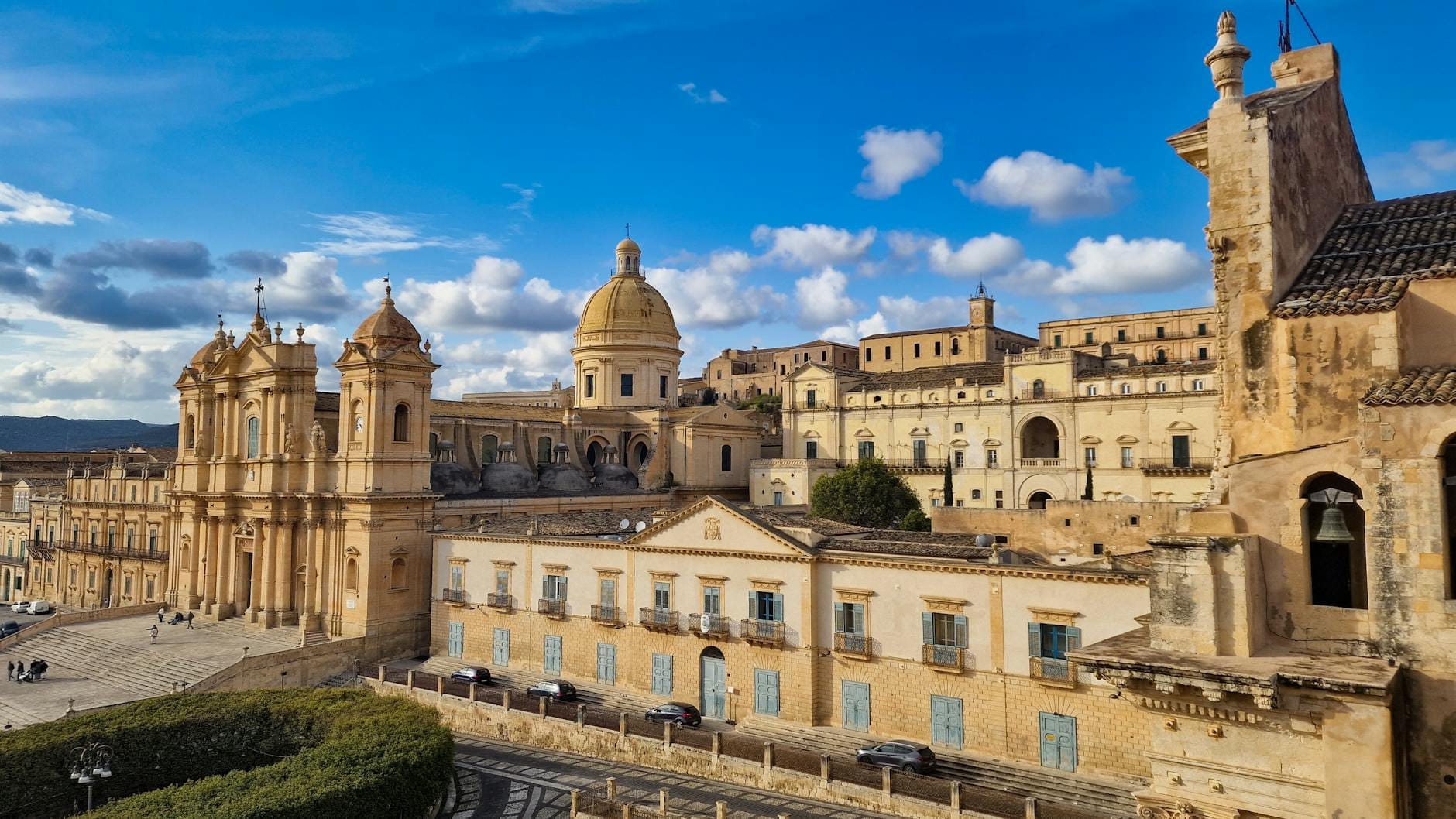
First Impressions: The Staircase, the Facade, the Square
The Cattedrale di San Nicolò, commonly known as Noto Cathedral, does not reveal itself gradually. Walk east along Corso Vittorio Emanuele, Noto's main ceremonial axis, and the cathedral's three-tiered facade appears framed at the end of a perfectly proportioned urban corridor. The warm golden-honey color of the local limestone, called pietra di Noto, catches morning light in a way that genuinely justifies the photographs you have already seen.
What stops most visitors is the staircase. A wide, symmetrical double-ramp of stone steps rises from Piazza Municipio to the cathedral's entrance platform, flanked by balustrades and framed by the Palazzo Ducezio (the town hall) across the square. In the morning, this square is quiet enough to hear pigeons on the cornices. By midday, tour groups photograph from the bottom of the steps while locals cut through the piazza on their way to the market.
💡 Local tip
Arrive before 9:30 AM or after 5:00 PM for the best light and the fewest people on the staircase. The limestone facade turns a deeper amber in late-afternoon sun, which makes for stronger photographs than the flat midday glare.
A practical note before climbing: the staircase is the only main approach, and it involves a significant number of steps. Visitors with reduced mobility should be aware that no step-free alternative is listed on official tourism pages. Confirm current accessibility arrangements directly with the cathedral or local tourist office before your visit.
Historical Context: Built from Disaster, Rebuilt from Disaster
Noto Cathedral exists because an earthquake destroyed its predecessor. On 11 January 1693, one of the most powerful seismic events in European recorded history — estimated at magnitude 7.4–7.7 — leveled much of southeastern Sicily in a matter of minutes. The old town of Noto, called Noto Antica, was abandoned entirely. In its place, Sicilian baroque architects and craftsmen built a new city on a different site, laid out on a rational grid with wide streets designed partly to allow debris to fall clear of pedestrians during future tremors.
Construction of the new cathedral began in the early 18th century, with the main structure largely completed in the first decades of the century, though further work continued and most sources date final completion to 1776. The building is dedicated to Saint Nicholas of Myra, the city's patron saint. Along with the churches and palaces that line the Corso, it became part of what is now inscribed as a UNESCO World Heritage Site: the Late Baroque Towns of the Val di Noto. The inscription recognizes eight towns rebuilt after 1693 as an outstanding ensemble of late baroque town planning and architecture.
History repeated itself, in a smaller but startling way, on 13 March 1996. The cathedral's dome collapsed without warning due to a structural defect — an event that shocked Italy and drew international attention to the fragility of baroque heritage buildings. The collapse took down part of the nave roof and caused significant interior damage. A major restoration project followed, and the rebuilt dome, completed with the cathedral’s reopening in 2007, is structurally reinforced but visually faithful to the original design. The cathedral you visit today is, in a real sense, both a 300-year-old monument and a modern feat of conservation engineering.
Tickets & tours
Hand-picked options from our booking partner. Prices are indicative; availability and final rates are confirmed when you complete your booking.
Monreale day trip from Palermo
From 20 €Instant confirmationFree cancellationPalermo Cathedral rooftop ticket with audio guide
From 15 €Instant confirmationFree cancellationSyracuse, Ortygia and Noto tour from Catania
From 109 €Instant confirmationFree cancellationTour of Ragusa, Modica and Noto from Syracuse with private driver
From 770 €Instant confirmationFree cancellation
Inside the Cathedral: What You Actually See
Step through the main doors and the interior temperature drops noticeably — the thick limestone walls keep the space cool even in July. The nave is tall and airy, with a basilica plan and nave columns topped by Corinthian capitals. The rebuilt dome overhead is the most conspicuous element: perfectly intact, decorated in pale tones, and lit by drum windows that cast clean shafts of light across the floor at certain times of day.
The side chapels contain locally venerated images and relics of Saint Corrado of Noto, an important local saint whose remains are kept here. The overall tone of the interior is devotional rather than theatrical — this is not a church that overwhelms with gilded excess. The craftsmanship is concentrated in the stonework, the column proportions, and the spatial sequence from the entrance to the apse.
Because the cathedral is a functioning parish church, Mass schedules mean the interior is sometimes partially closed to visitors. If you arrive during a service, be respectful: stay at the back, keep cameras lowered, and wait until the service ends before exploring further. The atmosphere during a weekday morning Mass, with a small local congregation and natural light falling through the dome, is genuinely moving even for secular visitors.
⚠️ What to skip
Dress code is strictly enforced. Shoulders and knees must be covered. Scarves and cover-ups are commonly available for purchase from vendors near the piazza if you arrive underprepared.
The Cathedral in Context: Noto's Baroque Streetscape
The cathedral cannot be fully understood in isolation. It is the anchor of an urban composition that extends along the entire length of Corso Vittorio Emanuele, a pedestrianized street lined with palace facades, church steps, and ornamental balconies dripping with carved stone figures: monsters, cherubs, and horse heads projecting from wrought-iron railings. The most famous of these is Via Nicolaci, a side street whose balconies rank among the most photographed in all of Sicily.
The piazza in front of the cathedral functions as Noto's social nucleus. On weekend evenings, particularly between May and October, the steps and square fill with locals out for the passeggiata — the evening stroll that remains a genuine cultural ritual in Sicilian towns. Children run circuits around the fountain. Older residents occupy benches near the palace. The cathedral facade is lit from below after dark, and the effect is considerably more dramatic than the daytime view.
If you want to understand the broader significance of what you are seeing, our guide to baroque Sicily covers the architectural movement, the key towns, and how Noto fits into the wider UNESCO ensemble that also includes Ragusa, Modica, Scicli, and Caltagirone.
Photography: Angles, Light, and What Most People Miss
The standard postcard shot is taken from the bottom of the staircase, centered on the facade. It is standard for a reason — the proportions are genuinely excellent. But two alternatives are worth knowing. First, walk to the far left or right corner of the piazza and shoot at a diagonal: you get the curve of the Palazzo Ducezio steps on one side and the cathedral on the other, with the depth of the piazza pulling the eye through the frame. Second, climb past the cathedral entrance and turn back: you will look down the Corso from above the rooftops, a perspective that conveys the town's planned geometry in a way no street-level shot can match.
Inside, the dome is the primary photographic subject. A wide-angle lens or the widest setting on a phone works best. Tripods are generally not permitted inside functioning churches without prior permission. The natural light through the drum windows peaks around 10–11 AM depending on the season.
Getting There and Getting Around Noto
Noto is most commonly visited as a day trip from Syracuse (Siracusa), which is approximately 30–40 minutes away by regional train or bus. The train station in Noto is about a 15-minute walk from the cathedral along a gently rising street. There is no particularly confusing navigation involved: follow signs toward the centro storico and the Corso will lead you directly to the piazza.
Visitors with a car should note that the historic center is a ZTL (limited traffic zone). Parking is available on the perimeter streets. If you are combining Noto with other southeastern destinations, see our baroque Sicily itinerary for routing suggestions that include Ragusa and Modica without excessive backtracking.
The town itself is compact enough to walk entirely in two to three hours, and the cathedral is centrally located. There is no meaningful public transit within Noto — it is a walking town. Comfortable shoes matter, particularly because the Corso and surrounding streets are paved with uneven stone.
ℹ️ Good to know
Noto's opening hours for the cathedral are often described in tourism materials as running through the day from Monday through Sunday, but hours can vary around Mass times, lunchtime closures, and special events. Verify current times on site or through the Visit Val di Noto portal before planning a timed visit.
Honest Assessment: Is It Worth Your Time?
Noto Cathedral is not a cathedral in the league of Monreale or Palermo for interior richness. If you are expecting the mosaic splendor of the Arab-Norman tradition, you will find the interior relatively restrained. What it offers instead is architectural coherence: a building that makes complete sense in its urban setting, a facade that represents the Sicilian baroque at a high level of craft, and a dome whose backstory adds genuine historical texture to the visit.
The cathedral is worth visiting even if baroque architecture is not your primary interest, because you cannot meaningfully visit Noto without passing through Piazza Municipio, and the building defines the piazza. Travelers who skip the interior and simply experience the exterior and the staircase still get significant value. Those who want deeper immersion in Sicilian church architecture should also visit the Cathedral of San Giorgio in Ragusa Ibla, which offers a comparable baroque statement in a more dramatically perched setting.
Visitors who find baroque aesthetics repetitive, or who are primarily interested in classical archaeology, ancient Greek ruins, or natural landscapes, may find that Noto as a whole delivers more through its street atmosphere and pastry shops than through the cathedral specifically. That is not a criticism of the building — it is an honest calibration of expectations.
Insider Tips
- The pietra di Noto limestone is unusually photogenic in overcast light, not just direct sun. If the sky is diffuse, the facade reads with exceptional detail and without harsh shadows — better for architecture photography than a clear blue-sky day.
- The best gelato and granite in town is not on the Corso itself but on the side streets just off the piazza. Prices drop and quality stays high once you move one block away from the main tourist flow.
- Noto holds an annual Infiorata festival on the third weekend of May, during which Via Nicolaci is carpeted with elaborate floral designs. The cathedral steps are part of the ceremonial route. If your travel dates overlap, this is worth adjusting plans for — but book accommodation months in advance.
- The small church of San Carlo al Corso, visible from the cathedral staircase, has a belltower you can climb for a rooftop view of the Corso and piazza. It is less visited than the cathedral and offers a more intimate baroque interior.
- If you are visiting in summer, go to Noto in the early morning and leave by noon. The Corso becomes genuinely congested with tour groups between 10 AM and 1 PM, and the heat on the exposed limestone piazza is intense. Late afternoon, after 4 PM, the town recovers its quieter character.
Who Is Noto Cathedral For?
- Architecture and design enthusiasts seeking the definitive Sicilian baroque facade
- Photography travelers working the golden-hour circuit through southeastern Sicily
- Cultural history visitors interested in post-earthquake urban reconstruction and conservation
- Travelers combining Noto with Syracuse or Ragusa on a baroque towns itinerary
- Couples and slow travelers who appreciate a beautifully preserved town for an evening passeggiata
Nearby Attractions
Other things to see while in Ragusa & the Baroque Southeast:
- Cathedral of San Giorgio, Ragusa
Rising above Piazza Duomo at the heart of Ragusa Ibla, the Cathedral of San Giorgio is the defining landmark of Sicily's UNESCO-listed baroque southeast. Designed by Rosario Gagliardi and consecrated in 1775, its three-tiered façade and dome are as striking in afternoon light as they are at dusk. This guide covers what to expect, when to go, and how to get the most from a visit.
- Marzamemi
Marzamemi is a hamlet of a few hundred residents on Sicily's southeastern tip, built around a thousand-year-old tuna fishery. Its 18th-century baroque square, clear Ionian waters, and unhurried pace make it one of the most rewarding small stops in the province of Syracuse.
- Modica & Its Chocolate
Modica, a steep baroque hill town in southeastern Sicily, is the undisputed home of Cioccolato di Modica IGP, a cold-processed chocolate with roots in Aztec tradition, brought to Sicily by the Spanish in the 16th century. Exploring this town means walking ancient stairways lined with chocolatiers, breathing in cocoa-scented air, and tasting something that genuinely has no modern equivalent.
- Ragusa Ibla
Ragusa Ibla is the ancient lower town of Ragusa, rebuilt in sweeping Baroque style after the catastrophic 1693 earthquake and now a UNESCO World Heritage Site. Its maze of honey-colored churches, palazzi, and stone stairways descends into the Hyblaean Hills with no admission fee and no fixed closing time. It rewards slow walkers who arrive early or linger past sunset.