Norway Resistance Museum: Norway's Most Significant WWII Site
Occupying a historic building at the top of Akershus Fortress, the Norway Resistance Museum (Norges Hjemmefrontmuseum) traces five years of German occupation and Norwegian defiance through documents, photographs, personal objects, and reconstructed scenes. It is compact, carefully curated, and far more affecting than its modest footprint suggests.
Quick Facts
- Location
- Akershus Fortress, Building 21, Sentrum, Oslo
- Getting There
- Walk 10–15 min from Oslo Central Station (Oslo S); tram lines 12 and 13 stop at Christiania Torv
- Time Needed
- 1.5 to 2.5 hours
- Cost
- Adults 150 NOK, seniors/students 100 NOK, under 18 free. Free with Oslo Pass.
- Best for
- History enthusiasts, families with older children, visitors with an interest in WWII and European resistance movements
- Official website
- www.forsvarshistoriskmuseum.no/norges-hjemmefrontmuseum
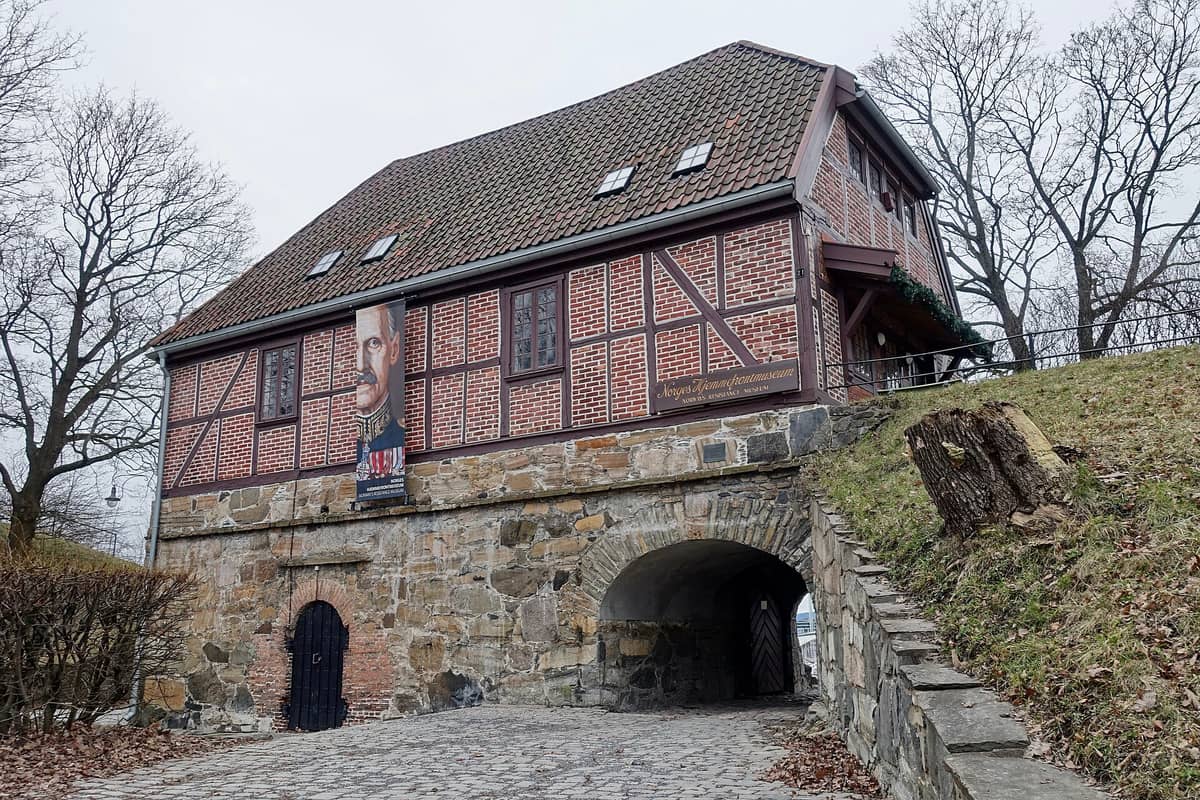
What the Norway Resistance Museum Actually Is
The Norway Resistance Museum, known in Norwegian as Norges Hjemmefrontmuseum, sits inside Building 21 at the top of Akershus Fortress, overlooking Oslo’s harbour and the city’s waterfront. It is one of the most focused and emotionally coherent war museums in Scandinavia, covering the five years between the German invasion of Norway in April 1940 and liberation in May 1945.
The museum has been operated by the Norwegian Armed Forces (Forsvaret) since 1995, and that institutional seriousness shows in the curation. There is no triumphalism here. The exhibits follow a chronological path from the shock of invasion through the organized resistance, the suffering of the civilian population, the fate of Norwegian Jews, and the final days of occupation. Personal objects, documents, and photographs carry the weight of the story far more than dramatic set-pieces.
ℹ️ Good to know
The museum is closed on 1 January, 17 May (Norway’s national Constitution Day), 24–26 December, and 31 December. Plan around these dates if visiting in high season or over the holidays.
The Setting: Akershus Fortress as Context
The location is not incidental. Akershus Fortress, which dates from the late 13th century, was the administrative center of the German occupation authority during WWII. The Gestapo operated on these grounds. Several Norwegian prisoners were held and executed here. Entering the museum through this fortress means the physical site and the historical subject are inseparable, and that connection gives the visit a gravity that purpose-built museum buildings rarely achieve.
The walk up to the museum from the main fortress gate takes about five minutes on cobblestone paths. The approach passes stone walls, cannon emplacements, and views across the fjord. If you have time before or after your museum visit, the fortress grounds themselves are worth exploring. You can read more about the site in our guide to Akershus Fortress.
The building itself is austere and functional, typical of 20th-century military architecture. Inside, the rooms are deliberately low-lit, with display cases and wall panels arranged to guide you through the chronology without overwhelming you. The atmosphere is quiet. Even on busy summer days, most visitors move through the exhibits in something close to silence.
Tickets & tours
Live prices and dates from our booking partner. If you book, we may earn a commission at no extra cost to you.
Oslo Fjord sightseeing audio-guided electrical boat tour
From 35 €Instant confirmationFree cancellationFjord cruise with live jazz music
From 64 €Instant confirmationFree cancellationLuggage Storage in Oslo
From 6 €Instant confirmationFree cancellationPicturesque dinner cruise in Oslo
From 137 €Instant confirmationFree cancellation
What You Will See Inside
The permanent exhibition opens with the German invasion of 9 April 1940, using maps, photographs, and contemporary documents to establish the speed and scale of what happened. Norway fell in roughly two months. King Haakon VII and the government escaped to Britain. The exhibits make clear how disorienting the occupation was for ordinary Norwegians, many of whom had little framework for understanding what was now expected of them.
The middle sections cover the mechanics of resistance: illegal newspapers printed in basements, radio operations, courier networks, and the role of the exiled government in London in coordinating activity. The objects here are quietly extraordinary. A tiny hand-printed newspaper. A forged identity document. A code sheet folded small enough to swallow. These are things people made and used at the risk of their lives, and seeing them at close range changes how you understand the word 'resistance'.
A section on the persecution of Norwegian Jews is among the most important parts of the museum. Norway deported around 773 Jews to Nazi extermination camps, most of them on the ship SS Donau in November 1942 and later the SS Gotenland. The museum does not flinch from the fact that Norwegian police and civil servants participated in these deportations. This is not comfortable history, and the exhibition does not present it as such.
The final galleries cover the liberation in May 1945, the return of the king, and the post-war trials of collaborators. The ending is not triumphant so much as somber and relieved. By the time you reach the exit, the five years feel compressed and legible in a way that is hard to achieve in larger, more sprawling war museums.
💡 Local tip
Pick up the printed room guide at the entrance. The English text on wall panels is thorough but dense, and the guide helps you sequence the galleries correctly and avoid missing the smaller display cases along the side walls.
Best Time to Visit and How It Changes by Time of Day
The museum generally opens at 10:00, with seasonal closing times that vary between 16:00 in winter and 17:00 in summer (and extended hours on some evenings). Arriving at opening time on a weekday gives you the best chance of moving through the exhibition at your own pace, particularly in July and August when cruise ship passengers and school groups arrive in mid-morning. By 11:30 on a summer day, the main galleries can become crowded enough that reading wall panels comfortably requires patience.
Afternoons are generally quieter after 14:00, especially in shoulder season. Winter visits (September through April) are noticeably less crowded overall, and the shorter closing time of 16:00 means there is less temptation to rush through. The low winter light over the Oslofjord, visible from the fortress grounds outside, adds its own atmosphere to the visit.
Summer hours run 10:00–17:00 daily, and winter hours run 10:00–16:00 daily. The museum is included in the Oslo Pass, which also covers entry to many other city museums and unlimited public transport. If you are visiting several paid attractions in a day, the pass often justifies itself.
Getting There and Practical Logistics
From Oslo Central Station (Oslo S), the walk takes roughly 10–15 minutes along the waterfront past Aker Brygge and up toward the fortress entrance on Festningsplassen. The route is flat until the fortress itself, where you gain elevation on cobblestones. Tram lines 12 and 13 stop closer to the fortress at Christiania Torv, which cuts the walk to about five minutes.
The uphill path inside the fortress involves uneven cobblestones and a moderate gradient. Visitors with mobility impairments should check the accessibility information on the official Forsvaret museum site before visiting, as dedicated access routes exist but require advance planning.
If you are combining the museum with other Sentrum attractions, the Oslo City Hall is a ten-minute walk west, and the Nobel Peace Center is on the same waterfront stretch. All three can reasonably be visited in a single full day.
⚠️ What to skip
Wear comfortable, flat-soled shoes. The cobblestones inside Akershus Fortress are irregular and can be slippery when wet. Oslo's weather can shift quickly, so bring a waterproof layer if there is any chance of rain.
Photography and What to Expect Emotionally
Photography is generally permitted in the permanent exhibition for personal use. Avoid flash, both out of courtesy to other visitors and because the display lighting is calibrated for the objects themselves. The most photographed elements are typically the reconstructed interior scenes and the wall-sized maps showing the progression of the war in Norway. The objects in glass cases, small and plainly lit, are harder to photograph but are the ones most worth slowing down for.
It is worth being honest about the emotional weight of this museum. The material is not sensationalized, but it is serious. The section on the deportation of Norwegian Jews in particular requires a certain steadiness. Visitors who are sensitive to content about persecution, detention, and execution should be aware of what the museum covers before they go in. This is not a reason to avoid it. On the contrary, it is one of the reasons it matters.
For broader context on Oslo's WWII-related sites and cultural memory, the Holocaust Center on the Bygdøy peninsula covers the history of Norwegian Jews in greater depth and is worth including if this part of the history is important to you.
Is It Worth Your Time? A Clear Assessment
The Norway Resistance Museum is not a spectacular attraction in the visual sense. There is no sweeping architecture, no immersive digital theatre, no gift shop full of oversized merchandise. What it offers is precision and honesty. For two hours in a quiet building, you understand what happened in Norway between 1940 and 1945 at the level of individual human decisions rather than broad historical narrative.
Visitors who find satisfaction in that kind of museum experience will consider this one of the best two hours they spend in Oslo. Visitors who prefer interactive, visually dynamic, or family-friendly entertainment experiences may find it slow. Children under about 12 are likely to lose interest quickly, and the content is not appropriate for young children without parental preparation and guidance.
If you are building an Oslo itinerary around history and culture, this museum belongs in it. See our 3-day Oslo itinerary for how to fit it alongside the city's other major sites.
Insider Tips
- The museum shop near the exit stocks a curated selection of books on Norwegian WWII history in both Norwegian and English, including primary source compilations that are difficult to find elsewhere. Worth ten minutes even if you are not a dedicated reader.
- The execution site within the Akershus Fortress grounds is marked with a simple memorial outside the museum building. Take a moment to find it before leaving the fortress. It contextualizes everything you just read inside.
- Oslo Pass holders enter free, but you still need to present the pass at the ticket desk for validation. Do not walk past assuming it is a wave-through. Staff check passes at the entrance.
- If you are visiting in summer and arriving by tram, get off at Christiania Torv rather than walking from Oslo S. The approach from Christiania Torv through the lower fortress gate is slightly less steep and avoids the main tourist bottleneck near the waterfront ticket booth.
- The museum is rarely crowded on weekday mornings in March, April, and October. These are genuinely good months to visit Oslo if your goal is quiet access to serious cultural institutions without summer pricing at hotels.
Who Is Norway Resistance Museum (Norges Hjemmefrontmuseum) For?
- WWII and modern European history enthusiasts who want detail beyond a general survey
- Travelers combining the museum with a walking tour of Akershus Fortress
- Oslo Pass holders maximizing their museum coverage in Sentrum
- Families with teenagers who are studying WWII or European history
- Visitors interested in the lesser-known Norwegian dimension of the Holocaust
Nearby Attractions
Other things to see while in Sentrum (City Centre):
- Akershus Castle and Fortress
Akershus Fortress (Akershus slott og festning) is a medieval royal stronghold that has guarded Oslo's harbour since around 1299. The fortress grounds are free to enter year-round, offering sweeping Oslofjord views, cobblestone courtyards, and a castle interior that spans seven centuries of Norwegian history.
- Damstredet & Telthusbakken
Two short streets in central Oslo preserve what the rest of the city lost to fire and modernisation: timber houses from the late 1700s and early 1800s, still inhabited, still cobbled. Free to walk at any hour, Damstredet and Telthusbakken offer a rare glimpse of pre-industrial Oslo just minutes from the parliament building.
- Historical Museum (Historisk Museum)
Housed in a grand early 20th-century building on Tullinløkka in central Oslo, the Historical Museum holds some of Norway's most remarkable ancient objects, from Viking gold jewelry to Egyptian mummies and Arctic indigenous artifacts. It is one of the most substantive indoor experiences the city offers, and it rewards visitors who take their time.
- National Museum (Nasjonalmuseet)
The National Museum (Nasjonalmuseet) is Norway's largest museum for art, architecture, and design, housed in a landmark building on the Oslo waterfront. From Edvard Munch's original Scream to Norwegian design and painting and centuries of decorative arts, it holds the country's most significant cultural collections under one roof.
Planning a trip? Discover personalized activities with the Nomado app.