North Avenue Beach: Chicago's Lakefront at Its Most Alive
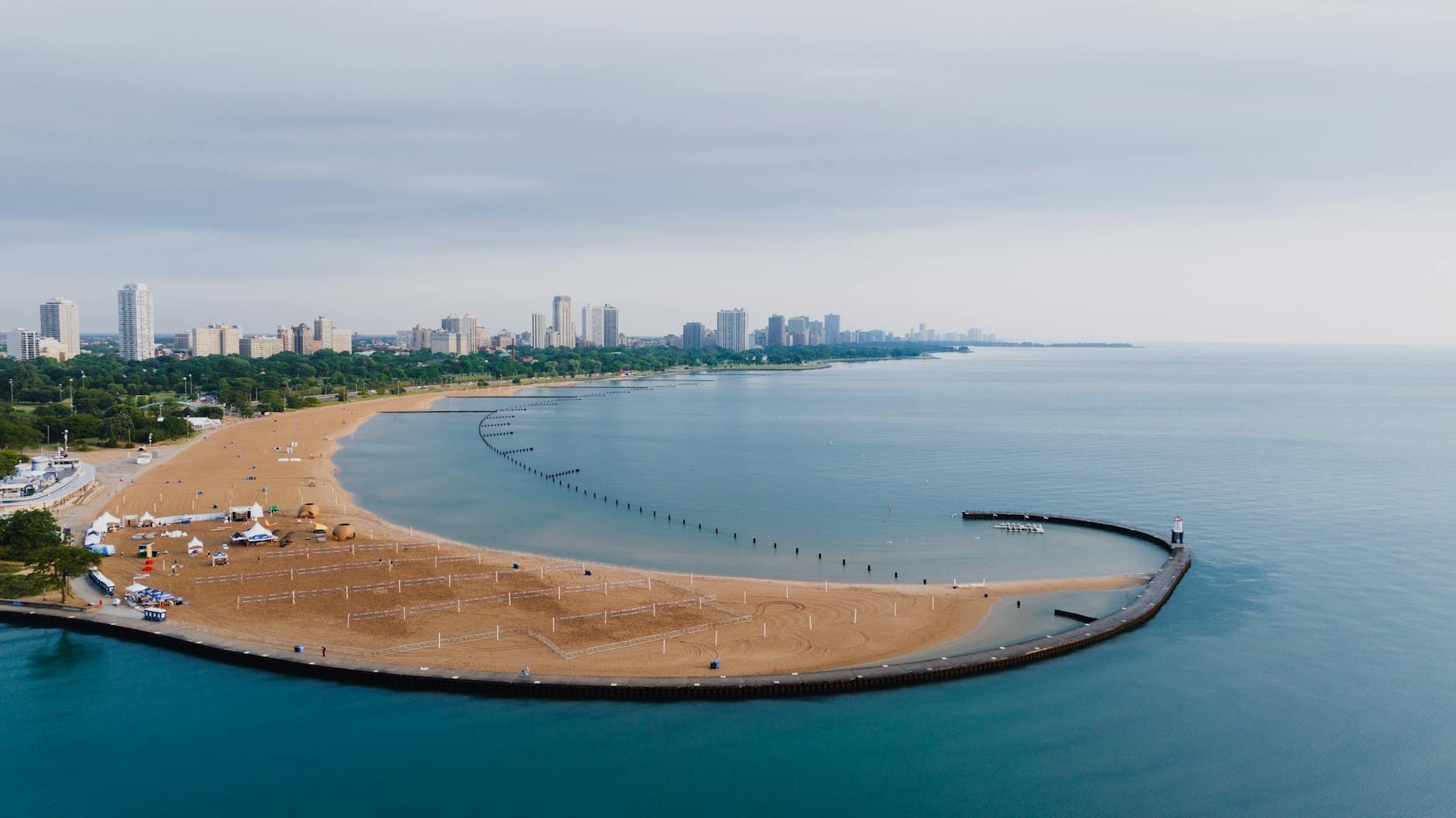
North Avenue Beach is Chicago's best-known urban beach, sitting on over 875,000 square feet of Lake Michigan shoreline in Lincoln Park. Free to enter, lined with volleyball courts, and anchored by an Art Moderne beach house that doubles as a full-service destination, it draws everyone from early-morning swimmers to late-afternoon sun seekers with one of the best skyline views in the city.
Quick Facts
- Location
- 1600 N. Jean-Baptiste Pointe DuSable Lake Shore Drive, Lincoln Park, Chicago, IL 60611
- Getting There
- CTA buses 72, 73, 151, and 156 all serve the area. No direct L stop — the beach is a short walk from several routes.
- Time Needed
- 1–4 hours depending on your pace. Half a day if you add the Lakefront Trail.
- Cost
- Free admission. Paid parking on-site (fills fast). Volleyball court rentals and concessions available at additional cost.
- Best for
- Swimmers, volleyball players, cyclists, skyline photography, summer afternoons with locals
- Official website
- www.chicagoparkdistrict.com/parks-facilities/beaches
What North Avenue Beach Actually Is
North Avenue Beach is a free public beach on the western shore of Lake Michigan, managed by the Chicago Park District and located in the Lincoln Park neighborhood. It sits on more than 875,000 square feet of reclaimed land, added to the Chicago shoreline through Works Progress Administration landfill projects in the 1930s. That history matters: none of this beach existed naturally. It was engineered, intentionally, to give Chicagoans a stretch of sand within reach of the city's densest neighborhoods.
The beach runs roughly between the North Avenue shoreline and the Oak Street curve to the south, with the Lakefront Trail passing directly behind the sand. On a warm Saturday in July, it is one of the most crowded places in Chicago. On a Tuesday morning in early June, it can feel remarkably calm, with joggers passing behind you, the lake stretching out grey and vast, and the downtown skyline cutting hard into the sky to the south.
ℹ️ Good to know
Swim season runs from late May (Memorial Day weekend) through Labor Day. Lifeguards are typically on duty daily from 11:00 a.m. to 7:00 p.m. during this period. Outside those hours — and outside those months — the beach is still accessible, but swimming without a lifeguard present is not advised.
The Beach House: An Architecture Story Worth Knowing
The North Avenue Beach House is the physical anchor of the site, and it is worth a closer look than most visitors give it. The original structure was completed in 1940, designed by architect Emanuel V. Buchsbaum as a WPA project. His reference point was unmistakably nautical: the building was designed to resemble an ocean liner, with a streamlined Art Moderne form, curved decks, and horizontal lines that echo a ship's hull. Sitting at the edge of an inland sea the size of a small country, the metaphor holds up.
The current 22,000-square-foot beach house was redesigned by Wheeler Kearns Architects, completed in 1999 and formally dedicated in May 2000. The ocean liner concept was preserved and reinterpreted. Today the building houses restrooms, changing facilities, concession stands, and a rooftop restaurant and bar. The upper deck offers elevated views of both the lake and the Chicago skyline, and it draws a crowd on summer evenings that has nothing to do with swimming.
If Chicago architecture interests you, the beach house fits into a broader story of lakefront design and WPA-era civic building. The Chicago Architecture Center maintains a record of the beach house and runs tours that contextualize projects like this within the city's larger architectural identity.
Tickets & tours
Hand-picked options from our booking partner. Prices are indicative; availability and final rates are confirmed when you complete your booking.
River North Food Tour
From 76 €Instant confirmationGo City | Chicago All-Inclusive Pass
From 127 €Instant confirmationFree cancellationiFLY Chicago Lincoln Park indoor skydiving experience
From 126 €Instant confirmationFree cancellationiFLY Chicago Rosemont indoor skydiving tickets
From 117 €Instant confirmationFree cancellation
How the Beach Changes Through the Day
Early morning, before 8:00 a.m., North Avenue Beach belongs to a specific kind of Chicagoan: open-water swimmers pulling on wetsuits at the water's edge, cyclists clicking into their pedals at the Lakefront Trail junction, dog walkers crossing the sand before the no-dogs rule kicks in. The light is flat, the lake is usually calmer than it will be later, and the air carries that particular smell of fresh water and cool sand that Lake Michigan produces when the wind is right.
By mid-morning the volleyball nets are filling up. North Avenue Beach has one of the largest concentrations of sand volleyball courts in the city, and organized leagues run throughout the summer. The sound shifts from quiet to the steady thump of serves and the scrape of sand. By noon in peak summer, the beach is at full capacity: towels overlapping, the concession stand lines stretching, music from portable speakers competing at the edges of earshot.
Late afternoon, around 4:00–6:00 p.m., is the quietest post-peak window. The early lunch crowd has left, and the after-work crowd hasn't arrived. The light turns warm and direct from the west, angling across the sand and illuminating the skyline from behind the beach house. This is the best window for photography of the lake itself, and also the most comfortable time to actually sit on the sand without feeling compressed by the crowd.
Evening at North Avenue Beach has its own logic. The rooftop bar draws people who came for sunset drinks, not swimming. The sand empties as the water cools, but the trail stays active with cyclists and runners well into dusk. In summer, the sky can turn extraordinary colors from this vantage point, with the downtown towers going dark against a pink and orange west.
💡 Local tip
For the best skyline views and the most breathable crowd levels, aim for a weekday afternoon in late May or early September. Peak summer weekends between noon and 4:00 p.m. are genuinely packed. Parking fills up fast on those days — take the bus.
Getting There and Getting Around
There is no single CTA 'L' line that drops you at the beach. The closest approach by rapid transit is the Red Line's Clark/Division stop, about a 15-minute walk west along North Avenue to the lakefront. More direct are several CTA bus routes: the 151 Sheridan and 156 LaSalle both run along Lake Shore Drive and stop close to the beach. The 72 North, 73 Armitage, 22 Clark, and 36 Broadway routes are also viable depending on your starting point. Check the CTA's trip planner for current service.
Cycling is one of the best ways to arrive. The Lakefront Trail runs directly behind the beach, connecting it to Grant Park and Museum Campus to the south and Montrose Beach to the north. The trail is paved, mostly flat, and well-marked, though it gets congested on summer weekends when foot traffic and cyclists share the same path.
If you drive, the on-site parking lot is paid and fills quickly on warm weekends. Arriving before 10:00 a.m. on a Saturday gives you a reasonable chance of finding a space. After that, neighborhood street parking involves a longer walk and competition with residents. A rideshare drop-off at the beach house entrance is the most stress-free car-based option.
What to Do Here Besides Swim
Swimming is the obvious draw, and the lake does get warm enough for comfortable swimming in July and August, typically reaching the low-to-mid 70s Fahrenheit on good days. But the water temperature is unpredictable and can drop sharply after a north wind. Check beach conditions through the Chicago Park District before making swimming the centerpiece of your trip.
Volleyball is a serious activity here, not just casual play. Organized leagues use the courts throughout the week, and pickup games fill in around them on weekends. Equipment rentals and court reservations are available through the Chicago Park District at 312-802-5839. Showing up and finding an open court without a reservation on a July weekend is ambitious.
North Avenue Beach is an excellent anchor for a broader lakefront walk. To the south, the trail connects to Oak Street Beach, which has a more compact, neighborhood-social feel. Further south still is Grant Park, the city's main outdoor civic space. To the north, the trail eventually reaches Montrose Beach, which is less developed and quieter.
The rooftop bar and restaurant in the beach house has become a destination in its own right during summer. The food is standard beach concession fare elevated slightly, and the prices reflect the location, but the view from the upper deck — lake in front, skyline behind — justifies one drink at minimum.
Practical Details for a Better Visit
The beach is free to enter. There is no admission gate, no wristband, no ticket. You walk down to the sand and that's it. The ADA-accessible beach walk means the site is reachable for visitors with mobility considerations, and the beach house has restrooms and changing facilities on-site.
What to bring: sunscreen rated for direct summer sun, a towel or mat (the sand is not especially soft), water (the concession prices are what you'd expect), and sandals you don't mind getting wet. The lake bottom near the shore is sandy but can have sharp stones or debris after storms. Shade is minimal — the beach is open and exposed, and the beach house is the only structure offering overhead cover.
Weather shapes the experience dramatically. Lake Michigan generates its own microclimate, and a day that feels warm in the city can feel cold at the water's edge with a north or east wind. In June, air temperatures can be deceptive — it may be 75°F downtown but noticeably cooler on the sand. September visits can be genuinely pleasant or genuinely cold depending on what's moving through.
⚠️ What to skip
Rip currents and high wave conditions do occur on Lake Michigan, particularly after storm systems. Pay attention to the beach flag warning system: yellow flags signal caution, red flags mean dangerous conditions and no swimming. This is not a ceremonial warning — the lake has real force when conditions deteriorate.
For a deeper understanding of Chicago's lakefront as a whole — its history, design, and the ongoing public debate about its future — the Chicago lakefront guide provides useful context before or after your visit.
Who Will Love This Beach — and Who Should Think Twice
North Avenue Beach works very well for people who want an urban beach experience that doesn't feel sanitized. The crowd is mixed, the setting is genuinely dramatic, and there is enough going on around the edges — the trail, the volleyball, the beach house — that a half day here has real texture. It is particularly good for visitors who want to understand how Chicagoans actually spend their summers.
It works less well for anyone expecting a quiet or secluded experience in high summer. On a hot weekend in July, this beach is at full Chicago scale. If you want space, water access, and fewer people, Montrose Beach to the north is a better option. If you want a beach-adjacent experience without the swim season limitations, the Lakefront Trail gives you the lake views and the movement without the crowd dynamics.
Visitors traveling with children should note that the beach, the trail, and the nearby Lincoln Park Zoo (free, about a 10-minute walk) can be combined into a full family day. The zoo is within easy walking distance to the west, and the combination is one of the better free itineraries in the city.
Insider Tips
- The rooftop deck of the beach house is accessible without ordering anything — walk up and take in the skyline view before committing to a drink. The south-facing perspective gives you the full downtown arc from a height that ground-level photography can't replicate.
- Weekday mornings in late May and early September are the single best time combination: the water is swimmable, the crowd is minimal, and the light is softer than peak summer. Many Chicagoans don't realize the swim season has started until mid-June.
- If you're planning volleyball, call the Chicago Park District at 312-742-3776 before showing up. Walk-in court availability on summer weekends is inconsistent, and organized league play often has priority during peak hours.
- The Divvy bike-share system has a station near the beach. Riding south along the Lakefront Trail to Navy Pier or Oak Street Beach is a 10–20 minute ride with unobstructed lake views the whole way — a more interesting approach than any bus route.
- The beach flag warning system is posted near the water. If the flags are red, the lake is producing dangerous conditions regardless of how calm it looks from the sand. Lake Michigan's wave action and currents can be severe and are regularly underestimated by visitors unfamiliar with it.
Who Is North Avenue Beach For?
- Swimmers and open-water athletes looking for an accessible urban lake session
- Volleyball players, especially those interested in the organized league scene
- Photographers after the Chicago skyline from the water's edge
- Families combining the beach with Lincoln Park Zoo on the same day
- Cyclists using the Lakefront Trail as a spine for a longer north-south exploration
Nearby Attractions
Other things to see while in Lincoln Park & Old Town:
- Alfred Caldwell Lily Pool
Tucked inside Lincoln Park, the Alfred Caldwell Lily Pool is a 3-acre National Historic Landmark redesigned in 1936–1938 in the Prairie School style. Admission is free, crowds are thin, and the experience is unlike anything else on Chicago's standard tourist circuit.
- Chicago History Museum
Founded in 1856 as the Chicago Historical Society, the Chicago History Museum is the city's oldest cultural institution. Located at the edge of Lincoln Park, it traces the full arc of Chicago's story, from its earliest Indigenous inhabitants to the Great Fire, the labor movement, and beyond. It rewards curious visitors who want more than skyline photos.
- Green City Market
Green City Market is Chicago's only year-round sustainable farmers' market, drawing top chefs, local farmers, and serious food lovers to Lincoln Park on Wednesdays and Saturdays during the outdoor season. Free to enter at both its outdoor Lincoln Park and indoor winter locations and rich with seasonal produce, artisan goods, and chef demos, it's one of the most authentic food experiences the city offers.
- Kingston Mines
Founded in 1968, Kingston Mines on North Halsted Street is the largest and oldest continuously operating blues club in Chicago. Two stages run simultaneously on weekends, keeping the music going until 4 a.m. This is where the city's blues tradition stays alive on a weekend night.