Neon Museum Warsaw (Muzeum Neonów): Poland's Cold War in Light
The Neon Museum (Muzeum Neonów) preserves over a hundred hand-crafted neon signs from communist-era Poland, now displayed inside the Palace of Culture and Science in central Warsaw. It is one of the few institutions in the world dedicated entirely to saving this form of socialist commercial art, and the juxtaposition of glowing mid-century signs inside Stalin's most iconic Warsaw building makes it one of the city's most visually striking cultural stops.
Quick Facts
- Location
- Palace of Culture and Science (4th floor), Plac Defilad 1, Warsaw city centre
- Getting There
- Centrum (M1) or Świętokrzyska (M1/M2) metro stations; trams and buses at Centrum/Dworzec Centralny
- Time Needed
- 45–90 minutes
- Cost
- Adult 25 PLN / Concession 18 PLN / Under 6 free; guided tours from 120 PLN per group
- Best for
- Design lovers, Cold War history buffs, photographers, and anyone curious about socialist visual culture
- Official website
- www.neonmuzeum.org/english
What the Neon Museum Actually Is
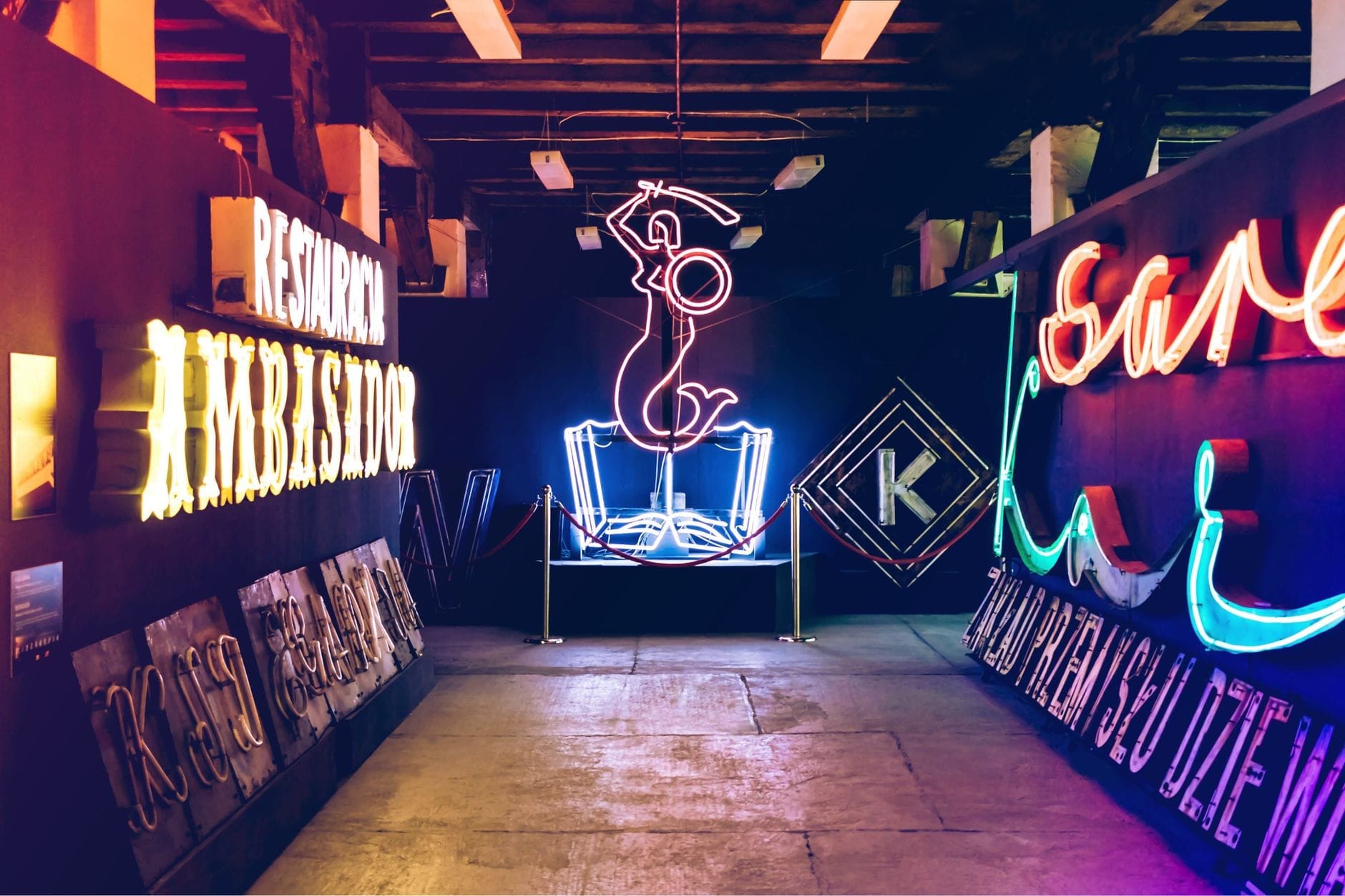
The Neon Museum (Muzeum Neonów) is a collection of restored and unrestored neon signs produced in Poland primarily during the communist period, roughly from the late 1940s through the 1980s. These were not advertisements for private businesses in the western sense. Under state socialism, neon signs were commissioned by the government to give Polish cities a modern, optimistic appearance, and many of the craftspeople who made them were trained artists and glassblowers working to a surprisingly high standard. The museum rescues signs that would otherwise have been scrapped, stores them, restores some, and displays them as objects of both design history and political memory.
Founded in 2012 at the Soho Factory complex in the Praga-Południe district, the museum relocated in 2025 to the Palace of Culture and Science in central Warsaw. That address change is significant: what was once a pilgrimage to the post-industrial east bank is now inside one of the most recognizable Stalinist-era buildings in Europe. The irony is intentional and adds a layer of meaning to the experience.
ℹ️ Good to know
Hours: Monday–Thursday and Sunday 11:00–18:00, Friday–Saturday 11:00–19:00. To reach the museum, enter via Marszałkowska Street, go down to level -1, and take the side elevators to the 4th floor. Elevators are on the left side of the main staircase and the building is described as wheelchair-user friendly, with accessible toilets on site.
The Collection: What You Will Actually See
Walking into the exhibition space, the first thing that registers is color temperature. Most museum lighting is cool and neutral. Here, the room pulses with warm reds, acid greens, electric blues, and deep yellows, all radiating from hand-bent glass tubes filled with neon or argon gas. The signs range from small typographic pieces no bigger than a café chalkboard to large architectural elements that once spanned building facades. Many are still lit. Others sit dark, their twisted glass tubes preserved as sculptural objects rather than light sources.
The subjects of the signs tell you exactly what socialist Poland needed to advertise: milk bars, cinemas, hotels, pharmacies, bookshops, and state-run department stores. You will see signs for venues and brands that no longer exist, their names transliterated into the decorative Cyrillic-adjacent lettering styles popular in the 1960s. The craftsmanship is remarkably detailed. Each tube was shaped by hand by specialist glassworkers, and the color gradations inside individual letters required genuine skill to achieve. These were not mass-produced products.
For context on the broader visual and architectural culture of that era, the communist Warsaw guide covers how the city's urban design was shaped by ideology, and helps frame what you are looking at inside the museum.
Tickets & tours
Hand-picked options from our booking partner. Prices are indicative; availability and final rates are confirmed when you complete your booking.
Pub crawl in Warsaw
From 28 €Instant confirmationFree cancellationWarsaw Museum of Modern Art entrance ticket
From 8 €Instant confirmationSafe and Convenient Luggage Storage in Warsaw Old Town
From 6 €Instant confirmationFree cancellationInteractive spy-themed city game with host-guide in Warsaw Old Town
From 90 €Instant confirmationFree cancellation
The Palace of Culture Setting: A Location That Changes the Experience
The Palace of Culture and Science (Pałac Kultury i Nauki) is Warsaw's most contested building. A gift from Stalin, completed in 1955, it is simultaneously the city's tallest structure, its most recognizable silhouette, and a symbol that Varsovians have never quite resolved their feelings about. Entering it to look at a collection of communist-era street signs is not a neutral act. The building's stone corridors, high ceilings, and Soviet institutional detailing form an unlikely but coherent backdrop for the neon pieces on the 4th floor.
If you have not visited the Palace of Culture and Science before, give yourself extra time to walk the public corridors and observe the building itself. The combination of Stalinist grandeur and mid-century neon creates a visit that works on two levels simultaneously.
Best Time to Visit and What to Expect by Hour
The museum is compact enough that crowd levels matter more than usual. On weekday mornings between 11:00 and 13:00, the space is generally quiet, with enough room to stand in front of individual signs without other visitors in your sightline. Friday and Saturday evenings, particularly between 17:00 and 19:00, attract a younger, more social crowd. The atmosphere shifts noticeably, with the glowing signs functioning almost like an installation at a gallery opening rather than a conventional museum.
Because the signs themselves are the light source in much of the space, the experience does not change with natural daylight the way an outdoor attraction does. The museum is genuinely good on a grey winter afternoon when Warsaw offers little else in terms of visual warmth. It is also a logical stop during a rainy day in any season.
💡 Local tip
Photography tip: Bring a phone or camera that handles low light well. The neon glow is flattering but requires either a wide aperture lens or a night-mode capable phone camera. Avoid flash, which kills the atmosphere completely and flattens the color. The best individual shots are close-up details of the glass tubes rather than wide room shots, which tend to look cluttered.
Historical and Cultural Significance
Poland's neon sign tradition has a specific historical arc. After World War II, the government invested in neon as a tool of urban modernization. Warsaw, rebuilt almost entirely from rubble, needed visible signs of progress, and glowing advertisements for state enterprises served that purpose. The craft peaked in the 1960s and 1970s, when Polish glassworkers developed distinctive regional styles that differ visibly from West German or American neon work of the same period.
The decline came with the economic crisis of the 1980s and accelerated sharply after 1989, when private businesses replaced state enterprises and opted for cheaper, faster LED and backlit plastic signage. Thousands of neon signs were dismantled and destroyed within a decade. The Neon Museum is one of the few institutions anywhere that systematically collected what remained, and its archive now represents an irreplaceable record of applied design under state socialism. It is one of only a handful of dedicated neon museums in the world.
The museum pairs naturally with a visit to the Museum of Warsaw, which documents the city's full reconstruction and postwar urban life in greater depth.
Practical Walkthrough: Getting There and Around
The museum is now in the city centre, which makes it easy to combine with other attractions. Both Centrum (M1 line) and Świętokrzyska (M1 and M2 lines) metro stations are a short walk away. Multiple tram lines and bus routes serve Dworzec Centralny and the surrounding streets. If you are arriving by taxi or ride-hailing app, ask to be dropped at the Marszałkowska Street side of the Palace of Culture.
Once inside the Palace, finding the museum requires a moment of orientation. Go down to level -1, then take the elevators on the left side of the main staircase up to the 4th floor. The signage inside the building is adequate but not always obvious on a first visit. Allow five extra minutes for navigation, particularly if you are coming from an unfamiliar entrance. Payment on site accepts both cash (PLN) and credit cards.
Guided tours are available for groups of at least 10 people, running approximately 45 minutes. Tours in Polish cost 120 PLN per group, plus individual entry tickets. English and French tours cost 150 PLN per group, plus individual tickets. These should be arranged in advance through the official website. For solo visitors, the displays include enough explanatory text in English to navigate the collection independently.
⚠️ What to skip
The museum relocated from its original Praga-Południe location to the Palace of Culture and Science in 2025. Any older blog posts or guidebooks that list the Soho Factory address in Praga are now out of date. Check the official site at neonmuzeum.org before visiting.
Honest Assessment: Is It Worth Your Time?
The Neon Museum is a genuinely unusual collection. It occupies a niche that almost no other institution fills, and the objects themselves are beautiful as well as historically interesting. For visitors with any interest in design, Cold War history, or Polish culture beyond the standard Old Town itinerary, it is a strong choice. The new Palace of Culture location also makes it logistically easy rather than a deliberate detour.
That said, the museum is small. Serious museum-goers accustomed to spending half a day at major institutions will cover the space in under an hour. The interpretive content, while thoughtful, is limited in volume. If you are visiting Warsaw for only one or two days and your interests run more toward history or art, the time might be better spent at the Warsaw Uprising Museum or the POLIN Museum.
Visitors who want a fuller picture of what to prioritize can read the guide to the best museums in Warsaw, which puts the Neon Museum in context alongside the city's larger institutions.
If you are building a longer itinerary, the three-day Warsaw itinerary shows how to fit this stop alongside other central Warsaw attractions without doubling back across the city.
Insider Tips
- The museum shop sells small neon-related souvenirs and prints that are genuinely distinctive compared to standard Warsaw tourist merchandise. If you are looking for a design-forward gift, it is worth a look before you leave.
- Arrive within the first 30 minutes of opening on a weekday for the quietest conditions. By midday, school groups and tour parties begin to arrive and the space, being compact, fills up quickly.
- The Palace of Culture itself is publicly accessible and free to walk through. After your museum visit, explore the building's corridors on adjacent floors for a feel of the Stalinist interior on a larger scale.
- If you are particularly interested in the craft of neon making rather than just the finished objects, the English-language guided tour covers the glassblowing techniques in detail that the standard display text only touches on.
- The museum is a logical midday stop because the neon-lit interior is not affected by weather or daylight. Save outdoor Warsaw attractions for clear afternoons and use the Neon Museum as your wet-weather or midday option.
Who Is Neon Museum (Muzeum Neonów) For?
- Design and graphic arts enthusiasts interested in mid-century applied art
- Cold War and socialist history buffs looking for something beyond standard political history
- Photographers seeking unusual low-light interior subjects
- Visitors who have already seen Warsaw's major sites and want something less conventional
- Families with older children who can engage with the historical context
Nearby Attractions
Other things to see while in Praga:
- Koneser Center & Museum of Polish Vodka
Housed in a restored neo-Gothic vodka factory on Warsaw's east bank, the Polish Vodka Museum (Muzeum Polskiej Wódki) offers guided tours through five centuries of distilling history, original industrial architecture, and optional tastings. The Koneser Center complex surrounding it has become one of Praga's most compelling destinations.
- Orthodox Cathedral of Saint Mary Magdalene
Built between 1867 and 1869, the Metropolitan Cathedral of Saint Mary Magdalene is Warsaw's first architecturally independent Orthodox church and the seat of the Polish Autocephalous Orthodox Church. Standing in the Praga district with its gleaming onion domes intact, it is one of the few Warsaw religious buildings to have survived World War II almost untouched.
- Praga Street Art
The Praga district on Warsaw's east bank hosts a notable concentration of murals and graffiti art, spread across pre-war tenements, former factory walls, and courtyards around ul. Ząbkowska. Free and accessible 24/7, it rewards slow walking and careful looking — especially in the flat, directional light of early morning or late afternoon.
- Warsaw Zoo
One of Poland's oldest and largest zoological gardens, Warsaw Zoo sits on the Praga side of the Vistula River across from the Old Town. Spread across 40 hectares of mature trees and winding paths, it houses over 500 species and carries a remarkable wartime history that sets it apart from most European zoos.