Orthodox Cathedral of Saint Mary Magdalene: Warsaw's Golden-Domed Survivor in Praga
Built between 1867 and 1869, the Metropolitan Cathedral of Saint Mary Magdalene is Warsaw's first architecturally independent Orthodox church and the seat of the Polish Autocephalous Orthodox Church. Standing in the Praga district with its gleaming onion domes intact, it is one of the few Warsaw religious buildings to have survived World War II almost untouched.
Quick Facts
- Location
- Aleja Solidarności 52, Praga-Północ, Warsaw
- Getting There
- Dworzec Wileński metro/rail station, approx. 3 min walk
- Time Needed
- 20–45 minutes
- Cost
- Free entry (active place of worship)
- Best for
- Architecture lovers, Orthodox Christianity, Praga neighbourhood walks
- Official website
- http://www.katedra.org.pl
What You Are Looking At
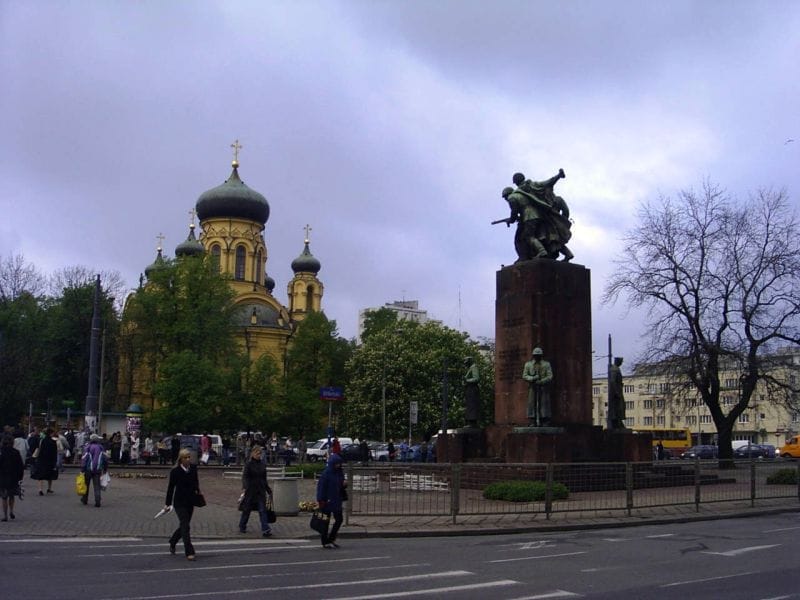
The Metropolitan Cathedral of Saint Mary Magdalene announces itself before you reach the door. Its three green onion domes catch the light in a way that feels conspicuously un-Polish, a deliberate contrast against the red-brick and stucco streetscape of Praga. The facade is compact, almost modest in footprint, but the vertical drama of the domes and the yellow and cream painted brickwork make it one of the most visually distinctive religious buildings in Warsaw.
The full Polish name is Sobór Metropolitalny Świętej Równej Apostołom Marii Magdaleny. In English it is most often called the Metropolitan Cathedral of Saint Mary Magdalene, though you will see variations in guidebooks. Whatever name you use, the building is one of the most important Orthodox temples in Warsaw and the formal seat of the Polish Autocephalous Orthodox Church, meaning this is the mother church for Polish Orthodoxy, not a side-street curiosity.
ℹ️ Good to know
This is an active cathedral with regular liturgical services. Visiting during a service is entirely possible and adds to the experience, but dress modestly, speak quietly, and avoid photographing worshippers without clear consent. Women are traditionally expected to cover their heads inside.
History: Built Under the Tsar, Survived the Nazis
The cathedral was constructed between 1867 and 1869, during the period when Warsaw was part of the Russian Empire. It was the first Orthodox church in the city to be designed as an architecturally independent building, rather than adapted from an existing structure. That distinction matters: it was conceived from the ground up as Orthodox sacred architecture, with the proportions, dome placement, and iconostasis layout that the tradition demands.
The timing of its construction places it firmly in the context of Russian imperial policy. After the failed Polish uprising of 1863, the tsarist administration pushed harder to embed Russian Orthodox identity into Warsaw's urban landscape. The cathedral on what is now Aleja Solidarności was part of that broader project, and its presence in predominantly Catholic Warsaw has always carried a degree of political subtext.
What makes the building remarkable in the context of Warsaw's history is not what happened to it but what did not. Opened in 1869, the cathedral survived the systematic destruction of World War II almost entirely intact, at a time when a large proportion of Warsaw was reduced to rubble. Praga, on the eastern bank of the Vistula, was occupied by Soviet forces before the full German demolition campaign reached it, which is why the neighbourhood retains more prewar architecture than almost anywhere else in the city. The cathedral is one of the most complete examples of that survival.
The Praga district's unusual architectural density is worth understanding before you visit. For more context on why this neighbourhood feels different from the rest of Warsaw, see the Praga neighbourhood guide.
Tickets & tours
Hand-picked options from our booking partner. Prices are indicative; availability and final rates are confirmed when you complete your booking.
Museum of John Paul II and Primate Wyszyński entrance ticket
From 8 €Instant confirmationPub crawl in Warsaw
From 28 €Instant confirmationFree cancellationWarsaw Museum of Modern Art entrance ticket
From 8 €Instant confirmationSafe and Convenient Luggage Storage in Warsaw Old Town
From 6 €Instant confirmationFree cancellation
Inside the Cathedral: What to Expect
The interior follows the standard layout of Eastern Orthodox churches: the nave is dominated by the iconostasis, the tall gilded screen of icons that separates the nave from the sanctuary. At Saint Mary Magdalene's, the iconostasis is elaborate and worth standing in front of for several minutes. The painted icons are arranged in tiers, each tier with its own theological programme, and the gold leaf catches the candlelight in a way that photographs rarely reproduce accurately.
The ceiling frescoes depict scenes from the New Testament and Orthodox hagiography. The colour palette is deep blues, reds, and gold, with a quality of paint and surface that reflects serious restoration work over the decades. The smell inside is a combination of beeswax candles, incense residue, and old timber, a sensory signature you will recognize instantly if you have visited Orthodox churches elsewhere in Eastern Europe.
The acoustic of the space deserves mention. The domed structure creates a long reverberation. If a cantor or choir is present during a service, the sound is extraordinary. Even outside of formal services, the low ambient hum of candles and the occasional murmur of individual prayer creates a contemplative atmosphere that is noticeably different from the more touristic atmosphere of Warsaw's major Catholic churches.
💡 Local tip
Weekday mornings tend to be the quietest time to visit for unhurried observation of the iconostasis and frescoes. Sunday services draw a genuine congregation and offer a more immersive but less private experience.
The Building from Outside: Architectural Details
Architecturally, the cathedral belongs to the Russian Revival style, which draws on Byzantine forms filtered through 19th-century Russian ecclesiastical design. The characteristic elements are all present: the bulbous onion domes on cylindrical drums, the kokoshnik decorative arches framing the upper walls, and the arched window surrounds with elaborate brick detailing. The exterior brickwork is painted in shades of yellow and cream with decorative detailing, a combination that reads as foreign and festive against the grey Warsaw sky in winter.
The three domes are the building's defining feature from the street. The central dome is the largest, sitting above the crossing, with two smaller domes flanking the bell tower section. At golden hour in late afternoon, the domes catch direct western light and the colour shifts from gold to deep amber. This is the best window for exterior photography, particularly from the pavement on the opposite side of Aleja Solidarności.
💡 Local tip
For the best exterior photograph, cross to the opposite side of Aleja Solidarności and position yourself slightly to the south. This angle captures all three domes with clear sky behind them and avoids the parked cars immediately in front of the entrance.
Getting There and Practical Notes
The cathedral sits at Aleja Solidarności 52 in Praga-Północ, directly opposite the Dworzec Wileński area. Dworzec Wileński is served by the M2 metro line (the east-west line), making this one of the easier Praga attractions to reach from the city centre. The walk from the metro exit to the cathedral entrance is about three minutes. Trams and several bus lines also stop nearby.
The cathedral fits naturally into a broader Praga walking route. The neighbourhood rewards slow exploration: Praga's street art scene and the Koneser cultural and dining centre are both within comfortable walking distance.
Accessibility is limited. The building is not barrier-free, and visitors using wheelchairs will need assistance from companions when entering and navigating the interior. There are steps at the entrance and no installed ramp as of available documentation. Confirm current conditions directly with the cathedral before visiting if this is a concern.
Entry is free, as this is an active place of worship rather than a ticketed tourist site. Opening hours are not published in a stable, reliably updated format by the cathedral or major listing platforms, so checking the official website at katedra.org.pl or calling ahead before a visit is the safest approach, particularly if you are planning around specific service times.
How It Fits Into a Warsaw Itinerary
The cathedral works well as the anchor point of a Praga half-day. Praga sits across the Vistula from Warsaw's Old Town, and its character is genuinely different: lower density, more prewar texture, a mix of renovation and deliberate preservation of the unreconstructed streetscape. Adding the cathedral to a Praga walk gives the neighbourhood visit a clear starting point and a strong architectural counterpoint to the Catholic churches that dominate Warsaw's western bank.
If you are putting together a broader religious and architectural itinerary for Warsaw, the cathedral pairs interestingly with Nożyk Synagogue and the St. John's Archcathedral as representatives of the city's three historically significant faith communities. The contrast in architectural language, liturgical atmosphere, and historical narrative across those three buildings is genuinely instructive.
Travelers who are primarily drawn to Warsaw's wartime history should also note that the cathedral's survival is itself a piece of that history. Understanding why Praga survived when the western bank did not adds significant context to the standard World War II narrative that most Warsaw itineraries follow. The cathedral is a physical reminder of a divide that shaped everything that came after.
For a structured approach to Warsaw's wartime sites, the Warsaw WW2 history guide provides useful orientation before you visit Praga.
Who Will Get the Most From This Visit
The cathedral rewards visitors with some interest in religious architecture, Eastern Orthodox liturgy, or the specific history of Praga's survival. If you are ticking off Warsaw's headline attractions and have limited time, it probably does not displace the Royal Castle or the Warsaw Uprising Museum from your priority list. But if you have a half-day in Praga, this is one of the two or three genuinely irreplaceable things in the neighbourhood.
Visitors who find Catholic church interiors repetitive will find the Orthodox iconostasis, the dome structure, and the particular quality of candlelit icon painting genuinely different. It is not a museum. It is not staged for tourism. That is both its limitation and its appeal.
Insider Tips
- Check the cathedral's official website at katedra.org.pl for service times before visiting. Attending even part of a Sunday Divine Liturgy, when the full choir sings in the resonant dome space, is a qualitatively different experience from a quiet weekday visit.
- The gold domes photograph best in late afternoon when western light hits them directly. Morning light catches the east-facing facade elements instead, so both ends of the day have merit depending on what you want to capture.
- Combine this visit with the Koneser Centre about 8–12 minutes' walk away. The contrast between a 19th-century imperial Orthodox cathedral and a repurposed Soviet-era vodka factory turned cultural hub captures Praga's layered character better than either site alone.
- If you are arriving by metro from the city centre, the M2 line from Centrum to Dworzec Wileński takes under 10 minutes. This makes the cathedral far more accessible than its eastern-bank location might suggest on a map.
- The cathedral is an active metropolitan seat, not a branch parish. Major Orthodox feast days, particularly Easter (Pascha), draw large congregations and create an atmosphere unlike anything available at Warsaw's more tourist-oriented religious sites.
Who Is Orthodox Cathedral of Saint Mary Magdalene For?
- Architecture and religious art enthusiasts interested in Eastern Orthodox design
- Travelers exploring Praga's prewar streetscape and wartime survival narrative
- Anyone building a multi-faith architectural itinerary across Warsaw
- Visitors looking to experience an active, non-staged place of worship
- Photographers seeking dramatic exterior subjects away from Warsaw's Old Town
Nearby Attractions
Other things to see while in Praga:
- Koneser Center & Museum of Polish Vodka
Housed in a restored neo-Gothic vodka factory on Warsaw's east bank, the Polish Vodka Museum (Muzeum Polskiej Wódki) offers guided tours through five centuries of distilling history, original industrial architecture, and optional tastings. The Koneser Center complex surrounding it has become one of Praga's most compelling destinations.
- Neon Museum (Muzeum Neonów)
The Neon Museum (Muzeum Neonów) preserves over a hundred hand-crafted neon signs from communist-era Poland, now displayed inside the Palace of Culture and Science in central Warsaw. It is one of the few institutions in the world dedicated entirely to saving this form of socialist commercial art, and the juxtaposition of glowing mid-century signs inside Stalin's most iconic Warsaw building makes it one of the city's most visually striking cultural stops.
- Praga Street Art
The Praga district on Warsaw's east bank hosts a notable concentration of murals and graffiti art, spread across pre-war tenements, former factory walls, and courtyards around ul. Ząbkowska. Free and accessible 24/7, it rewards slow walking and careful looking — especially in the flat, directional light of early morning or late afternoon.
- Warsaw Zoo
One of Poland's oldest and largest zoological gardens, Warsaw Zoo sits on the Praga side of the Vistula River across from the Old Town. Spread across 40 hectares of mature trees and winding paths, it houses over 500 species and carries a remarkable wartime history that sets it apart from most European zoos.