MuseumsQuartier Vienna: Art, Architecture, and Open Courtyards in a Former Imperial Stable
The MuseumsQuartier Wien is one of the largest cultural complexes in the world, converting the Habsburg imperial court stables into a sprawling campus of modern art museums, independent galleries, and open public courtyards. Entry to the grounds is free around the clock, while individual institutions charge their own admission. Whether you want to spend three hours or an entire day, this is the cultural center of gravity for contemporary Vienna.
Quick Facts
- Location
- Museumsplatz 1, 1070 Vienna (7th District, Neubau)
- Getting There
- U2 MuseumsQuartier station (direct access); trams along Ringstraße also stop nearby
- Time Needed
- 2–3 hours for the complex and one museum; a full day if visiting multiple institutions
- Cost
- Courtyards and public areas: free, 24/7. Museum admission varies by institution — verify current prices directly with each venue
- Best for
- Modern art lovers, architecture enthusiasts, families, and anyone who wants a relaxed outdoor space at the center of the city
- Official website
- www.mqw.at
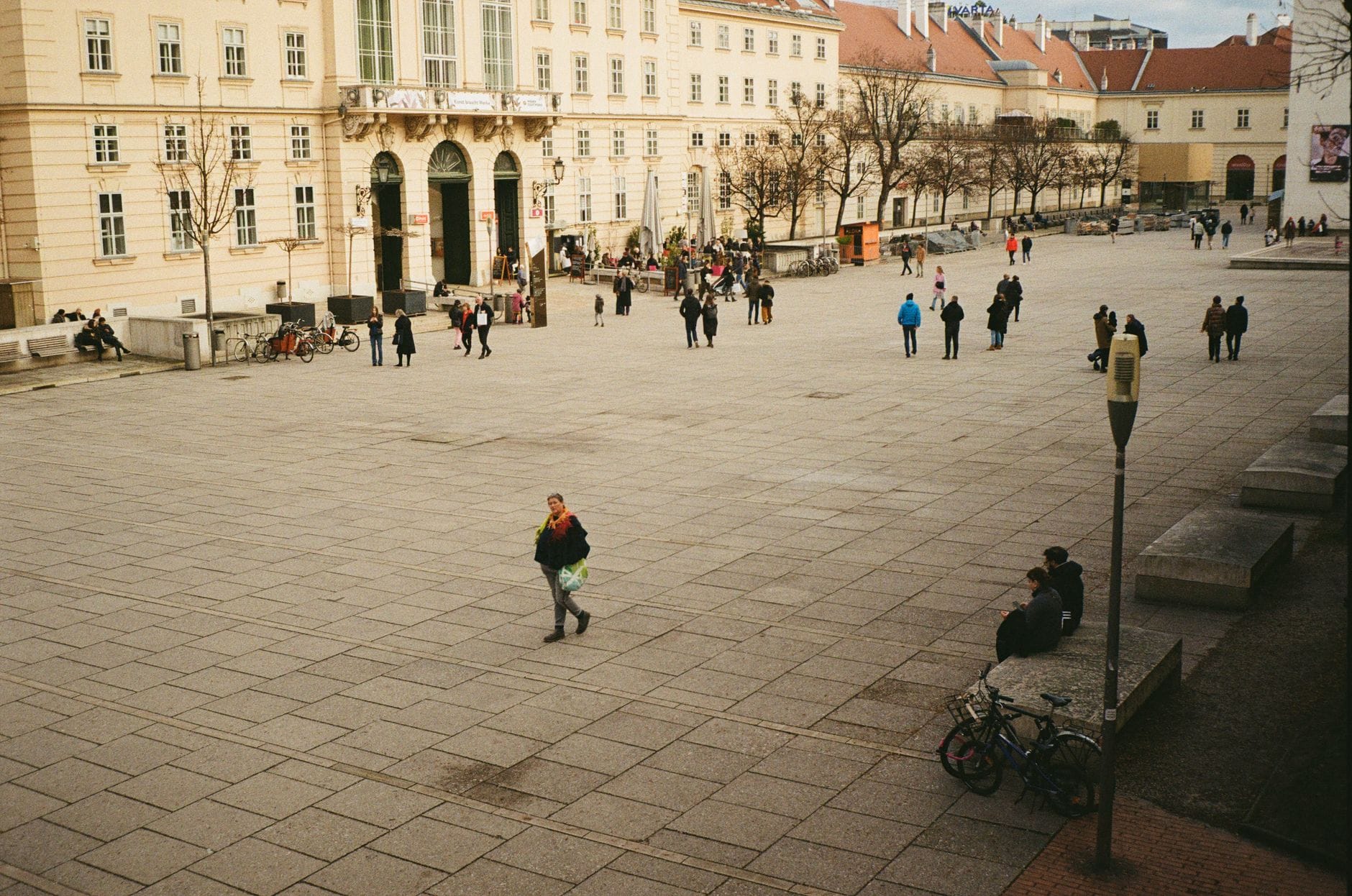
What the MuseumsQuartier Actually Is
The MuseumsQuartier Wien, known locally as the MQ, is not a single museum. It is a campus: a dense network of cultural institutions, open courtyards, cafés, and event spaces spread across a complex that covers somewhere between 60,000 and 90,000 square meters. That scale puts it among the largest arts and culture districts in the world, though its physical footprint feels surprisingly human-scale once you are inside.
The anchor institutions are the Leopold Museum, which holds the world's largest collection of Egon Schiele paintings, and mumok (Museum of Modern Art Ludwig Foundation Vienna), whose dark basalt exterior makes it look like a monolith dropped into a Baroque courtyard. Kunsthalle Wien, ZOOM Kindermuseum for children, and a cluster of smaller experimental venues fill out the roster. But the MQ is also, importantly, a place where many visitors come without going to a single museum.
ℹ️ Good to know
The outdoor courtyards of the MuseumsQuartier are open and free to enter 24 hours a day, seven days a week. You do not need a ticket, a reservation, or even a plan. This makes it one of the few genuinely public spaces in central Vienna where you can simply sit down without spending anything.
The Imperial Stables Beneath the Contemporary Facade
The bones of the MQ are Baroque. The site was originally the imperial court stables of the Habsburgs, a grand utilitarian complex built to house the horses and carriages of the imperial household. The two long Baroque wings that frame the main entrance from Museumsplatz date from this era and are among the most substantial surviving examples of imperial service architecture in Vienna.
The complex was redeveloped and officially opened in its current form in 2001, inserting contemporary volumes — including the striking basalt cube of mumok — into the historic shell. The result is an architectural dialogue between Baroque stonework and late 20th-century brutalism that is more coherent than it sounds. For anyone interested in how cities adapt their heritage buildings for new uses, the MQ is a compelling case study. The Vienna architecture guide covers this transformation in broader context alongside the Ringstraße and Otto Wagner's contributions to the city.
The Baroque Fischer von Erlach wing along the street front is classified as a historic monument, which is why the architects had to place the new museum volumes inside and behind the existing structures rather than replacing them. Look closely at the roofline transitions between old and new as you move through the courtyards: the joins are surprisingly abrupt, which is itself part of the architectural honesty of the project.
Tickets & tours
Hand-picked options from our booking partner. Prices are indicative; availability and final rates are confirmed when you complete your booking.
mumok entrance ticket
From 18 €Instant confirmationImperial Vienna 72-hour hop-on hop-off bus
From 55 €Instant confirmationFree cancellationSkip-the-Line Entrance with Guide to Schonbrunn Palace and Gardens
From 45 €Instant confirmationFree cancellationLuggage Storage in Vienna
From 6 €Instant confirmationFree cancellation
The Courtyards: Vienna's Informal Living Room
The inner courtyards of the MQ function as a meeting point for a particular cross-section of Vienna: students from the nearby Academy of Fine Arts, tourists who have walked over from the Kunsthistorisches Museum, young parents with small children, and older Viennese residents who have been using the space since it opened. In summer, the courtyards fill with people sitting on the large, colorful outdoor furniture installations (known locally as the Enzis, the curved bright-orange lounge pieces that became something of a symbol of the MQ's identity). In winter, a Christmas market and ice-skating rink occasionally occupy parts of the outer courtyard, though you should verify current seasonal programming before visiting.
The atmosphere in the early morning, before 9 a.m., is notably calm. The courtyards smell faintly of stone and coffee from the few café kiosks that open early. By midday in July and August, the main Haupthof (central courtyard) is loud with conversation in a dozen languages and can feel cramped near the museum entrances. If you prefer a quieter experience of the architecture, aim for a weekday morning. The surrounding MuseumsQuartier neighborhood also has quieter streets worth exploring between visits.
💡 Local tip
The Hof (rear courtyard behind the main Haupthof) tends to be less crowded even during peak hours. It connects through to smaller gallery spaces and the Q21 creative cluster, which hosts studios, design shops, and occasional free exhibitions.
The Major Museums: What to Expect Inside
Leopold Museum
The Leopold Museum is the main reason many international visitors come to the MQ at all. Its permanent collection centers on Austrian Expressionism, with the world's largest concentration of work by Egon Schiele. If you have any interest in Schiele's raw, angular figurative work, this is the most complete single presentation of it anywhere. The Egon Schiele guide for Vienna gives detailed context on what to look for before you go.
Gustav Klimt, Richard Gerstl, and Oskar Kokoschka are also well represented in the permanent galleries. The building itself, a white limestone cube designed by Ortner and Ortner, is naturally lit through a large central atrium. Admission prices vary by exhibition and visitor category; verify current fees on the Leopold Museum's website before visiting, as they update seasonally.
mumok
mumok (Museum of Modern Art Ludwig Foundation Vienna) covers 20th and 21st-century art across seven floors, with particular depth in Fluxus, Viennese Actionism, and Pop Art. The building's dark volcanic basalt exterior is instantly recognizable from the courtyard. Inside, the galleries are cool and deliberately neutral. The collection is strong rather than spectacular for a casual visitor, and the changing special exhibitions often outperform the permanent hang in terms of immediate impact. The mumok museum page covers the collection and visiting details in full.
ZOOM Kindermuseum
ZOOM is a hands-on children's museum with interactive zones aimed at different age groups from infants to early teens. It operates on a timed-entry, reservation basis, so if you are visiting with children this is the one institution in the MQ where you genuinely need to book ahead. Walk-in availability on busy weekends is unpredictable. Check the ZOOM website for current session times and availability.
Getting There and Moving Around the Complex
The U2 subway line has a station called MuseumsQuartier that deposits you directly at the main entrance on Museumsplatz. It is a short walk from Karlsplatz (U1, U2, U4) if you are coming from the city center or the area around Karlskirche. Trams running along the Ringstraße stop within a few minutes' walk of the main entrance. The MQ is fully pedestrianized within its boundaries, and the ground surfaces are largely level, which makes it workable with pushchairs and wheelchairs, though individual museums should be contacted for specific accessibility details.
The Kunsthistorisches Museum and the Naturhistorisches Museum sit immediately outside the MQ entrance on Maria-Theresien-Platz, making it natural to combine a visit here with either of those institutions. The Kunsthistorisches Museum is particularly worth pairing if you are spending a full cultural day in this part of the city.
⚠️ What to skip
Photography policies vary by institution inside the MQ. In the Leopold Museum and mumok, flash photography and tripods are generally not permitted in permanent galleries. Always check posted signs at each room entrance rather than assuming a blanket rule.
Eating and Staying Longer Than Planned
Several cafés and restaurants operate within the MQ complex. The options range from outdoor kiosks serving coffee and sandwiches to sit-down restaurants inside the museum buildings. Quality and price vary considerably. The café attached to the Leopold Museum is a reasonable choice for a midday break if you have been through the galleries. On warm evenings, the outdoor bars in the courtyards draw a post-work crowd and the atmosphere shifts noticeably from daytime tourist traffic to something more local.
The surrounding streets, particularly into Neubau (the 7th district), have a higher concentration of independent restaurants and bars within five minutes' walk of the MQ exits. This area is among the more interesting parts of Vienna for eating and browsing independent shops. The Vienna food guide covers the broader city options if you are planning meals around cultural visits.
Honest Assessment: Who This Works For and Who Might Feel Differently
The MQ works well for visitors who are comfortable making their own choices about how to spend time. If you arrive without a plan, the free courtyards give you somewhere to orient yourself before deciding which institution to enter. But the complex can also feel slightly disorienting on a first visit: the map of interconnected buildings, courtyards, and passage points is not immediately intuitive, and signage inside the Baroque wing corridors is less clear than it could be.
Visitors expecting a single coherent museum experience may be surprised by how fragmented the MQ feels. It is genuinely a campus, not a building, and the experience of moving between institutions involves going back outside, potentially queuing again, and re-entering on different tickets. For travelers with limited time in Vienna who want to see one major art collection efficiently, it may be cleaner to go directly to the Leopold Museum and skip the complex as a whole.
In very hot summer weather, the stone courtyards retain heat and midday sun can be uncomfortable. There is limited shade in the main Haupthof. Early morning or early evening visits are noticeably more pleasant between June and August.
Insider Tips
- The Q21 section of the MQ, in the east wing of the Baroque building, houses a cluster of small creative studios, design and concept shops, and occasionally free exhibition spaces. It is consistently less crowded than the main museum areas and worth exploring even if you are not visiting the major museums.
- If you are planning to visit both the Leopold Museum and mumok on the same day, check whether a combined ticket is currently available at the MQ ticket desk or online. Combined options have existed historically but availability and pricing change, so verify before assuming.
- The roof terrace of the Leopold Museum offers a direct view across the courtyard roofline toward the Kunsthistorisches Museum dome. It is accessible to museum visitors and less photographed than the courtyard level views.
- ZOOM Kindermuseum requires advance booking for timed entry sessions. Do not turn up with children expecting to walk in, particularly on weekends or during school holidays. Book directly on the ZOOM website at least a few days ahead.
- The MQ hosts free outdoor events, film screenings, and temporary installations throughout the summer months in the courtyards. Check the official MQ events calendar at mqw.at before your visit to see what might coincide with your trip.
Who Is MuseumsQuartier For?
- Modern and contemporary art enthusiasts, particularly those with an interest in Austrian Expressionism and the Leopold Museum's Schiele collection
- Families with children who have booked ahead for ZOOM Kindermuseum
- Architecture and urban design visitors who want to study the conversion of Baroque imperial buildings into contemporary cultural spaces
- Travelers who want a relaxed outdoor city space where they can sit, eat, and plan their next move without spending anything
- Full-day culture visitors combining MQ institutions with the Kunsthistorisches Museum and Naturhistorisches Museum just outside the entrance
Nearby Attractions
Other things to see while in MuseumsQuartier & Mariahilf (6th–7th Districts):
- Haus des Meeres (Aqua Terra Zoo)
A former World War II anti-aircraft tower in central Vienna now houses over 10,000 animals across 600 species. Haus des Meeres blends serious conservation with genuine spectacle, and the rooftop view over the 6th district alone justifies the climb.
- Leopold Museum
Housed in a striking limestone cube at the heart of the MuseumsQuartier, the Leopold Museum holds the world's largest Egon Schiele collection alongside major works by Gustav Klimt, Oskar Kokoschka, and Richard Gerstl. For anyone drawn to the raw, unsettling beauty of Viennese fin-de-siècle art, this is one of the most concentrated and rewarding museum experiences in Central Europe.
- MUMOK (Museum of Modern Art)
mumok, the Museum of Modern Art Ludwig Foundation Vienna, houses the largest collection of modern and contemporary art in Central Europe. Set inside a striking basalt lava cube in the MuseumsQuartier, it spans Viennese Actionism, Pop Art, Fluxus, and beyond. Here is everything you need to plan a worthwhile visit.