mumok Museum of Modern Art Vienna: What to Know Before You Visit
mumok, the Museum of Modern Art Ludwig Foundation Vienna, houses the largest collection of modern and contemporary art in Central Europe. Set inside a striking basalt lava cube in the MuseumsQuartier, it spans Viennese Actionism, Pop Art, Fluxus, and beyond. Here is everything you need to plan a worthwhile visit.
Quick Facts
- Location
- Museumsplatz 1, 1070 Vienna (MuseumsQuartier, 7th District)
- Getting There
- U2 MuseumsQuartier or U2/U3 Volkstheater; Bus 48A and Tram 49 stop at Volkstheater
- Time Needed
- 2 to 3 hours for a focused visit; 3 to 4 hours if you read every label
- Cost
- Paid admission (check mumok.at for current prices); free entry for visitors under 19
- Best for
- Contemporary art lovers, architecture enthusiasts, rainy-day culture seekers
- Official website
- www.mumok.at
What mumok Actually Is
mumok, short for Museum moderner Kunst Stiftung Ludwig Wien, is not a typical art museum that plays it safe. It is the largest museum for modern and contemporary art in Central Europe, with a collection that spans Viennese Actionism, Pop Art, Fluxus, Nouveau Réalisme, Concept Art, and media-based work. Founded on 20 September 1962 by art historian Werner Hofmann, the institution originally operated in the 20er Haus in the Schweizergarten district before relocating to its purpose-built home in the MuseumsQuartier, which opened in 2001.
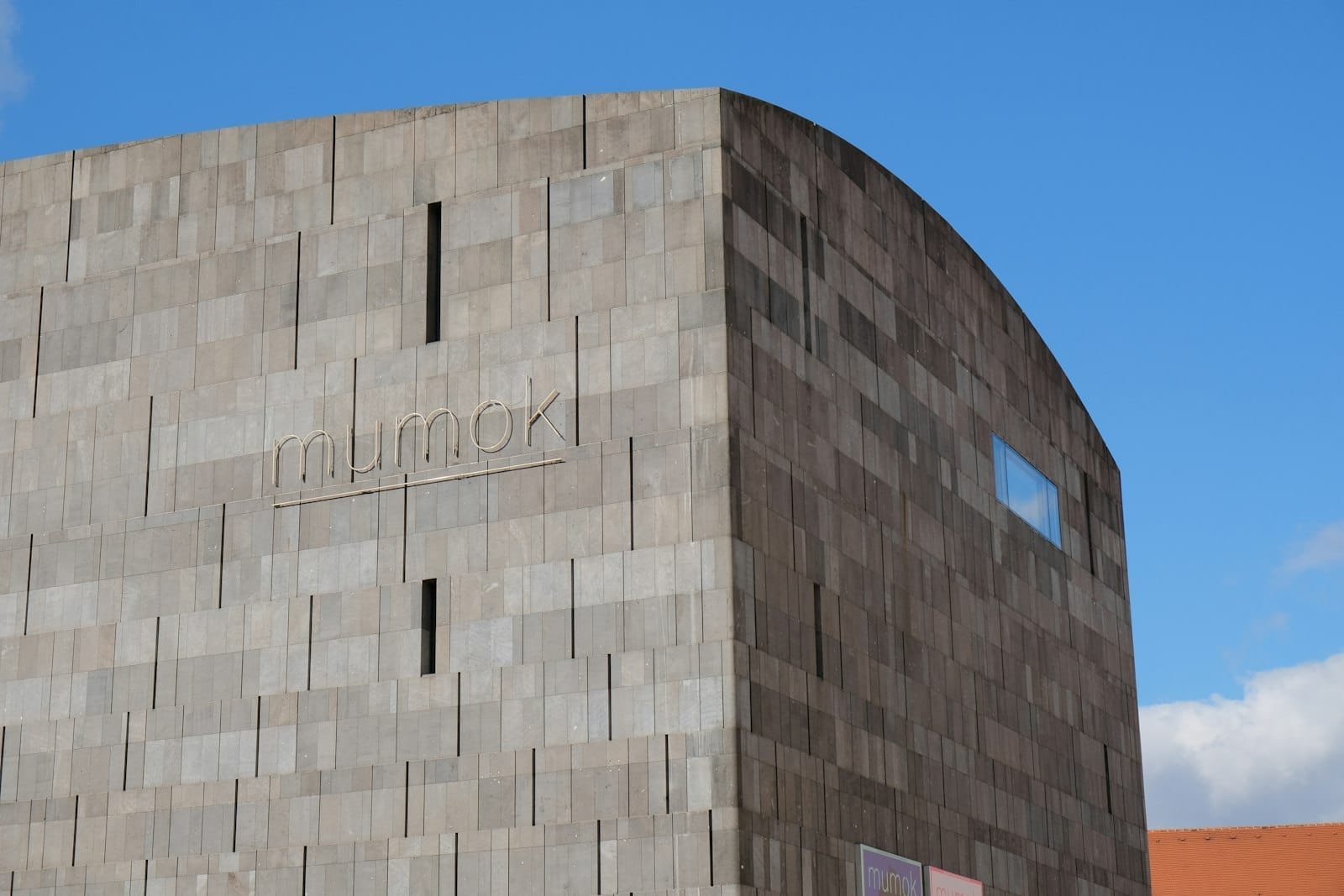
The building itself sends a clear signal before you enter. Clad in dark basalt lava stone quarried from volcanic deposits, the cube sits in stark contrast to the white limestone of the neighboring Leopold Museum and the baroque Naturhistorisches Museum beyond the square. It reads as deliberately confrontational, which is appropriate given what is inside.
The MuseumsQuartier complex surrounding mumok is one of the largest cultural districts in the world. If you are spending a full day in the area, consider pairing your visit with the Leopold Museum next door, which focuses on Egon Schiele and Austrian modernism, offering a complementary rather than redundant experience.
The Building: Orientation and First Impressions
The entrance level is calm and spacious. Staff are present but not hovering. The cloakroom is near the entrance, and bag storage is available for free. The ticket desk is straightforward, and audio guides are available for rent if you want more context than the wall text provides.
The interior layout follows a series of floors connected by a central staircase and elevator. The building is fully accessible: the main entrance has no steps, swinging doors are approximately 120 cm wide, and both the main and side entrances connect to an elevator that serves all levels including the restaurant. Visitors using wheelchairs or traveling with strollers will find the building genuinely navigable, not just technically compliant.
💡 Local tip
The basalt lava facade means the building absorbs heat in summer but stays cool inside. On warm days, the interior temperature is noticeably more comfortable than outside, making this a practical afternoon destination from June through August.
Tickets & tours
Hand-picked options from our booking partner. Prices are indicative; availability and final rates are confirmed when you complete your booking.
mumok entrance ticket
From 18 €Instant confirmationImperial Vienna 72-hour hop-on hop-off bus
From 55 €Instant confirmationFree cancellationSkip-the-Line Entrance with Guide to Schonbrunn Palace and Gardens
From 45 €Instant confirmationFree cancellationLuggage Storage in Vienna
From 6 €Instant confirmationFree cancellation
The Collection: What You Will Actually See
mumok's permanent collection runs to approximately 10,000 works, though only a rotating selection is on display at any time. The heart of the collection includes major holdings in Viennese Actionism, a radical Austrian art movement of the 1960s that used performance, the body, and often deliberately disturbing imagery to challenge post-war Austrian society. Artists like Hermann Nitsch, Günter Brus, and Otto Muehl are represented in depth, and this is one of very few museums in the world where you can engage seriously with their work in a proper institutional context.
Beyond Actionism, the Pop Art holdings are substantial, with works by Andy Warhol, Roy Lichtenstein, and Claes Oldenburg forming a recognizable thread through the permanent galleries. The Fluxus collection is less well-known internationally but genuinely strong. Temporary exhibitions, which rotate several times a year, typically occupy two or three floors and tend to focus on single artists or thematic groupings. These shows are often ambitious and can shift the entire atmosphere of the museum.
Be aware that mumok is not a museum where you drift pleasantly through rooms of easily digestible paintings. Some of the work on display, particularly in the Actionism galleries, is confrontational and has been deliberately designed to unsettle. This is not a criticism; it is the point. But visitors expecting impressionist crowds or a comfortable survey of European painting history will find the experience jarring rather than rewarding.
⚠️ What to skip
mumok is closed every Monday. If your Vienna itinerary runs Tuesday through Sunday, plan accordingly. Opening hours are 10:00 to 18:00 on all open days. There are no extended evening hours on the standard schedule, so do not leave this for a late-afternoon slot if you want more than an hour inside.
When to Visit and How the Experience Changes
Weekday mornings between 10:00 and noon offer the quietest conditions. The MuseumsQuartier fills significantly on weekend afternoons, particularly in summer, when the courtyard outside becomes a social space for locals and tourists alike. Inside mumok, however, the crowds rarely reach the overwhelming levels you might encounter at the Kunsthistorisches Museum or Schönbrunn. The work here is specialized enough that it self-selects for visitors who are genuinely interested.
Saturday afternoons during exhibition openings are a different matter. These events attract a younger, design-aware Viennese crowd and can make the museum feel like a different institution entirely: noisier, more social, with wine in plastic cups and extended hours. Check the mumok website before visiting if you want to catch or avoid an opening.
Vienna's wet season runs through late spring and summer, with May through August seeing the most rainfall. On grey or rainy days, the MuseumsQuartier courtyard empties out and the museums inside fill up correspondingly. If the sky looks uncertain, go early. For a broader picture of how weather shapes museum-going in Vienna, the best museums in Vienna guide covers seasonal strategy across the major institutions.
Getting There: Transit Options That Actually Work
The simplest route is U2 to MuseumsQuartier station, which deposits you directly into the complex. The exit brings you out into the main courtyard, and mumok is visible immediately to your left as you face the Leopold Museum. The walk from exit to entrance takes under two minutes.
From the 1st District or the Ringstrasse, Trams D, 1, 2, and 71 stop at Dr.-Karl-Renner-Ring/Burgring. From there, the walk through the MuseumsQuartier gate is approximately 10 to 15 minutes, passing the Kunsthistorisches Museum and the main courtyard. This approach gives you a better sense of the institutional scale of the area.
The MuseumsQuartier sits at the western edge of the Ringstrasse, Vienna's grand 19th-century boulevard. If you are walking from the inner city, the approach through the Fischer von Erlach Gate gives context for how the complex connects to the older fabric of the city.
Photography, the Café, and Practical Details
Photography policies at mumok vary by exhibition. The permanent collection galleries generally allow photography without flash for personal, non-commercial use, but temporary exhibitions may restrict this entirely. Check signage at each gallery entrance rather than assuming either way. The works are often highly graphic, and reproduction rights can be complicated.
The museum café is located on the ground floor and accessible without a ticket, making it a reasonable stop even if you decide not to visit the galleries. The space is decent rather than exceptional, with coffee, light meals, and a small selection of art books. For serious post-museum eating, the surrounding MuseumsQuartier courtyard has a range of options, and the 7th District streets beyond offer considerably more variety.
If you are building a full cultural day in this part of Vienna, the MuseumsQuartier area has enough to fill eight hours without repeating yourself, between mumok, the Leopold Museum, temporary exhibition halls, design shops, and the surrounding district streets.
Who Might Not Enjoy This
Visitors primarily motivated by Vienna's imperial history will likely find mumok disorienting. The collection makes few concessions to accessibility or comfort, and the interpretive texts assume some familiarity with post-war European art movements. Children under 10 tend to lose interest quickly unless a specific family program is running, and the scale of some Actionist works can be disturbing for younger visitors.
Travelers on very tight schedules who want a single overview of Viennese culture will get more return on time from the Kunsthistorisches Museum or the Belvedere. mumok rewards visitors who are already curious about contemporary and conceptual art, not those coming to tick a box.
Insider Tips
- The museum publishes its current exhibitions clearly on mumok.at before your visit. Checking in advance takes five minutes and prevents the disappointment of arriving to find that the show you were interested in closed the previous week.
- The rooftop terrace is not consistently accessible, but on days when it is open during events or special programs, it offers an unusual view across the MuseumsQuartier courtyard and toward the Rathaus. Ask at the ticket desk whether access is available on the day.
- Visitors under 19 enter free of charge, which makes mumok one of the more practical options for younger travelers. Bring ID for anyone who looks close to 19.
- The MuseumsQuartier courtyard benches and loungers (installed seasonally) fill up fast on sunny afternoons. If you want to sit outside after your visit, arrive at the museum early enough to finish before the midday rush occupies every surface.
- mumok's library and archive hold research materials on the collection and are accessible by appointment for those with specific scholarly interests. This is not advertised prominently but is available through the museum's administrative contacts.
Who Is MUMOK (Museum of Modern Art) For?
- Contemporary and conceptual art enthusiasts who want institutional depth rather than a survey
- Architecture observers interested in how the basalt lava cube functions as a statement within its baroque and neoclassical surroundings
- Travelers building a full MuseumsQuartier day who want contrast with the Leopold Museum's Expressionist focus
- Rainy-day visitors seeking a substantial indoor experience that lasts two to three hours
- Anyone specifically interested in Viennese Actionism, one of the most significant and least globally represented art movements of the 20th century
Nearby Attractions
Other things to see while in MuseumsQuartier & Mariahilf (6th–7th Districts):
- Haus des Meeres (Aqua Terra Zoo)
A former World War II anti-aircraft tower in central Vienna now houses over 10,000 animals across 600 species. Haus des Meeres blends serious conservation with genuine spectacle, and the rooftop view over the 6th district alone justifies the climb.
- Leopold Museum
Housed in a striking limestone cube at the heart of the MuseumsQuartier, the Leopold Museum holds the world's largest Egon Schiele collection alongside major works by Gustav Klimt, Oskar Kokoschka, and Richard Gerstl. For anyone drawn to the raw, unsettling beauty of Viennese fin-de-siècle art, this is one of the most concentrated and rewarding museum experiences in Central Europe.
- MuseumsQuartier
The MuseumsQuartier Wien is one of the largest cultural complexes in the world, converting the Habsburg imperial court stables into a sprawling campus of modern art museums, independent galleries, and open public courtyards. Entry to the grounds is free around the clock, while individual institutions charge their own admission. Whether you want to spend three hours or an entire day, this is the cultural center of gravity for contemporary Vienna.